this week in theater

HARPER LEE’S TO KILL A MOCKINGBIRD

(photo by Julieta Cervantes)

Atticus Finch (Jeff Daniels) addresses the court in Aaron Sorkin’s Broadway adaptation of Harper Lee’s To Kill a Mockingbird (photo by Julieta Cervantes)

Shubert Theatre
225 West 44th St. between Broadway & Eighth Aves.
Tuesday – Sunday through November 3, $89-$199
tokillamockingbirdbroadway.com

About a dozen years ago, friends of mine had a baby they named Atticus, after the lawyer in Harper Lee’s Pulitzer Prize–winning 1960 novel, To Kill a Mockingbird; Gregory Peck won his only Oscar for portraying the highly principled Atticus Finch in Robert Mulligan’s 1962 film. If my friends had seen Aaron Sorkin’s Broadway adaptation of Lee’s book before giving birth, they may have chosen a different name. Following a legal dispute with the estate, which claimed that Oscar and Emmy winner Sorkin — who has written such plays as A Few Good Men and The Farnsworth Invention, such films as Moneyball and The Social Network, and such series as The West Wing and The Newsroom, — had broken their contract by making too many changes to Lee’s original story, the play opened at the Shubert Theatre after an undisclosed settlement to mixed reviews, some celebrating Sorkin’s version, others vilifying it as a disgrace. I find myself somewhere in between; directed by Bartlett Sher, the production is outstanding, but too many of Sorkin’s alterations scream out, too patently obvious and political-minded.

(photo by Julieta Cervantes)

Dill (Gideon Glick) is lifted up by Scout (Celia Keenan-Bolger) and Jem (Will Pullen) in To Kill a Mockingbird (photo by Julieta Cervantes)

Set in sweltering Maycomb, Alabama (inspired by Lee’s hometown of Monroeville), in 1934, the poignant story about racial injustice is narrated by Atticus’s young daughter, Scout, played by forty-one-year-old actress Celia Keenan-Bolger, retelling what happened when a black man named Tom Robinson (Gbenga Akinnagbe) is accused of raping a white woman, Mayella Ewell (Erin Wilhelmi), and is defended by the widowed Atticus Finch (Jeff Daniels). Scout spends the summer hanging out with her older brother, Jem (Will Pullen), and new neighbor Dill (Gideon Glick), goofing around, traipsing too close to the house where local weirdo Arthur “Boo” Radley (Danny Wolohan) resides, and watching the trial. The white townspeople are furious that Atticus is helping a black man, and they make sure to let him know it, threatening Finch and his family with violence. But Atticus is determined not to give up, believing that he has enough evidence on his side to convince the all-white jury of Tom’s innocence. But racism rules all in Maycomb.

(photo by Julieta Cervantes)

Atticus (Jeff Daniels) and daughter Scout (Celia Keenan-Bolger) take a break on the front porch in Aaron Sorkin adaptation of classic novel (photo by Julieta Cervantes)

Sorkin makes some critical adjustments to Lee’s novel and the film, focusing on different aspects and characters. Judge Taylor (the ever-reliable Dakin Matthews) becomes more involved in the trial, castigating prosecutor Horace Gilmer (Stark Sands) and such witnesses as Bob Ewell (Frederick Weller), Mayella’s father, for ignoring protocol. The Finches’ maid, Calpurnia (LaTanya Richardson Jackson), speaks with a decidedly twenty-first-century attitude, intent on getting Atticus woke. Atticus also is a modern-day figure, beset by a political correctness that makes him want to see the best in all people, even men who don white hoods in the middle of the night and lie on the stand. His determination to reserve judgment of those who so obviously deserve it feels oddly reminiscent of President Trump’s declaration that there are good people on both sides of the Charlottesville conflict, although nothing else about Atticus is Trumpian.

Miriam Beuther has crafted a homey southern set, complete with musicians on either side of the stage for added atmosphere, with Kimberly Grigsby on pump organ and Allen Tedder on guitar, playing original music by Adam Guettel. Two-time Tony nominee and Emmy and Obie winner Daniels (Blackbird, God of Carnage) is both tender and stalwart as Atticus, an understanding man who has too much faith in humankind, while three-time Tony nominee Keenan-Bolger (The Glass Menagerie, The 25th Annual Putnam County Spelling Bee) is terrific as the adventurous and curious Scout, a young girl wise beyond her years, without being overly precocious. The cast also features Danny McCarthy as Sheriff Heck Tate, Wolohan as Mr. Cunningham, Phyllis Somerville as Mrs. Henry Dubose, and Neal Huff as the mysterious Link Deas. Sorkin’s version of Lee’s classic Bildungsroman is not your mother’s To Kill a Mockingbird, nor your grandmother’s. It is built around the continuing legacy of America’s greatest shame, from the seventeenth century to now, when it’s sadly still relevant, even if it’s been fiddled with far too much and there are unlikely to be a glut of babies named Atticus in the near future.

DIARY OF ONE WHO DISAPPEARED

An older photographer (actor Wim van der Grijn) interacts with his imaginary younger self (tenor Andrew Dickinson) in

An older photographer (actor Wim van der Grijn) interacts with his imaginary younger self (tenor Andrew Dickinson) in Diary of One Who Disappeared (photo © Jan Versweyveld)

BAM Howard Gilman Opera House
Peter Jay Sharp Building
230 Lafayette Ave.
April 4-6, $28-$140, 7:30
718-636-4100
www.bam.org
www.transparant.be

A World War I–era song cycle inspired by an aging Czech composer’s infatuation with a young woman seems an unlikely subject for Ivo van Hove’s usual theatrical treatment, but the Belgian director and Flemish opera company Muziektheater Transparant have reinterpreted Leos Janáček’s Diary of One Who Disappeared in a quietly affecting sixty-five-minute production that is making its US premiere at BAM’s Howard Gilman Opera House this week. In the summer of 1917, the sixty-three-year-old Janáček began an eleven-year epistolary relationship with twenty-six-year-old Kamila Stösslová. Both were married; over eleven years, Janáček wrote more than seven hundred letters to her declaring his undying love, while Stösslová answered only intermittently, replying fewer than fifty times, and without Janáček’s intimate passion. Janáček used Stösslová as his muse; she inspired several of his operas and the song cycle Diary of One Who Disappeared. At BAM, the attractive set, designed by van Hove’s longtime partner, Jan Versweyveld, is a long, horizontal darkroom with photography equipment and a piano nearly hidden within a small bookshelf, behind which is a sleeping area; a low ceiling makes it feel like the performers are trapped in a mysterious diorama. The romantic story is told as a fantasy memory, as an older photographer (actor Wim van der Grijn) interacts with his imaginary younger self (tenor Andrew Dickinson), cast as a young farmer enticed into a torrid affair with a young Romany woman, Zefka (mezzo soprano Marie Hamard). (Janáček often referred to Kamila in his letters as a “black Gypsy girl.”)

(photo © Jan Versweyveld)

Leoš Janáček’s Diary of One Who Disappeared gets the Ivo van Hove treatment at BAM (photo © Jan Versweyveld)

When the old photographer enters through a door in the back of the set, he is carrying an urn, the ashes of his late wife, and he admits he gave her only half his heart. He walks around the stage reciting lines from Janáček’s letters as Zefka and the younger man sing songs with lyrics taken from anonymous poems published in a 1916 newspaper. The lovely music is played by pianist Lada Valešová, with an offstage choir of Raphaële Green, Annelies Van Gramberen, and Naomi Beeldens contributing background vocals. Belgian composer Annelies Van Parys has added tender musical fragments that expand on Janáček’s themes.

The pacing is slow and genuine, with van Hove adding some of his signature multimedia touches, including live video of the two men developing a picture of Zefka, the use of an old-fashioned overhead projector, and footage of a naked woman beamed onto the actor’s body, as if she is deep within him. Versweyveld’s sensual lighting goes from cold blues to fiery reds. It’s a heartfelt story of unrequited love that spurred great creativity; inspired by Stösslová, Janáček also wrote Glagolitic Mass, Sinfonietta, and String Quartet No. 2 as well as characters in The Cunning Little Vixen, The Makropulos Affair, and Katya Kabanová. “I know that my compositions will be more passionate, more ravishing: you’ll sit on every little note in them. I’ll caress them; every little note will be your dark eye,” he wrote to her. It was an unrequited love that makes for a moving piece of theater.

THE TRAGEDY OF JULIUS CAESAR

(photo by Gerry Goodstein)

Brutus (Brandon J. Dirden) looks into the eyes of Julius Caesar (Rocco Sisto) in Shana Cooper’s adaptation of Julius Caesar at TFANA (photo by Gerry Goodstein)

Theatre for a New Audience, Polonsky Shakespeare Center
262 Ashland Pl. between Lafayette Ave. & Fulton St.
Through April 28, $90-$115
866-811-4111
www.tfana.org

Director Shana Cooper makes her Off Broadway debut with a fierce, violent adaptation of William Shakespeare’s Julius Caesar, running at Theatre for a New Audience’s Polonsky Shakespeare Center through April 28. Cooper’s version is bold and aggressive, set in a Rome that is falling apart by the minute. Sibyl Wickersheimer’s set features crumbling white drywall, slabs of which serve as bridges connecting the stage to the aisles in the audience (which many characters use to enter and exit scenes), and a large statue sloppily wrapped in a sheet with packing tape. Raquel Barreto’s costumes range from contemporary suits, dresses, leather jackets, and hoodies to cultlike outfits with creepy masks worn by Caesar’s (three-time Obie winner Rocco Sisto) partying supporters. The story is familiar: After military triumphs, Caesar returns to Rome as a fantastically populist hero; the entrenched power holders, the Roman senators, panic at the thought of his mob of true believers proclaiming him king/dictator and destroying the republic. Following the rally at which Caesar is three times offered and three times refuses a crown presented by Mark Antony (Jordan Barbour), a group of senators and soldiers plot to assassinate Caesar, led by Brutus (Obie winner Brandon J. Dirden), Cassius (Matthew Amendt), and Caska (Stephen M. Spencer). “It is no matter. Let no images / Be hung with Caesar’s trophies. I’ll about, / And drive away the vulgar from the streets,” coconspirator and senator Cinna (Armando McClain) declares.

(photo by Gerry Goodstein)

Marcus Brutus (Brandon J. Dirden) affirms his love for his wife, Portia (Merritt Janson), in Shakespeare tragedy at TFANA (photo by Gerry Goodstein)

Cassius adds, “And why should Caesar be a tyrant then? / Poor man, I know he would not be a wolf, / But that he sees the Romans are but sheep. / Those that with haste will make a mighty fire / Begin it with weak straws. What trash is Rome? / What rubbish and what offal? When it serves / For the base matter to illuminate / So vile a thing as Caesar!” Substitute “deplorables” for “base matter” and Trump for Caesar, and Shakespeare’s genius for illuminating human nature is stunningly clear. A soothsayer (Michelle Hurst) warns Caesar to “beware the Ides of March,” but the august leader dismisses her prophecy. Joined by Decius Brutus (Barrett O’Brien), Trebonius (Mark Bedard), Metellus Cimber (Ted Deasy), and Caius Ligarius (Liam Craig), the senators attack Caesar, whose own triumvirate of loyalists consists of Antony, Octavius Caesar (Benjamin Bonenfant), and Lepidus (Craig). Brutus is the most conflicted by the coming assassination attempt, fraught with worry about taking action against a man he professes to love. The conspirators might have thought they were saving Rome, but soon they are at war, threatening the stability of the city and leaving behind a trail of blood.

Cooper infuses her telling with a ferocious, unrelenting male energy as characters shout and run around the theater, immersing the audience in the proceedings. She and choreographer Erika Chong Shuch turn the battle scenes into brutal, vicious dances that counterbalance the earlier, gentle passion displayed among the men as they softly touch and look lustfully at one another, giving textured meaning to such lines as “I have much mistook your passion” and “Nor construe any further my neglect / Than that poor Brutus, with himself at war / Forgets the show of love to other men.” The play occasionally rides off the rails, as when it uses two posters of watching eyes. Dirden (Jitney, All the Way) is the heart of the show as Brutus fights to stay true to his soul and prove to his wife, Portia (Merritt Janson), that he is a good man, a very different kind of Brutus as compared to, for example, Corey Stoll’s conniving, manipulative version in Oskar Eustis’s controversial Shakespeare in the Park adaptation that explicitly turned Caesar into Donald Trump. Cooper’s thrillingly testosterone-fueled production demonstrates that Julius Caesar is likely to always be relevant as long as men strive for power — and others seek to take them down.

THE WHITE DEVIL

(photo by Carol Rosegg)

John Webster’s 1612 The White Devil gets modern multimedia makeover in Red Bull revival (photo by Carol Rosegg)

Lucille Lortel Theater
121 Christopher St. between Bleecker & Hudson Sts.
Tuesday – Sunday through April 14, $77-$97
212-352-3101
www.redbulltheater.com

“Of all deaths, the violent death is best; / For from ourselves it steals ourselves so fast, / The pain, once apprehended, is quite past,” Flamineo gruesomely observes in John Webster’s 1612 play The White Devil, now being given a flashy, contemporary revival — with plenty of violent death — by Louisa Proske at the Lucille Lortel, where the Red Bull production opened Sunday night. Flamineo is deliciously played by Tommy Schrider, who marches across the stage and into the aisles in his hip black jacket, plotting to get ahead no matter who he leaves in his wake. Flamineo is arranging for his sister, the fashionable, social-climbing Vittoria Corombona (Lisa Birnbaum), to cuckold her milquetoast husband, Camillo (Derek Smith), with the brash Duke of Brachiano (Daniel Oreskes), who is married to the sweetly innocent Isabella (Jenny Bacon), with whom he has a bright son, Giovanni (Cherie Corinne Rice). Isabella’s brother, Francisco de Medici, the Duke of Florence (T. Ryder Smith), is aghast when he learns about the deception and decides to protect his sister, enlisting the help of his good friend, the powerful Cardinal Monticelso (Robert Cuccioli). Cornelia (Socorro Santiago), Flamineo and Vittoria’s mother, is not exactly pleased with her children’s deceptions. Meanwhile, the murderous, anarchic Count Lodovico (Smith), a Rasputin-like presence with a lust for life — and death — is released from prison and has his own aims on Vittoria, aided by Hortensio (Bacon) and Gasparo (Edward O’Blenis). And finally, Vittoria’s servant, Zanche (Rice), falls in love with Francisco. What follows is villainy and jocularity in delightful abundance.

(photo by Carol Rosegg)

Relationship between Vittoria Corombona (Lisa Birnbaum) and the Duke of Brachiano (Daniel Oreskes) is at center of The White Devil (photo by Carol Rosegg)

Kate Noll’s elegantly minimalist set juts into the audience, who sit on three sides of the bare stage. At the back is a shallow glass-walled lobby with a central doorway flanked by two small video monitors. Blinds roll up and down the windows as needed for Yana Birÿkova’s large video projections, which range from live footage to offstage murders. The compelling sound and music are by Chad Raines. Believed to be Webster’s first solo playwrighting effort — most of his work was done in collaboration with other writers — The White Devil debuted at the Red Bull theater in London more than half a millennium ago and hasn’t had a New York City revival since a 1965 downtown production starring Frank Langella, Carrie Nye, Maria Tucci, and Paul Stevens, but opera and theater director Proske (peerless, La bohème) makes it feel fresh and alive, turning it into a modern noir thriller reminiscent of James M. Cain’s The Postman Always Rings Twice and Double Indemnity. With one minor exception, the cast ably delivers Webster’s (The Duchess of Malfi) poetic language, adding gleeful gestures that elicit laughter despite the tragic proceedings. The text is surprisingly contemporary, ahead of its time, which helps explain why it was initially a failure when it debuted; Proske’s updates are visual in nature. It does not feel like an old play, but it is an age-old story, of passion and love, treachery and vengeance, expertly told.

THE O’CASEY CYCLE: JUNO AND THE PAYCOCK

(photo by Carol Rosegg)

Capt. Boyle (Ciarán O’Reilly) and his wife, Juno (Maryann Plunkett), see brighter days ahead in Juno and the Paycock (photo by Carol Rosegg)

Irish Repertory Theatre, Francis J. Greenburger Mainstage
132 West 22nd St. between Sixth & Seventh Aves.
Through May 25, $50-$70
212-727-2737
irishrep.org

The Irish Rep’s inaugural 1988–89 season included The Plough and the Stars, part of Sean O’Casey’s 1923–26 Dublin Trilogy; the company brought it back again in 1997. To celebrate its thirtieth anniversary season, the Irish Rep is presenting revivals of the first two plays in the trilogy, the 1924 Juno and the Paycock and the 1923 The Shadow of the Gunman, in repertory through May 25, along with screenings of the 1937 John Ford film version of The Plough and the Stars with Barbara Stanwyck, Preston Foster, and Barry Fitzgerald and a reading series. For the occasion, which the Irish Rep is calling “The O’Casey Cycle,” the Francis J. Greenburger Mainstage theater has been transformed into a ramshackle 1920s tenement; Charlie Corcoran’s set extends well beyond the stage: Windows and brick walls run up the sides and down the hall, clothes are hanging to dry by the balcony, and there’s even a small bed hidden beneath the stairs by the restrooms. It’s now back in a “darling” adaptation after previous stagings at the Irish Rep by artistic director Charlotte Moore in 1995 and 2013–14.

(photo by Carol Rosegg)

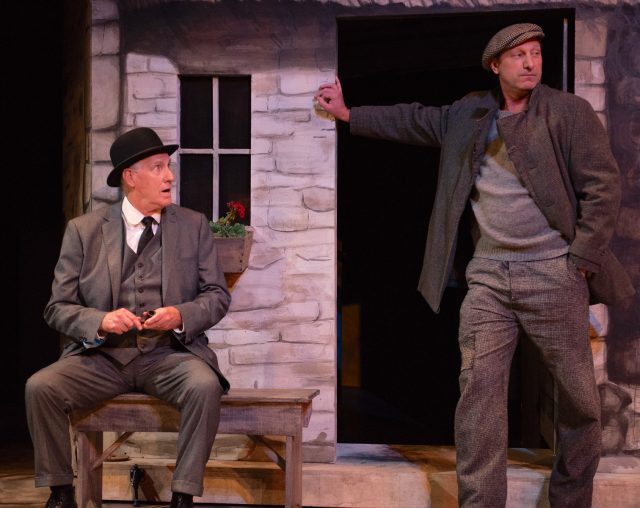
Capt. Boyle (Ciarán O’Reilly) waxes philosophic with Joxer Daly (John Keating) in Sean O’Casey revival at the Irish Rep (photo by Carol Rosegg)

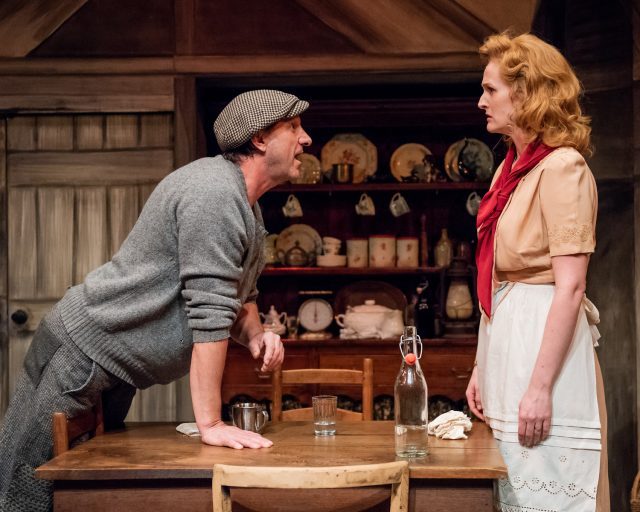
Juno and the Paycock takes place in 1922, during the Irish Civil War between the Diehard Republicans and the Free Staters, as matriarch Juno Boyle (Tony winner Maryann Plunkett) is trying to make ends meet in her family’s small apartment. Her husband, Capt. Boyle (Ciarán O’Reilly), spends most of his time, and what little money they have, hitting the pub with his best friend, the gangly ne’er-do-well Joxer Daly (John Keating), and complaining about terrible pains in his legs whenever the possibility of a job arises; their daughter, Mary (Sarah Street), is on strike with her trade union; and their son, Johnny (Ed Malone), is a bitter young man who lost an arm in the revolution and is worried that the IRA will show up at any moment to right a wrong. The Boyles hit the jackpot when schoolteacher Charles Bentham (James Russell) arrives to tell them that Capt. Boyle has inherited a significant sum of money from a dead relative. Mary, who has been courted by nudnik Jerry Devine (Harry Smith), begins dating the elegant Bentham, and the captain and Juno immediately start celebrating their good fortune by refurnishing their home and considering moving to a better location. But being a classic Irish melodrama about the futility of the working and lower classes, prosperity is not necessarily waiting for them around the corner.

(photo by Carol Rosegg)

Johnny (Ed Malone) is nervous as his sister, Mary (Sarah Street), and mother, Juno (Maryann Plunkett), try to calm him down in Juno and the Paycock (photo by Carol Rosegg)

Seamlessly directed by Neil Pepe, the longtime artistic director of the Atlantic Theater, Juno and the Paycock is a joy to behold. It’s somewhat reminiscent of The Honeymooners, only Irish, with Capt. Boyle / Ralph Kramden always scheming to fill his empty coffers, the none-too-bright Joxer / Ed Norton unwittingly by his side, offering comic relief, and Juno / Alice doing her best to keep it all together. “There’ll never be any good got out o’ him so long as he goes with that shouldher-shruggin’ Joxer,” Juno says about her husband. “I killin’ meself workin’, an’ he sthruttin’ about from mornin’ till night like a paycock!” As downtrodden as the times are, O’Casey injects plenty of humor into the story, which was also made into a film by Alfred Hitchcock in 1930. The cast, which is very similar to the 2013–14 edition (the main changes are Plunkett as Juno and Street as Mary; Terry Donnelly has played neighbor Maisie Madigan in all three Irish Rep versions), is outstanding, fully embodying a troubled family and its tight-knit, suspicious community, making the most of O’Casey’s well-drawn characters.

The socioeconomic conditions of 1920s Dublin might not provide a lot of opportunities for the Boyles, but they also have to take a long, hard look at themselves for the desperate situation they’re in, at least some of which they bear responsibility for, as O’Casey explores the concept of living by one’s principles. It’s also about looking forward. “Maybe, Needle Nugent, it’s nearly time we had a little less respect for the dead, an’ a little more regard for the livin’,” Mrs. Madigan says to the tailor (Robert Langdon Lloyd). Joxer, wonderfully played by the tall, gangly, wild-haired Keating, the longtime Irish Rep treasure, has a habit of describing things as “darling,” and that’s just what this production is, a darling adaptation of a powerful, poignant play.

THIRD RAIL PROJECTS: OASIS

Madison Krekel in Oasis

Madison Krekel is one of five performers in Third Rail Projects’ site-specific Oasis at the Winter Garden

Brookfield Place
230 Vesey St.
April 1-5, 8-12, free, 12:00 & 1:00
Friday, April 12, free, 7:30
thirdrailprojects.com
bfplny.com/stories/oasis

Brooklyn-based immersive theater experts Third Rail Projects returns to the Winter Garden at Brookfield Place for its latest presentation, Oasis. On weekdays from April 1 to 12, the company behind such productions as Then She Fell, Ghost Light, and The Grand Paradise will stage free, specially commissioned pop-up performances in the expansive, palm-tree-lined space as part of Arts Brookfield’s thirtieth anniversary. Designed by architect César Pelli, the Winter Garden, in what was then known as the World Financial Center, opened in 1988 and was rebuilt following the terrorist attacks on 9/11. Oasis is set in the 1980s, as four overworked men and women dream of a better life, imagining the Winter Garden as a respite from all the madness. Conceived, directed, and choreographed by Jennine Willett, designed by Dan Daly, and performed by Julia Kelly, Madison Krekel, Edward Rice, Jessy Smith, and Ryan Wuestewald, the play will consist of ten ten-minute lunchtime vignettes taking place at noon and 1:00; on April 12 at 7:30, the episodes will be brought together as a full-length experience. Admission is free, and no advance RSVP is necessary.

LIFE SUCKS.

(photo by Russ Rowland)

Seven characters examine love and loss in Life Sucks. at the Wild Project (photo by Russ Rowland)

The Wild Project
195 East Third St. between Aves. A & B
Through April 20, $20-$79
thewildproject.com
www.wheelhousetheater.org

In 2018, Wheelhouse Theater Company staged one of the best plays of the year, a no-holds-barred version of Kurt Vonnegut’s Happy Birthday, Wanda June. The New York City troupe has now delivered one of the best plays of 2019, Aaron Posner’s outrageously funny, irreverent reimagining of Anton Chekhov’s Uncle Vanya titled Life Sucks., which opened last week at the Wild Project, where it continues through April 20. A follow-up to Stupid Fucking Bird, Posner’s “sort of” adaptation of Chekhov’s The Seagull (next Posner will take on Three Sisters, to be called No Sisters), Life Sucks. — the period in the title is intentional, making it a simple and direct statement of fact — is set in the present, with seven characters gathered at a country estate run by the bitter, sardonic, tightly wound Vanya (Jeff Biehl) and his niece, Sonia (Kimberly Chatterjee), a wholly competent and caring young woman with severe self-esteem issues. The pedantic and egotistical elderly Professor (Austin Pendleton) and his much younger wife, the beautiful Ella (Nadia Bowers), have arrived unannounced to relax and share some important news. Also on hand are Babs (Barbara Kingsley), a nonjudgmental, smart, and funny artist; Dr. Aster (Michael Schantz), a tall, sexy, but odd workaholic whom women are drawn to; and the honest-to-a-fault Pickles (Stacey Linnartz), an average Jane and loyal lesbian who takes things rather literally.

(photo by Russ Rowland)

The ubiquitous Austin Pendleton plays the Professor in Aaron Posner’s reimagining of Uncle Vanya (photo by Russ Rowland)

As in Stupid Fucking Bird, the characters interact with the audience throughout. The play opens with the seven men and women lined up at the front of the stage, making announcements about cell phones, exits, and photography and pointing out, “We’re the actors. And you, of course, are the audience.” “Our play transpires in four succinct acts . . . just like Chekhov’s original, superior play,” the Professor explains. “Most of it is going to be about love and longing. Yep. That’s right, campers. LOVE. And LONGING,” Vanya promises. “It’s also about the audacious, ludicrous, and protean nature of the obstreperous and ever-feckless human heart,” the Professor adds. And Dr. Aster expounds, “It’s also about how disastrously, irretrievably fucked up the world is, and the insanity of the choices we humans have made for the last four hundred years.” In addition, the genius work deals with the very nature of theater itself.

(photo by Russ Rowland)

Pickles (Stacey Linnartz) bares her soul in Aaron Posner’s brilliant Life Sucks. (photo by Russ Rowland)

Over the course of two hours and fifteen minutes, various characters admit their unrequited love for others — most crucially, Vanya desperately desires Ella, which increases his hatred of the Professor — and they all share their likes and dislikes and pour out personal monologues that reveal their deepest inner thoughts directly to the audience, sometimes even requesting a response. “How many of you would like to sleep with me if you could?” Ella asks, then waits for an answer. When Vanya wants to speak with the audience, he says to Babs and Sonia, “Can I have the room?” Director and Wheelhouse founder Jeff Wise (DANNYKRISDONNAVERONICA, Happy Birthday, Wanda June) controls the glorious chaos as the barriers between what is real and what isn’t break down in hysterical ways, but it’s key to understand that the characters are always the characters, never the actors portraying them. Brittany Vasta’s set is a cozy living room with a piano, a trio of wall hangings, and a back wall constructed partially from wooden crates that carry theater supplies, with such words as “Uncle Vanya” stenciled on them. The cast is splendid, but it’s Biehl who rules the day, filling the Wild Project with riotous doom and gloom as Vanya, his disappointment with life hovering over the space like a dark cloud.

Chekhov’s play, itself a revised version of his earlier The Wood Demon, lends itself to reinterpretation, from Louis Malle’s film Vanya on 42nd Street and Markus Wessendorf’s Uncle Vanya and Zombies to Sally Burgess’s opera Sonya’s Story, Richard Nelson’s Apple Family–like version for the Hunter Theater Project, and New Saloon’s experimental Minor Character: Six Translations of Uncle Vanya at the Same Time. With Life Sucks., Posner, a longtime director who has also written reverent adaptations of Chaim Potok’s The Chosen and My Name Is Asher Lev, has created a Vanya for the twenty-first century, a brilliant skewering of contemporary values and, in the end, a triumphant celebration of that little thing called life.