this week in theater

A BEAUTIFUL DAWNING: OKLAHOMA! AT 75

ll-oklahoma-at-75

Who: Kerstin Anderson, Phillip Attmore, Jason Gotay, Nyla Watson, more
What: 92Y’s Lyrics & Lyricists
Where: 92nd St. Y, Kaufmann Concert Hall, 1395 Lexington Ave. at 92nd St., 212-415-5500
When: May 4-6, $30-$85
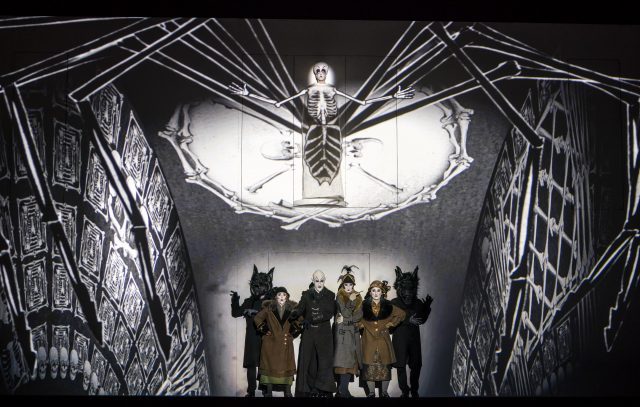
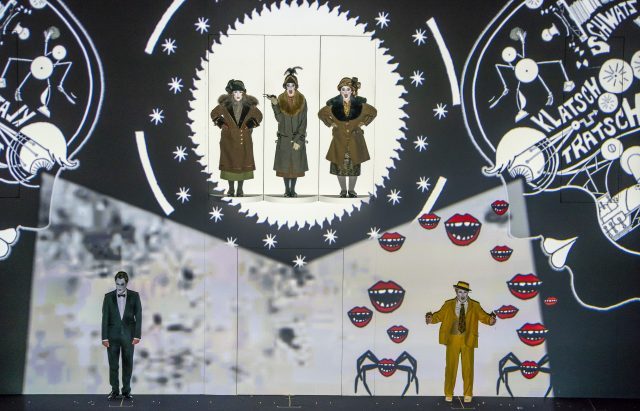
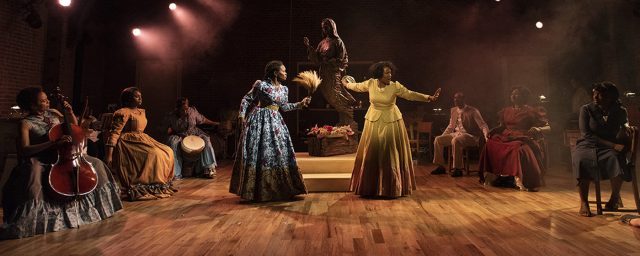
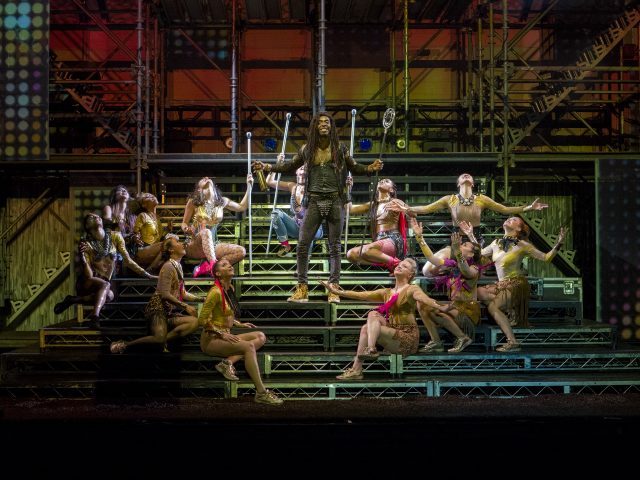
Why: Daniel Fish’s current Broadway adaptation of Rodgers & Hammerstein’s first collaboration, Oklahoma!, has many singing its praises and others decrying it as an abomination. I raved about it in my review, to which Oscar Hammerstein III replied, “Nonsense. The play is a travesty posing as experimental; a parasite feasting on the original musical.” In honor of the work’s diamond anniversary, the 92nd St. Y’s Lyrics & Lyricists series is presenting “A Beautiful Dawning: Oklahoma! at 75,” five shows May 4-6 celebrating its ongoing influence and legacy. The cast features vocalists Kerstin Anderson, Phillip Attmore, Jason Gotay, and Nyla Watson, with Justin Smith on violin, Scott Kuney on guitar, Mark Vanderpoel on bass, and Perry Cavari on drums. Parker Esse directs; Ted Chapin is writer and host and Andy Einhorn the music director, with projection design by Dan Scully. “We’ll be taking a deep look at the show — from its unlikely creation, through its years as a staple of the repertoire, through to the various modern reinterpretations that attest to the show’s continuing relevance,” Chapin said in a statement. “And of course, because this is L&L, there will be a few oddities thrown in among the show’s beloved and well-known songs.” We’re guessing that chili will not be served.

LINK LINK CIRCUS

(photo by Brigitte Lacombe)

Isabella Rossellini returns as ringmaster in Link Link Circus at Hunter College (photo by Brigitte Lacombe)

Hunter College
The Frederick Loewe Theatre
930 Lexington Ave. at 68th St.
April 18 – May 3, students $10-$15, adults $37-$42
www.huntertheaterproject.org
hunter.cuny.edu

Independent Spirit Award winner Isabella Rossellini is the creator and star of the thoroughly charming and wholly educational one-woman, one-dog show Link Link Circus, which continues at Hunter College’s Frederick Loewe Theatre through May 3. Ten years ago, her surprise hit web series Green Porno delighted the internet with inventive, low-budget costumes, videos, and props to explore the mating rituals of animals, and she premiered a live version of the show in 2014. Following that exploration “below the waist,” as she puts it, in Link Link Circus Rossellini, who is currently working on her master’s degree in animal behavior and conservation at Hunter and runs an organic farm in Bellport, seeks to answer the question: “Can animals think and feel?” Serving as ringmaster, Rossellini uses wacky humor, playfully silly costumes, cardboard cutouts of such scientists and philosophers as Socrates, B. F. Skinner, and René Descartes, a toy circus train, and other oddities to take a look at animals from the waist up instead of the waist down, concentrating primarily on intelligence, the mind, and consciousness.

She is joined by her dog, Peter Pan — named after the fictional character who doesn’t want to grow up, which matches Rossellini’s approach to the eighty-minute show — who performs numerous tricks, and set designer, composer, puppeteer, and costume designer Andy Byers, who handles many of the props, as she examines how bees dance, how chickens respond to stimuli, and how female ducks control their fertilization desires, with quirky animation by Courtney Pure. Rossellini, who wrote and codirects the show with Guido Torlonia (Handmade Cinema, The Tribute to Ingrid Bergman), is warm and engaging in her role as host and ringmaster, connecting with the audience even as she was fighting a bad cold the night we went. There’s a sweet Pee-wee’s Playhouse vibe to the production and the feeling that anything can happen at any moment, which belies the classic W. C. Fields adage “Never work with children or animals.” An enormous amount of fun, Link Link Circus is also affordable, with no tickets more than $42, part of Gregory Mosher’s new Hunter Theater Project initiative. [Ed. note: The above promotional video is for a previous run of the show at a different venue, but we included it here to give you a good sense of what it is all about.]

NORMA JEANE BAKER OF TROY

(photo by Stephanie Berger)

Ben Whishaw and Renée Fleming star in Norma Jeane Baker of Troy at the Shed (photo by Stephanie Berger)

The Shed
The Griffin Theater in the Bloomberg Building
545 West 30th St. at Eleventh Ave.
Tuesday – Sunday through May 14, $49-$172
646-455-3494
theshed.org

An alarming number of walkouts were noted during previews of Norma Jeane Baker of Troy, the inaugural production at the Shed, the sprawling new arts center at Hudson Yards, even though the show runs a mere ninety minutes and boasts the all-star duo of actor Ben Whishaw (His Dark Materials, The Crucible) and opera legend Renée Fleming (Carousel, Living on Love). When I saw it last week, only one couple got up and left, about halfway through; however, there was an embarrassing amount of empty seats in the Griffin Theater, which can hold five hundred. Norma Jeane Baker of Troy is an incomprehensible experimental melologue, combining spoken dialogue by Anne Carson with vocal and instrumental music by Paul Clark. It’s an anachronistic mash-up of Euripides’s 412 BCE play Helen with the tabloid-style tale of Marilyn Monroe, equating the two sex symbols as tragic heroines of different kinds of wars initiated by men. (Monroe was born Norma Jeane Mortenson in 1926 but often used the last name of her mother’s second husband, John Newton Baker.)

(photo by Stephanie Berger)

Renée Fleming and Ben Whishaw share an intimate moment in incomprehensible mash-up at the new Griffin Theater (photo by Stephanie Berger)

It’s New Year’s Eve, 1963, and while everyone else in New York City is partying, an unidentified man (Whishaw) and woman (Fleming) are sitting at a small desk in a dark, noirish office with large windows in the back. (The too-long set is by Alex Eales.) While he dictates what appears to be a screenplay, alternating with narrated “History of War” tapes, she dutifully types into her stenography machine, occasionally repeating a phrase out loud in song. (It was sometime difficult to tell if Fleming was singing live or some of her sung dialogue was prerecorded; the sound design is by Donato Wharton.) He is a straightforward, persnickety fellow, declaring every bit of punctuation and line break. His story involves Helen and Marilyn as well as Truman Capote, Homer, Pearl Bailey, Menelaus, Fritz Lang, Hermione, and “Arthur, king of Sparta and New York,” most likely a reference to Arthur Miller, the native Manhattanite who was married to Monroe from 1956 to 1961.

He sometimes adds a newspaper article or other piece of paper to an easel like detectives do when tracking down criminal masterminds. However, very little of it makes any sense. Carson (The Mile-Long Opera, Autobiography of Red) is an award-winning Canadian poet and essayist and teacher of ancient Greek whose translations of Aeschylus, Sophocles, and Euripides have been performed by Classic Stage Company, but Norma Jeane Baker of Troy is impenetrable. (Dare I say it was Greek to me?) It feels as if she and director Katie Mitchell, a veteran of the Royal Shakespeare Company and the National Theatre known for her adventurous, controversial productions (The Waves, The Seagull), are trying to confuse and, well, bore the audience. In that regard, they are thoroughly successful.

AIN’T NO MO’ / WHITE NOISE

(photo by Joan Marcus)

Pastor Freeman says goodbye to Brother Righttocomplain’ in Jordan E. Cooper’s Ain’t No Mo’ (photo by Joan Marcus)

AIN’T NO MO’
The Public Theater, LuEsther Hall
425 Lafayette St. by Astor Pl.
Tuesday – Sunday through May 5
212-967-7555
www.publictheater.org

The Public Theater is currently presenting two very different new plays that tackle America’s shameful legacy of slavery and systemic racism head-on, incorporating uncomfortable humor into angry works that pull no punches. Actor and playwright Jordan E. Cooper’s Ain’t No Mo’ consists of a series of hit-or-miss comic vignettes — mostly the former — built around the premise that the United States of America is sending all the black people in the country back to Africa on free flights. The stairway leading up to LuEsther Hall is lined with stenciled signs that announce, “Welcome to African-American Airlines . . . where if you broke & black we got yo back! . . . Fasten your seatbelts, it’s going to be a fast & furious ride.” It is indeed a fast and furious ride, performed by the talented cast of Marchánt Davis, Fedna Jacquet, Crystal Lucas-Perry, Ebony Marshall-Oliver, Simone Recasner, Hermon Whaley Jr., and Cooper like they are on a live variety show.

(photo by Joan Marcus)

“Real Baby Mamas of the South Side” is one of several wild vignettes in play at the Public Theater (photo by Joan Marcus)

The first scene takes place on November 4, 2008, the night that Barack Obama was elected the first black president of the nation. Pastor Freeman is delivering a fiery eulogy for the dear departed Brother Righttocomplain’, declaring that with a black man in the White House, black people can no longer criticize and blame society for any woes they experience. “Because the president is a n-gga there ain’t no mo’ discrimination, ain’t no mo’ holleration, ain’t gone be NO more haterration in this dancerie, do you hear me what I say? I say it ain’t no mo’,” he preaches to his devoted flock. He demands that the audience shout out, “The president is my n-gga,” but none of the white people in the theater take him up on it. In the next scene, “reparations flight” stewardess Peaches (played in fab drag by Cooper) explains on the phone, “Well, bitch, I don’t know what to tell you ’cause if you stay here, you only got two choices for guaranteed housing and that’s either a cell or a coffin. After this flight, there will be no more black folk left in this country, and I know ya’ll don’t wanna be the only ones left behind because them muthafuckas will try to put you in a museum or make you do watermelon shows at SeaWorld and shit. Hurry up or I will give your seat to some of the Latinos on stand-by.”

(photo by Joan Marcus)

Peaches (playwright Jordan E. Cooper) helps all the African Americans leave the country in Ain’t No Mo’ (photo by Joan Marcus)

Other scenes in the two-hour intermissionless play are set in an abortion clinic where millions of black women are terrified of bringing a son into this dangerous racist world, a television reality show in which a white woman is transitioning into becoming black, and a mansion where a wealthy black family is keeping a black slave in the basement, hiding not only him but also their own identities. Kudos are due Kimie Nishikawa’s goofy, imaginative sets, Montana Levi Blanco’s flashy costumes, and Cookie Jordan’s hysterical hair, wig, and makeup design. Cooper gets right to the point when a woman at the clinic tells a reporter, “The problem is we’re racing against a people who have never had to compete, and people who have never had to compete are fearful of competition and they will annihilate any being that challenges their birth-given promise of a victory.” As wildly funny, if occasionally over the top and too scattershot, as Ain’t No Mo’ can be, it’s also a bitter pill to swallow. At the end of the show, a large American flag unfurls from above and the cast stands in front of it, arms folded, staring accusingly at the audience; there are no smiles or bows, but there is raucous applause from the seats.

(photo by Joan Marcus)

Dawn (Zoë Winters) tries to help Leo (Daveed Diggs) through a traumatic event in Suzan-Lori Parks’s White Noise (photo by Joan Marcus)

WHITE NOISE
The Public Theater, Anspacher Theater
425 Lafayette St. by Astor Pl.
Tuesday – Sunday through May 5
212-967-7555
www.publictheater.org

Suzan-Lori Parks’s White Noise explores many of the same themes as Ain’t No Mo’, but the Pulitzer Prize winner does so in a far more controlled environment, a compelling and surprising work that will hit you in the gut even as it makes you laugh. Directed by Public Theater head Oskar Eustis, White Noise begins with a long monologue beautifully delivered by Daveed Diggs as Leo, sitting in a red chair, discussing his inability to sleep, which began at the age of five when a woman in a church basement told him, “Leo, I know you know how the sun shines up above. But do you also know that, one day, the sun is going to die? You know that, don’t you? One day the sun is going to die, and everything in the whole world is gonna go all black.” He explains that he is going to tell us about “me and Dawn and Misha and Ralph” (a sly reference to Christopher Durang’s Chekhov takeoff Vanya and Sonia and Masha and Spike as well as Paul Mazursky’s 1969 romantic comedy Bob & Carol & Ted & Alice?), four friends who went to college together and now, in their thirties, are trying to settle down and figure out what to do with their lives.

(photo by Joan Marcus)

Four college friends go bowling in world premiere at the Public (photo by Joan Marcus)

Leo is a self-described “fractured and angry and edgy black visual artist” who has been unable to create and has recently been brutalized by the police while out on a walk because of his insomnia. “I thought they were going to shoot me. I thought, I’m going to be one of those guys that they shoot,” he says. He is living with Dawn (Zoë Winters), a white social justice lawyer on an important, sensitive case involving a teenager. Leo used to be with Misha (Sheria Irving), a black woman who hosts an internet call-in show titled Ask a Black and is now living with Ralph (Thomas Sadoski), Dawn’s previous lover, a white teacher from a wealthy family who is up for a prestigious tenured position at his college. The four talk about life, love, careers, their brief band, and more while bowling, a sport the men lettered in at school. But Leo shocks them when he announces he has an outrageous, completely controversial forty-day plan to protect himself from the racist powers that be. “Should They stop me next time, I will have something to say. Something that would give Them pause. Make Them think. Make Them leave me be. Make Them leave me the fuck alone,” he tells his friends, who think he is nuts, and even more so when Ralph agrees to take part in it. “Like the brother said, ‘Nothing can be changed until it’s faced,’” Leo says, quoting James Baldwin. “The pain and rage need to get worked out of my system. I’ll take myself to the lowest place and know for ever after that if I can bear it, then I can bear anything. And my mind will be free.”

(photo by Joan Marcus)

Leo (Daveed Diggs) and Misha (Sheria Irving) fight the power in White Noise (photo by Joan Marcus)

White Noise is superbly presented by Eustis (Julius Caesar, Compulsion), who directs with a sharp understanding of the complex material. Clint Ramos’s set is centered by a bowling lane where the characters roll their balls that disappear under the audience and then return to the back of the stage. Is it too simplistic to suggest that balls of multiple colors knocking down white pins is a metaphor? It’s also dramatic and entertaining, the sound of the ball hitting the lane and rolling out of sight echoing through the theater. (The cool sound design is by Dan Moses Schreier.) Diggs (Hamilton, Blindspotting), Winters (An Octoroon, Love and Information), Sadoski (Other Desert Cities, reasons to be pretty), and Irving (Crowndation, While I Yet Live) are a bright, youthful ensemble who skillfully navigate plot twists that shake their characters’ foundations. Parks’s (Topdog/Underdog, Fucking A) potent dialogue, well-drawn characters, and daring situations make the play’s three hours and fifteen minutes pass gracefully. Some of the scene changes are accompanied by music from Parks’s band, which has played at the Public and other venues. (In addition, Parks, the institution’s first Master Writer Chair, is performing the free Watch Me Work in the lobby mezzanine on select Mondays at 5:00, a “play with an action and dialogue” that is “also a meta-theatrical free writing class.”) White Noise and Ain’t No Mo’ are a bold one-two punch, the former from a playwright at the top of her craft, the latter from a fearless up-and-comer filled with promise.

NANTUCKET SLEIGH RIDE

(photo by  T. Charles Erickson)

Venture capitalist Edmund Gowery (John Larroquette) and his secretary (Stacey Sargeant) are about to receive some strange visitors in new John Guare play (photo by T. Charles Erickson)

Lincoln Center Theater at the Mitzi E. Newhouse
150 West 65th St. between Broadway & Amsterdam Ave.
Tuesday – Sunday through May 5, $92
212-362-7600
www.lct.org

A one-hit-wonder searches for his long-lost identity in John Guare’s bizarre wild romp, Nantucket Sleigh Ride, a fabulistic memory play about a memory play that continues at the Mitzi E. Newhouse through May 5. Only Guare’s second play to premiere at Lincoln Center since 1992’sFour Baboons Adoring the Sun (the other being 2010’s A Free Man of Color), the witty and slyly urbane Nantucket Sleigh Ride is again charmingly directed by four-time Tony winner Jerry Zaks, who previously helmed Guare’s Tony-winning classics The House of Blue Leaves and Six Degrees of Separation. Early in the play, not-too-successful venture capitalist Edmund Gowery (John Larroquette), known as Mundie, asks his therapist, Dr. Harbinger (Douglas Sills), if he’d like him to sign a copy of his only play, Internal Structure of Stars. “Why do you need to sign it?” the doctor says. “Because this play is me!” Mundie answers. “Who are you?” Dr. Harbinger responds. It’s a funny running gag that as Mundie meets a wide variety of people, almost all of them have been influenced by the play in one way or another, but nobody wants him to sign their beloved copy.

(photo by  T. Charles Erickson)

Schuyler (Douglas Sills) has reads a story to his kids (Adam Chanler-Berat and Grace Rex) in Nantucket Sleigh Ride (photo by T. Charles Erickson)

It’s 2010, and for the first time in a long time, Mundie, who wrote the play more than thirty-five years before, is back in the limelight, his name an answer to a clue in the Sunday Times crossword. While enjoying the sudden burst of attention, he is interrupted by two people, Poe (Adam Chanler-Berat) and Lilac (Grace Rex), who have tracked him down in order to fill in their missing memory of what happened to them on Nantucket in the summer of 1975. They appear as if it is still 1975, eager young children with supposed bright futures ahead of them, even though they are portrayed by adult actors. The narrative then returns to that faraway time and place, with Mundie often addressing the audience directly in the present, offering details and sharing the thoughts in his head as he traveled to Nantucket and encountered some very strange goings-on, involving blind Argentine writer Jorge Luis Borges (Germán Jaramillo), filmmaker and accused child molester Roman Polanski, a cryogenically frozen, cartoon-parent-killing Walt Disney (Sills), the book and movie versions of Jaws, painter Rene Magritte, kiddie porn, Alfred Hitchcock’s Suspicion, and a twelve-pound lobster.

The unmarried and childless Mundie is in love with Antonia (Tina Benko), the exotic mother of two — she’s a fiery flamenco dancer who speaks five languages and is working on her doctorate at Wharton — who is married to his lawyer, Gilbert (Jordan Gelber). Gilbert also represents Elsie (Clea Alsip), the daughter of famous children’s book writer Clarence Spooner and the mother of Poe and Lilac; her husband, Schuyler (Sills), is a devious sort who seems unconcerned that local dude McPhee (Will Swenson) is in love with his wife. Mundie also has to be careful what he says and does around police officer Aubrey Coffin (Stacey Sargeant), who appears to have it in for him. Whew; got all that?

(photo by  T. Charles Erickson)

New John Guare play at Lincoln Center has more than a touch of the surreal (photo by T. Charles Erickson)

David Gallo’s marvelous set is anchored by a back wall of rows of doors that open up to roll furniture in and out and reveal various characters on one upper level who interject at opportune, and inopportune, moments, delivering poetic lines, non sequiturs, key points, and random nonsense. “What if nightmares were true?” Borges declares. Tony and Emmy winner Larroquette (Night Court, How to Succeed in Business without Really Trying) is sensational as Mundie, a selfish man forced to face some questionable decisions he made in the past. The 110-minute intermissionless play, a rewrite of Guare’s Are You There, McPhee?, which ran briefly at Princeton’s McCarter Theatre in 2012, is a satisfying dish of magical surrealism, even though the labyrinthine plot goes a bit haywire in the second act, with a few annoying holes and absurdist diversions, although Guare harpoons most of it in by the end. (Be sure to pay close attention, as many of the little details are more significant and relevant than you might at first realize.)

Although the tale is centered around writing, from Mundie’s play and potential screenplay to Borges’s poems to Spooner’s kids’ books, it is about much more; Guare, who wrote his first plays when he was eleven, the same age as Mundie’s protagonist — and Mundie based Internal Structure of Stars on things that happened to him when he was eleven — is delving into issues of childhood dreams and how that leads to adult successes and failures. “Lightning struck me once. That’s once more than it strikes most people,” Mundie acknowledges. Guare is also equating writers with psychiatrists, both professions in which memories are excavated. “I have developed a revolutionary technique that can go deep into your subconscious and dredge up memory after memory, crying out to be transformed into plays,” Dr. Harbinger tells Mundie. A new play at Lincoln Center by New York City native Guare, a Pulitzer and Oscar nominee who has won the Tony, the Obie, and the Olivier and who recently turned eighty-one, is an event unto itself, and Nantucket Sleigh Ride lives up to those expectations. It will also have you searching to see if there are any key gaps in your childhood memories.

17 BORDER CROSSINGS

(photo by Randall Ortega Chaves)

Thaddeus Phillips takes his passport around the world in 17 Border Crossings (photo by Johanna Austin)

New York Theatre Workshop
79 East Fourth St. between Second & Third Aves.
Tuesday – Sunday through May 12, $79
www.nytw.org

Watching Thaddeus Phillips’s 17 Border Crossings, making its Off-Broadway premiere at New York Theatre Workshop, is like sitting through a friend of a friend’s narrated vacation photos. There might be a handful of cool stories, but most of it is just not that interesting to strangers. The Denver-born theater creator has traveled all over the globe, and he has compiled stories of seventeen of his international transits through particularly fraught spots in 17 Border Crossings, including East Mostar to West Mostar, Venezuela to Colombia, Syria to Greece, Israel to Jordan, and Egypt to Gaza. Directed by Tatiana Mallarino, who previously helmed Phillips’s ¡El Conquistador! at NYTW, the ninety-minute show begins with Phillips, who designed the set, sitting at a desk, talking about the history of passports. When he turns his attention to his crossings, he moves around the stage, operating a pulley system with a suitcase on one side and a horizontal row of lights near the center, pulling them up and down depending on what’s called for and manipulating the rest of David Todaro’s lighting design as well.

(photo by Randall Ortega Chaves)

David Todaro’s lighting design steals the show at New York Theatre Workshop (photo by Johanna Austin)

Phillips, who has also staged Red-Eye to Havre de Grace, The Archivist, and other works with his Philly-based Lucidity Suitcase Intercontinental company, occasionally randomly speaks into a microphone. (The sound design is by Robert Kaplowitz.) A few of the tales stand out: a trip from Singapore to Bali with a woman with a Croatian passport and on board a train going from Hungary to Serbia on which Phillips is joined by a mysterious man who does a very mysterious thing in their cabin. But most of the anecdotes don’t have much of a point, and the writing is not sharp enough to sustain the length; you might think that he would delve into the refugee crisis, but that doesn’t come up that much, although he shares the story of Mozambique stowaway Jose Matada, which of course is not one of his own. Eventually, you might find yourself counting what crossing he’s up to and checking the list tucked into the program, hoping you’re getting near the end. It’s a pleasant show — which has done a lot of traveling itself, playing on five continents and was presented at BAM’s Fishman Space in 2015 — but it’s more like a nice day trip than an epic journey.

THE PAIN OF MY BELLIGERENCE

(photo by Joan Marcus)

Cat (Halley Feiffer) and Guy (Hamish Linklater) are on a first date not-necessarily-from-hell in The Pain of My Belligerence (photo by Joan Marcus)

Playwrights Horizons
Peter Jay Sharp Theater
416 West 42nd St. between Ninth & Tenth Aves.
Tuesday – Sunday through May 12, $49-$89
www.playwrightshorizons.org

In such plays as I’m Gonna Pray for You So Hard and A Funny Thing Happened on the Way to the Gynecologic Oncology Unit at Memorial Sloan-Kettering Cancer Center of New York City, playwright, screenwriter, and actress Halley Feiffer has shown that she doesn’t like to make things easy for the audience. In her latest provocation, The Pain of My Belligerence, which opened tonight at Playwrights Horizons, she’ll make you squirm and cringe over and over again, but you won’t be able to take your eyes off the train wreck of a relationship at the center of this bitter black comedy. Feiffer, the daughter of Pulitzer Prize–winning cartoonist and writer Jules Feiffer, portrays the squirrely Brooklyn-based, almost-thirty-year-old journalist Cat, who is on a first date with Guy (Hamish Linklater), a smarmy forty-year-old architect and restaurateur who was featured in a magazine article she wrote about his wildly successful business partner. They are in a small, private, cozy booth at one of his fancy eateries, and he is just about as hideous as a man can be, making insensitive sexist and racist jokes, repeatedly touching her inappropriately, and getting ridiculously mad at her when she tries to say something. But every time she thinks about leaving, he puts on his oily, smug charm and she relents — and even gets titillated by his gross come-ons.

“Are you bored?” he asks. “A little,” she says, adding, “Joking.” He responds, “You bitch,” and she laughs. A moment later she begins, “How do you —” He cuts her off, saying, “Shut up.” She argues, “I wasn’t interrupting!” He says, “I know, just wanted to see how it’d feel to tell you to shut up.” She asks, “How did it feel?” He replies, “Amazing,” and she laughs again. She calls him “terrible” and “horrible,” while he describes himself as “evil, a serial killer, a monster, the devil, a sociopath,” but instead of getting up from the table, she sidles over closer to him, even moving in for a possible kiss. Everyone in the theater — from the actors and the characters themselves to the audience — knows this potentially destructive relationship can only be trouble, as Guy is a textbook example of toxic masculinity and the white patriarchy — but Cat appears to be reveling in her brutal subjugation. All it takes is a few words from him (“I’m being a jerk. I’m really sorry. I just. I get nervous. Around women who I want to like me. I overcompensate.”) and she seems happy to drive right through what should be big red stoplights. Their poisonous codependency continues into the second act before leading to a brilliant turn of events in the third.

(photo by Joan Marcus)

Cat (Halley Feiffer) and Guy (Hamish Linklater) have some cross words for each other in world premiere at Playwrights Horizons (photo by Joan Marcus)

The Pain of My Belligerence takes place on election day in 2012, 2016, and 2020, with Mark Wendland’s entrancing set design expanding in each act as director Trip Cullman and Feiffer, in their sixth collaboration, put things in perspective, with Cat becoming ever more compressed each step of the way. No political figures are named in the eighty-minute play, but we inherently understand what occurred in the first two presidential elections while being fearful of what might happen next, casting a pall even over a graphic sex scene. Feiffer gives a bold, brave performance, baring all, while Linklater (Seminar, Cymbeline) earns the audience’s wrath as a master manipulator, but Vanessa Kai (KPOP, Somebody’s Daughter) steals the show in the third act as a beguiling surprise character, her every movement exquisitely choreographed by Cullman (Lobby Hero, Significant Other) as the play reexamines victimization, misogyny, harassment, and hypocrisy during the #MeToo era. Although the play is not autobiographical, it is loosely based on deeply personal and intimate elements of Feiffer’s life, including dealing with a debilitating illness and searching for answers in unstable relationships with men. She doesn’t exactly tie it all up in a cute little bow at the end, instead continuing our discomfort until the lights go out — and the unique experience of the play follows us out into the street, sticking with us like an aching bruise that just won’t go away.