this week in theater

GARY: A SEQUEL TO TITUS ANDRONICUS

(photo by Julieta Cervantes)

Gary (Nathan Lane) and Janice (Kristine Nielsen) have got quite a cleaning job ahead of them in Taylor Mac’s Gary: A Sequel to Titus Andronicus (photo by Julieta Cervantes)

Booth Theatre
222 West 45th St. between Broadway & Eighth Ave.
Tuesday – Sunday through June 16, $39 – $169
shubert.nyc/theatres/booth

Downtown fave Taylor Mac makes quite an impression with his Broadway debut, the eminently strange and hysterically funny Gary: A Sequel to Titus Andronicus. The play is set just after the bloodbath that concludes Shakespeare’s violent tragedy and is prefaced by a monologue by a midwife named Carol (Julie White), who self-referentially explains directly to the audience, “Like God, a sequel hides inside an ending: / When time is up you pray that it’s extending. / For life, to the cultured, and to the philistine / Once felt, is craved ’til thrills become routine. / But once routine the thrills, to thrill, must grow. / And if they don’t, an outrage starts to show. / So double up on savagery and war: / To satisfy you multiply the gore.” She introduces not only the rhythmic nature of the dialogue and the British accents all three characters will speak in but also the Monty Python-like comedy of spurting blood in which anything goes and no joke is too high or low. The Clown (named Gary by Mac and portrayed with extra relish by Nathan Lane), who had delivered a letter to Saturninus in the original Bard play, has avoided execution by agreeing to become a maid. Little does he know that he will have to work with the stern, humorless Janice (Kristine Nielsen) to clean up more than a thousand ragged bodies piled high in the royal banquet room, a fate perhaps worse than death.

(photo by Julieta Cervantes)

Carol (Julie White) find herself in an icky predicament in Gary: A Sequel to Titus Andronicus (photo by Julieta Cervantes)

“I always was a clown who hated clowns,” Gary, who used to juggle pigeons on the street, confesses to the bodies. Belittled by Janice, he tells her he is “more like an everyman who’s a nobody else” and shares his dream of becoming a fool, which he describes as “a clown with ambition.” (Master clown and actor Bill Irwin is credited with the movement.) Janice teaches him the ropes, which involves thoroughly eliminating the remaining gas from each victim and then sucking out their innards and blood using two separate hoses. Mac includes a parade of flatulence and penis jokes that are not the usual Broadway fare while also taking on the current political climate in America. “Ya think the streets are all clean and nifty? Ya know as well as I it’s a hell on earth out there and only getting worse, what with the autocracy turned to a democracy turning back to an autocracy, as we speak,” Janice, who refuses to talk in rhymes or Iambic pentameter, says. A moment later, Gary bursts into tears and Janice uncaringly asks, “What ya crying for?” He answers, “The state of the world.”

The puns and buffoonery keep on coming as Pulitzer Prize finalist Mac (A 24-Decade History of Popular Music) and five-time Tony Award-winning director George C. Wolfe (Angels in America, Topdog/Underdog) push Janice, Carol, and Gary deeper into the mess left behind by the powers that be. The near-endless supply of dead people on Santo Loquasto’s imaginative set evokes the casualties of wars waged by tyrannical governments. “Seems the casualty is how casual it is,” Gary opines. But there are also glimmers of hope. Explaining the surprising emotions he experienced when he was barely saved from being hanged and saw the sky as if for the first time, Gary says to Janice, “Once ya feel that, it’s proof, aint’ it? Proof ya don’t gotta live your life accepting the muck.” He believes he can save the world, which Mac thinks everyone is capable of. Referring to the court, Gary says, “If two maids could turn the hopelessness of a massacre into a coup of beauty, they too can imagine a better world.”

(photo by Julieta Cervantes)

Gary (Nathan Lane) impresses Janice (Kristine Nielsen) for a moment in Broadway comedy (photo by Julieta Cervantes)

Tony winners Lane (Angels in America, The Producers) and White (The Little Dog Laughed, Airline Highway) and Tony nominee and Obie winner Nielsen (Vanya and Sonia and Masha and Spike, Dog Opera) have a blast together. At the last moment, Andrea Martin, who was cast as Janice, got hurt and had to leave the show, so Nielsen moved from Carol to Janice and White came on as Carol, creating a formidable comic trio with a lot to say about society while making the audience laugh itself silly.

Mac, who uses the gender pronoun “judy,” delivers some grand pronouncements without becoming preachy, getting right to the point when Gary declares that the next step should be “not a violent coup. An artistic one. An onslaught of ingenuity that’s a transformation of the calamity we got here. A sort of theatrical revenge on the Andronicus revenge. A comedy revenge to end all revenge. Well, not just a comedy. A sorta folly. Not a spectacle. Or a comedy folly that is a spectacle. Sorta a machination. That’s full of laughter. But more than laughs. But with the laughs. Well, sorta a thinking man’s laughter. But could be a knee-slapper.” Which is just what Mac’s play is.

RED BULL THEATER: MAC BETH

(photo by Richard Termine)

Lady Macbeth (Ismenia Mendes) reaches out to her royal husband (Isabelle Fuhrman) in inventive reimagining of Shakespeare tragedy (photo by Richard Termine)

Lucille Lortel Theatre
121 Christopher St. between Bleecker & Hudson Sts.
Tuesday – Sunday through June 9, $77-$117
212-352-3101
www.redbulltheater.com

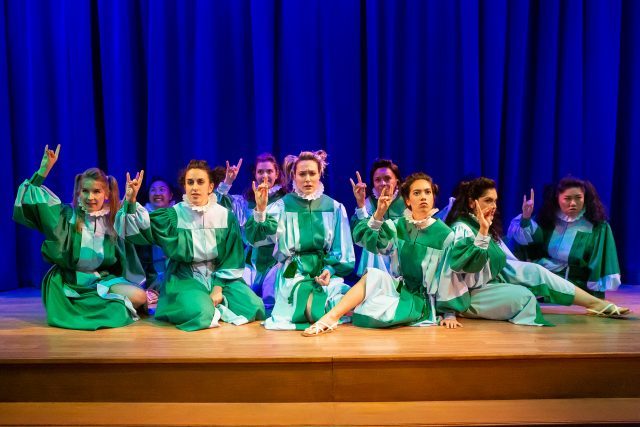
Erica Schmidt’s beautifully frenetic Shakespeare adaptation Mac Beth — yes, she has made the title two words, perhaps to emphasize the more feminine second half of the title — is an exhilarating demonstration of grrl power, ratcheted up to the nth degree. The Red Bull production, which continues at the Lucille Lortel Theatre through June 9, is set at a girls school where seven students enact an all-female version of Macbeth. They are dressed in schoolgirl uniforms of buttoned white shirts under tartan tops and skirts, with bloodred socks reaching up to their knees; aggressively ominous and gender-neutral hooded capes are added for the Weird Sisters. (The costumes are by Jessica Pabst.) Catherine Cornell’s set juts into the audience, covered in fake grass with a partially overturned couch, an iron bathtub, a campfire, and water-filled craters, as if the aftermath of a wild sorority bash. (When the characters imbibe, they do so from red plastic cups, a party staple.) And although they speak in the traditional iambic pentameter, they don’t disguise their voices to be more adult, instead sounding like a bunch of kids invigorated by putting on a show exactly the way they want to.

(photo by Richard Termine)

The Weird Sisters (Sharlene Cruz, AnnaSophia Robb, and Sophie Kelly-Hedrick) stir the boiling cauldron in Mac Beth (photo by Richard Termine)

Macbeth (Isabelle Fuhrman) is returning from a successful military campaign with the loyal Banquo (Ayana Workman) when they come upon three witches (AnnaSophia Robb, Sophie Kelly-Hedrick, and Sharlene Cruz, who play multiple roles) who predict that Macbeth will become Thane of Cawdor, then king, while Banquo’s sons will one day rule. Fear, jealousy, and revenge take over as the power grab is on, but with delicious twists; in the Bard’s day, his plays were performed by an all-male cast, but this twenty-first-century all-woman cast — armed with smartphones — revels in the gender shifts without altering the original text. “Are you a man?” Lady Macbeth (Ismenia Mendes) asks her husband. Facing a ghost (hysterically played by Workman), Macbeth declares, “What man dare, I dare: be alive again, / And dare me to the desert with thy sword; / If trembling I inhabit then, protest me / The baby of a girl. Hence, horrible shadow! / Unreal mock’ry, hence!” It’s as if they are caught up in a teenage horror flick, with all the adolescent tropes in place but seen only from the girls’ point of view. Even one of the witches’ prophecies takes on new meaning when she predicts, “Be bloody, bold, and resolute: laugh to scorn / The power of man, for none of woman born / Shall harm Macbeth.” At one point Lady Macbeth tells a witch, “Unsex me here.”

(photo by Richard Termine)

AnnaSophia Robb and Sophie Kelly-Hedrick play witches and other characters in Bard play set at a girls school (photo by Richard Termine)

Schmidt’s (A Month in the Country, Invasion!) breathlessly paced version flies by in a furious ninety minutes, both sexy and sinister, gleefully performed by the terrific cast led by Fuhrman’s (All the Fine Boys, Orphan) tortured Macbeth and Mendes’s (Marys Seacole, Orange Is the New Black) malevolent Lady Macbeth. Robb (The Carrie Diaries, Bridge to Terabithia), NYU Tisch freshman Kelly-Hedrick, and recent CCNY grad Cruz make strong off-Broadway debuts, playing the witches as well as Duncan, Malcolm, Fleance, Rosse, Angus, Lenox, and other minor characters; in particular, Kelly-Hedrick captures the essence of girlhood — tinged with menace — in her squeaky delivery. Schmidt’s inventive staging also boasts a thrilling storm, a creepy doll, and a touch of gymnastics, although if there was one more loud bang against the tub I was going to scream. Schmidt was inspired to revisit Macbeth by reading stories about girls being murdered in the woods. In Mac Beth, she takes back the power, putting the girls in charge in a gender swap that is as exciting as it is, in this day and age, necessary. Schmidt makes us look at the bloody power plays of Scottish kings as if they are the social dominance battles of high school — and vice versa — and every audience member comes out a winner.

CURSE OF THE STARVING CLASS

(photo by Joan Marcus)

Ella (Maggie Siff) is unable to control her son, Wesley (Gilles Geary), in Curse of the Starving Class (photo by Joan Marcus)

The Pershing Square Signature Center
The Irene Diamond Stage
480 West 42nd St. between Tenth & Eleventh Aves.
Tuesday-Sunday through June 2, $35-$55
212-244-7529
www.signaturetheatre.org

The Signature Theatre’s long relationship with Sam Shepard, dating back to 1996, continues with a powerful production of his Obie-winning 1978 stunner, Curse of the Starving Class. The play, which shatters any illusions about the American dream, began a remarkably fruitful period for Shepard, followed by such works as Buried Child, True West, Savage/Love, Fool for Love, and A Lie of the Mind over the next seven years. The Signature previously staged the play in 1997; the new adaptation is directed with a vengeance by Terry Kinney, the Steppenwolf cofounder who has directed Fool for Love and, who, incidentally, suffered a panic attack playing Tilden in Buried Child, which led to his six-year absence from acting in theater.

Kinney opens the show with an unforgettable moment involving Julian Crouch’s set, a large, open, rancid farmhouse kitchen in California where the supremely dysfunctional, self-destructive Tates are living a bizarre life. The father, Weston (David Warshofsky), is a drunk who broke down the door the night before in an alcoholic rage. His delusional wife, Ella (Maggie Siff), is so frightened of him that she has contacted a lawyer, Taylor (Andrew Rothenberg), in order to sell the house. Their young daughter, Emma (Lizzy DeClement), is desperate to run away. And her older brother, Wesley (Gilles Geary), is following in his father’s less-than-stellar footsteps. “This thing is no joke. Your whole life is changing. You don’t want to live in ignorance, do you? Squalor and ignorance,” Ella tells Emma. Emma is furious when she finds out that her mother and brother have sabotaged her 4-H project involving a chicken she had raised “from the incubator to the grave,” a stern metaphor for how the members of the family treat one another. The tension rises when Ellis (Esau Pritchett), the owner of the Alibi bar, arrives with some pretty compelling claims himself.

(photo by Joan Marcus)

Emma (Lizzy DeClement) searches for answers as Taylor (Andrew Rothenberg) looks on in Shepard revival at the Signature (photo by Joan Marcus)

The Tates are like precursors to the Gallagher clan on the Showtime series Shameless, only without the sex and the comic relief. (The bar in Shameless is even named the Alibi.) There seems to be no way out from under the vicious cycle of alcoholism and violence that ensnares them, and they are doing everything they can to make sure to slam the door on any possible exit. Shepard includes numerous references to food throughout the play: Ella makes bacon early on, Emma is looking for her fryer, Wesley is constantly scouring the usually empty refrigerator, Weston inexplicably brings home a bag of artichokes, and a maggot-laden sheep is boarded in the kitchen.

“No one’s starving! We don’t belong to the starving class!” Emma screams. “There’s no such thing as a starving class,” her mother answers. “There is so! There’s a starving class of people, and we’re not part of it!” Emma responds, to which Ella replies, “We’re hungry, and that’s starving enough for me!” But what the Tates are hungry for is a question Shepard’s play never explicitly answers.

(photo by Joan Marcus)

Ellis (Esau Pritchett) has bad news for the Tates in Curse of the Starving Class (photo by Joan Marcus)

The play is full of surprises, with a freshness that doesn’t feel the least bit stale, the unpredictability of the Tates front and center. Weston might drive a Kaiser-Frazer and a Packard, but there’s nothing old-fashioned about the problems they all are facing. Curse of the Starving Class is a wickedly brutal tale, a classic Shepard tale of toxic masculinity, addiction, and the dashing of hope. The family is so explosive that Emma believes there is nitroglycerine running through their veins, flowing in their blood. She might be right.

CONTINUITY

(photo © Matthew Murphy)

Alex Hurt, Jasmine Batchelor, Megan Ketch play actors making an ecological disaster flick in Bess Wohl’s Continuity (photo © Matthew Murphy)

Manhattan Theatre Club
MTC at New York City Center
The Studio at Stage II
130 West 56th St. between Sixth & Seventh Aves.
Tuesday – Sunday through June 9, $69-$90
212-581-1212
continuityplay.com
www.manhattantheatreclub.com

At one point in Bess Wohl’s fiendishly clever Continuity, the Manhattan Theatre Club world premiere that opened last night at Stage II at City Center, the stage is empty for several minutes. The set, designed by Adam Rigg, is anchored by a white styrofoam ice floe with a wall of ice in the back, leaning ominously forward. It’s an uncomfortably funny moment, the barenness a warning of what just might happen if the world keeps on its current pace, because the play is as much about narrative continuity as the continuity of humanity itself. The show within a show is about global warming, as in real life politicians, scientists, environmentalists, artists, and lay people fiercely disagree on what to do about climate change and whether it’s already too late; the deserted stage predicts a time in the not-too-distant future when living beings no longer exist on our doomed planet. But Wohl and director Rachel Chavkin, who previously collaborated on the smash hit Small Mouth Sounds, are not just preaching to the choir or spewing grandiose melodramatic rhetoric. Continuity is a sublime one-hundred-minute journey into the glorious stupidity of humanity as it faces its possible demise.

(photo © Matthew Murphy)

Jake (Alex Hurt) and David (Darren Goldstein) watch some monkeys online in Manhattan Theatre Club world premiere at City Center (photo © Matthew Murphy)

A film crew is in the New Mexico desert making an ecological disaster epic. Director Maria (Rosal Colón), a Sundance Award–winning indie filmmaker, is helming her first studio picture, not wanting to screw up her big break, while needy Hollywood star Nicole (Megan Ketch), who is playing environmentalist Eve, is having some issues, creating maddening delays for the crew and her fellow actors, the good-looking Jake (Alex Hurt), who is playing George, an ecoterrorist, and earnest, underutilized Anna (Jasmine Batchelor), who portrays Lily, a climatologist who has been captured by a gun-wielding George. “The time for science is over,” the Keanu Reeves–like hunk declares. “It’s time for action.” When screenwriter David Caxton (Darren Goldstein) arrives unexpectedly, Maria worries that the studio has sent him to keep an eye on her. Soon Larry (Max Baker), the crotchety science adviser, is questioning plot points that will wreak havoc on the film’s narrative and drain the story of its special-effects-laden promises. Through it all, the loyal PA (Garcia) does whatever is asked of him, no matter how patently absurd.

(photo © Matthew Murphy)

Maria (Rosal Colón) and David (Darren Goldstein) find themselves at odds while on-set in New Mexico (photo © Matthew Murphy)

Continuity was partly inspired by Wohl’s experience writing the cancer movie Irreplaceable You, so the film shoot feels authentic. The title of the play comes not only from the technical term for maintaining consistent details in a movie but also from the idea of uninterrupted existence, which is in global danger because of climate change. Wohl (Barcelona, American Hero) explores carbon neutrality, recycling, hypocrisy, science, capitalism, and other concepts as she litters the dialogue with such silly puns and wonderfully chosen phrases as “Stop shifting the ground under my feet,” “Water under the bridge,” and “The pace is glacial.” She and Chavkin (Hadestown, Natasha, Pierre & the Great Comet of 1812) also probe race, gender, the #MeToo movement, and sexual orientation as Maria’s attempt to finish the scene before it gets dark mimics humankind’s not-so-concerted effort to save the Earth. “Please take care of our iceberg,” the offstage first assistant director tells everyone about a prop that people keep ruining, as if reminding all of us of the tenuousness of our situation. Lily and Jake watch a video on his phone of a monkey doing something amazing, as if evolution is being turned around. David is giving himself a fake tan, like a natural one is out of the question. It’s no coincidence that Maria won an award at Sundance, both because of the name of the festival itself as well as its relationship with seminal environmentalist Robert Redford. The stage production is doing what it can to not leave its own carbon footprint, reusing plastic bottles and other props and recycling cut-up paper into falling snow. Wohl calls Continuity “a play in six takes,” but we don’t have that many chances left to get it right.

HAPPY TALK

(photo by Monique Carboni)

Marin Ireland and Susan Sarandon star in Jesse Eisenberg’s Happy Talk for the New Group at the Signature (photo by Monique Carboni)

The New Group at the Pershing Square Signature Center
The Alice Griffin Jewel Box Theatre
480 West 42nd St. between between Ninth & Tenth Aves.
Tuesday – Sunday through June 16, $40-$125
thenewgroup.org

Susan Sarandon is delightful as a suburban New Jersey housewife with a flexible connection to reality in Jesse Eisenberg’s superb Happy Talk, which opened last week at the Signature Center. The actor and writer’s fourth play, second for the New Group (following The Spoils), and first in which he does not appear is also his first non-autobiographical work, although it is infused with his childhood love for musical theater. Sarandon is Lorraine, a dedicated, longtime actress — dedicated to community theater, to be precise. Her current role is Tonkinese vendor Bloody Mary in the local JCC production of South Pacific, which has apparently taken over her life. Eisenberg makes clear that is her usual modus operandi as she immerses herself in the part, waxing poetic about her craft while a Serbian home-care aide deals with the prosaic details of Lorraine’s ill, grumpy husband, Bill (Daniel Oreskes), who spends most of his time sitting uncomfortably in a chair, reading a Civil War tome, and refusing to partake in conversation, and her dying mother, Ruthie, who is never seen but is often heard via a loud buzzer she presses repeatedly to demand help. It is soon clear that the relentlessly cheerful aide, Ljuba (Marin Ireland), is an undocumented immigrant saving money to buy an American husband so she can get her green card and bring her daughter to the States.

(photo by Monique Carboni)

Ljuba (Marin Ireland), Lorraine (Susan Sarandon), and Jenny (Tedra Millan) share a rare moment of smiles in New Group world premiere (photo by Monique Carboni)

The narcissistic Lorraine is desperately frightened about being left alone and demands to be the center of attention and action. To cement her control of all around her, she arranges a potential fake marriage between Ljuba and a young gay man, Ronny (Nico Santos), who is playing Lt. Joseph Cable alongside Lorraine in the Rodgers & Hammerstein show. “Darling, I’m an artist. We live in the shadows, we bend the rules,” she tells Ljuba. “Now I want you to stop worrying. I will take care of everything.” Lorraine sees the “marriage” like a scene from a play she is writing, directing, and starring in, further establishing her preference for theater fantasy over real-life situations. Speaking about facilities for aging parents, she says, “It’s just horrible, all due respect. No one touches them. No one talks to them. It’s horrid the way we treat the elderly in this society. But Ljuba — she’s just incredible. She actually sleeps in the room with her. Can you imagine?” she explains even though she never goes in to see or speak with her mother. She later adds, “I trust a computer far more than a person to take care of me!” Meanwhile, Lorraine and Bill’s estranged daughter, Jenny (Tedra Millan), is an angry young woman with a surprise announcement to make — although maybe it’s not so surprising given her mother’s attitude toward her own responsibilities as both a mother and a daughter.

(photo by Monique Carboni)

Ljuba (Marin Ireland) has some unhappy words for Lorraine (Susan Sarandon) as Ronny (Nico Santos) looks on in Happy Talk (photo by Monique Carboni)

Happy Talk is astutely directed by New Group head Scott Elliott (The True, Mercury Fur), capturing Eisenberg’s sharp, snappy dialogue as Lorraine and company careen around Derek McLane’s impeccably rendered suburban kitchen/living room set. Tony nominee and Obie winner Ireland (On the Exhale, Marie Antoinette), a genuine New York City theater treasure, and Oscar winner Sarandon (Atlantic City, The Rocky Horror Picture Show), in her first stage appearance since 2009’s Exit the King on Broadway with Geoffrey Rush, make a dynamic duo, Ireland going toe-to-toe with Sarandon as her character mutters asides that reveal she’s a lot smarter than others might think. Sarandon occasionally channels Bette Davis (think All About Eve) — perhaps not coincidentally, she was recently nominated for an Emmy for her portrayal of Davis in the FX series Feud, opposite fellow Emmy nominee Jessica Lange’s Joan Crawford; the implication works terrifically in a twisted plot turn.

Eisenberg (Asuncion, The Revisionist) fills the play with references to such musicals as Fiddler on the Roof, Sunset Boulevard, Once Upon a Mattress, Evita, Oliver! and Oklahoma! that add to the fun while also exploring such topics as cultural appropriation, elder abuse, and immigration. About halfway through the show, which continues at the Alice Griffin Jewel Box Theatre through June 16, Lorraine says with rare clarity, “I always thought that my lot in life was to help people en masse. Through my work. People see me on stage. They see the human condition — it filters through me — and maybe they learn a little something about themselves. And if they’ve walked away with a new sense of understanding, of being able to look at their fellow man and not just see a husk, but a soul? Well then, I’ve done my job.” Here, Eisenberg and Happy Talk accomplish just that.

OCTET

(photo by Joan Marcus)

Eight characters share their fears of being unconnected in Dave Malloy’s Octet (photo by Joan Marcus)

The Pershing Square Signature Center
The Romulus Linney Courtyard Theatre
480 West 42nd St. between Tenth & Eleventh Aves.
Tuesday – Sunday through June 23, $35 through June 9, $85 after
212-244-7529
www.signaturetheatre.org

Dave Malloy’s Octet is a brilliant chamber choir musical about our obsession with technology, primarily the internet and smartphones. The Brooklyn-based Malloy, the Obie-winning, Tony-nominated mastermind behind Natasha, Pierre & the Great Comet of 1812, Ghost Quartet, and Beardo, and scenic designers Amy Rubin and Brittany Vasta have transformed the Signature’s malleable Romulus Linney Courtyard Theatre into a church basement where eight addicts gather to share their personal dilemmas. The audience enters through a hallway with a bulletin board and announcements, then walks down a few stairs and across the stage, where several people are removing bingo tables and setting up a circle of chairs for the meeting. But it’s not alcohol, drugs, or sex that has brought these people together; it is their overdependence on digital connection with the rest of the world.

(photo by Joan Marcus)

Friends of Saul gather in a church basement to talk about their smartphone addictions in Signature world premiere (photo by Joan Marcus)

Their meeting begins with a hymn that poetically sums up their predicament, as they sing in unison, “There was a forest / One time some time / I walked through a forest / One time some time / The forest was beautiful / My head was clean and clear / Alone without fear / The forest was safe / I danced like a beautiful fool / One time some time. . . . But now / The woods are dark and cold / Clogged with nettles and roots / There is a monster / And I am a monster / Addiction, obsession / Insomnia, depression / And the fear that I’ve wasted too much of my self / On rapid and vapid click-clicks / Isolation, anxiety / Inability to assimilate with society / And the fear that the monster will find me / Infect me and blind me / Butcher my heart and distort my soul.” Next, each addict reads aloud one of the Eight Principles (“There is a deep emptiness,” “Content is not connection is not consensus is not conformity is not contentment”), each principle foreshadowing that character’s emotional state of mind. Over the course of the next ninety minutes, which unfold in real time, each of the eight addicts gets the opportunity to sing about their personal strife, all performed in gorgeous a cappella melodies arranged by Malloy, who also wrote the sensational book, lyrics, and music.

They have been invited to the meeting, which takes place at a different location every time, by the unseen yet apparently all-seeing Saul, who may or may not exist. Each song is introduced by a blow into a pitch pipe, preparing everyone for the next confession, another journey into the troubled mind, body, and spirit. Henry (Alex Gibson) can’t break away from Candy Crush; Karly (Kim Blanck) keeps swiping on sex and dating apps; Toby (Justin Gregory Lopez) is hooked on conspiracy theories; Jessica (Margo Seibert) is an ego-surfer; Marvin (J. D. Mollison) is a scientist who thinks the World Wide Web might be God; first-timer Velma (Kuhoo Verma) has gone cold turkey for two days; Ed (Adam Bashian) loves porn; and Paula (Starr Busby) is haunted by the “stale pale glow” of the screen while in bed with her husband.

Splendidly directed by Annie Tippe (Ghost Quartet, Cult of Love), who doesn’t allow the audience to let its guard down for even a second in the relatively tight, intimate quarters, Octet delves into humanity’s psychological makeup and the neurological circuits that tie us to our phones, desperate for the constant connection that we think will alleviate our deep-seated fear of missing out and of being trapped inside our own heads for any period of time whatsoever. Karly explains, “Well, I would love to pay attention to you / But I simply can’t / I might have an invite / I might have a coupon / I might have a snippet / There might be a morsel or a nugget / A factoid, a zinger / A recap, a blurb / Why, there might be a tidbit! / I simply must check my tidbits / What if there’s a pause? / What if there’s a lull? / At dinner, at a movie / My God, even at the theater!” (Thankfully, no cell phones went off during the performance I attended.)

But it’s not just about technological addiction; it’s about all our obsessions, the things that keep us up at night, the inner and outer elements that prevent us from reaching our full potential as individuals and as an interdependent society. “I feel my body stretched between two cliffs / One side is fantasy / The other reality / I feel my fingers start to lose their grip / And I can’t hold on,” Karly sings, a feeling everyone has experienced. In writing the libretto, Malloy researched scientific and religious texts, Sufi poetry, and online comment boards, going far beyond mere social media to take a look at who we are today, and how we got to be that way. Christopher Bowser’s lights never go all the way down, as if we are part of the group; in fact, some audience members sit on the floor, in the same folding chairs the actors do. Octet is a mesmerizing work of genius, the first of three plays Malloy will be producing for his five-year residency at the Signature — and the company’s first musical in its thirty-year history. I have my pitch pipe at the ready for the next one.

ASHITA NO MA-JOE: ROCKY MACBETH

(photo © Richard Termine)

Theater Company Kaimaku Pennant Race give a unique twist to Macbeth at Japan Society (photo © Richard Termine)

Japan Society
333 East 47th St. at First Ave.
May 15-18, $28
212-715-1258
www.japansociety.org
www.kpr.tokyo

Theater Company Kaimaku Pennant Race founder Yu Murai’s Ashita no Ma-Joe: Rocky Macbeth is silly fun, a goofy comic mash-up of William Shakespeare’s Macbeth and the late 1960s manga Ashita no Joe (“Tomorrow’s Joe”). Continuing at Japan Society through May 18, it’s a riotous twist on both stories that creates something fresh and new — and completely wild and unpredictable. The show takes place in and around a light-blue boxing ring onstage, open on two sides, along which the audience of no more than sixty sits. Inside the ring is a second, much smaller ring, with a malleable, flexible mat that occasionally is lifted to reveal various characters, bits of scenery, and video of a koi pond by Kazuki Watanabe. To get you in the mood as you enter the empty theater, audio plays of Steve Albert, Dr. Ferdie Pacheco, and former champ Bobby Czyz calling the November 1998 championship bout between Ricardo “Finito” Lopez and Rosendo Alvarez. Beer, wine, and popcorn is available for purchase and can be consumed during the performance, as if you’re in a boxing arena. The three actors, Takuro Takasaki (Macbeth), G. K. Masayuki (Banquo), and Kazuma Takeo (Lady Macbeth), wear absurdly tight head-to-foot costumes that are a mix of wrestling uniforms and the sperm characters from Woody Allen’s Everything You Ever Wanted to Know About Sex.

(photo © Richard Termine)

Macbeth faces his destiny in Japanese mashup (photo © Richard Termine)

The dialogue can be seen on two monitors — unfortunately placed at angles that make it difficult to read and follow the action onstage simultaneously — but it’s not critical to catch every word, as there is a lot of repetition and exposition. The sixty-minute show features key plot points and quotes from Macbeth, including the witches’ prophecies and Macbeth’s rise to the top — to become both king and yokozuna — as he goes after King Duncan, Banquo, and Macduff; however, in this version, Lady Macbeth is not as central to his quest. There are also elements of Ashita no Joe, with such characters as Woolf and Joe, as well as tips of the hat to legendary sumo wrestler Kitanoumi and boxer Wajima Koichi. Along the way, Macbeth displays his boxing skills with the “back-spinning uppercut,” “triple cross counter,” and other punches and jabs and starts seeing apparitions of the men he has vanquished. “The boxing ring howls and calls for fresh blood,” one declares. There are also anachronistic pop culture references, a shaky-looking scaffold that serves as the castle (and where writer-director Murai runs things), and a battle scene in which six members of the audience need special protection. (We strongly suggest you sit in the seats warning about pebbles.) As with even the best boxers, not everything hits its mark, but more than enough does to score a knockout, a crazy, unusual immersive Shakespeare adaptation from a company that previously brought us Romeo and Toilet and King Lear, Sadaharu. There’s no telling what wonderful nonsense they’ll be up to next, but we’ll be there.