this week in theater

ARTHUR MILLER’S ALL MY SONS

(photo by Joan Marcus)

Joe Keller (Tracy Letts) and his son Chris (Benjamin Walker) face off in Roundabout revival of All My Sons (photo by Joan Marcus)

American Airlines Theatre
227 West 42nd St. between Broadway & Eighth Ave.
Tuesday – Sunday through June 30, $99-$352
212-719-1300
www.roundabouttheatre.org

In Jack O’Brien’s poignant Roundabout revival of Arthur Miller’s breakthrough play, All My Sons, an all-American family is caged in a psychological, metaphorical jail as their world falls apart over the course of a hot August day in 1947. The story takes place in the comfortable Midwest suburban backyard of the home of Joe and Kate Keller (Tracy Letts and Annette Bening), where the consequences of WWII are building in intensity, turning their house into a prison of their own making. Their oldest son, Larry, a pilot in the war, has been missing for three years. While Joe, a sturdy, self-made factory owner, and Larry’s younger brother, Chris (Benjamin Walker), an idealist who also fought in the war, have accepted Larry’s death, Kate refuses to believe he is gone, insisting that he is alive and will be back any minute. Chris has invited Larry’s former girlfriend and their childhood neighbor, Ann Deever (Francesca Carpanini), to visit them so he can propose to her; Joe tries to talk him out of it, telling him that it would destroy Kate. Ann’s brother, George (Hampton Fluker), is also on his way to the Kellers’ house after speaking with his father, Steve, who is in prison; Steve, Joe’s former business partner, was locked up for a crime that Joe might know a lot more about than he’s admitting.

“Can I see the jail now?” Bert (alternately played by Alexander Bello or Monte Green) asks Joe, who has made the eager young boy a detective to keep watch over the community. “Seein’ the jail ain’t allowed, Bert. You know that,” Joe says. “Aw, I betcha there isn’t even a jail. I don’t see any bars on the cellar windows,” Bert responds. “Bert, on my word of honor, there’s a jail in the basement,” Joe assures him. It’s not long before Joe’s word of honor is under question, as is the American dream itself.

(photo by Joan Marcus)

George Deever (Hampton Fluker) has some critical thoughts to share with the Keller clan in Arthur Miller Broadway revival (photo by Joan Marcus)

All My Sons, which won a Best Author Tony for its Broadway debut (directed by Elia Kazan and starring Ed Begley, Beth Miller, Arthur Kennedy, and Karl Malden) and was named Best Revival forty years later (with Richard Kiley, Joyce Ebert, Jamey Sheridan, and Jayne Atkinson), isn’t a bit creaky despite being more than seventy years old. The central issue it deals with — the devastating impact war can have on families — is an unfortunately universal, timeless one. “Well, that’s what a war does,” Joe tells neighbors Frank and Lydia Lubey (Nehal Joshi and Jenni Barber). “I had two sons, now I got one. It changed all the tallies. In my day when you had sons it was an honor. Today a doctor could make a million dollars if he could figure out a way to bring a boy into the world without a trigger finger.”

(photo by Joan Marcus)

Chris (Benjamin Walker) wants to marry Ann (Francesca Carpanini) against his parents’ wishes (photo by Joan Marcus)

Three-time Tony winner O’Brien (Hairspray, The Hard Problem), who directed a 1987 television adaptation that featured James Whitmore, Aidan Quinn, Michael Learned, and Joan Allen, also focuses on rampant postwar consumerism and profiteering; the key plot point evokes the recent controversy over the safety of the Boeing 737 Max. “Money. Money-money-money-money. You say it long enough it doesn’t mean anything,” explains Dr. Jim Bayliss (Michael Hayden), who lives in the Deevers’ old house and complains of his wife’s (Chinasa Ogbuagu) insistence that he make more cash. Award-winning playwright and actor Letts (Mary Page Marlowe, Who’s Afraid of Virginia Woolf?) is sublime as Joe, a robust man who is willing to do anything to protect his family, while Bening (Coastal Disturbances, King Lear) is haunting as Kate, who appears to be a shadow of a woman, seemingly existing solely for Larry and living in a fog. The couple is trapped in their home, unable to escape the lies they’ve surrounded themselves with; Walker (Bloody Bloody Andrew Jackson, American Psycho) is bold and strong as Chris, the only one who can actually leave the premises as he considers a life somewhere else. Each of the three acts (with one intermission) begins with a projection of the Keller house on a translucent scrim, slowly rising to reveal Douglas W. Schmidt’s set as if a jail door opening. “It’s bad when a man always sees the bars in front of him. Jim thinks he’s in jail all the time,” Sue tells Ann. O’Brien knows his subject matter and directs with a sure hand and the confidence that comes with understanding the responsibility of helming a Great American Play, one that feels that it hasn’t aged a bit after all these decades.

HILLARY AND CLINTON

(photo by Julieta Cervantes)

John Lithgow and Laurie Metcalf star as Bill and Hillary Clinton in Lucas Hnath’s latest play (photo by Julieta Cervantes)

Golden Theatre
252 West 45th St. between Broadway & Eighth Ave.
Tuesday – Sunday through June 23, $39-$159
hillaryandclintonbroadway.com

It’s easy to imagine that in some alternate universe, Hillary Clinton is still running for president. Lucas Hnath does just that in Hillary and Clinton, his modestly entertaining play running at the Golden Theatre. Hnath originally wrote the show in 2008, when Clinton was battling Barack Obama for the Democratic presidential nomination; it debuted in 2016 in Chicago, Obama’s adopted hometown. But Hnath has completely rewritten the tale for its Broadway bow, keeping the 2008 setting but filtering it through the lens of Clinton’s shocking 2016 loss to Donald J. Trump. The ninety-minute one-act opens with Laurie Metcalf taking the stage with a broken microphone, proposing that there are multiple versions of our universe. “Imagine, okay, that light years away from here on one of those other planet Earths that’s like this one but slightly different that there’s a woman named Hillary,” she proposes. Metcalf then becomes Hillary, with John Lithgow as her husband, former president Bill Clinton. Neither actor attempts to mimic the character they are portraying, either vocally or physically. Metcalf wears sweatpants, Uggs, a turtleneck, and a zippered fleece, while Lithgow is dressed in jeans or shorts, sneakers, and a leather jacket. (The casual, suburban-style costumes are by Rita Ryack.) They look and talk just like Laurie Metcalf and John Lithgow.

Hillary is in a nondescript New Hampshire hotel room (designed by Chloe Lamford), preparing for the state primary. Her campaign manager, the schlubby Mark (Zak Orth), is not overly concerned that she is trailing in the polls to the upstart Obama (Peter Francis James). “I’d actually be more worried if we were winning too fast,” Mark says. “As far as I’m concerned it’s good for you to be the underdog.” Hillary replies, “So me losing is a strategy?” Mark insists that Hillary keep Bill far away, but he soon comes knocking, offering advice that Mark and Hillary are not too keen on. “People don’t vote with their brain,” Bill explains like a wise professor. “They don’t, even people who think they do, don’t. It’s never not emotional.” One of the problems, he points out, is that she is not very likable, which she is not thrilled to hear. Perhaps this universe is not so different from ours after all. They all talk deals, but they don’t get into specific policies; Hnath focuses on the couple’s personalities and their desires — including the unsavory ones that led to Bill’s impeachment.

(photo by Julieta Cervantes)

Hillary campaign manager Mark (Zak Orth) is not thrilled that Bill has joined the team in Hillary and Clinton (photo by Julieta Cervantes)

Two-time Tony winner Joe Mantello (The Boys in the Band, Take Me Out), who directed Metcalf to a Tony as Nora in Hnath’s bold, insightful Ibsen sequel, A Doll’s House, Part 2 (she has won two Tonys and three Emmys and has been nominated for an Oscar), treats the Clintons just like regular people, a married couple having a series of familiar disagreements, even if in this case it involves one of them possibly becoming the leader of the free world. Two-time Tony winner Lithgow (Sweet Smell of Success, Dirty Rotten Scoundrels) — he’s also won six Emmys and been nominated for two Oscars and four Grammys — has a calm grace as Bill, who is more needy than one would expect. Hillary and Clinton is not meant to be biographical, or even truthful. Did the things that come up in the play, especially between Barack and Hillary, actually happen in real life? It doesn’t really matter. Hnath has given us an slice of alternate Americana, and while it might not be as satisfying as Grandma’s apple pie, it is a sly, tasty little snack.

HADESTOWN

(photo by Matthew Murphy)

Hermes (André De Shields) narrates the love story between Eurydice (Eva Noblezada) and Orpheus (Reeve Carney) in Hadestown (photo by Matthew Murphy)

Walter Kerr Theatre
219 West 48th St. between Broadway & Eighth Ave.
Tuesday – Sunday through January 5, $109-$249
www.hadestown.com

After a thirteen-year gestation period, Anaïs Mitchell’s sizzling-hot Hadestown has descended on Broadway, burning it up to packed houses at the Walter Kerr Theatre. Mitchell wrote the book, music, and lyrics to the Tony-nominated show, which has transformed since 2006 from a small presentation in Vermont with friends and a 2010 concept album to evolving productions at New York Theatre Workshop, the Citadel in Canada, and London’s West End. The fiery musical is a potent combination of the Greek myths of Persephone and Hades, Orpheus and Eurydice, flavored with the American version of the proletarian struggle against capital. The narrative journeys from Persephone’s raucous jazz bar into the underworld, telling the tragic mythological fable of a doomed love affair between Orpheus (Reeve Carney), here written as a naïve, wide-eyed dreamer, and Eurydice (Eva Noblezada), who becomes a practical and realistic young traveler trying to survive in supremely hard times. They meet at a railway station on the road to hell, which is run by the devious King Hades (Patrick Page) and his far more sympathetic wife, Persephone (Amber Gray), from atop their not-quite-ivory tower. “Now some may say the weather ain’t the way it used to be / But let me tell you something that my mama said to me: / You take what you can get / And you make the most of it / So right now we’re living it,” Persephone sings.

Down below, in hell, a workers chorus of factory slaves (Afra Hines, Timothy Hughes, John Krause, Kimberly Marable, and Ahmad Simmons) toils away in horrific heat. The proceedings are narrated with devilish charm, Our Town-style, by Hermes (André De Shields), the messenger god. “It’s a sad song / It’s a sad tale, it’s a tragedy / It’s a sad song / But we sing it anyway,” he explains. When the desperate Eurydice is lured by Hades, Orpheus can save her only by writing the most beautiful song ever written as the Fates (Jewelle Blackman, Yvette Gonzalez-Nacer, and Kay Trinidad) keep a close watch on it all.

(photo by Matthew Murphy)

Hades (Patrick Page) and Persephone (Amber Gray) survey their domain in sizzling Broadway musical (photo by Matthew Murphy)

Director Rachel Chavkin (Natasha, Pierre & the Great Comet of 1812; Small Mouth Sounds) marvelously melds a steampunk aesthetic with New Orleans bravado and depression-era gloom, maintaining an energetic fast pace to what, at its heart, is a simple, poetic love story. Mitchell’s music, performed by onstage musicians (pianist Liam Robinson, violinist Dana Lyn, cellist Marika Hughes, guitarist Michael Chorney, trombonist Brian Drye, double bassist Robinson Morse, and percussionist Ben Perowsky) as if at a honky tonk, range from R&B, soul, and jazz to folk, blues, country, and pop with enthusiastic orchestrations by Todd Sickafoose and rousing choreography by David Neumann that avoid typical Broadway melodrama. Rachel Hauck’s set, anchored by Hades’s grim, looming tower, seems to breathe smoke and fire. Michael Krass’s costumes include some ravishing touches, from Persephone’s green velvet dress and Hades’s impeccable pinstripe suit to Hermes’s spectacular sharkskin ensemble.

(photo by Matthew Murphy)

Eurydice (Eva Noblezada) makes a decision she’ll regret as the Fates hover over in Hadestown (photo by Matthew Murphy)

Page (Spring Awakening, Coriolanus), whose booming baritone echoes throughout the theater, and Carney (Penny Dreadful; Hello, Stranger), who plays Orpheus with a sweet innocence, are worthy adversaries, having already battled it out in Spider-Man: Turn Off the Dark, in which Carney was the web-throwing superhero and Page the villainous Green Goblin. Noblezada (Les Misérables, Miss Saigon) does well as the underwritten, underdeveloped Eurydice, while Gray (Natasha, Pierre & the Great Comet of 1812; An Octoroon) has a stomping good time as Persephone. Mitchell and Chavkin make a strong connection between the burgeoning love between the young Orpheus and Eurydice, who are fighting fate for a chance at a life together, and Hades and Persephone, who lost their spark long ago and might not be able to get it back. There are also references to modern-day climate change, capitalism, and politics without getting heavy-handed, offering the hope of spring. “Wipe away your tears, brother / Brother, I know how you feel / I can see you’re blinded / By the sadness of it all,” Persephone declares. “Look a little closer and / Everything will be revealed / Look a little closer and / There’s a crack in the wall!”

TOOTSIE THE MUSICAL

(photo by Matthew Murphy)

Michael Dorsey (Santino Fontana) and Jeff Slater (Andy Grotelueschen) lament their situations in Broadway musical adaptation of Tootsie (photo by Matthew Murphy)

Marquis Theatre
210 West 46th St. at Broadway
Tuesday – Sunday through December 22, $79-$469
tootsiemusical.com

Robert Horn moves Sydney Pollack’s 1982 hit, Tootsie, from television soap opera to self-reflective Broadway musical in the book for the Broadway musical adaptation of the film, a ten-time Oscar nominee, continuing at the Marquis Theatre through December 22. The movie starred Dustin Hoffman as Michael Dorsey, an impossibly difficult thespian who dresses as a woman, Dorothy Michaels, to land a job on a daytime soap; he lives with his goofy best friend, Jeff Slater (Bill Murray), is close with his ex-girlfriend, determined actress Sandy Lester (Teri Garr), and falls for one of his costars, Julie Nichols (Jessica Lange). In the Broadway version, Dorsey/Michaels is played with flair and panache by Santino Fontana, who dresses as a woman to play the nurse in Ron Carlisle’s (Reg Rogers, who was played in the movie by Dabney Coleman) disastrous musical sequel to Romeo & Juliet entitled Juliet’s Curse. (The role of Julie’s father, who has the hots for Dorothy and is played in the film by Charles Durning, is excised from the show.) Fontana changes hair and costumes at near-record pace as he flits between his ever-growing role onstage while trying to maintain his offstage relationships and keep his ruse a secret from everyone except Jeff (Andy Grotelueschen).

(photo by Matthew Murphy)

Dorothy Michaels (Santino Fontana) has some pointers for Julie Nichols (Lilli Cooper) as they rehearse Juliet’s Curse (photo by Matthew Murphy)

Michael battles on-set with the womanizing Carlisle; angers his agent, Stan Fields (Michael McGrath, in a very different role from the agent played by Pollack in the film); auditions for the same part Sandy (Sarah Stiles) covets; and haplessly attempts to woo Julie (Lilli Cooper). While the arc of his instant success worked in the movie more than three dozen years ago, it often strains credulity here, particularly during the show-within-a-show’s opening night. But getting there can be lots of fun, with antic choreography by Denis Jones and tongue-in-cheek music and lyrics by David Yazbek, although Scott Ellis’s (The Elephant Man, Kiss Me, Kate) direction is bumpy and inconsistent, Simon Hale’s orchestrations of the ballads are overly conventional, and Dorsey is occasionally too unlikable as the production stumbles over making itself relevant in the #MeToo generation.

(photo by Matthew Murphy)

Sandy Lester (Sarah Stiles) wears her heart on her sleeve as Jeff (Andy Grotelueschen) looks on in Tootsie (photo by Matthew Murphy)

Tony nominee Stiles (Hand to God, Avenue Q) nearly steals the show as the desperate Sandy, bringing the house down with “What’s Gonna Happen?,” documenting her futility in both life and career; Tony nominee Rogers (Holiday, The Royal Family) is appropriately slimy as the sleazy, self-important director; Fiasco veteran Grotelueschen (Into the Woods, Cyrano de Bergerac) is warm and funny as Jeff; and Julie Halston (On the Town, Anything Goes) supplies solid support as producer Rita Marshall. William Ivey Long’s costumes and Paul Huntley’s hair and wig design are absolutely fabulous, and David Rockwell’s constantly-in-motion set has its own choreography. There was a sweet, unscripted incident the night I went, the first performance after the production had been nominated for eleven Tonys; when Stan tells Michael he might be up for a Tony, the audience burst into spontaneous applause for several minutes as Fontana (Rodgers & Hammerstein’s Cinderella, Brighton Beach Memoirs), who earned a well-deserved nod for Best Actor in a Musical, sheepishly grinned and blushed: a meta-moment in a production built around its own kind of meta.

EVERYTHING THAT HAPPENED AND WOULD HAPPEN

(photo by Stephanie Berger)

Heiner Goebbels explores the last hundred years of European history in Everything that happened and would happen (photo by Stephanie Berger)

Park Avenue Armory, Wade Thompson Drill Hall
643 Park Ave. at 67th St.
June 3-9, $40-$95
212-933-5812
armoryonpark.org

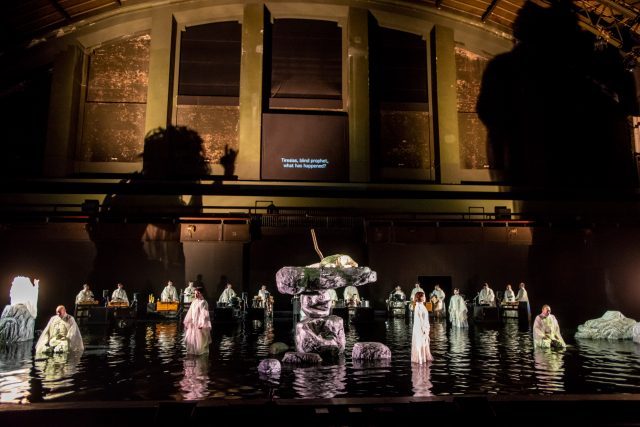
German composer and artist Heiner Goebbels constructs, deconstructs, and reconstructs the last hundred years of European history in Everything that happened and would happen, making its American premiere at Park Ave. Armory through June 9. Reconfigured for the armory’s Wade Thompson Drill Hall — it was originally staged in a former railway depot in Manchester — the multimedia, polyphonic spectacle starts as soon as the doors open, so be sure to get there early. The audience sits in rising rafters on the west side of the hall, watching a team of dancers in black (Juan Felipe Amaya Gonzalez, Sandhya Daemgen, Antoine Effroy, Ismeni Espejel, Montserrat Gardó Castillo, Freddy Houndekindo, Tuan Ly, Thanh Nguyễn Duy, John Rowley, Annegret Schalke, Ildikó Tóth, Tyra Wigg) carry seemingly random objects onstage — long tubes, metallic seashells, a gold sun, large cloths that they hang from above — position them carefully, then remove them.

Various people read passages from Patrik Ouředník’s 2001 Europeana: A Brief History of the Twentieth Century, a tragicomic, stream-of-consciousness look at the twentieth century, exploring war, racism, colonialism, collective memory, liberal democracy, the Holocaust, Barbie dolls, and more. Sentences are occasionally projected on hanging sheets designed with trees, maps, and architectural structures, in addition to unedited footage from Euronews’s No Comment, with no narration or context; the night we attended featured very recent live, often violent images from Syria, Colombia, and other nations. (The video design is by Rene Liebert.) In one corner smoke oozes out of a cave, creating a face. Rocks storm down in an avalanche. The dancers roll column-like plinths across the stage, pedestals without busts; later, one performer climbs on top of one and reads from Ouředník’s book.

(photo by Stephanie Berger)

Everything that happened and would happen has been reimagined for the Park Ave. Armory (photo by Stephanie Berger)

The dissonant score, from John Cage’s Europeras 1&2, is played by Camille Émaille on percussion, Gianni Gebbia on saxophone, Cécile Lartigau on ondes Martenot, Nicolas Perrin on guitar and electronics, and Léo Maurel on several specially built, unusual instruments. (The props are from Goebbels’s 2012 production of Europeras 1&2.) Willi Bopp’s stunning sound design has music and words emerging from numerous speakers throughout the hall, as if a choreographed sonic dance. Goebbels is a master of deception; while you’re watching one element, others will sneak up on you, offering surprises galore, evoking life itself — and war, specifically, but without the immediate threat. A long, narrow beam becomes a mobile trench. Black monoliths creep up out of the darkness. At one point I felt as if Birnam Wood was stealthily approaching; another reminded me of George Washington crossing the Delaware (even if it’s not from the last century). The dancers and musicians improvise, furthering the anything-can-happen atmosphere.

Perhaps what’s most invigorating about the 135-minute-plus intermissionless show — Goebbels’s third project at the armory, following Stifter’s Dinge in 2009 and De Materie in 2016 — is that despite the serious topics that are broached, abstract and not, Goebbels leaves it up to us to interpret what we are experiencing; he gives us the building blocks from which we can form our own narrative. “Everything that happened and would happen doesn’t participate in all the attempts to have yet another opinion as to the meaning of what has happened; quite the opposite. Guided by a deep mistrust in the transmission of a one-directional message, I don’t even try,” Goebbels explains in his director’s note. “Everything that happened and would happen seeks to open up a space of images, words, and sounds generous enough to avoid the impression that somebody on stage is trying to tell you what to think. It is a space for imagination and reflection, in which the construction of sense is left for everyone to assemble.”

(photo by Stephanie Berger)

Words, images, movement, and sound come together in unique, contemplative ways in Heiner Goebbels’s return to the armory (photo by Stephanie Berger)

It can be slow going, and several members of the audience did not make it to the end, which is too bad, because Everything that happened and would happen proves to be a provocative durational exploration of the past, present, and future fusing together, a multimedia barrage on the eyes and ears that demands our attention even as the mind wanders. Even when not much appears to be going on, something is, of course, mimicking life and the choices we make as we go about our day; Goebbels metaphorically hands us the controls and we watch and listen to what we want to, self-curating the presentation. Ouředník writes, “Historians said that historical memory was not part of history and memory was shifted from the historical to the psychological sphere, and this instituted a new mode of memory whereby it was no longer a question of memory of events but memory of memory.” On opening night, at the close of the show, Goebbels himself was helping the ushers steer the audience to the exits on the far side of the stage, forcing everyone to march along a battered landscape and take stock of where we are at this very moment in time, where we’ve been, and where we’re going. It’s a fitting finale to an adventurous evening of intoxicating, memorable theater.

TRIPTYCH (EYES OF ONE ON ANOTHER)

(photo by Maria Baranova)

Triptych (Eyes of One on Another) takes a unique multimedia look at the work of Robert Mapplethorpe (photo by Maria Baranova)

BAM Howard Gilman Opera House
Peter Jay Sharp Building
230 Lafayette Ave.
June 6-8, $30-$60, 7:30
718-636-4100
www.bam.org

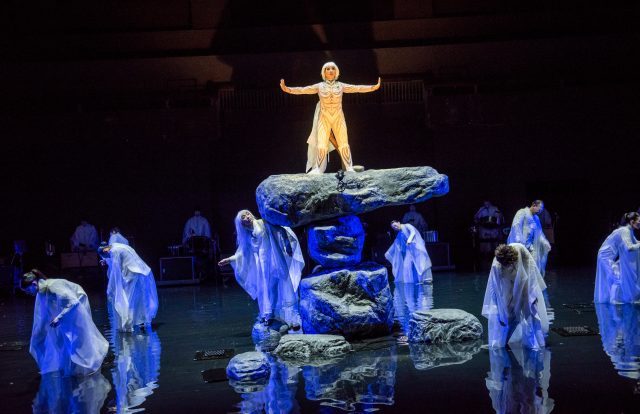
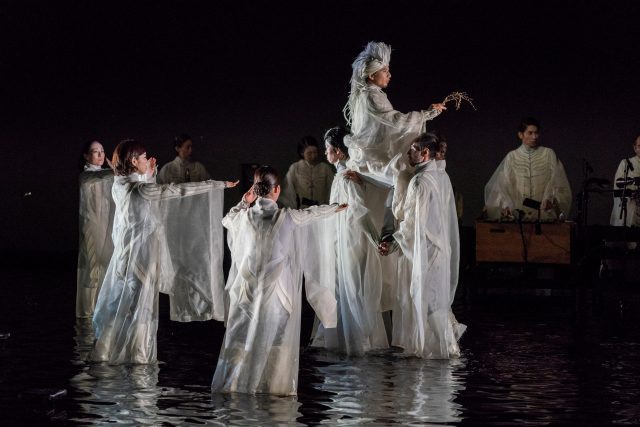
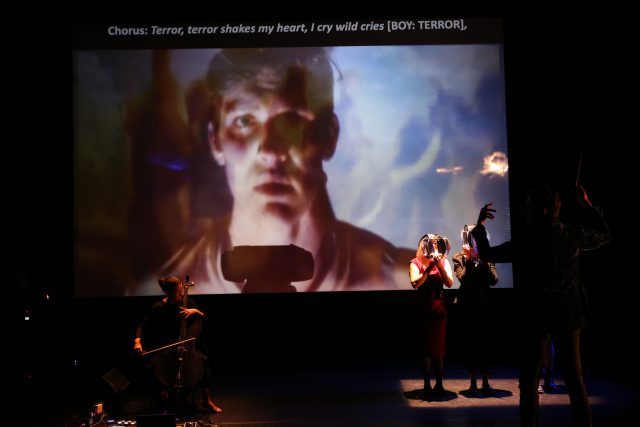
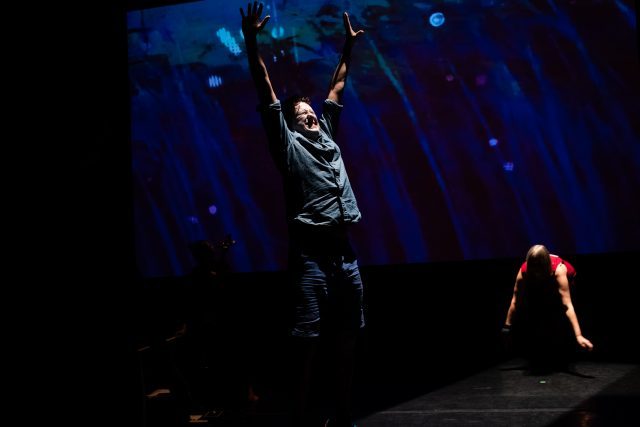
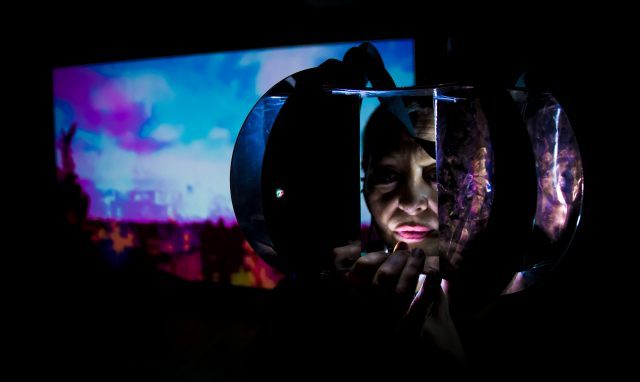
The controversial work of the late photographer Robert Mapplethorpe has been undergoing a renaissance over the last few years, with documentaries, gallery and museum shows, and, perhaps most influentially, Patti Smith’s award-winning memoir about her life with Mapplethorpe, Just Kids. Now comes composer Bryce Dessner and librettist Korde Arrington Tuttle’s multimedia Triptych (Eyes of One on Another), playing at BAM’s Howard Gilman Opera House June 6-8. The sixty-minute theatrical oratorio is divided into three sections based on Mapplethorpe’s XYZ portfolios, which explore sadomasochism, flowers, and African American male nudes, respectively. The first part centers on Smith’s poem “The Boy Who Loved Michelangelo,” set to a Monteverdi madrigal; the second on Dessner’s personal reaction to the 1990 Mapplethorpe obscenity trial in Cincinnati, the composer’s hometown; and the third on poet and performance artist Essex Hemphill’s “The Perfect Moment,” which was critical of Mapplethorpe’s depiction of black bodies. “Aesthetics can justify desire, / but desire in turn / can provoke punishment. / Under public scrutiny / the eyes of one man / are focused on another. / Is it desire, equality, / disgust, or hatred?” he writes. Meanwhile, in a program note, dramaturg Christopher Myers asks, “Is it possible to imagine these men who are photographed with the impersonal intimacy of flowers, or bronze sculptures, as full human beings, with desires and pleasures of their own? Can we read the desire of the photographer, his conflicts and self-denials, in his steadfast commitment to a classical language that recasts leather daddies and daddy’s boys into upper middle class living room fantasies? Where in this thorny bramble of gazes, objectification, outrage, and intimacy do our own wants and expectations as an audience live?”

The production, which features giant projections of rarely shown Mapplethorpe photographs, is directed by Kaneza Schaal, with music performed live by Roomful of Teeth (Cameron Beauchamp, Martha Cluver, Eric Dudley, Estelí Gomez, Abigail Lennox, Thomas McCargar, Thann Scoggin, and Caroline Shaw), joined by soprano Alicia Hall Moran and tenor Isaiah Robinson; Brad Wells is the music director and conductor, with Jessica McJunkins on violin, Tia Allen on viola, Byron Hogan on cello, Kyra Sims on French horn, Ian Tyson on clarinet and bass clarinet, Laura Barger on piano and harmonium, Donnie Johns and Victor Pablo on percussion, and James Moore on guitar. The set and costumes are by Carlos Soto, lighting by Yuki Nakase, and video by Simon Harding. On June 7 at 6:00, the talk “Mapplethorpe in Performance with Bryce Dessner, Kaneza Schaal, and Korde Arrington Tuttle” will be held in the BAM Hillman Attic Studio.

HEINER GOEBBELS: EVERYTHING THAT HAPPENED AND WOULD HAPPEN

everything that happens

Park Avenue Armory, Wade Thompson Drill Hall
643 Park Ave. at 67th St.
June 3-9, $40-$95
212-933-5812
armoryonpark.org

In 2009, German composer and artist Heiner Goebbels brought Stifter’s Dinge to Park Avenue Armory, a work for five pianos, sans performers, an architectural, musical, kinetic collage with the voices of William S Burroughs, Malcolm X, and Claude Lévi-Strauss. In 2016, his multidisciplinary De Materie featured a lighted zeppelin and a flock of sheep. His latest spectacle to come to the Wade Thompson Drill Hall is Everything that happened and would happen, running June 3-9. Originally staged in a former railway station in Manchester, the 160-minute intermissionless piece, reconfigured for the armory, combines unedited footage from Euronews’s No Comment, music from John Cage’s “Europeras 1&2,” and text based on Patrik Ouředník’s Europeana: A Brief History of the Twentieth Century. “Heiner Goebbels is an artist who defies classification. Composer, visual artist, theatrical pioneer, philosopher, and poet of the stage, he has for decades created compelling productions using a wide variety of performers,” armory artistic director Pierre Audi said in a statement. “The Drill Hall thrives on art forms flirting with each other, teasing us, provoking us, challenging us. Goebbels is the ring master par excellence who offers us a production especially inspired by the armory space. The result is an immersive experience that leaves each of us, the spectators, with our own experience and interpretation.”

The work, which was co-commissioned by Park Avenue Armory, 14—18 Now, Artangel, and Ruhrtriennale and explores a century of world history, is conceived and directed by Goebbels, with lighting by Goebbels and John Brown, sound by Willi Bopp, and video by Rene Liebert, with five musicians (Camille Emaille, Gianni Gebbia, Cécile Lartigau, Léo Maurel, Nicolas Perrin) and twelve performers and dancers (Juan Felipe Amaya Gonzalez, Sandhya Daemgen, Antoine Effroy, Ismeni Espejel, Montserrat Gardó Castillo, Freddy Houndekindo, Tuan Ly, Thanh Nguyễn Duy, John Rowley, Annegret Schalke, Ildikó Tóth, Tyra Wigg). On June 6 at 5:30, Goebbels will take part in an artist talk with Gelsey Bell.