this week in theater

NEXT WAVE 2019

(photo by Heidrun Lohr)

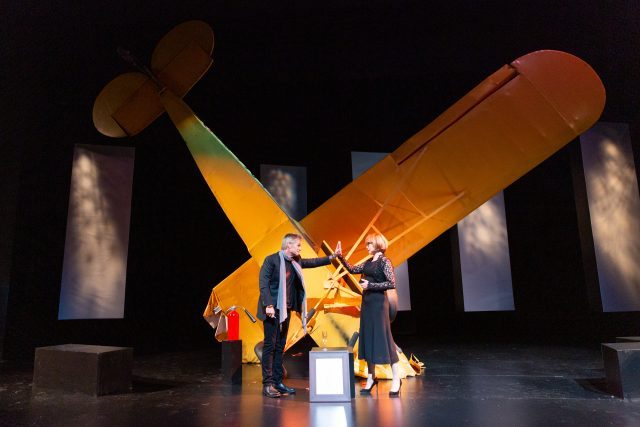
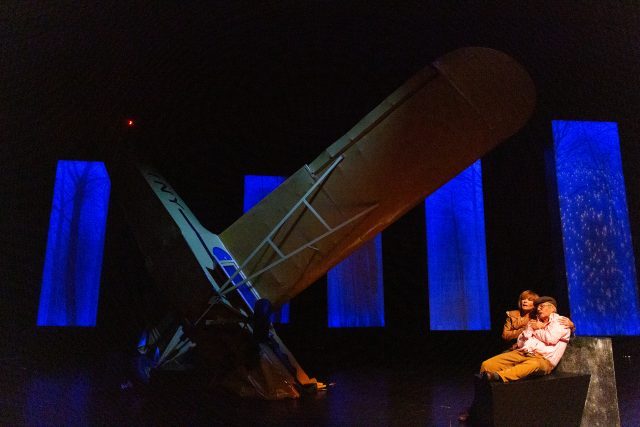
The Second Woman repeats the same scene from John Cassavetes’s Opening Night one hundred times (photo by Heidrun Lohr)

BAM Howard Gilman Opera House, Peter Jay Sharp Building, 230 Lafayette Ave.
BAM Fisher, Fishman Space, 321 Ashland Pl.
October 15 – December 15
718-636-4100
www.bam.org

Like myriad loyal BAMgoers, I look forward every year to the announcement of the Next Wave Festival at the Brooklyn Academy of Music, which has been presenting cutting-edge, experimental, and innovative dance, music, film, theater, opera, and hard-to-categorize multidisciplinary performances from around the world for nearly forty years. We eagerly scour the schedule to see when our longtime BAM favorites will be returning, scanning for such beloved names and companies as Robert Wilson, Sasha Waltz, Grupo Corpo, Batsheva, Philip Glass, Sankai Juku, Ivo van Hove, Mark Morris, Théâtre de la Ville, William Kentridge, Laurie Anderson, and the incomparable Pina Bausch, programmed by masterful executive producer Joe Melillo since 1999.

But this year’s lineup features nary a single familiar name, including that of Melillo, who retired after the Winter/Spring season. For his debut Next Wave Festival, new artistic director David Binder has opted to include a roster of performers all making their BAM debuts as well. But don’t be scared off by the lack of recognition. There was a time when no one in New York had ever seen Pina Bausch, Sankai Juku, Batsheva, Sasha Waltz, et al. And by its very nature, the Next Wave is all about the future of performance, delivered to an eager and intrepid audience open to anything and everything.

(photo by Ernesto Galan)

Dead Centre’s Hamnet tells the story of Shakespeare’s son (photo by Ernesto Galan)

“In programming my first season at BAM, I was inspired by the genesis of Next Wave and the groundbreaking work of my predecessors, Harvey Lichtenstein and Joe Melillo,” Binder said in a statement. “Next Wave is a place to see, share, and celebrate the most exciting new ideas in theater, music, dance, and, especially, the unclassifiable adventures. We’ve invited a slate of artists who have never performed at BAM. Each and every one of them is making a BAM debut, with artistic work that’s surprising and resonant. I’m excited to launch this season and to build BAM’s next chapter
with you.”

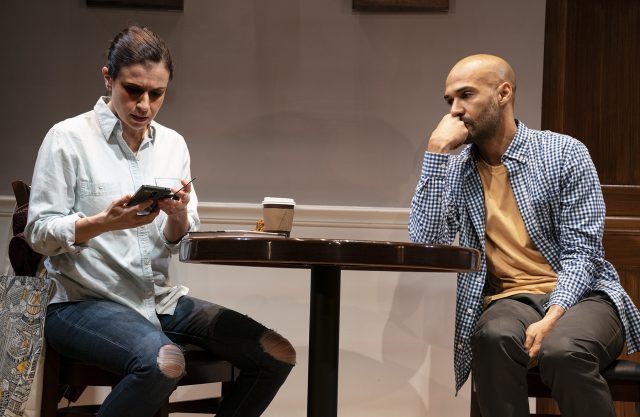
The 2019 Next Wave roster is an impressive one, kicking off October 15-20 with Michael Keegan-Dolan and Teaċ Daṁsa’s Swan Lake / Loch na hEala, about a young girl sexually assaulted by a priest. In The Second Woman, Alia Shawkat performs the same scene from John Cassavetes’s Opening Night one hundred times with one hundred different men over the course of twenty-four consecutive hours. Christiane Jatahy’s What if they went to Moscow? explores film and theater in a retelling of Anton Chekhov’s Three Sisters that takes place concurrently onstage at the BAM Fisher and onscreen at BAM Rose Cinemas, the audiences switching places as the performance repeats. In Dante or Die’s User Not Found, audience members sit in a café at the Greene Grape Annex on Fulton St., following the exploits of a man a few tables away. Dimitris Papaioannou breaks boundaries as he explores human existence in The Great Tamer. And Glenn Kaino’s When a Pot Finds Its Purpose will be the inaugural free exhibition at the new Rudin Family Gallery at BAM Strong.

(photo by Justin Jones)

Dante or Die’s User Not Found takes place in the Greene Grape Annex on Fulton St. (photo by Justin Jones)

The 2019 Next Wave Festival also includes Bruno Beltrão/Grupo de Rua’s Inoah, Dumbworld’s free outdoor art piece He Did What?, Selina Thompson’s free interactive installation Race Cards, Dead Centre’s Hamnet, Marlene Monteiro Freitas’s Bacchae: Prelude to a Purge, Untitled Projects/Unicorn Theatre, UK’s The End of Eddy, Peeping Tom’s 32 rue Vandenbranden, Fuel/National Theatre/Leeds Playhouse’s Barber Shop Chronicles, Kyle Marshall Choreography’s A.D. & Colored, Kate McIntosh’s In Many Hands, and Meow Meow’s A Very Meow Meow Holiday Show. Still worried about unfamiliarity? If you’ve been to BAM before, you should be ready, willing, and able to be surprised, and if you’ve never been to BAM, you should be preparing to make your debut.

HEROES OF THE FOURTH TURNING

(photo by Joan Marcus)

It’s Catholic conservative against Catholic conservative in world premiere of Will Arbery’s Heroes of the Fourth Turning at Playwrights Horizons (photo by Joan Marcus)

Playwrights Horizons, Mainstage Theater
416 West 42nd St. between Ninth & Tenth Aves.
Tuesday – Sunday through November 10, $49-$89
www.playwrightshorizons.org

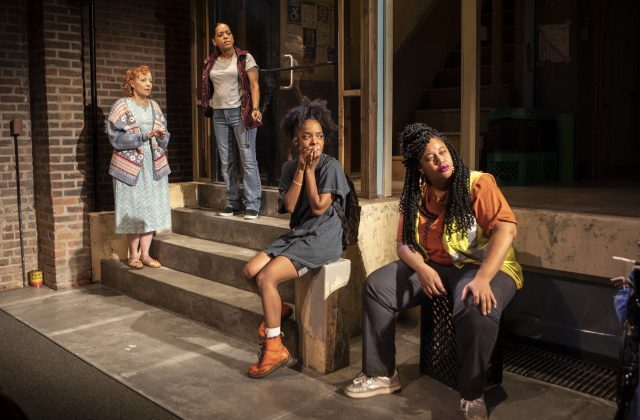
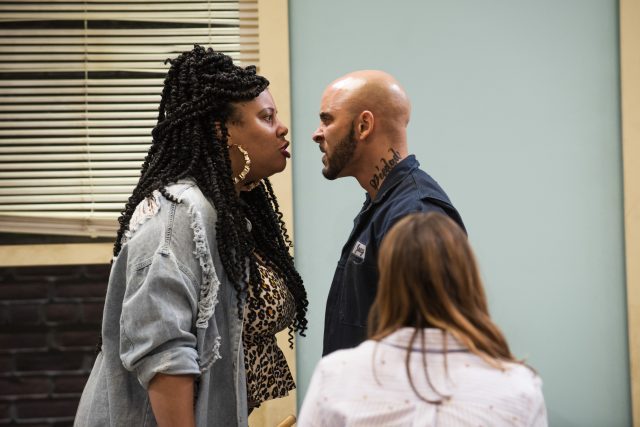
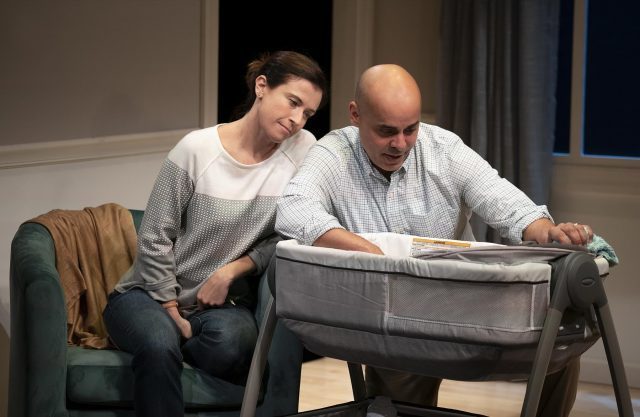
Almost every day we see news about the cannibalistic infighting among the Democrats as the moderate, liberal, and progressive wings argue over policy and identity politics while the original field of more than two dozen candidates to challenge President Donald Trump is whittled down. What appeared to be a slam dunk has been hampered by uncertainty and venomous attacks on their own. Tired of watching them yelling at one another? Then perhaps it’s time to hear some Republicans ripping each other apart, as playwright and filmmaker Will Arbery twists audience expectations in his unnerving and wickedly poignant Heroes of the Fourth Turning, making its world premiere at Playwrights Horizons through November 10. New York City theatergoers who are used to seeing liberal-minded works that attack, and often deride, religious conservatives and Trump supporters are in for a surprise as Arbery, who was raised in a Christian conservative home in Dallas, Texas, brings together five Republicans who are also hampered by uncertainty and let loose some venomous attacks. “We are living in barbaric times,” Justin says.

It’s August 19, 2017, one week after the Charlottesville riot and two days before the solar eclipse, and a group of friends are mingling in Justin’s backyard in the small town of Lander, Wyoming, pop. 7,000. (The cozy evening set is by Laura Jellinek.) He’s hosting a party for Dr. Gina Presson (Michele Pawk), who has just been inaugurated president of Transfiguration College of Wyoming, the alma mater of Justin (Jeb Kreager), Emily (Julia McDermott), Kevin (John Zdrojeski), and Teresa (Zoë Winters). They all graduated Transfiguration over the past fifteen years, and all are in the path of totality, a scientific term relating to the eclipse as well as a metaphor for their attempts to find their individual paths in the world. Although the Republicans control the White House and Congress, the friends are concerned about the Democrats. “There are more of them. We lost the popular vote, by a lot. And they’re mobilizing. In many ways, they are in power. And they’re trying to wipe us out,” Justin says. “There’s a war coming,” Teresa warns.

(photo by Joan Marcus)

Kevin (John Zdrojeski), Justin (Jeb Kreager), and Teresa (Zoë Winters) pray for better times in new political play (photo by Joan Marcus)

Kevin, who drinks, smokes, and snorts too much, is an off-balance clod who spurts out whatever’s on his mind, which pisses off the cold, calculating Teresa, who has moved to Brooklyn. “Don’t say gross things in a holy space,” Teresa declares after he makes a rude remark. “This isn’t a holy space; it’s just Justin’s house,” Kevin replies. “The panopticon, Kevin, Catholicism is the panopticon. This is a holy space,” Teresa explains. “It’s also a profane space,” Kevin responds.

They bicker over the Virgin Mary, morality, identity, the LGBT community, Trump, Hillary Clinton, Barry Goldwater, abortion, Patrick Buchanan, and more, making many of the same arguments that liberals do; in fact, if you were to switch a few names or words here and there, it could be a battle between lefties. There’s also a sexual energy that looms, from a past secret to possible future hook-ups.

The verbal sparring heats up when the distinguished Gina joins them and is not happy about Teresa’s unyielding support of far-right ideologues. Gina — a right-wing mirror of Hillary Clinton, down to her personal style — tells her, “These new people on the right, they’re not true conservatives. They’re charlatans, they’re hucksters. And honestly, darling, they’re a bit racist.” Meanwhile, Emily, who is very ill with what appears to be Lyme disease, is somewhere in the middle, searching for the human element. “Wow, she is . . . I’m sorry but she is such a hypocrite,” she says of Teresa. “At the ceremony, she had a little audience and she was trying to get me to admit that my liberal friend was a bad person. And I’m sorry, but I think it’s unfair to argue that I should cut ties with someone just because they’re on the other side. I can’t see things in black-and-white like that. I have a full faith, it’s my rock, it’s my pain, it’s my everything — and I also am friends with whoever I want to be friends with.”

(photo by Joan Marcus)

Kevin (John Zdrojeski) and Emily (Julia McDermott) discuss love and politics in Heroes of the Fourth Turning (photo by Joan Marcus)

Arbery (Plano, Evanston Salt Costs Climbing) was inspired by William Strauss and Neil Howe’s 1997 book The Fourth Turning: An American Prophecy — What the Cycles of History Tell Us About America’s Next Rendezvous with Destiny and his own family: He was raised in Texas by Catholic conservatives who were not a bunch of numbskull deplorables but fellow citizens with a different point of view. Teresa explains that there are four turnings, each one lasting about a generation: High, Awakening, Unraveling, and Crisis. In the play, as in America today, we are at Crisis mode. Not only won’t Republicans listen to Democrats, and liberals won’t listen to conservatives, but all the caterwauling within the same party is creating chaos; empathy and compassion have all but disappeared when it comes to politics. “Trump was made possible by the uneducated. . . . Liberty is being attacked, by both sides, and it’s tragic to see. Polarities make way for a tyrant,” Gina says, but Teresa proclaims, “Trump is a Golem molded from the clay of mass media and he’s come to save us all.”

Danya Taymor’s (Daddy, Pass Over) sharp, eagle-eyed direction smooths over some rough patches and carefully avoids turning the play into the kind of political posturing and manufactured conflicts we see on television news and social media, and monologues delivered by the three actresses are downright exhilarating, even if your personal opinions are completely contrary to theirs. In fact, the three female characters are stronger than the two males, and that shows in the acting; McDermott (Epiphany, Queens), Tony winner Pawk (A Small Fire, Hollywood Arms), and Winters (White Noise, An Octoroon) kick the men’s butts. But the real star of the show just might be sound designer Justin Ellington; the play begins with a blaring gunshot, and Ellington later lets loose a shrill, mysterious explosion of loud noise several times, a clarion call that perhaps is meant to wake us up to what is happening to every one of us, no matter who you plan to vote for in 2020.

NOVENAS FOR A LOST HOSPITAL

(photo  by Julieta Cervantes)

Saint Elizabeth Ann Bayley Seton (Kathleen Chalfant) rules over Novenas for a Lost Hospital (photo by Julieta Cervantes)

Rattlestick Playwrights Theater and other locations
224 Waverly Pl.
Wednesday – Monday through October 13, $20-$60
212-627-2556
www.rattlestick.org

Cusi Cram’s Novenas for a Lost Hospital is part historical walking tour, part theatrical drama, honoring the legacy of St. Vincent’s in Greenwich Village, guiding sixty guests a night from a church courtyard to a theater to the park across the street from where the nonprofit Catholic hospital stood from its beginnings as a one-room medical facility founded by the Daughters of Charity in 1849 until April 2010, when it closed due to ballooning debt and questionable redevelopment plans. In the two-plus-hour show, longtime West Village residents Cram, Rattlestick artistic director Daniella Topol, and dramaturg Guy Lancaster relate the history of St. Vincent’s, a Level 1 trauma institution and teaching hospital that treated victims of the cholera epidemic in 1849, the Triangle Shirtwaist Factory fire in 1911, the Titanic sinking in 1912, the FALN bombing in 1975, and the 9/11 attacks in 2001.

(photo  by Julieta Cervantes)

Cusi Cram’s Novenas for a Lost Hospital explores the history of St. Vincent’s in Greenwich Village (photo by Julieta Cervantes)

But the hospital is perhaps most well known for being front and center battling the AIDS crisis of the 1980s and 1990s, which is what Cram focuses on from the start, in the courtyard of St. John’s in the Village, where a singer (Goussy Celestin) welcomes everyone, hands are ritually washed, a quartet does the Hustle, and an ailing man bathes himself with agonizing difficulty. The action then heads indoors to the Rattlestick black box, where a collection of newspaper articles and photographs about St. Vincent’s are on display on upturned gurneys. After they are wheeled out, a long, repetitive, melodramatic middle section switches back and forth between 1849 and more contemporary times, led by Sisters of Charity founder and first American-born saint Elizabeth Ann Bayley Seton (Kathleen Chalfant), who is accompanied by Sister Mary Ulrica (Natalie Woolams-Torres) and Sister Mary Angela Hughes (Kelly McAndrew) in the past and a pair of nurses (Woolams-Torres and McAndrew) more recently.

They are visited by flamboyant Afro-Caribbean slave, hairdresser, and philanthropist Pierre Toussaint (Alvin Keith) as they treat a series of patients, primarily Lazarus (Ken Barnett), so named because he won’t die, his boyfriend (Justin Genna), and choreographer JB (Justin Genna). “A crisis can be very grounding. Purposeful,” Lazarus tells the audience. “Not dying was my job for three years. And before that, trying to save everyone I loved or admired from dying a miserable, humiliating death was my job.”

(photo by Julieta Cervantes)

The audience is led from a courtyard to a theater to a park in Novenas for a Lost Hospital (photo by Julieta Cervantes)

Ultimately, the show, which is divided into nine novenas, including “A Prayer for the Reluctantly Resurrected,” “A Prayer for the Forgotten,” and “A Prayer for the Beauty of Chaos,” makes its way through the streets to NYC AIDS Memorial Park for a grand finale that brings everything full circle. Despite plenty of bumps and slow moments, Novenas for a Lost Hospital is a touching communal experience, a unique eulogy for an institution that helped define a neighborhood — and a city — through more than a century and a half and is now a memory of a bygone era when money wasn’t everything and individual lives mattered.

CROSSING THE LINE: WHY?

Kathryn Hunter in Peter Brook and Marie-Hélène Estienne's play 'Why?' at the Bouffes du Nord in Paris, June 2019 Pascal Gely

Kathryn Hunter wonders why in Peter Brook and Marie-Hélène Estienne production about theater itself (photo by Pascal Gely)

Theatre for a New Audience, Polonsky Shakespeare Center
262 Ashland Pl. between Lafayette Ave. & Fulton St.
Through October 6, $85-$120
866-811-4111
www.tfana.org
crossingthelinefestival.org

The basic three-letter question “Why?” can be a repeated response, over and over again, from a curious child learning about the world, a deeply philosophical inquiry into human nature, or a painful cry when tragedy occurs. In Peter Brook and Marie-Hélène Estienne’s Why?, continuing at Theatre for a New Audience’s Polonsky Shakespeare Center through October 6, it relates to two queries, general and specific: Why do we make and attend theater, and why did Josef Stalin have theater innovator Vsevolod Meyerhold and his actress wife, Zinaida Reich, brutally killed?

Part of FIAF’s multidisciplinary Crossing the Line Festival, Why? is also the centerpiece of “Peter Brook\NY,” a two-week, two-borough tribute to the ninety-four-year-old theater and film director — he actually prefers being called a “distiller” — an Emmy and two-time Tony winner who has written such books as The Open Door: Thoughts on Acting and Theatre, Tip of the Tongue: Reflections on Language and Meaning, and The Shifting Point: Theatre, Film, Opera 1946-1987 and has directed such plays as Hamlet with Paul Scofield, The Visit with Alfred Lunt and Lynn Fontanne, Marat/Sade, and more recently The Suit, The Prisoner, and The Valley of Astonishment. He is a fixture at TFANA, which is around the corner from the BAM Harvey Theater, which he helped renovate in 1987 for his epic version of The Mahabharata. He and Estienne have been collaborating for more than forty decades, and they know theater.

(photo by Pascal Gely)

Marcello Magni gets serious after clowning around in Why? (photo by Pascal Gely)

The first half cheerfully explores why there is theater at all, how it came to be, and what can make it so special. The show begins with Hayley Carmichael, Kathryn Hunter, and Marcello Magni, all dressed in black, giving a kind of master class in acting. Highlights include a clownish Magni running around in circles and Hunter wondering how to make the line “My Lord, the carriage awaits” not boring. They interact with the audience, even bringing a few people onstage for some clever improv, and clearly are in love with their chosen profession, just as we are in love with watching them. There’s lots of laughter, accompanied by Laurie Blundell on piano. Theater appears to be a friendly, safe space for everyone.

But in the second act, the trio, still wearing the same costumes, moving about on the same, mostly empty stage (Brook is known for his spare sets, as evidenced by his seminal book The Empty Space — A Book About the Theatre: Deadly, Holy, Rough, Immediate), the trio becomes far more serious, reading letters, news reports, and other documents relating what happened to Stanislavski protégé Meyerhold and Reich when they supported the communist revolution instead of Stalin, who dealt with them in violent, theatrical ways. The harsh tale also involves actor and director Konstantin Stanislavski and poet Vladimir Mayakovsky. “Theater is a dangerous weapon,” Meyerhold famously wrote in the 1920s. Nearly a century later, it still is; it may be able to entertain, educate, and enlighten us, but it is also seen by far too many as a threat, which Brook and Estienne point out in their inimitable, inestimable way.

SATOSHI MIYAGI: ANTIGONE

(photo: © Stephanie Berger)

The Park Ave. Armory’s Wade Thompson Drill Hall has been transformed into the Styx-like Sanzu River for breathtaking version of Antigone (photo © Stephanie Berger)

Park Avenue Armory
Wade Thompson Drill Hall
643 Park Ave. at 67th St.
Through October 7, $35-$175
Artist talk with Satoshi Miyagi and Carol Martin, October 4, $15, 6:30
armoryonpark.org

Satoshi Miyagi’s lush Antigone at the Park Ave. Armory is likely to be the most stunning and graceful adaptation of Sophocles’s classic Greek tragedy you’ll ever experience. Originally presented in a courtyard in a fourteenth-century palace in France to open the 2017 Avignon Festival, the hundred-minute production has been adjusted for the armory’s massive Wade Thompson Drill Hall. The work uses almost exactly half the drill hall space, taking place on a long, shallow eighteen-thousand-gallon pond at the far end of the hall, with the audience sitting in rising rafters before it. Miyagi, who previously staged a different version of the twenty-five-hundred-year-old play in 2004, has now infused it with Buddhist meditations on ritual and death. As the audience is being seated, characters in white kimono-like dress are standing like ghosts in the water, surrounded by several large cairns. (The elegant set is by Junpei Kiz, the sublime costumes by Kayo Takahashi, and the fab hair and makeup by Kyoko Kajita.) The main actors come out and gleefully announce that they are a troupe from the small city of Shizuoka about to put on Antigone, identifying who they are portraying and playfully giving an English-language summary of the story. At the end of the intro, the charming Micari, who plays the title character, exclaims, “We invite you to see what happens next. Enjoy the show!”

What happens next is exquisite. Miyagi combines elements of traditional Noh, kabuki, and bunraku theater to create a brilliant retelling of the well-known tale, with the main characters each portrayed by two actors, one who speaks the dialogue (in Japanese, with English supertitles) while kneeling in the water, the other who lyrically moves about the space and interacts with the rest of the cast. The priest (Tsuyoshi Kijima) floats in on a small raft with paper lanterns; he stops to give shiny white wigs to the protagonists. The sons of Oedipus, Eteocles (Morimasa Takeishi) and Polyneices (Keita Mishima), have killed each other in battle, the former fighting for King Creon (Kouichi Ohtaka; Kazunori Abe), the latter leading a revolt. Creon has declared that Eteocles is to get a hero’s funeral while Polyneices will be treated as a traitor, his body left to rot and decay in the desert — and that anyone who attempts to give him an honorable burial will be stoned to death.

(photo: © Stephanie Berger)

Antigone (Micari) declares her freedom from the rules of the state in lush Satoshi Miyagi production (photo © Stephanie Berger)

Oedipus’s daughters, Antigone (Micari; Maki Honda) and Ismene (Asuka Fuse; Yuumi Sakakibara), disagree on how to proceed: While Ismene does not want to challenge Creon’s decree, Antigone is determined to follow the law of the gods and do right by Polyneices. “One sought to destroy us. One fought to defend us,” Ismene says about her brothers. “The dead are all the same. We send them off with the same rites,” Antigone argues. “That will not do. The death of a hero is different than that of a traitor,” Ismene answers. Antigone: “The difference doesn’t extend past death.” Ismene: “An enemy is an enemy even after death.” Antigone: “I was not born to hate. I was born to love.” Antigone, who is betrothed to Creon’s son, Haemon (Yoneji Ouchi; Daisuke Wakana), buries Polyneices and is turned in by a guard (Katsuhiko Konagaya; Tsuyoshi Kijima) who witnessed her illegal act. Creon then has to decide the fate of his would-be daughter-in-law as both Haemon and the blind prophet Tiresias (Takahiko Watanabe; Soichiro Yoshiue) demand mercy.

Antigone features a thrilling percussion score by Hiroko Tanakawa. Koji Osako’s extraordinary lighting design puts small lights in front of the moving actors, casting huge shadows on the wall that hover over everything like the gods looking down on humanity while evoking shadow puppet theater. Translated by Shigetake Yaginuma, the narrative, which resonates with regard to current global political situations (particularly in Japan, Greece, and America), centers on themes of gender and power. “As long as I live, no woman shall impose her will,” Creon says. “Never let a woman triumph over you,” he tells his son, who is torn between his love of Antigone and his duty to his father. Early on, Ismene explains to Antigone, “I cannot act in defiance of the state.” But Antigone refuses to acknowledge the government above the gods. “I do not fear the king,” she declares. “The law of the gods is what is most precious. . . . In the eyes of the king, mine must seem the actions of a stupid woman. But in my eyes, the king is foolish.”

(photo: © Stephanie Berger)

Haemon (Yoneji Ouchi) is torn between love for this betrothed and responsibility to his father in Antigone (photo © Stephanie Berger)

Throughout the show, the chorus (Ayako Terauchi, Fuyuko Moriyama, Haruka Miyagishima, Kenji Nagai, Mariko Suzuki, Miyuki Yamamoto, Moemi Ishii, Momoyo Tateno, Naomi Akamatsu, Ryo Yoshimi, Shunsuke Noguchi, Yu Sakurauchi, Yukio Kato, Yuya Daidomumon, Yuzu Sato) slowly wanders across the Styx-like Sanzu River, which leads the dead to the afterlife, mostly silent except for the sounds of their feet gliding on the water and occasional musical verses, including, “Wonders are many, and none is more wonderful than man. . . . Never without resources, he has devised escapes from desperate plagues. Only against Death shall he call for aid in vain.” Miyagi, who with the Shizuoka Performing Arts Center has also staged Medea, Mahabharata, and Peer Gynt among other classics, is emphasizing the notion that death is the great equalizer, that people should not be basing their earthly deeds on how it will impact what may or may not occur when the end comes. It’s not about heaven and hell or good vs. evil, the living and the dead or the rich and the poor; his Antigone is set in an ambiguous time and place that could be anywhere and everywhere, a breathtaking display of philosophy and artistry that, at its core, is about the basic decency of love, honor, and respect. Do whatever you can to see it, even if you have to defy your own personal gods of schedules and emails.

OEDIPUS: Sex with Mum Was Blinding

(photo by Carol Rosegg)

Sound and image create a confusing cacophony in Elli Papakonstantinou’s OEDIPUS: Sex with Mum Was Blinding (photo by Carol Rosegg)

BAM Fisher, Fishman Space
321 Ashland Pl.
September 25-29, $30
718-636-4100
www.bam.org/oedipus

Shortly after Elli Papakonstantinou’s OEDIPUS: Sex with Mum Was Blinding begins, the sarcastic MC (Misha Piatigorsky), a cross between Joel Grey’s emcee from Cabaret and the Joker from Batman recently escaped from Arkham Asylum, brings up the topic of free will and declares, “Oh! Did I say? . . . You are not allowed to leave this room until this is over!” Not everyone inside BAM Fisher’s Fishman Space obeyed, as there were a handful of walk-outs during the ninety-minute production, but they would have fared better if they had stuck it out a little longer; while the first hour of this multimedia collaboration between the Athens-based ODC Ensemble and New York City’s the Directors Company is a chaotic mess, things improve significantly when Papakonstantinou, who is credited with the concept, stage direction, libretto, and lighting, turns her attention to the specific matter at hand: the tragic story of Oedipus (Lito Messini), his wife and mother, Jocasta (Nassia Gofa), and their children.

For much of the show, the audience has no idea where to look or what to listen to as ideas of responsibility, judgment, faith, and determinism are raised. A doctor (science adviser Manos Tsakiris) talks to a woman (Theodora Loukas) about a dream she had. A boy (Elias Husiak) can’t recognize his own face. A three-woman chorus (Anastasia Katsinavaki, Messini, Gofa) sings about riddles while wearing futuristic sci-fi helmets. Smoke drifts up from a tray of dry ice. A male-voiced Siri talks in mathematical equations. Audience members are practically forced to answer questions about their own image and relationship with their parents, then shout out four pieces of text that are in the program. And live footage of extreme close-ups of faces, hands, feet, and nostrils are projected onto a large rear screen along with shots of car traffic, causing yet more confusion. I was most riveted by the MC’s long, thin baton he used for conducting, hoping that, when he put it away in the front pocket of his shirt, it would not end up poking him in the eye. (This is Oedipus, after all.)

(photo by Carol Rosegg)

Misha Piatigorsky stars as a sarcastic piano-playing MC and conductor in OEDIPUS: Sex with Mum Was Blinding (photo by Carol Rosegg)

But then we reach Level Three and the actual story of Jocasta and Oedipus starts playing out onstage with the characters themselves (instead of being told to us in the third person), and we are lifted by Gofa’s lovely jazz phrasings and Messini’s beautiful soprano. The narrative suddenly wraps around us and we feel, for the first time, emotional resonance. The MC’s expert piano playing and co-composer Julia Kent’s splendid cello merge together in wonderful ways, as the earlier theories that were so much balderdash now make sense. It’s too bad this experimental Oedipus didn’t start off like this. “We are haunted by the myth of our potential,” the woman says, which could be about the show itself, the audience haunted by what could have been.

CAESAR & CLEOPATRA

(photo by Carol Rosegg)

Cleopatra (Teresa Avia Lim) and Caesar (Robert Cuccioli) share an intimate moment in Gingold production (photo by Carol Rosegg)

Theatre Row, Theatre One
410 West 42nd St. between Ninth & Tenth Aves.
Tuesday – Sunday through October 12, $69
gingoldgroup.org
www.theatrerow.org

Last week a friend of mine posted a photo on social media of his ridiculous view of the Gingold Theatrical Group’s presentation of Bernard Shaw’s Caesar & Cleopatra at Theatre Row; he was sitting behind a young man well over six feet tall, with a long neck, wide ears, and a topknot that added another six inches, blocking nearly two-thirds of the stage. My friend wasn’t missing much.

Written in 1898, Caesar and Cleopatra imagines a fictional meeting between Roman ruler Julius Caesar (Robert Cuccioli) and Egyptian queen Cleopatra (Teresa Avia Lim). Thirty years Cleopatra’s senior and far more versed in the ways of the world, Caesar is like Professor Higgins to her Eliza Doolittle. In fact, the play emerged out of an early draft of what would become Pygmalion. Caesar has arrived in Egypt ahead of his troops and at first does not believe that the young, whiny woman is who she claims to be; she doesn’t realize who he is as well. “Caesar’ll know that I’m a queen when he sees my crown and robes!” she declares. He responds, “He will know Cleopatra by her pride, her courage, her majesty, and her beauty.”

(photo by Carol Rosegg)

Politics takes center stage in Caesar & Cleopatra at Theatre Row (photo by Carol Rosegg)

But soon he is teaching her how to be a leader while she battles for control of Egypt against her brother, King Ptolemy, a puppet manipulated by his regent, Pothinus (Rajesh Bose). Caesar is joined by his humorless secretary, Britannus (Jonathan Hadley), and forthright military aide, Rufio (Jeff Applegate), while Cleopatra is nearly always accompanied by her mystical, protective nurse, Ftatateeta (Brenda Braxton). Later the dashing Apollodorus the Sicilian (Dan Domingues) devotes himself to her, but you’re unlikely to care by then.

Last year, Gingold turned the Lion Theatre into a London air-raid shelter during the Blitz for its scattershot version of Heartbreak House. The troupe is now back in the same space, renamed Theatre One after a renovation of Theatre Row, but they end up with the same unfortunate result. (Perhaps that specific room is doomed; I can’t remember the last time I saw something I liked in what was the Lion.) Director David Staller has done a deep dig into the history of the play, incorporating elements from letters, production notes, Shaw’s original handwritten manuscript, an early draft of the 1945 screenplay, and other sources, and perhaps that’s part of the problem; the show has no pace or rhythm. Brian Prather’s set is supposed to be an excavation site but looks more like unfinished scaffolding with plastic sheeting. It’s almost as if Staller, who has directed all of Shaw’s works, knows the play so well, and wanted to include so many unique touches, that he lost sight of the big picture. Cuccioli, as a smooth-talking superhero Caesar, and Lim, as a #metoo-era Cleopatra, never develop the necessary chemistry in choice parts previously played onstage and -screen by such pairs as Lionel Atwill and Helen Hayes, Cedric Hardwicke and Lilli Palmer, Hardwicke and Claire Bloom, Laurence Olivier and Vivien Leigh, Claude Rains and Leigh, Alec Guinness and Geneviève Bujold, Rex Harrison and Elizabeth Ashley, and Christopher Plummer and Nikki M. James. “We learn from history that we learn nothing from history,” Caesar says at one point. He’s more right about that than he realizes. If only “veni” and no “vidi”: Where was that tall guy with the topknot to block my view?