this week in theater

INSIDE THE WILD HEART

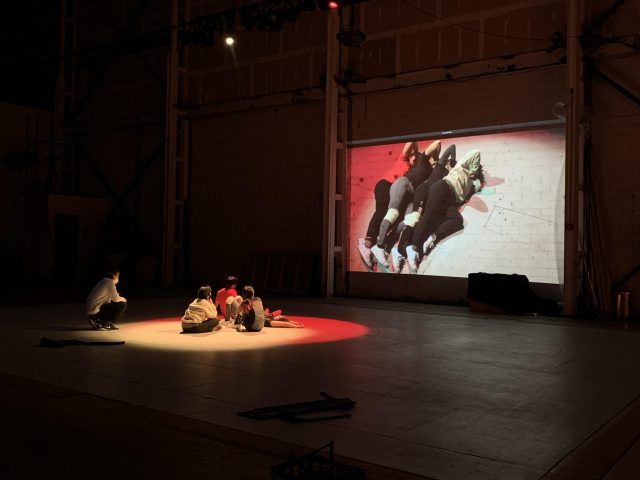
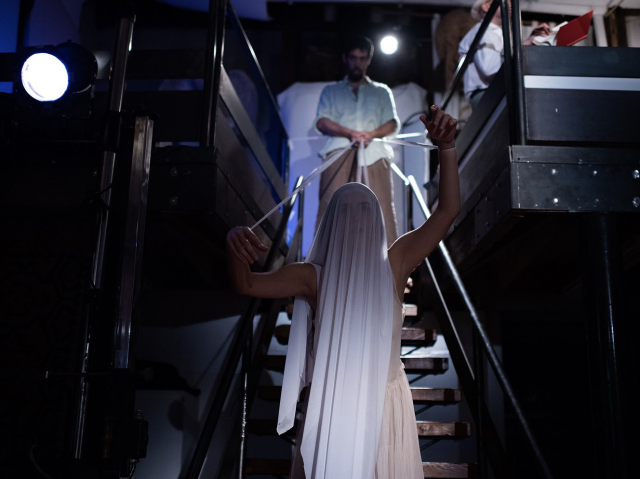
Immersive production of Inside the Wild Heart has been reimagined for online livestreaming (photo by Erika Morilla)

INSIDE THE WILD HEART
Thursday – Sunday through December 20, $20-$50 (based on what you can afford)
Encore run: Wednesday, Friday, Sunday, February 12 – March 28, $15-$50
www.group.br.com

I’m an immersive theater junkie. Put on a show in an abandoned hotel or warehouse, in an empty church or a cemetery, or behind the scenes at an arts venue and I will be first in line. There’s just something about wandering among storylines and characters on your own path and schedule, even when knowing you’re likely not to see everything or understand completely what’s happening and I’m there, from Sleep No More, Then She Fell, and Ghost Light to The Grand Paradise, Empire Travel Agency, and Counting Sheep.

I don’t know how I missed Group.BR’s Inside the Wild Heart, which was first presented in a Williamsburg gallery in 2016, then two years later at Aich Studios, an 1848 brownstone and former foundry in the Gramercy Park area. The New York-based Brazilian company filmed one of the 2018 shows, enlisting nine friends with cameras to place themselves throughout the three floors and a mezzanine and take continuous video without getting in the way of the audience, which is allowed to walk, stand, and sit wherever they want as they chase the action over two hours. Artistic director Andressa Furletti didn’t know what she would do with the footage until the pandemic hit and she discovered the Gather.town digital platform, which she immediately realized would supply her with just what was needed in order to virtually reimagine the show, which is based on the writings of prominent Jewish author Clarice Lispector. Thus, it turns out that I didn’t miss the show after all; via the innovative platform, I was able to amble, observe, follow, and interact not only with the recorded footage but with other live audience members as well.
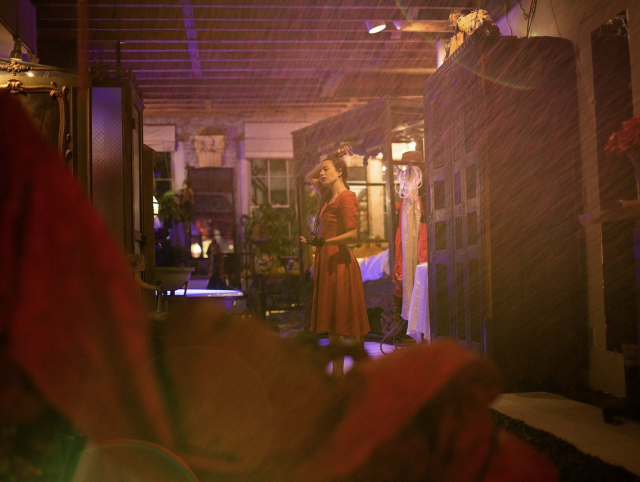
Group.BR uses the Gather.town digital platform to bring the interactive Inside the Wild Heart to the internet

Inside the Wild Heart features characters, dialogue, and plots from nine novels and eight short stories by the Ukraine-born Brazilian Lispector (1920-77), who wrote such books as Near to the Wild Heart, The Passion According to G.H., The Stream of Life, and The Woman Who Killed the Fish. Each audience member is assigned a video-game-like avatar that they guide with their keyboard across an animated architectural rendering with couches, chairs, a fireplace, a bathroom, screening areas, and a bar where they can take a break and speak with others. Everyone is encouraged to keep their cameras on but their microphones muted except when they’re in the bar; whenever you’re in a room, you can not only see the other avatars who are there as well but you can see their names and photos at the top of the screen. There’s also a live chat where you can connect with one another, but the night I went, nearly all the other comments were in Portuguese.

Don’t be in a hurry to try to see everything quickly; you have time to take it slow and linger in a room for fifteen minutes or more as the semblance of a story takes shape, a nonlinear narrative told through video, still photographs, dance, music, prerecorded film, and various surprises. You might encounter a woman in a claw-foot tub, people preparing for a wedding, a lady with a whip, and a ghostlike figure climbing stairs, with talk of love, murder, motherhood, the Society of Shadows, the Tree of Secret Desires, and the existence of God. Make sure to find the rare television interview with Lispector, who shares such thoughts as “Adults are sad and solitary” and “I think that when I’m not writing I’m dead.” Other Lispector quotes pop up here and there, including “Getting lost is also a way,” “What I desire doesn’t have a name yet,” and “If you were you, how would you be and what would you do?”

The show is directed by Linda Wise and performed by Balardini, Furletti, Mirko Faienza, Patricia Faolli, Fabiana Mattedi, Gio Mielle, Gonçalo Ruivo, Yasmin Santana, Ibsen Santos, and Montserrat Vargas, with scenic design and art installations by Vargas and Furletti, costumes by Jussara Lee, lighting by Charlie Jarboe, score by Sergio Krakowski (with Mario Forte on violin), and video design by Paul Leopold. Together they have managed to ably re-create the immersive theater experience online, resulting in a fab interactive presentation that is a lot of fun while introducing you to quite an eclectic writer.

Inside the Wild Heart runs Thursday to Sunday through December 20; on December 10, Group.BR will celebrate the centennial of Lispector’s birth with “Clarice’s Day,” a free sixteen-hour party on Zoom, Instagram, Facebook, and YouTube that includes “The Morning Is a Premature Flower” with Balardini (5:00 am), videos of scenes from the books Besieged City and A Breath of Life as performed in Inside the Wild Heart (10:00), such readings and/or discussions as “Clarice in English” (10:20), “Clarice and Visual Arts” (11:00), “Clarice in Life and Works” (12:30), and “Clarice and Theater” (5:00), a musical performance of Sara Carvalhos’s “Perto do Coração Selvagem” by Késia Decoté on the toy piano (2:30), short films (3:00), and a special 7:00 screening of the full play, followed by a talkback. [Ed. note: Inside the Wild Heart is back for a much-deserved encore run, February 12 – March 28.]
A CHRISTMAS CAROL

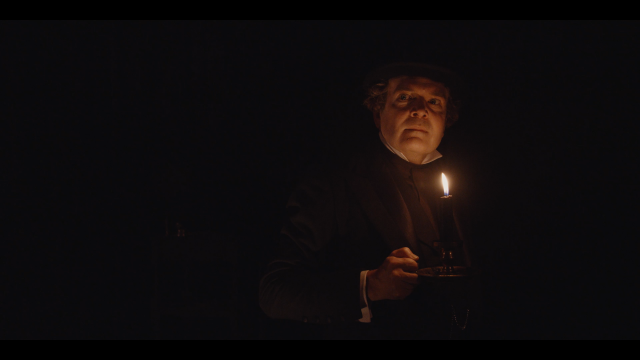
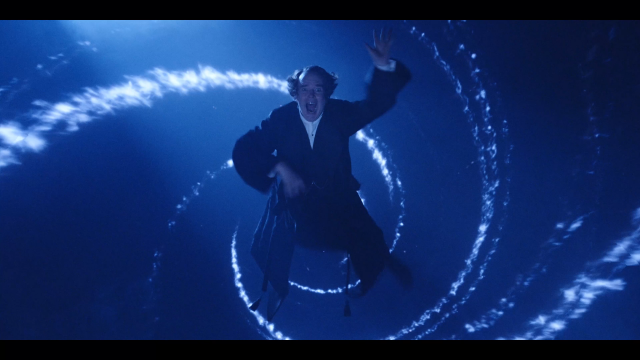
Jefferson Mays portrays more than fifty characters in A Christmas Carol (photo by Chris Whitaker)

A CHRISTMAS CAROL
Twenty-four-hour stream through January 3, $50 ($30 with code SCROOGE through 12/12)
Daily lottery: $15 (10 random winners)
www.achristmascarollive.com

Jefferson Mays’s mostly one-man version of Charles Dickens’s A Christmas Carol is the best filmed theatrical production made during the pandemic that I have seen. It is also the best one I’ve heard. Tony winner Mays may be the star of the holiday tale, spectacularly portraying more than fifty characters in ninety minutes, but Joshua D. Reid nearly steals the show with his stunning sound design, which works hand in hand with Ben Stanton’s pinpoint-precision lighting; headphones and as large a screen as possible are a must to fully appreciate this outstanding presentation. A big monitor and great speakers will also increase the scare level, because first and foremost, this telling is a ghost story, with genuine frights, one of which made my heart drop into my stomach.

Originally produced at the Geffen Playhouse in LA in 2018, the play, adapted by Mays and his wife, Susan Lyon, with director Michael Arden, has been reimagined by Arden and set and costume designer Dane Laffrey for online viewing. It was recorded in October at the historic United Palace theater on Broadway at 175th St., built in 1930 as a lush vaudeville and movie house that served as a church for the Rev. Ike and his ministry from 1969 to 2017. United Palace calls itself the Home of Spiritual Artistry, and that’s exactly what you’ll find in A Christmas Carol.

“Oh! But he was a tight-fisted hand at the grindstone, was Scrooge!” Mays announces early as the narrator. “A squeezing, wrenching, grasping, scraping, clutching, covetous, old sinner! Secret, and self-contained, and solitary as an oyster.” The word “solitary” hits us differently during the pandemic lockdown, as we watch a single actor onstage, performing in an empty theater for an audience of one, or maybe a few more, sheltering at home.

He continues, “Nobody ever stopped him in the street to say, `My dear Scrooge, how are you?’ No beggars implored him to bestow a trifle, no children asked him what it was o’clock, no man or woman ever once in all his life inquired the way to such and such a place, of Scrooge. Even blind men’s dogs, when they saw him coming on, would tug their owners into doorways. . . . But what did Scrooge care! It was the very thing he liked. To edge his way along the crowded paths of life, warning all human sympathy to keep its distance.” At that instant, Arden cuts to a far shot of Mays, looking lonely and far away, socially distanced from the rest of humanity.

A Christmas Carol has been reimagined for online viewing during the pandemic (photo by Chris Whitaker)

Cinematographer Maceo Bishop’s camera follows Mays across the space, zooms in for extreme close-ups, and occasionally pulls back to remind us that Mays is on a stage; this Christmas Carol is a hybrid piece of film/theater, a new kind of work that is both and neither, something that is likely to last beyond Covid-19, when venues are open again for audiences to sit together in community while people around the world are craving access to the same show. At one point, when Mays is shifting between Ebenezer Scrooge and one of the ghosts, Mays not only changes his voice for each character, enhanced by Reid’s bold sound manipulation, but he merely needs to shift his shoulders from left to right to move between the roles, his face bathed in green as the ghost and in white light as the grinchy banker. It’s a terrifying scene that could not be captured in the theater for all to see, while on a movie screen it would lose its intimacy. There are also video projections, smoke and fog, and lighting effects so palpable they have an intense physicality to them.

Mays knows his way around multiple parts; his breakthrough came in 2003 in Doug Wright’s Pulitzer Prize-winning I Am My Own Wife, in which he portrayed the real-life Charlotte von Mahlsdorf and thirty-nine others, earning a Tony, and he played nine members of the D’Ysquith family in the Tony-winning musical A Gentleman’s Guide to Love and Murder. In A Christmas Carol, he plays more than fifty characters, from Jacob Marley, Bob Cratchit, Fezziwig, and Tiny Tim to Fred, Scrooge, and the Ghosts of Christmas Past, Present, and Future. He does so in the same Victorian outfit, a white shirt under a dark suit and long coat, with a top hat. His hair, styled by Cookie Jordan, fluffs up over each ear, evoking an unbalanced Princess Leia.

Mays inhabits the roles from the very start with an easygoing grace and familiarity; when he was a child, his parents would read the story to the family every year. Two-time Tony nominee Arden (Spring Awakening, Once on This Island) began his career playing Tiny Tim in a Texas community theater production of A Christmas Carol when he was ten. The care and understanding they have for the material shines through; the only weakness is Sufjan Stevens’s treacly caroling, which feels like it was meant for a different holiday show.

A Christmas Carol streams through January 3 and is a benefit for more than fifty local theater companies and venues around the country that have been impacted by the Covid-19 crisis. When two gentlemen knock at the door seeking a charity donation, Scrooge is none too happy, leading to the following exchange:

“Many thousands are in want of common necessaries; hundreds of thousands are in want of common comforts, sir.”

“Are there no prisons?” asked Scrooge.

“Plenty of prisons,” said the gentleman.

“And the Union workhouses?” demanded Scrooge. “Are they still in operation?”

“They are. Still,” returned the gentleman, “I wish I could say they were not.”

He politely gets to the point.

“What shall I put you down for?”

“Nothing!” Scrooge replied.

“You wish to be anonymous?”

“I wish to be left alone,” said Scrooge. “Since you ask me what I wish, gentlemen, that is my answer. I don’t make merry myself at Christmas and I can’t afford to make idle people merry.”

This Christmas Carol should make many people merry during what will be a very challenging holiday season, with the coronavirus raging inside and outside prisons, millions out of work, so many charities and businesses in need of funds, and the desperate need to not be alone overwhelming our daily existence. Mays, Arden, et al. don’t just transport us to another plane for ninety thrilling minutes — they have given us a present that will stay with us for a long time.

VIRTUAL KYOGEN PERFORMANCE DOUBLE FEATURE WITH MANSAI NOMURA

MANSAI NOMURA’S KYOGEN: KAGAMI-KAJA (A MIRROR SERVANT) + SHIMIZU (SPRING WATER)
Japan Society
Launch with Watch Party: Wednesday, December 9, free with RSVP (suggested price $5-$20), 8:30 (available on demand through December 31)
Live Talk + Q&A with Mansai Nomura on YouTube: Saturday, December 12, 9:00
www.japansociety.org

A Holder of Important Intangible Cultural Property, kyogen actor Mansai Nomura returns to Japan Society — virtually — in an online double feature launching with a livestreamed watch party complete with real-time commentary on December 9 at 8:30. Nomura, the star of the cult movie duology Onmyoji, was last at Japan Society in 2015 with the Mansaku-no-Kai Kyogen Company, founded by his grandfather in 1957 and then run by his father, Mansaku Nomura, staging the solo piece Nasu no Yoichi, based on a chapter from The Tale of the Heike, as well as Akutaro (Akutaro Reforms) and Bonsan (The Dwarf Tree Thief). (Nomura was previously seen in New York City in March 2013 in Sanbaso, Divine Dance, a collaboration with Hiroshi Sugimoto that was copresented by Japan Society at the Guggenheim.)

Kagami-kaja (“A Mirror Servant”) is part of kyogen double feature from Japan Society (photo © Shinji Masakawa from Setagaya Public Theatre)

This time Nomura, the artistic director of Setagaya Public Theatre, will be performing in two works. The new Kagami-kaja (“A Mirror Servant”) was written for Nomura by comedian, novelist, rapper, and avid gardener Seiko Ito; Nomura conceived of and directs and stars in the story about a servant who gets trapped in his reflection. The evening also includes the traditional piece Shimizu (“Spring Water”), a complex tale involving a trickster servant and a tea ceremony. Nomura will introduce each show, and he will also take part in a live talk and Q&A on December 12 at 9:00 that will delve into the history of the seven-hundred-year-old art form known as kyogen. Admission to both events is free, although there is a suggested donation of $5 to $20 based on what you can afford during these challenging times, during which Japan Society has continued to deliver innovative, cutting-edge programs online. If you miss the livestream of the double feature, it will be available for on-demand viewing through December 31; the discussion will take place on YouTube.

FOLKSBIENE CHANUKAH SPECTACULAR

Who: Carol Burnett, Emanuel Azenberg, Mayim Bialik, Billy Crystal, Tovah Feldshuh, Beanie Feldstein, Joel Grey, Jackie Hoffman, Carol Kane, Barry Manilow, Mandy Patinkin, Itzhak Perlman, Eleanor Reissa, Neil Sedaka, Steven Skybell, Dr. Ruth Westheimer, Jerry Zaks, Geni Brenda, Mendy Cahan, Yefim Chorny, Josh Dolgin, Suzanna Ghergus, Miwazow Kogure, Shura Lipovsky, Freydi Mrocki, Polina Shepherd, Merlin Shepherd, Motl Didner, Zalmen Mlotek, Frank London, Tatiana Wechsler, Elmore James, more
What: Global online Chanukah celebration
Where: National Yiddish Theatre Folksbiene
When: Tuesday, December 8, free with RSVP, 7:00 (available for ninety-six hours)
Why: National Yiddish Theatre Folksbiene is doing more than its part in keeping alive Yiddish theater and the Yiddish language itself, with regular presentations at the Museum of Jewish Heritage. But with the pandemic lockdown, it has adapted to online shows and discussions, and on December 8 it will welcome in the Festival of Lights with a Chanukah celebration with guests from around the world. Debuting on December 8 at 7:00 and available on demand for ninety-six hours, “Folksbiene Chanukah Spectacular” features an all-star lineup, beginning with an audio greeting from Carol Burnett and including appearances by such favorites as Mayim Bialik, Billy Crystal, Tovah Feldshuh, Beanie Feldstein, Joel Grey, Jackie Hoffman, Carol Kane, Barry Manilow, Mandy Patinkin, Itzhak Perlman, Neil Sedaka, Dr. Ruth Westheimer, and many others.

Although it’s free to watch, Chanukah gelt will be gladly accepted, as this is a fundraiser for the company, which in recent years has staged such wonderful Yiddish productions as Fiddler on the Roof, The Sorceress, and The Golden Bride, under the leadership of conductor and artistic director Zalmen Mlotek, who said in a statement with executive director Dominick Balletta, “We’re excited to present this exceptional Yiddish celebration, bringing together Yiddish ambassadors from across the globe, from across the United States to as far away as Australia. This will be a theatrical experience like no other — presented virtually so that families and communities across the world can enjoy it together.” Directed and produced by Adam B. Shapiro, the evening will include music and dance, comedy sketches, and tributes to the golden age of Yiddish theater, along with a grand finale led by members of the Children’s Choir from Tzipporei Shalom of Congregation Beth Shalom in New Jersey. There’s also a special preshow Zoom event with Skybell, Mlotek, and others if you donate at a certain level, in addition to an appetizer delivery from the Lox Cafe.

THE BOOK OF JOB: KNOX COUNTY, OHIO

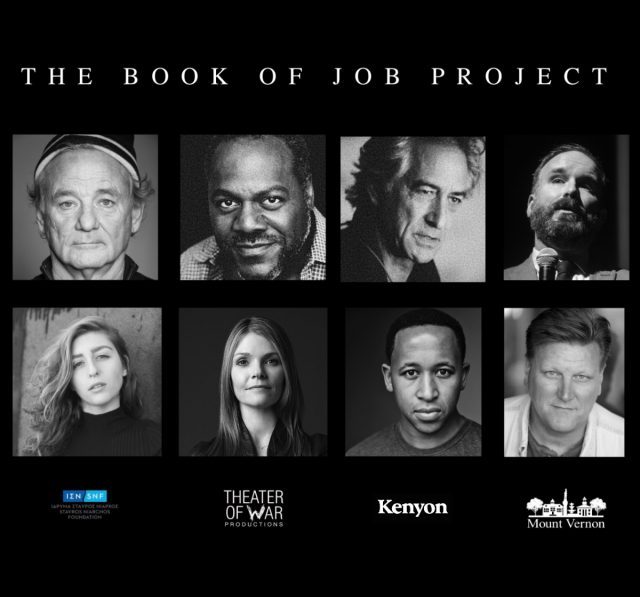
Who: Bill Murray, Frankie Faison, David Strathairn, Marjolaine Goldsmith, Kathryn Erbe, Nyasha Hatendi, Bryan Doerries, Matthew T. Starr, more
What: Dramatic reading and interactive community discussion
Where: Theater of War Zoom
When: Sunday, December 6, free with RSVP, 4:00
Why: “So Satan went forth from the presence of the Lord, and smote Job with sore boils from the sole of his foot even unto his crown.” That was only one of many indignities the patient, blessed Job is forced to endure in the Bible as questions of faith and righteousness are brought to bear. How would Job react to 2020? Theater of War has been extremely busy during the pandemic lockdown, presenting dramatic readings of King Lear, Antigone, Oedipus the King, and other classic works, relating them to public health and social justice issues happening around the country today in light of the George Floyd protests and the Covid-19 crisis. On December 6, Bill Murray, Frankie Faison, David Strathairn, Marjolaine Goldsmith, Kathryn Erbe, and Nyasha Hatendi will read from the Book of Job, translated by Stephen Mitchell and directed and adapted by artistic director Bryan Doerries, who will also facilitate a conversation with Mayor Matthew T. Starr of Mount Vernon, Ohio, and other local community leaders in Knox County; Theater of War is in the midst of a yearlong virtual residency at Kenyon College, which is located in Gambier, Ohio. Knox County is named after Henry Knox, an officer in the American Revolution who later served as secretary of war.

KENNETH TAM: THE CROSSING

The Crossing marks Kenneth Tam’s live, virtual debut at the Kitchen OnScreen (rehearsal photo courtesy Lumi Tan and Kenneth Tam)

Who: Kenneth Tam, Lumi Tan
What: Kenneth Tam’s first live performance
Where: The Kitchen OnScreen Zoom
When: December 5-6, free with RSVP, 7:00
Why: Brooklyn-based multidisciplinary artist Kenneth Tam has been in residence at Queenslab in Ridgewood since October 30, preparing a new work for the Kitchen, following all Covid-19 protocols as he rehearses the piece and prepares for its livestream debut December 5-6. Performed by Martin Richard Borromeo, Paulina Meneses, James Lim, and Resa Mishina, The Crossing explores issues of race, gender, identity, ritual, and assimilation in relation to Asian Americans and Culturally Based Fraternal Organizations, centering on Taoist funeral rites, probate ceremonies, and the brutal hazing death of Baruch college freshman and pledge Michael Deng in 2013 while running through the gantlet known as the Glass Ceiling. Admission is free with RSVP; the December 6 performance will be followed by a Q&A with Tam (All of M, Breakfast in Bed) and Kitchen curator Lumi Tan. You can see previous Kitchen OnScreen projects here by Baseera Khan, Autumn Knight, and Ka Baird with Max Eilbacher.

EdgeCut: SANITY

Katelyn Halpern and Paul Pinto’s Living Room video is part of “EdgeCut: Sanity”

Who: Malena Dayen, Karen Lancel & Hermen Maat, Caitlin & Misha, Katelyn Halpern, Paul Pinto, divinebrick, Chris SooHoo
What: 3D live, interactive experience
Where: New York Live Arts
When: Saturday, December 5, $7-$15, 1:00 – 4:00
Why: On October 10, EdgeCut introduced us to the remarkable NowHere platform for the first part of its collaboration with New York Live Arts, “Captivity,” five hours of short performance works, discussions, and networking in which audience members navigated through different levels in order to watch livestreamed events in little pods and hang out with curators, creators, and other visitors in their pods. You could steer through fantastical landscapes, float in space, and pull up next to another pod and talk about where you’d been so far or where you were off to next, with cameras on so your face is visible on the front of your pod. I’ve tried just about every form of online entertainment while we’re all sheltering in place and arts venues are closed, and nothing else comes close to this one, even given various hiccups that require patience.

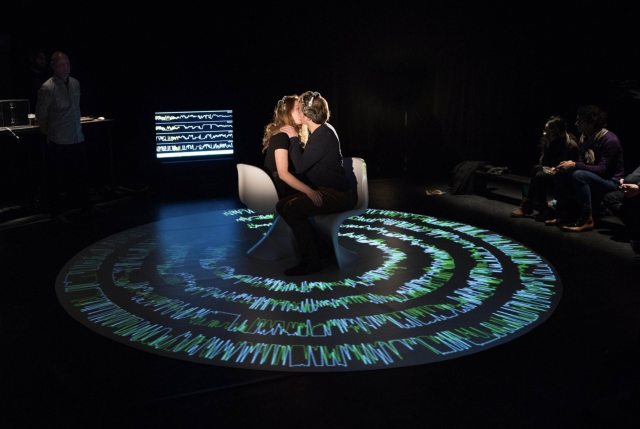
The second iteration, “Sanity,” takes place December 5 from 1:00 to 4:00, a more manageable three hours that will feature four unique rooms. In the Growth Room, you can catch director and singer Malena Dayen’s opera While You Are with Me and the bright and colorful Living Room music video of dancing television heads by multidisciplinary artists Katelyn Halpern and Paul Pinto; in the Worry Room, you can let out steam with Caitlin & Misha’s Infinite Worries Bash, a participatory installation of electroacoustic piñatas that inquires, “Can the destruction of these interactive worry vessels create space for clarity?”; in the Transformation Room, you can meditate to divinebrick and Chris Soohoo’s Performance Prayer; and in the Kissing Room, you can share private moments courtesy of intimacy agents Karen Lancel and Hermen Maat, who ask, “Can we measure a kiss and what kissers feel together?”

Intimacy agents Karen Lancel and Hermen Maat explore what online kissing is like at “EdgeCut: Sanity”

Curated by Heidi Boisvert and Kat Mustatea, the EdgeCut program, which originally convened at the New Museum’s NEW INC incubator for art, tech, and design for in-person presentations, is now seeking to expand and redefine the virtual 3D experience during the pandemic lockdown, exploring the question “How do we create collective experience and transformative gatherings in this moment of ‘a crisis within a crisis’ that speak to transition, change, healing, humanity?” The works were chosen through an open call; the finale of the trilogy, “Humanity,” is scheduled for February 13, 2021. Tickets range from $7 per room to $15 for the full experience, which has to be seen to be believed.