this week in theater

OLD VIC: IN CAMERA — A CHRISTMAS CAROL

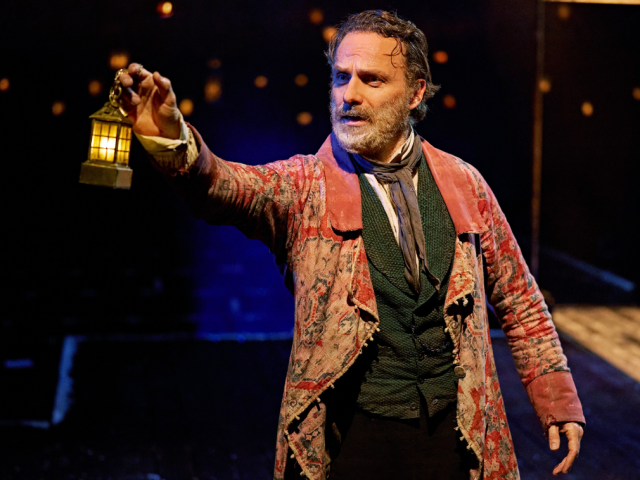
Andrew Lincoln shines a light on a different aspect of Scrooge’s psyche in Old Vic adaptation (photo by Manuel Harlan)

A CHRISTMAS CAROL
The Old Vic, London
Through December 24, £10-£65
www.oldvictheatre.com

For its fourth “In Camera” presentation, the Old Vic has revived Jack Thorne’s 2017 reimagining of Charles Dickens’s A Christmas Carol, which moved to Broadway in fall 2019 and plans to return next holiday season. Thorne’s bold adaptation minimizes the traditional ghost story elements and instead develops a narrative that focuses on Ebenezer Scrooge’s childhood trauma (George Samuel Townsend plays him as a boy, Andrew Lincoln as an adult) and how it influenced his development into the greedy, heartless man he now is — revealing the psychological damage wrought by a demanding, overbearing father (Michael Rouse), never mentioned in Dickens’s original; the boy’s relationship with his adored sister, Fan (Melissa Allan), named only once by Dickens; and his one chance at love with Belle (Gloria Obianyo), the daughter of his employer, Mr. Fezziwig (Clive Rowe), who in this version runs a funeral parlor, although Dickens himself never elucidates Fezziwig’s business.

The heart-tugging Cratchit family — Scrooge’s clerk, Bob (John Dagleish), Bob’s wife (Maria Omakinwa), and their children, including the lame Tiny Tim (Rayhaan Kufuor-Gray, Lara Mehmet, Lenny Rush, or Eleanor Stollery) — is almost an afterthought in Thorne’s retelling, while Scrooge’s deceased partner, Jacob Marley (Rouse), is given more prominence, as is Scrooge’s nephew, Fred (Eugene McCoy). The Ghosts of Christmas Past, Present, and Future are portrayed by a trio of women (Julie Jupp, Golda Rosheuvel, and a surprise third character) who are not daunting spirits but rather have much more intimate connections with Scrooge.
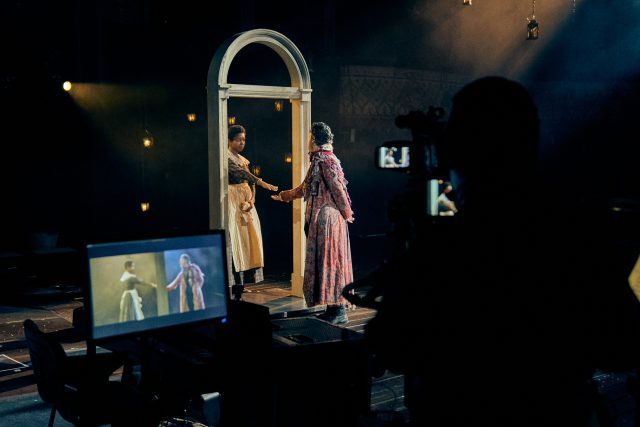
Old Vic’s “In Camera” livestreamed production of A Christmas Carol follows Covid-19 protocols (photo by Manuel Harlan)

The Old Vic’s “In Camera” series, live plays streamed direct from its London stage, adhering to all Covid-19 protocols and performed without an audience, previously offered very short runs of Brian Friel’s Faith Healer with Michael Sheen, David Threlfall, and Indira Varma, Stephen Beresford’s Three Kings with Andrew Scott, and Duncan MacMillan’s Lungs with Claire Foy and Matt Smith. Helmed by Tony-winning artistic director Matthew Warchus (Matilda, God of Carnage), A Christmas Carol is riveting theater for most of its two-hour length. The action is filmed with multiple cameras that give tantalizing close-ups as well as long views, while the tech crew often utilizes split screens so expertly that it’s sometimes difficult to figure out whether actors are actually next to each other or are socially distancing, especially during several handshakes.

Lincoln (The Walking Dead, Parlour Song) is sensational in one of the most familiar roles ever written, playing Scrooge as a flawed human being rather than a brutally cold and unforgiving ogre. It’s a welcome change, as are the changes brought to other minor characters, with stand-out performances by Obianyo, Rowe, and Rosheuvel. The cast also features Rosanna Bates as Jess, Tim van Eyken as Nicholas, and Sam Lathwood as Ferdy. This is not your grandparents’ Christmas Carol.

The set by Rob Howell, who also designed the period costumes, is anchored by a slotted-wood floor, with frames without doors through which characters enter and exit and dozens of lanterns hanging from the ceiling. At the 2017-19 in-person shows, audience members received clementines and cookies; the Old Vic tries to maintain a level of interactivity by having an online quiz that begins about an hour before the play starts and by providing a family activity pack that can be downloaded for free here.

Which brings us to the ending. Throughout the show, Christmas carols are played by a masked band in the balcony, consisting of pianist and musical director Will Stuart, cellists Christopher Allan and Pedro Vieira da Silva, violinist Clare Taylor, and clarinetist Martin Robertson. The songs often get in the way of the narrative, especially with Thorne’s (Harry Potter and the Cursed Child, His Dark Materials) unexpected twists, but it all becomes particularly annoying when the music, acting, and staging all combine to go way over the top during Scrooge’s rethinking of what Christmas means. What was a gripping, tense tale instantaneously lapses into a tired traditional holiday finale, turning its back on everything that came before. It had challenged what we know about this classic story but then settled for the lowest common denominator for its conclusion, which is a shame. Or, of course, I’m just being a scrooge. Bah, humbug.
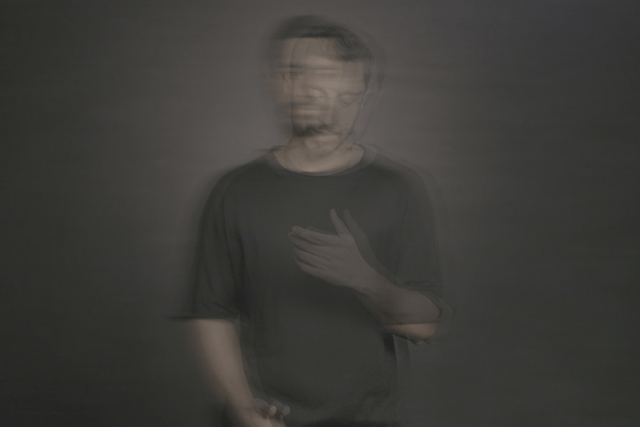
THE LONG GOODBYE: ONLINE EDITION

Actor, activist, and rapper Riz Ahmed takes viewers on a personal journey of music and storytelling in one-time-only livestream of The Long Goodbye

Who: Riz Ahmed
What: One-man show with music and stories
Where: BAM, Manchester International Festival
When: Saturday, December 19, $6.75 – $27 (pay-what-you-feel), 3:00
Why: Back in March, British actor, musician, and activist Riz Ahmed was scheduled to premiere his one-man show, The Long Goodbye, at the Manchester International Festival, followed by a run at BAM this fall, but the pandemic lockdown scrapped those plans. Emmy winner Ahmed has appeared in such films as Nightcrawler, Sound of Metal, and his latest, Mogul Mowgli, such television shows as Dead Set, The Night Of and The OA, and such plays as Stephen Adly Guirgis’s Jesus Hopped the ‘A’ Train and the opera Gaddafi in addition to being a founding member, known as Riz MC, of the hip-hop band Swet Shop Boys, which has released the full-length record Cashmere and the EPs Swet Shop and Sufi La. This past March, he released the concept album The Long Goodbye, featuring such tracks as “The Breakup (Shikwa),” “Can I Live,” “Deal with It,” and “Karma,” with such special guests as Mindy Kaling, Mahershala Ali, and Hasan Minhaj. You can check out his latest video, “Once Kings,” here.

Ahmed combines all those talents in his virtually reimagined The Long Goodbye: Online Edition, streaming live one-time-only on December 19 at 3:00. Co-commissioned by MIF and BAM, the thirty-minute presentation is a companion piece to the full show, which has been postponed to 2021, once theaters are allowed to open and welcome audiences once again. Directed by Kirsty Housley with sound by Gareth Fry, the show is a personal journey with live music and storytelling that asks the question: “How did we get here?” Tickets are $6.75 to $27 based on what you can pay, but they are very limited, so act now if you want to catch what should be a unique, compelling experience.

VIRTUAL IMPOSSIBILITIES

VIRTUAL IMPOSSIBILITIES
the wild project
December 16-20, $20, 8:00 (extended Saturdays at 3:00 & 8:00, January 2 – February 27)
www.virtualimpossibilities.com

Over the summer, New York City-based mentalist and magician Eric Walton created a Zoom show for private clients and holiday parties, displaying his feats of wonder for individuals, couples, and groups. He is now taking the sixty-minute presentation, Virtual Impossibilities, public through the Lower East Side arts and culture hub the wild project. From December 16 to 20 [ed. note: extended Saturdays at 3:00 & 8:00, January 2 – February 27], Walton will be dazzling an unlimited amount of audience members with card tricks, word games, and more in this fully interactive online performance. Walton’s previous shows include Esoterica and Eric Walton: Mentalist, which incorporate philosophy and metaphysics into his many mysteries; he has also created the fun short “Welcome to the Show!” A Rube Goldberg Machine, delivered the lecture “The Psychology of Magic,” and writes and recites such poetry as “An Injunction to the Poet to Embellish, Elaborate, and Barnumize.” In addition, he is a proud vegan and activist. Tickets are $20 per household; come ready to participate and to have your mind blown.

JASON SURAN: RECONNECTED

RECONNECTED: A VIRTUAL EXPERIENCE WITH MENTALIST JASON SURAN
Friday & Saturday nights through January 15 (extended through July 23), $50, 8:30
www.jasonsuran.com/reconnected

It’s one thing for mentalists to blow your mind in person. But over Zoom?

Performer and corporate consultant Jason Suran has figured out a way to do just that with his virtual show Reconnected, which takes place weekends through July 23. At each sixty-minute presentation, Suran appears before about three dozen people who have paid fifty dollars each to experience Suran’s unique abilities at what he calls “brainfuckery.” Beaming in from his home in New York City, Skokie-born Suran, whose previous works include The Other Side: A Psychological Seance and All in Your Head: An Evening of Mindreading, performs psychological illusions involving words, numbers, sharp objects, and a homemade pendulum that seem impossible but unfurl before your very eyes.

Even if you’re skeptical about mentalists and mindreading, Suran is likely to win you over with his innate charm and good humor. It also helps if you participate, either volunteering or being chosen; I have to admit to being a wee bit disappointed until Suran called on me to be part of the big finale, which was unforgettable.

When not performing feats of wonder, Suran, who conceived of the show with coproducer Adam Rei Siegel, trains corporate executives to improve observation and communication skills through his seminar “Hacking Minds,” focusing on cold reading, memory systems, and strategic questioning. Those talents are in full evidence in Reconnected; you should come prepared to use your own powers of observation and communication as well, at a moment’s notice, to enhance your experience.

“The best part of my job has always been connecting with the audience. I mean, that’s the whole point of reading minds,” Suran says in a sneak preview you can watch above. “The strange thing is, after all the shows I’ve done, all the rooms I’ve worked, all the people I’ve gotten to know, the truth is, I’ve never felt closer to the crowd than I do right now.” At a time when we are all hungering to be part of a crowd, to sit beside other people in a dark theater as we are entertained, Reconnected gives us the opportunity to connect with others, even if it’s onscreen. As the pandemic lockdown continues, there’s a lot to be said for that — and it certainly doesn’t hurt when that connection is loads of fun.

THE FLYING LOVERS OF VITEBSK

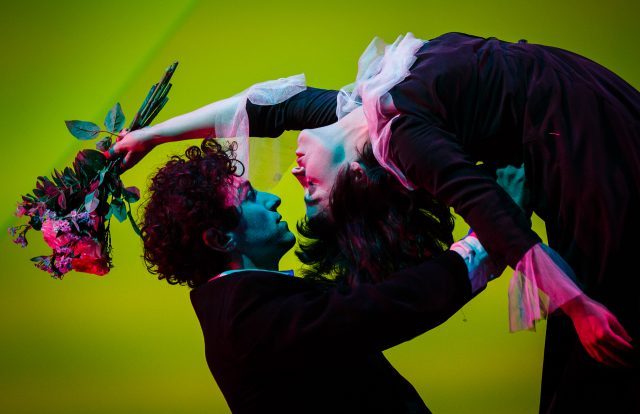
Marc Antolin and Audrey Brisson shine as Marc and Bella Chagall in The Flying Lovers of Vitebsk (photo © Steve Tanner)

THE FLYING LOVERS OF VITEBSK
December 11-18, $20 three-day rental
nyuskirball.org/chagall

Standing in front of a Marc Chagall painting can transport you to another world, a fantastical realm of lavish colors where humans and animals float through the air and fiddlers perform on rooftops. The Bristol Old Vic, Kneehigh, and Wise Children have captured the essence of the lush canvases as well as the artist himself in the gorgeously rendered revival of Daniel Jamieson’s The Flying Lovers of Vitebsk, streaming via NYU Skirball through December 18.

Filmed with three cameras and no audience at the UK’s Bristol Old Vic Theatre, the ninety-minute show is one of the best productions of the pandemic lockdown, an enchanting, bittersweet love story that will make your heart soar. Essentially a memory play, The Flying Lovers of Vitebsk recounts the tender romance between Chagall (Marc Antolin), born Moishe Zakharovich Shagal in 1887 in what is now Belarus, and Bella Samoylovna Rosenfeld (Audrey Brisson), born eight years later in the shtetl of Vitebsk to a well-off family that owned three jewelry stores. They fall madly, passionately in love when they meet in 1909; “I want to waste the rest of my life with you,” she tells him. Over the course of their life together, they experience more highs than lows as they deal with his success as a painter in Western Europe but struggles at home amid WWI, the Russian Revolution, and the rise of fascism and anti-Semitism.

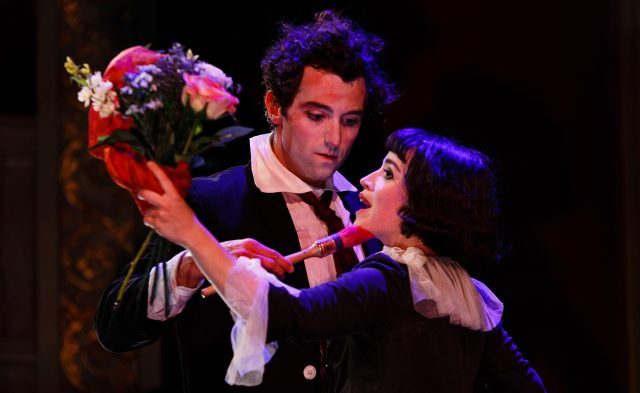
The Flying Lovers of Vitebsk brings to vivid life the memorable relationship between Marc and Bella Chagall (photo © Steve Tanner)

Director Emma Rice’s staging is magnificent, as are the performances. Antolin (The Trial, Taken at Midnight) and Brisson (Secret Cinema, The Wild Bride) are engaging as the sweethearts, both wearing white greasepaint as if primed canvases ready for action; when he paints her, he gently touches her face with a brush. They occasionally break into song, in English, French, and Yiddish, accompanied by composer and pianist Ian Ross and cellist James Gow, who also appear as minor characters throughout. There are also several scenes of lovely contemporary dance, choreographed by Rice and Etta Murfitt, that reference such Chagall works as 1914’s Blue Lovers, 1915’s Green Lovers and Birthday (when it premiered in 1992, the play was titled Birthday), 1916’s Lovers in Pink, 1917’s Study for Double Portrait with Wine Glass, and the much later Bouquet with Flying Lovers (ca 1934-47).

The small, intimate set by Sophia Clist, who also designed the costumes, places the actors in between empty wooden picture planes in the front and a wall of twisted canvas in the back, with drawings of flowers on the floor; it as if the Chagalls are a painting come to life. The playful nature of Marc’s painting is echoed in Rice’s use of props, including a red balloon as Bella’s mother, a portrait of their rabbi that Brisson sits behind and puts her arms through, and animal objects from the paintings that become Salvador Dalí-like chapeaux. Cinematographer Steve Tanner occasionally cuts to a long shot of the mostly empty theater, reminding us where we are and what we’re experiencing together, but he quickly puts us right back onstage with Marc and Bella and their impassioned love. Malcolm Rippeth’s lighting and Simon Baker’s sound are excellently coordinated for online viewing.

Early on, Marc tells his biographer and son-in-law, Franz Meyer, “When some things are gone, you thirst for their details in such a heartbreaking way. You feel an agony of need to remember.” The Bristol Old Vic’s The Flying Lovers of Vitebsk is an exhilarating reminder of the power of live theater, the power of art, and the power of true love. Don’t miss it.

THE DYBBUK

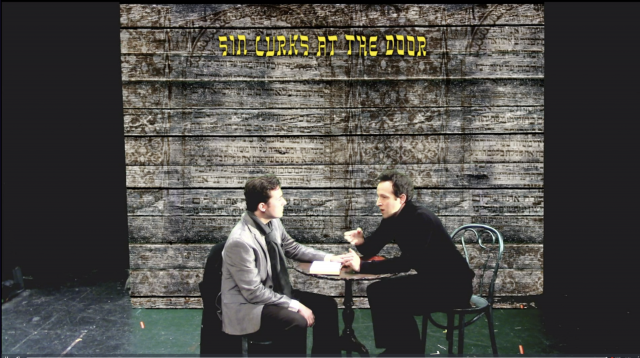
Theater for the New City is presenting a livestreamed adaptation of The Dybbuk through Sunday (screenshot by twi-ny/mdr)

Theater for the New City
December 9-13, $5-$36 (pay-what-you-can)
www.stellartickets.com
theaterforthenewcity.net

Good things come to those who wait. If there’s one thing we’ve learned during this pandemic, it’s that we need to have patience. Help is on the way, but if we as a nation follow protocols and have strong leadership, we can each make a difference, even with an administration that has turned its back on its people. We also have to be patient with the return of live theater as companies around the world experiment with Zoom, livestreaming, recording onstage without an audience, and other attempts to bring storytelling to a starving public.

So there I was on December 9, watching the hundredth-anniversary premiere of Theater for the New City’s livestreamed revival of the popular Yiddish play The Dybbuk, performed live onstage and broadcast over the Stellar platform. The chat function was on, so virtual attendees started getting ornery quickly when the show didn’t start exactly on time. And once it did, there were significant technical problems involving superimposed text, the green screening, and, most important, the sound, with a screeching electronic score drowning out the dialogue. Several people in the chat began complaining, even demanding a refund. But a solitary voice of reason explained that this is an opening night different from in-person opening nights and everyone should calm down. And she was right, because the tech crew was on the case, and after a near-disastrous beginning, the rest of the play was wonderful.

Written in 1914 by Jewish playwright S. An-ski, aka Shloyme Zaynvl Rapoport, who hailed from what is now Belarus, The Dybbuk premiered at the Elyseum Theatre in Warsaw on December 9, 1920, one month after An-ski’s death at the age of fifty-seven. Presented in association with New Yiddish Rep, this new English-language adaptation (with a fair sprinkling of Yiddish) is by NYR artistic director David Mandelbaum. The Dybbuk takes place in an old Jewish shtetl, where a long-arranged match between Menashe and Leah, the daughter of the wealthy Sender, dooms the love young student Khanan has for her. But on her wedding day, she is possessed by a spirit who will not let her marry Menashe, and the case soon comes before the judgment of the learned rabbi.

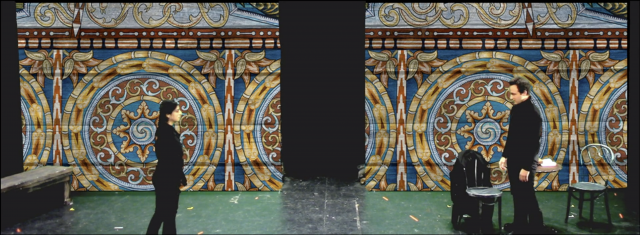
Cool backgrounds propel Theater for a New City virtual revival of classic Yiddish play (screenshot by twi-ny/mdr)

Director Jesse Freedman eventually works out the kinks in real time and gets everything in sync — with lighting by Alexander Bartieneff, sound by Eamon Goodman, and video by Tatiana Stolpovskaya — resulting in a moving and delightful production that features fun backgrounds and solid performances by Darrel Blackburn, Amy Coleman, Hannah Gee, Lev Harvey, Lucie Lalouche, Thomas Morris, and Mandelbaum as the rabbi. “A play about possession seems particularly suited to the times. The country has been possessed by the evil spirits of strife and division and could use a good exorcism to bring it back to its senses,” Mandelbaum said in a statement. “An intrepid group of artists is soldiering on through this pandemic minefield to honor the one-hundredth anniversary of this iconic play with the battle cry of their calling: ‘The show must go on.’ This will be a spiritual fusion of live performance and digital artistry. The ‘possession’ of live theater by the spirits of techno-wizardry.”

So be patient; the show will go on. It might not get off to a big start, but it packs quite a wallop by the finish.

For more on The Dybbuk, which was also made into a classic 1937 Yiddish film directed by Michał Waszyński, you can check out the Congress for Jewish Culture’s recent panel discussion “The Dybbuk at 100” on Facebook with playwright, translator, and theater historian Nahma Sandrow, Baruch College assistant professor and author Debra Caplan, and author and UT Austin senior lecturer in Yiddish Itzik Gottesman, moderated by writer, translator, actress, and theater historian Caraid O’Brien. The organization will also be presenting its own production of The Dybbuk on December 14 at 7:00 in Yiddish with Mike Burstyn, Shane Baker, Mendy Cahan, Refoyel Goldwasser, Amitai Kedar, Yelena Shmulenson, Suzanne Toren, and Michael Wex, directed by Allen Lewis Rickman; it can be seen here.

MOLIÈRE IN THE PARK: PEN/MAN/SHIP

Who: Molière in the Park theater company
What: Livestreamed performances and Q&As
Where: FIAF Facebook and Molière in the Park YouTube
When: Saturday, December 12, free with RSVP, 2:00 & 7:00 (show will be available for viewing through January 3)
Why: After staging Zoom adaptations of three classic seventeenth-century plays by Jean-Baptiste Poquelin — better known as Molière — Brooklyn-based Molière in the Park is getting significantly more contemporary with its latest live, online production, playwright, TV writer, and educator Christina Anderson’s new work, Pen/Man/Ship. Following The Misanthrope, Tartuffe, and The School for Wives, Molière in the Park moves into the late nineteenth century with Pen/Man/Ship, which takes place in 1896 aboard a ship heading for Liberia shortly after the US Supreme Court decided in Plessy v. Ferguson to uphold the constitutionality of racial segregation under the concept of “separate but equal.” The cast features Crystal Lucas-Perry, Kevin Mambo, Jared McNeill, and Postell Pringle; the parable is directed by Molière in the Park founding artistic director Lucie Tiberghien using Liminal Entertainment Technologies’ StreamWeaver software, which takes actors out of Zoom boxes and puts them in front of backgrounds that more resemble indoor and outdoor sets while also allowing the tech crew to work together regardless of where they are. Copresented with the French Institute Alliance Française (FIAF) in partnership with the Prospect Park Alliance and the LeFrak Center at Lakeside, the play will be performed live twice on December 12, at 2:00 and 7:00, followed by Q&As with the creatives; a recording will be available for on-demand viewing through January 3.