this week in theater

BLINDNESS

Blindness plunges in-person audiences into literal and metaphorical darkness (photo by Helen Maybanks)

BLINDNESS
Daryl Roth Theatre
101 East Fifteenth St. at Union Square
Tuesday – Sunday through September 5, $116 per pair
www.blindnessevent.com
www.darylroththeatre.com

The first in-person, extended-run indoor theatrical presentation in New York since restrictions lifted has arrived, and it’s a doozy. British playwright Simon Stephens’s adaptation of Portuguese Nobel laureate José Saramago’s 1995 dystopian novel, Blindness, was long in the works prior to the coronavirus crisis, but its subject matter and staging are tailor-made for this precise moment in time.

The seventy-minute socially distanced sound and light installation debuted at the Donmar Warehouse last August and opened last night at the Daryl Roth Theatre in Union Square. Originally conceived as a fully staged production with a cast of a hundred by Tony winner Stephens and director Walter Meierjohann, it has been reimagined for the pandemic. A maximum of eighty-six masked people are allowed in the theater, seated in chairs in pods of two, either facing the same or opposite directions; each couple is at least six feet away from other pairs.

The set consists of dozens of horizontal and vertical fluorescent lights hanging from above, forming a kind of abstract traffic pattern, warmly changing colors from red, blue, and green to yellow and orange; as the audience enters, the sounds of cars can be heard. The otherwise empty, ominous set is by Lizzie Clachan, with lighting by Jessica Hung Han Yun. Every audience member receives a pair of headphones through which the foreboding tale unfolds. The text is performed by Olivier-winning English actress Juliet Stevenson (Truly, Madly, Deeply; Death and the Maiden), who starts out as the Storyteller before becoming the protagonist. “If you can see, look,” the Storyteller begins. “If you can look, observe.”

The dark parable immerses you in an epidemic in which a man driving down the street suddenly and inexplicably goes blind — everything turns white — and after he goes to an ophthalmologist, the doctor and several of his patients soon lose their sight as well. The contagion spreads, and only the doctor’s wife retains her vision; she takes over the narrative, which turns into an apocalyptic nightmare in which the nation’s leaders turn their back on its citizenry. “If there was a government, it was a government of the blind trying to rule the blind,” the doctor’s never-named wife says. “I didn’t know if there was going to be a future. We needed to decide how we were going to live.”

Juliet Stevenson comes face-to-face with Trevor the binaural microphone while recording Blindness (photo courtesy Donmar Warehouse)

The audio was recorded using a binaural microphone, called Trevor, that is shaped like a human head, similar to the one Simon McBurney used in his 2016 Broadway show, The Encounter. Stevenson’s physical proximity to Trevor affects how we ultimately hear her words, giving it a three-dimensional quality. At times it seems that the doctor’s wife is far away, her voice muffled in the distance, while a minute later you can practically feel her hot breath on your neck as she whispers in your ear, as if she is standing right next to you. It can be unnerving, and it’s supposed to be, melding well with the story, which grows harsher and harsher. The genius sound design is by Ben and Max Ringham, who previously used binaural recordings and silent disco headphones for Ella Hickson’s spy thriller, Anna, at the National Theatre in May 2019. You might be sitting in a space with no stage, no furniture, no props, only chairs and lights, but Stephens’s writing is so descriptive, and Stevenson’s reading so clear and poetic, that you’ll think you are in the quarantine bunker where the blind characters are struggling to survive.

Although the theater does transform into total darkness for several scenes, random flashes of white lights in the second half are distracting, with no apparent connection to the story except to perhaps evoke an instant of white blindness. Depending on where you are sitting, you might be facing another audience member, which can be unsettling; usually at the theater, the only people in front of you who you might make eye contact with are the actors onstage. That said, it’s fabulously exciting to be in a theater with other people, experiencing something together. In addition, everyone gets a flashlight to turn on in case they require technical or personal assistance, although that can be disruptive, particularly when it’s pitch black and someone suddenly flicks the light on. There is no intermission, no bathroom breaks, no gathering in the lobby to chat; if you have to leave for some reason, there is no reentry. And speaking of distractions, the night I was there, I did not see anyone on their cell phone or hear any ringers go off. Sheer bliss.

Blindness, which was adapted into a 2007 play by Godlight Theatre Company, a 2008 film by Fernando Meirelles starring Julianne Moore, Mark Ruffalo, and Danny Glover, and a 2011 opera by Anno Schreier and Kerstin Maria Pöhler — Saramago also wrote a sequel, Seeing, in 2004 — is not simply a technological marvel that explores the breakdown of society in a health crisis that is all too familiar today; it examines how we as a culture interpret how and what we see. It’s merely coincidental that we are watching a show about a pandemic, involving food insecurity, economic distress, governmental refusal to take action, and so much grief and loss, during a pandemic. Blindness delves into the interconnectedness of humanity amid greed, selfishness, and a metaphorical blindness that can lead to racism, hate, militarism, and othering. Stephens follows Saramago’s style of not using proper names for characters or locations; this could be happening to anyone, anywhere, at any time.

In writing the play, Stephens (Sea Wall, Heisenberg, The Curious Incident of the Dog in the Night-Time), who is partially sighted, consulted with Hannah Thompson, a partially sighted professor of French and Critical Disability Studies at Royal Holloway, University of London, who explained ocularcentrism to him, the belief that sight is the most privileged of the five senses and how misunderstood having less vision is. (She prefers the term “vision gain” to “vision loss.”) Early on, the Storyteller says, “Who would have believed it? Seen at a glance, the man’s eyes seemed healthy. The iris looked bright, luminous. The sclera white, as compact as porcelain. The eyes wide open, the wrinkled skin of the face, the eyebrows suddenly screwed up.” As this immersive sound and light installation reminds us, taking life, and all its wonders, for granted comes at your own risk.

THEATER OF WAR FRONTLINE: MICHIGAN

Who: Taylor Schilling, Bill Camp, David Strathairn, Nyasha Hatendi, Bryan Doerries
What: Livestreamed Zoom reading and discussion
Where: Theater of War Zoom
When: Wednesday, June 30, free with RSVP, 8:30
Why: Theater of War continues its extraordinary pandemic programming with “Frontline,” an evening of dramatic readings featuring Taylor Schilling, Bill Camp, David Strathairn, and Nyasha Hatendi of scenes from ancient Greek plays by Sophocles (Ajax, Oedipus the King, Philoctetes, Women of Trachis) that relate to today’s health care crisis. Following the reading, there will be a discussion facilitated by director, translator, adapter, and artistic director Bryan Doerries focusing on nurses, doctors, first responders, and other health care professionals, hosted by Michigan Health & Hospital Association and Blue Cross Blue Shield Blue Care Network of Michigan. Admission is free; if you haven’t seen any of Theater of War’s events, now is the time; among their other recent presentations are The Oedipus Project exploring the pandemic and the climate crisis, Antigone in Ferguson looking at racialized police violence, End of Life and King Lear Project examining caregiving and death, and Poetry for the Pandemic.

COMMUNION

Stacy Ross guides a live audience through a Zoom gathering in Communion

COMMUNION
American Conservatory Theater (A.C.T.)
Through June 27, $60
www.act-sf.org

“Can we build a true sense of community over Zoom in one evening?” Stacy Ross asks in Christopher Chen’s Communion, a live, interactive presentation from A.C.T. in San Francisco. Continuing through June 27, the seventy-minute Zoom production is hosted by the popular Bay Area actress, who has played such characters as Hedda Gabler, Malvolio, Clytemnestra, Ophelia, Candida, and Leni Riefenstahl. In Communion, she’s herself — or is she? — speaking directly into the camera from a small, cluttered room. She wears a green felt hat and braids, asking us questions, discussing bliss and tacos, and considering Zoom as a tool for intimacy.

Prior to the show, attendees are given several prompts, one involving a guiding principle you have, another a person you’ve allowed to get inside your head in a bad way. Volunteers come forward and share their answers, with Ross commiserating. Viewers are also sent to breakout rooms to talk about the idea of “communion” in smaller groups. Thus, a good part of your experience will be impacted by how much you and others choose to participate. Ross may be a consummate host, but she can control only so much of what happens.

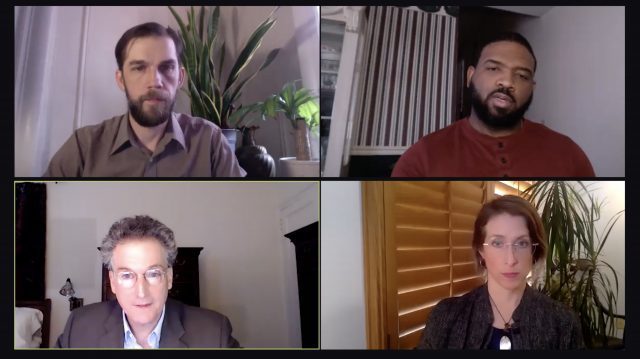
Obie winner Chen (The Hundred Flowers Project, The Headlands) and Tony-winning director Pam MacKinnon (Clybourne Park, Who’s Afraid of Virginia Woolf?) navigate through Zoom fatigue — with America opening up, is the end coming for entertainment via little onscreen boxes? — with a wink and a nod, holding back a surprise (which one of the people in my breakout room guessed). To say any more would be to say too much.

Most Zoom theater has been created as an alternative to live, in-person shows, where strangers congregate in dark spaces, suspending disbelief as they are temporarily transported to different worlds. Communion was made specifically for Zoom, challenging us to look at who we are, as individuals and as theater lovers, as we come out of a pandemic that has changed us all, for better or worse.

THE DARK MASTER

Kuro Tanino’s The Dark Master is a VR treat for the senses (photo © Japan Society)

THE DARK MASTER
Japan Society
333 East 47th St.
June 23-28, $45
212-715-1258
www.japansociety.org

Kuro Tanino’s The Dark Master was originally scheduled to be a fully staged production at Japan Society in January 2021 as part of a four-city US tour. However, because of the pandemic lockdown, Japan Society artistic director Yoko Shioya suggested that Tanino reimagine the piece for virtual reality. The result is a thoroughly satisfying and uniquely tasty experience, a delectable treat for the senses.

Continuing through June 28, The Dark Master is presented to ten audience members at a time, sitting in individual mirrored cubicles on Japan Society’s stage. Wearing headphones and VR headsets (and facemasks), you are taken into a tiny, claustrophobic restaurant where you are served food by a grouchy owner-chef (Kiyobumi Kaneko). He decides that you are to become the next cook, and your training begins as hungry customers come in and sit at the counter, excited for the carefully prepared fare.

Inspired by first-person video games and an indie manga written by Marei Karibu and illustrated by Haruki Izumi, The Dark Master immerses you in a mysterious world that can be as funny as it is creepy. Kaneko is a hoot as a surly smoker who seems relatively disinterested in what he’s doing yet creates miraculous dishes that not only look good but smell great — be prepared for a multisensory adventure. The virtual reality extends about 180 degrees, so be sure to turn to your right and left and up and down to take it all in; you are also given hands that hold a menu, pour a drink, and bring the victuals to your mouth, which could produce a sort of personal AMSR encounter A brief video at the end takes you behind the scenes of how some of it was done.

The Dark Master takes place for only ten people at a time at Japan Society (photo © Keizo Maeda)

A sculptor, painter, and former psychiatrist, Tanino (Frustrating Picture Book for Adults, Fortification of Smiles) literally and figuratively gets into your head for forty-five minutes as performers from his experimental theater company, Niwa Gekidan Penino (NGP), including Kaneko, F. O. Pereira Koichiro, and Bobmi Hidaka, traipse through the restaurant, with narration by Saika Ouchi. The dialogue has been dubbed into English by the original Japanese cast; the fab set is by Takuya Kamiike, with moody lighting by Masayuki Abe, crackling sound by Koji Sato and Shintaro Mastunomiya, and videography and editing by Nobuhiro Matsuzawa. In 2014, NGP made its American debut at Japan Society with The Room Nobody Knows, which featured a spectacular two-level set that represented the unconscious and subconscious minds. With this VR iteration of The Dark Master, Tanino serves up a wonderful physical and psychological meal, one that can be enjoyed together by strangers, just like watching theater or eating in a restaurant, two of life’s necessities (and genuine pleasures) that were unavailable for so much of the last sixteen months.

ANDROMEDA’S SISTERS: AN ARTS & ADVOCACY GALA

Who: The Neo-Political Cowgirls
What: Fifth annual benefit gala
Where: NPC Cowgirls online and Leiber Collection Museum in East Hampton
When: Saturday, June 26, $25 streaming, $125-$250 in person, 5:00
Why: Last summer, the nonprofit organization the Neo-Political Cowgirls hosted the fourth annual “Andromeda’s Sisters” online, two virtual evenings of short performances, workshops, and discussion focused on advocacy, including, most memorably, Catherine Curtin in Joy Behar’s stirring monologue Where Are You At? and Laura Gómez in Dipti Bramhandkar’s Brown Girl’s Guide to Self-Pleasure. This year, “Andromeda’s Sisters: An Arts & Advocacy Gala,” which took place in person in 2019 at Guild Hall, goes hybrid, happening online as well as at the Leiber Collection Museum in East Hampton on June 26 at 5:00.

The 2021 event includes a reading of Kathryn Grant’s one-act play Order My Steps, about a prison inmate reconnecting with her estranged adult daughter, directed by Florencia Lozano and NPC founder Kate Mueth and starring Curtin and Irene Sofia Lucio, followed by a panel discussion on social justice and advocacy with Planned Parenthood Federation of America president and CEO Alexis McGill Johnson, New Hour for Women and Children — Long Island founder Serena Ligouri, and novelist and editor Angie Cruz. Founded in 2007, the Neo-Political Cowgirls “are committed to making work for women and about women — to creating a space where women and girls from all walks of life can share their experiences, joys, concerns, and spirits through professional dance.” The gala gets its name from the legend in which Princess Andromeda, captured by Poseidon, is saved by the daughters of the God of the Sea, leading to the idea that sisters should seek to help one another in these difficult times. Access to the livestream is $25; in-person tickets are $125-$250.

ARTISTS & COMMUNITY: THE ORESTEIA

Kelley Curran reprises her STC role of Clytemnestra in virtual TFANA production (photo from STC world premiere by Scott Suchman)

Who: Obi Abili, Corey Allen, Helen Carey, Kathleen Chalfant, Kelley Curran, Franchelle Stewart Dorn, Rinde Eckert, Robin Galloway, Ismenia Mendes, Rad Pereira, Reynaldo Piniella, Sophia Skiles, Simone Warren, Emily Greenwood, Drew Litchenberg
What: Virtual production of Ellen McLaughlin’s adaptation and translation of Aeschylus’s trilogy and talks
Where: TFANA online
When: June 25, 7:00 through June 29, 7:00, free with RSVP
Why: In the spring of 2019, Ellen McLaughlin’s The Oresteia, an adaptation of Aeschylus’s trilogy of Agamemnon, The Libation Bearers, and The Eumenides, had its world premiere at the Shakespeare Theatre Company in DC. “The Oresteia are three of the oldest plays we have,” McLaughlin (Tongue of a Bird, Blood Moon) said at the time. “They show us Aeschylus grappling with the experiment of civilization — considering, with clear eyes, its weaknesses and its hopes. The Greeks had no illusions about the fragility of society and of democracy. They knew all too well that the whole undertaking was always at risk, threatened by forces both without and within.”

As part of its digital programming and its “Artists & Community” series, Brooklyn-based Theatre for a New Audience is presenting a virtual production of The Oresteia, streaming for free June 25-29. The 160-minute work, which delves into the nature of history, justice, and humanity, is directed by Andrew Watkins (The Yellow Wallpaper, Before You Go), who has been assistant or associate director on several TFANA shows (The Skin of Our Teeth, A Doll’s House), with original music by Kamala Sankaram (Looking at You, The Parksville Murders). The outstanding cast features Reynaldo Piniella as Orestes, Obi Abili as Agamemnon, Kelley Curran as Clytemnestra, Rinde Eckert as Chorus A and Watchman, Corey Allen as Chorus B, Sophia Skiles as Chorus C, Robin Galloway as Chorus D, Rad Pereira as Electra and Chorus E), Helen Carey as Nurse and Chorus F, Franchelle Stewart Dorn as Chorus G, Ismenia Mendes as Cassandra and Chorus H, Simone Warren as Iphigenia and Chorus I, and Kathleen Chalfant as the Narrator. Seven of the actors are reprising their roles from the STC world premiere. “We have to remember that these stories were as ancient to the Greeks as they are to us,” McLaughlin added. “They used these old stories to look at their own times and to assess their souls, the size of them, what they were capable of, and what they were up against. I believe that’s what artists do, and if you’re lucky, you do it with an extraordinary company like this one.” In addition to the stream, TFANA will host a pair of discussions, on June 26 at 4:00 moderated by Yale classics professor Emily Greenwood and on June 27 at 2:00 moderated by STC dramaturg Drew Litchenberg; you can register for the talks here.

NY CLASSICAL THEATRE: KING LEAR WITH HAPPY ENDING

NY Classical returns to live, in-person performances with King Lear in parks around the city this summer

KING LEAR
Multiple locations
Tuesday – Sunday, June 24 – August 8, free with RSVP, 7:00
nyclassical.org/king-lear

In June 2020, with the pandemic lockdown shuttering live performance around the country, theater companies scrambled for ways to present work in virtual platforms. NY Classical, which has presented more than seven hundred free, mostly outdoor shows since 2000, was working on an adaptation of King Lear for that summer, using Nahum Tate’s 1681 “happy ending.” Instead, they staged an online Zoom reading last June. In a twi-ny talk, artistic director Stephen Burdman explained, “King Lear, with alternating endings (both Shakespeare’s and Tate’s), was always our plan for our 2020 summer season. This is the culmination of a three-year project of investigating how Shakespeare’s company toured their shows outside London. In the time of plague, theaters were closed in Elizabethan London, and while we never expected to have a pandemic of our own. . . . We also had great success with both our six-actor Romeo and Juliet as well as the alternating versions of The Importance of Being Earnest, so this project was a combination of these recent experiments. We auditioned and hired the actors and staff prior to New York State on Pause, and we wanted to make sure to keep our commitments to these wonderful people. In addition to a union salary, they are receiving pension and healthcare. This is an opportunity for us to develop the production with these artists and serve our audience community in the safest way possible.”

With the lockdown over and New York rising from the ashes of a devastating health and economic crisis, NY Classical is ready to stage King Lear the way it originally intended to, in parks across the city. The cast features John Michalski as Lear, Connie Castanzo as Cordelia and the Fool, Jasminn Johnson as Goneril, Aryana Sedarati as Regan, Nick Salamone as Gloucester, Linden Tailor as Edgar, Amar Atkins as Edmund, Michael Stewart Allen as Cornwall, Grant Chapman as Oswald, Cedric Lamar as Kent, and Clay Storseth as Albany, with Ollie Corchado, Evan Moore-Coll, and Saleemah Sharpe. The two-hour production, directed by Burdman, will run Tuesdays to Sundays beginning June 24 through July 11 in Central Park at West 103rd St., followed July 13-18 at MetroTech Commons in Brooklyn, July 20-25 in Carl Schurz Park, and July 27 – August 8 at the Battery. Admission is free, but advance RSVP is strongly suggested, as tickets are limited.