this week in theater

WE’RE GONNA DIE

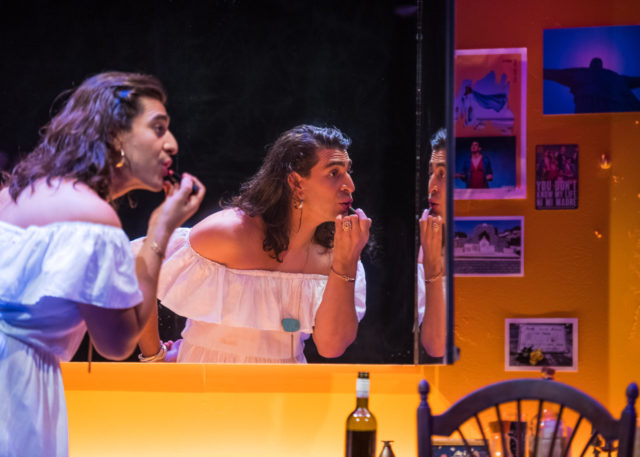
Regina Aquino stars in Round House Theatre’s virtual version of Young Jean Lee’s We’re Gonna Die

WE’RE GONNA DIE
Round House Theatre online
Available on demand through July 25, $32.50
www.roundhousetheatre.org

One of the last in-person plays I saw before the pandemic lockdown was Second Stage’s dynamic, ebullient version of Young Jean Lee’s We’re Gonna Die. Near the end, silver balloons bearing the name of the show were released from the ceiling of the Tony Kiser Theater, gently drifting down on the audience. I brought two home, and, remarkably, one of them is still partially filled, resting on top of a shelf where I see it every day. It is a symbol of the resilience of the human spirit, and of theater itself, which is on its way back after a difficult time.

Sixteen months later, Maryland’s Round House Theatre has mounted a more subdued but still powerful virtual version of the sixty-five-minute show, filmed live with a masked, limited, socially distanced audience and streaming through July 11. We’re Gonna Die consists of a series of first-person true stories and accompanying songs that look at how we approach and deal with impermanence. It was originally staged by Lee and her band, Future Wife, at Joe’s Pub in 2011 and then at Lincoln Center’s Clare Tow Theater in 2013. Raja Feather Kelly tore the roof off with his production at Second Stage, which took place in a hospital waiting room and featured a breakout performance by Janelle McDermoth.

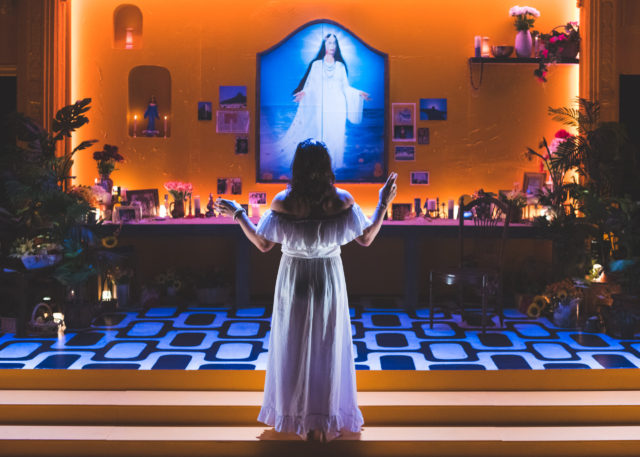
At Round House, Regina Aquino stars as the narrator and singer, who relates the tales as if they all happened to her. (They were actually compiled from friends and relatives of Lee’s.) She runs up the steps, writhes across the floor, and jumps up and down on Paige Hathaway’s two-level set, which features bold colors and graphic symbols, with the musicians of the Chance Club each in their own large, homey cubicle: bassist Jason Wilson, keyboardist Laura Van Duzer, guitarist Matthew Schleigh, and drummer Manny Arciniega. The evening begins with an original composition by the Chance Club, “Wagons and Stars,” to set the mood, and then the show kicks off with the first of six vignettes that cover a wide spectrum of age and health, from the innocence of children to the isolation of growing old, exploring insomnia, the health-care system, family responsibilities, friendship, and generational angst, including “Lullaby for the Miserable,” “Comfort for the Lonely,” “When You Get Old,” and “Horrible Things.”

“I would have horrible nightmares and wake up with this feeling of dread that I was gonna die the exact way my father did,” Aquino says, talking about having trouble sleeping. “And if anyone tried to help me, I would just get angrier and angrier, and no one could do anything.” In the propulsive “I Still Have You,” she declares, “You still have me / I’m in your bed / I’ll hold your hand / until you’re dead / If I die first / you’ll be alone / but until then / you’ll have a home.”

Regina Aquino shares stories of loneliness and loss amid rocking songs in We’re Gonna Die

The show is fluidly directed and choreographed by Paige Hernandez, with cinematography by Maboud Ebrahimzadeh, costumes by Ivania Stack, sound by Mathew M. Nielson, and lighting by Harold F. Burgess II, making it a successful hybrid that is anchored by Aquino’s (The Events, Eureka Day) warm, intimate performance that will have you hanging on her every word.

In the grand finale, “I’m Gonna Die,” everyone joins in for a celebratory chorus that is filled with hope after a year in which more than six hundred thousand American died of Covid-19. The show has always had a positive outlook, but it hits a little deeper now. We all have developed a very different relationship with mortality, so don’t be surprised when you join in, with a smile on your face, as Aquino sings, “I’m gonna die / I’m gonna die someday / Then I’ll be gone / And it’ll be OK.”

In my March 2020 review of Kelly’s production at Second Stage, I wrote, “‘There’s a very good chance you’re not going to die,’ President Trump said when news about the coronavirus crisis was first spreading. While that might be true when it comes to Covid-19, it’s not true in general.” Indeed, what a year and a half it has been, as that balloon can attest.

The stream is available on demand through July 25; you can watch a panel discussion with Aquino, dramaturg Naysan Mojgani, and others here.

TINY HOUSE

Westport Country Playhouse’s virtual Tiny House is streaming through July 18

TINY HOUSE
Westport Country Playhouse
Through July 18, $25 per viewer, $100 per household
www.westportplayhouse.org

In Westport Country Playhouse’s virtual version of Michael Gotch’s first full-length play, Tiny House, Sam (Sara Bues), referring to her childhood, says, “I still hate fireworks.” Her mother, Billie (Elizabeth Heflin), asks, “You do?” Sam responds, “Yeah, they scare me. Like gunshots. Or someone jumping out and yelling boo! They don’t feel like a celebration. They feel like bad surprises.”

There are a lot of fireworks and bad surprises in store for the wisecracking Billie, the ultraserious Sam, Sam’s snarky husband, Nick (Denver Milord), and Billie’s second husband, the goofy but likable Larry (Lee E. Ernst), as the family comes together for the Fourth of July holiday at Sam and Nick’s new, and extremely small, eco-conscious house in the mountains. Billie is used to the finer things in life, which changed when her first husband was sent to prison; she also has very different political views than Nick does, leading to some vicious battles.

“Solar, bio-friendly, 100% recycled materials, tiny carbon footprint, completely self-sustaining. We’re like pioneers, I guess,” Nick explains. “My firm got Interior Design magazine up here after we finished the build, did a shoot; they’re going to follow the story for the first year or so. In installments.”

“Nice,” Larry says.

Nick adds, “Sam’s writing the copy for it —”

“—in monthly installments —” Sam cuts him off.

“Nice!” Larry repeats.

“— like a real-time journal,” Nick says.

“The Donner party kept a journal, too,” Billie snipes. “For a while.”

They are soon joined by neighbors Win (Stephen Pelinski) and Carol (Kathleen Pirkl-Tague), Renaissance Faire veterans who arrive in Medieval (and, later, Middle-Earth) costumes and make such pronouncements as “Hear ye! Hear ye! Kingdoms Major and Kingdoms Minor! Your Monarch
approacheth! Tremble and be amazed!” and “Zounds, he knows! / A fellow traveller!”

Meanwhile, another neighbor, Bernard (Hassan El-Amin), is a Keats-spouting, marmot-offering, well-armed survivalist who believes the end of the world is coming. “My sources are active. Triangulated and triple sourced,” he warns Nick and Sam, continuing, “Verifiable intel, not misdirection. Multiple potential flash points worldwide. Zero Hour feel to it.” Nick responds, “I don’t know, you know? Stuff I’m hearing just feels like garden-variety neo-Cold War saber rattling if you ask me.” As the fireworks approach, so does the sturm und drang as dark family truths emerge amid one key piece of advice for all to heed: “Don’t fuck with an elf.”

The show was originally workshopped with a different cast at Westport in 2018 and performed in January 2019 by the Resident Ensemble Players at the University of Delaware under the title Minor Fantastical Kingdoms, with that cast reuniting for this virtual edition, with playhouse artistic director Mark Lamos helming all three iterations. Part of Westport’s ninetieth anniversary virtual 2021 season, the one-hundred-minute Tiny House is tailor made for this moment in time as we emerge from lockdown, when we faced isolation and loneliness, unable to see friends and family for more than a year as we fought over politics and sought bits of joy in unexpected places.

Tiny House was filmed by Lacey Erb with the actors in different locations, performing in front of green screens, employing methods mastered by the Irish Rep; in fact, the digital design, which includes benches, chairs, and couches that make it appear that the actors are together in the same space and looking out at the forest and a vast mountain landscape, is by longtime Irish Rep designer Charlie Corcoran, based on Hugh Landwehr’s original set. Dan Scully served as editor, with costumes by Tricia Barsamian (Will and Carol’s getups are particularly fun and fanciful) and music and sound by Rob Milburn and Michael Bodeen.

The cast is highlighted by a wickedly delicious turn by Heflin (The Government Inspector, The Odd Couple), who never misses a beat as we learn more about her character’s situation, and Bues (Falling Away, The Sign in Sidney Brustein’s Window) as Billie’s daughter, who is having issues dealing with the sins of her parents. The show will be available on demand through July 18; you can check out a symposium about the work here, and there will be a talkback on July 12. Next up for Westport is John Patrick Shanley’s Doubt: A Parable in November.

GHOSTING: A PERFORMANCE ON SCREEN

Who: Anne O’Riordan
What: One-woman online play
Where: #IrishRepOnline
When: Through July 4, free with RSVP (suggested donation $25)
Why: The Irish Rep continues to be the most consistently innovative and creative company on the planet during the Covid-19 crisis with Anne O’Riordan and Jamie Beamish’s Ghosting, its latest “performance on screen.” The one-woman show debuted in London and made its Irish premiere at Theatre Royal in Waterford in 2019; O’Riordan returned to that stage in April 2020 for a livestreamed production that is now available on demand through July 4 via the Irish Rep, in conjunction with Throwin Shapes. O’Riordan plays Sí, a young Irish woman working in London when a strange visitor materializes in her apartment in the middle of the night. “I lie in bed and think. I know no one likes that these days but it’s ok to be on your own, with just your thoughts,” she tells us early on. “I like it. In the dark. No lights, no sound, no one to annoy me. You can lie there and hold your breath and wonder; is this it? Is this what it will be like to be dead? That’s all I was doing last night, the same thing I’ve done every night since I came to London five years ago. I was lying there awake, on my own. That’s fine sure. Who else do I want? Who else do I need? I don’t need anyone else in my life. I was thinking that exact thought last night when I realised that someone was in the bedroom with me.”

It turns out to be Mark Kelly, her onetime boyfriend who had ghosted her six years before, suddenly refusing to see her or speak with her, with no explanation. The next morning, Sí gets a text from her sister, Aisling, letting her know that Kelly died two days before. Sí says, “I feel a huge knot in my stomach. I don’t know why I’m even remotely bothered, sure he’s been dead to me for six years. He’s been blocked out of my mind for . . . well, until last night. When he . . .” At the spur of the moment, she decides to fly back home to attend the funeral, going back to her sister and father and hometown that she has been ghosting ever since she left for London. Once there, she learns more about her family and Kelly, complicating her situation and providing just as many questions as answers.

The seventy-five-minute play was written by O’Riordan and Beamish, who also serves as director, composer, and sound and projections designer, with lighting by Dermot Quinn and live video editing by Seán O’Sullivan. O’Riordan (Call the Midwife, Doctors) traverses the dark, empty set, the camera sometimes coming in for a close-up, then pulling back for a longer shot as if we’re sitting in the audience, which is empty. The projections take us from Sí’s office, the airport, and a smokey bar to a funeral home and the beach as Sí deals with a London colleague she calls Hobbit Tom; Laura, a high school acquaintance; the tall Lorcan, who works at the funeral parlor; and Mark’s mother, who has a surprising story to share. All the while, Sí considers whether she should see her father for the first time in what has been too long.

O’Riordan is mesmerizing as she examines her life not unlike how many of us have done over the last year and a half, as the coronavirus pandemic shuttered us in our homes, eliminated public gatherings, kept us far from loved ones, and was the cause of too many funerals. “We never really go away, do we?” the lonely Sí asks. “There’s always something left behind. Never mind them ghosts. I don’t believe in them anyway.” But with plays like Ghosting, we can still believe in the power of theater to help us face the world and get through the darkness.

IT’S ONLY A PLAY

A terrific cast yucks it up onstage in George Street Playhouse’s virtual version of Terrence McNally’s It’s Only a Play (cinematography by Michael Boylan)

IT’S ONLY A PLAY
George Street Playhouse online
Through July 4, $33
georgestreetplayhouse.org

“I’m struck by how laughter connects you with people. It’s almost impossible to maintain any kind of distance or any sense of social hierarchy when you’re just howling with laughter,” Monty Python cofounder John Cleese said in the 2001 BBC series The Human Face. There is no human reaction as infectious as laughing, particularly in a theater where strangers gather to be entertained; one’s enjoyment of a comedic movie or play often relies at least in part by the sounds of glee emerging from fellow audience members. So what to do during a pandemic lockdown, when connection with others in dark spaces is impossible? The George Street Playhouse has the answer in its hysterical virtual revival of Terrence McNally’s It’s Only a Play.

The New Jersey troupe, founded in 1974, previously moved into the home of board member Sharon Karmazin for a pair of excellent one-person shows, Theresa Rebeck’s Bad Dates, starring Andréa Burns primarily in a bedroom, and Becky Mode’s Fully Committed, with Maulik Pancholy portraying forty roles in the basement. That was followed by Nia Vardalos’s Tiny Beautiful Things, which featured four actors throughout Karmazin’s lake house in the Garden State. Now the company is back onstage with seven actors for its uproarious version of McNally’s 1982 farce, which made its Broadway debut in 2014 in director Jack O’Brien’s all-star iteration at the Gerald Schoenfeld Theatre. That production featured Nathan Lane, Megan Mullally, F. Murray Abraham, Stockard Channing, Matthew Broderick, Rupert Grint, and Micah Stock, which it helps to know as references abound in this one.

Laughter might be contagious, but even sitting alone at my computer, I was exuberantly howling at the two-hour show, surprising myself at how often I let out loud snickers, snorts, and guffaws at the merriment happening onstage at the New Brunswick Performing Arts Center. It’s Only a Play takes place at an opening-night party at the ritzy home of first-time Broadway producer Julia Budder (Christine Toy Johnson) as everyone awaits the reviews, primarily Ben Brantley’s assessment in the New York Times. Julia has put her money behind playwright Peter Austin’s (Andy Grotelueschen) The Golden Egg, which could be theater gold or lay a giant egg.

They are joined by the show’s prima donna, Virginia Noyes (Julie Halston), a fading actress who can’t get a job in Hollywood anymore; actor James Wicker (Zach Shaffer), the star of a successful if empty television sitcom Out on a Limb who is best friends with Austin but nonetheless passed on appearing in the new play, which was written for him; Sir Frank Finger (Greg Cuellar), an eccentric British director who is so sick and tired of being praised for everything he does that he’s hoping to finally have a turkey on his hands; brash critic Ira Drew (Triney Sandoval), who desperately wants to be part of the in crowd; and Gus P. Head (Doug Harris), a doofy wannabe “actor-slash-singer-slash-dancer-slash-comedian-slash-performance artist-slash-mime” who has just moved to New York City and is handling the coats for the evening. Rapid-fire hilarity ensues with harsh needling, heaps of insincerity and phoniness, and plenty of ego-driven inside jokes that had me rolling with laughter.

“I don’t have to call in again for another couple of hours,” Noyes, who is wearing a house arrest ankle bracelet, tells Wicker and Head. “For a while they had me checking in every fifteen minutes. What did they think I was going to do? Kill somebody else? It was an accident. It wasn’t like they were both my parents.”

Upon entering the bedroom, Austin declares, “All my life, I dreamed that they would yell, ‘Author, author’ when I walked into my opening-night party and they did, only it was for Tom Stoppard, who was right behind me.”

George Street Playhouse returns to its home in It’s Only a Play (cinematography by Michael Boylan)

On the phone complaining to his agent, Wicker says, “Thank God for my series or I might’ve had to tell Peter the truth about his godawful play. But do you think I got even so much as a mention in the program? I only created the lead in his one and only hit, and it’s as if I never existed. The egos in this business. I know they don’t close plays after one performance, but in this case they should make an exception. What’s the word for a mercy killing? Euthanasia. They do it for people; why not plays?”

The show is directed by Kevin Cahoon with a joyful franticness, with cinematography and editing by Michael Boylan that makes it feel more like a play than a film, although occasional close-ups look awkward. David L. Arsenault’s set is glamorous, with lovely costumes by Alejo Vietti. The bright lighting is by Alan C. Edwards, with sound and music by Ryan Rumery. The cast is outstanding, reveling in the nonstop barrage of McNally’s gorgeous words; four-time Drama Desk nominee Halston gloriously chews up everything in her path, while Tony nominee Grotelueschen has a glow in his eyes as he waxes poetic about theater with a capital T. Sandoval can barely contain himself as the bitter critic hobnobbing in the inner sanctums, while Harris excels as the star-struck greenhorn who has a penchant for using terms of endearment for people he doesn’t know. Shaffer has a ball with the bulk of the most acerbic lines, Cuellar digs into Finger’s oddities with verve, and Johnson is delightful as a naive but genuine producer who regularly bungles the English language.

The stream begins with a shot of a curtain descending on an empty stage as a gentle piano version of Irving Berlin’s “There’s No Business Like Show Business” plays, but the music soon swells with a full orchestra as the title and author name in ornate lettering take over the screen and the curtain rises, revealing the fab set while paying tribute to the beloved McNally (Master Class, Love! Valour! Compassion!), who died in March 2020 of Covid-19 at the age of eighty-one. “When I saw a marquee go dark tonight,” Austin later says, “I thought, ‘It’s important that those lights keep burning. New York without the theater is Newark.’” In this case, that’s an unfair knock against Newark, which is less than thirty miles from New Brunswick, where It’s Only a Play was filmed and George Street is based, but it does serve as a delicious amuse bouche as the lights return to Broadway this fall and we’ll once again be able to laugh with one another in person.

BLINDNESS

Blindness plunges in-person audiences into literal and metaphorical darkness (photo by Helen Maybanks)

BLINDNESS
Daryl Roth Theatre
101 East Fifteenth St. at Union Square
Tuesday – Sunday through September 5, $116 per pair
www.blindnessevent.com
www.darylroththeatre.com

The first in-person, extended-run indoor theatrical presentation in New York since restrictions lifted has arrived, and it’s a doozy. British playwright Simon Stephens’s adaptation of Portuguese Nobel laureate José Saramago’s 1995 dystopian novel, Blindness, was long in the works prior to the coronavirus crisis, but its subject matter and staging are tailor-made for this precise moment in time.

The seventy-minute socially distanced sound and light installation debuted at the Donmar Warehouse last August and opened last night at the Daryl Roth Theatre in Union Square. Originally conceived as a fully staged production with a cast of a hundred by Tony winner Stephens and director Walter Meierjohann, it has been reimagined for the pandemic. A maximum of eighty-six masked people are allowed in the theater, seated in chairs in pods of two, either facing the same or opposite directions; each couple is at least six feet away from other pairs.

The set consists of dozens of horizontal and vertical fluorescent lights hanging from above, forming a kind of abstract traffic pattern, warmly changing colors from red, blue, and green to yellow and orange; as the audience enters, the sounds of cars can be heard. The otherwise empty, ominous set is by Lizzie Clachan, with lighting by Jessica Hung Han Yun. Every audience member receives a pair of headphones through which the foreboding tale unfolds. The text is performed by Olivier-winning English actress Juliet Stevenson (Truly, Madly, Deeply; Death and the Maiden), who starts out as the Storyteller before becoming the protagonist. “If you can see, look,” the Storyteller begins. “If you can look, observe.”

The dark parable immerses you in an epidemic in which a man driving down the street suddenly and inexplicably goes blind — everything turns white — and after he goes to an ophthalmologist, the doctor and several of his patients soon lose their sight as well. The contagion spreads, and only the doctor’s wife retains her vision; she takes over the narrative, which turns into an apocalyptic nightmare in which the nation’s leaders turn their back on its citizenry. “If there was a government, it was a government of the blind trying to rule the blind,” the doctor’s never-named wife says. “I didn’t know if there was going to be a future. We needed to decide how we were going to live.”

Juliet Stevenson comes face-to-face with Trevor the binaural microphone while recording Blindness (photo courtesy Donmar Warehouse)

The audio was recorded using a binaural microphone, called Trevor, that is shaped like a human head, similar to the one Simon McBurney used in his 2016 Broadway show, The Encounter. Stevenson’s physical proximity to Trevor affects how we ultimately hear her words, giving it a three-dimensional quality. At times it seems that the doctor’s wife is far away, her voice muffled in the distance, while a minute later you can practically feel her hot breath on your neck as she whispers in your ear, as if she is standing right next to you. It can be unnerving, and it’s supposed to be, melding well with the story, which grows harsher and harsher. The genius sound design is by Ben and Max Ringham, who previously used binaural recordings and silent disco headphones for Ella Hickson’s spy thriller, Anna, at the National Theatre in May 2019. You might be sitting in a space with no stage, no furniture, no props, only chairs and lights, but Stephens’s writing is so descriptive, and Stevenson’s reading so clear and poetic, that you’ll think you are in the quarantine bunker where the blind characters are struggling to survive.

Although the theater does transform into total darkness for several scenes, random flashes of white lights in the second half are distracting, with no apparent connection to the story except to perhaps evoke an instant of white blindness. Depending on where you are sitting, you might be facing another audience member, which can be unsettling; usually at the theater, the only people in front of you who you might make eye contact with are the actors onstage. That said, it’s fabulously exciting to be in a theater with other people, experiencing something together. In addition, everyone gets a flashlight to turn on in case they require technical or personal assistance, although that can be disruptive, particularly when it’s pitch black and someone suddenly flicks the light on. There is no intermission, no bathroom breaks, no gathering in the lobby to chat; if you have to leave for some reason, there is no reentry. And speaking of distractions, the night I was there, I did not see anyone on their cell phone or hear any ringers go off. Sheer bliss.

Blindness, which was adapted into a 2007 play by Godlight Theatre Company, a 2008 film by Fernando Meirelles starring Julianne Moore, Mark Ruffalo, and Danny Glover, and a 2011 opera by Anno Schreier and Kerstin Maria Pöhler — Saramago also wrote a sequel, Seeing, in 2004 — is not simply a technological marvel that explores the breakdown of society in a health crisis that is all too familiar today; it examines how we as a culture interpret how and what we see. It’s merely coincidental that we are watching a show about a pandemic, involving food insecurity, economic distress, governmental refusal to take action, and so much grief and loss, during a pandemic. Blindness delves into the interconnectedness of humanity amid greed, selfishness, and a metaphorical blindness that can lead to racism, hate, militarism, and othering. Stephens follows Saramago’s style of not using proper names for characters or locations; this could be happening to anyone, anywhere, at any time.

In writing the play, Stephens (Sea Wall, Heisenberg, The Curious Incident of the Dog in the Night-Time), who is partially sighted, consulted with Hannah Thompson, a partially sighted professor of French and Critical Disability Studies at Royal Holloway, University of London, who explained ocularcentrism to him, the belief that sight is the most privileged of the five senses and how misunderstood having less vision is. (She prefers the term “vision gain” to “vision loss.”) Early on, the Storyteller says, “Who would have believed it? Seen at a glance, the man’s eyes seemed healthy. The iris looked bright, luminous. The sclera white, as compact as porcelain. The eyes wide open, the wrinkled skin of the face, the eyebrows suddenly screwed up.” As this immersive sound and light installation reminds us, taking life, and all its wonders, for granted comes at your own risk.

THEATER OF WAR FRONTLINE: MICHIGAN

Who: Taylor Schilling, Bill Camp, David Strathairn, Nyasha Hatendi, Bryan Doerries
What: Livestreamed Zoom reading and discussion
Where: Theater of War Zoom
When: Wednesday, June 30, free with RSVP, 8:30
Why: Theater of War continues its extraordinary pandemic programming with “Frontline,” an evening of dramatic readings featuring Taylor Schilling, Bill Camp, David Strathairn, and Nyasha Hatendi of scenes from ancient Greek plays by Sophocles (Ajax, Oedipus the King, Philoctetes, Women of Trachis) that relate to today’s health care crisis. Following the reading, there will be a discussion facilitated by director, translator, adapter, and artistic director Bryan Doerries focusing on nurses, doctors, first responders, and other health care professionals, hosted by Michigan Health & Hospital Association and Blue Cross Blue Shield Blue Care Network of Michigan. Admission is free; if you haven’t seen any of Theater of War’s events, now is the time; among their other recent presentations are The Oedipus Project exploring the pandemic and the climate crisis, Antigone in Ferguson looking at racialized police violence, End of Life and King Lear Project examining caregiving and death, and Poetry for the Pandemic.

COMMUNION

Stacy Ross guides a live audience through a Zoom gathering in Communion

COMMUNION
American Conservatory Theater (A.C.T.)
Through June 27, $60
www.act-sf.org

“Can we build a true sense of community over Zoom in one evening?” Stacy Ross asks in Christopher Chen’s Communion, a live, interactive presentation from A.C.T. in San Francisco. Continuing through June 27, the seventy-minute Zoom production is hosted by the popular Bay Area actress, who has played such characters as Hedda Gabler, Malvolio, Clytemnestra, Ophelia, Candida, and Leni Riefenstahl. In Communion, she’s herself — or is she? — speaking directly into the camera from a small, cluttered room. She wears a green felt hat and braids, asking us questions, discussing bliss and tacos, and considering Zoom as a tool for intimacy.

Prior to the show, attendees are given several prompts, one involving a guiding principle you have, another a person you’ve allowed to get inside your head in a bad way. Volunteers come forward and share their answers, with Ross commiserating. Viewers are also sent to breakout rooms to talk about the idea of “communion” in smaller groups. Thus, a good part of your experience will be impacted by how much you and others choose to participate. Ross may be a consummate host, but she can control only so much of what happens.

Obie winner Chen (The Hundred Flowers Project, The Headlands) and Tony-winning director Pam MacKinnon (Clybourne Park, Who’s Afraid of Virginia Woolf?) navigate through Zoom fatigue — with America opening up, is the end coming for entertainment via little onscreen boxes? — with a wink and a nod, holding back a surprise (which one of the people in my breakout room guessed). To say any more would be to say too much.

Most Zoom theater has been created as an alternative to live, in-person shows, where strangers congregate in dark spaces, suspending disbelief as they are temporarily transported to different worlds. Communion was made specifically for Zoom, challenging us to look at who we are, as individuals and as theater lovers, as we come out of a pandemic that has changed us all, for better or worse.