this week in lectures, signings, panel discussions, workshops, and Q&As

NARRATIVE MATERIALITY: DAWOUD BEY AND TORKWASE DYSON IN CONVERSATION

Dawoud Bey, A Man in a Bowler Hat, Harlem, NY, from “Harlem, U.S.A.,” gelatin silver print, ca. 1976 (collection of the artist and Sean Kelly Gallery, New York; Stephen Daiter Gallery, Chicago; and Rena Bransten Gallery, San Francisco / © Dawoud Bey)

Who: Dawoud Bey, Torkwase Dyson, Elisabeth Sherman
What: Live online discussion
Where: Whitney Museum Zoom
When: Thursday, July 8, free with advance RSVP, 6:00 (exhibit continues through October 3)
Why: One of the many pleasures of “Dawoud Bey: An American Project,” the exemplary survey of the work of Queens-born photographer Dawoud Bey, is listening to him describe his process on the audio guide. The sixty-eight-year-old artist and Columbia College Chicago professor shares detailed aspects of his career while discussing numerous photos and series. You can hear more from Bey on July 8 at 6:00 when he participates in the Zoom talk “Narrative Materiality” with interdisciplinary artist Torkwase Dyson, moderated by exhibition cocurator Elisabeth Sherman.

On the audio guide, Bey talks about about his series “Night Coming Tenderly, Black,” a 2017 commission for the Front Triennial in Cleveland consisting of photos taken along what was the Underground Railroad in Ohio, dark shots of houses, trees, and the sea without people, “Of necessity, those locations, most of them were never known. They couldn’t be. They weren’t supposed to be. So there is that layer of invisibility built into the history. And so what I did was through research finding a few sites that are in fact known to be related to the Underground Railroad and then began to look at the landscape around those sites imagining a fugitive African American moving through that landscape, what that landscape might have looked like and felt like.”

In her catalog essay “Black Compositional Thought: Black Hauntology, Plantationscene, and Paradoxical Form,” Dyson writes, “Blackness will swallow the whole of terror to be free. It will move across distances, molecules, units — through atmospheres and concrete, in magic and bloodstreams to self-liberate. To image and imagine movements and geographies of freedom, known and unknown, is to regard this space as irreducible, or to regard black spatial geography as irreducible. ‘Night Coming Tenderly, Black’ is attuned to the irreducible place of black liberation inside terror. Each photograph makes manifest in the viewer a full-body, ongoing refusal to belong to a nation, land, person, or state under a system of terror, as conditioned by architecture, agriculture, modernity, or industrialized white supremacy. The process of freeing a full black body from spatial terror while black flesh holds and is seen as material and terror is liberation.”

Bey continues, “They’re all about the imagination. Looking closely at a piece of the land and noticing all of these thorns that certainly make the landscape so much more threatening if one had to move through it. So when I thought about it through that particular narrative, the landscape became for me a very transformed space. And that’s the space and place that I want the viewer to think about when they look at that work. I want them to completely forget about the present. This work is not about the present, which is why those photographs are all so large. I wanted to create a physical space for the viewer to enter into that, allow them just to be in that landscape.”

Named after a quote from Langston Hughes’s poem “Dream Variation” — “Rest at pale evening. . . . / A tall, slim tree. . . . / Night coming tenderly / Black like me.” — the series is notable in that there are no people in these dark, mysterious photographs, which more than hint at the ghosts of those who escaped slavery through the Underground Railroad as well as their descendants. These large-scale works demand and reward intense viewing, beautiful in and of themselves while imbued with the narrative of this country’s original sin.

“Night Coming Tenderly, Black” is one of only several powerful series in the show, which continues on the first and eighth floors of the Whitney through October 3. Bey’s 2012 “Birmingham Project,” which was included in the New Museum’s recently closed “Grief and Grievance: Art and Mourning in America,” features black-and-white diptychs that pair a photo of a child the same age as one of the four Black girls (Addie Mae Collins, Denise McNair, Carole Robertson, Cynthia Wesley) killed in the 1963 KKK bombing of the 16th Street Baptist Church in Alabama and the two boys (Johnny Robinson, Virgil Ware) murdered in the aftermath with an image of a grown woman or man the age the victims would have been in 2012 had they lived. It’s a brutal reminder of what racism continues to take away, evoking the missing men, women, and children in “Night Coming Tenderly, Black.”

Bey’s first series, “Harlem, USA,” invites viewers into the Harlem of the mid- to late-1970s, with 35mm black-and-white photographs of Deas McNeil in his barbershop, two girls having fun posing in front of a local restaurant, three well-dressed women leaning on a “Police Line” barrier during a parade, and a dapper old man wearing a white bowtie and a black bowler.

In the 1980s, Bey headed upstate to Syracuse, where he again focused on the Black community in its natural surroundings. “It was a deliberate choice to foreground the Black subject in those photographs, giving them a place not only in my pictures . . . but on the wall[s] of galleries and museums when that work was exhibited,” Bey notes. He moved from the 35mm wide-angle-lens camera to a tripod-mounted 4 × 5-inch-format camera for his Polaroid street portraits of strangers he met, including a boy eating a Foxy Pop, a young man and woman hugging in Prospect Park, and a young man on an exercise bicycle in Amityville, all looking directly at the camera. Bey would give the instant Polaroid picture to his subjects, then print them later from the negative; for this exhibit, they can now be seen nearly life-size.

Dawoud Bey, Martina and Rhonda, Chicago, IL, six dye diffusion transfer prints (Polaroid), 1993 (Whitney Museum of American Art; gift of Eric Ceputis and David W. Williams 2018.82a-f / © Dawoud Bey)

In 1991, Bey turned to a two-hundred-pound, six-foot-tall, five-foot wide Polaroid camera to photograph friends and such fellow artists as Lorna Simpson, putting together two, three, and as many as six exposures for each, the edges of the Polaroids visible, letting us inside his process as he emphasizes the complexities of the people in these color images.

Another room is dedicated to Bey’s “Class Pictures,” color photos of marginalized teenagers whose words are seen alongside the pictures. “Sometimes I wonder what color my soul is. I hope that it’s the color of heaven,” Omar says. Kevin admits, “Thanks to the death of my father I grew up much too fast and never learned how to ask anyone for help. I carry my own burdens . . . alone. This is my curse.”

Bey returned to Harlem in 2014–17 for “Harlem Redux,” pigmented inkjet prints that focus on place rather than people in a changing neighborhood that is very different from the Harlem he photographed four decades earlier, best exemplified by Girls, Ornaments, and Vacant Lot, NY, which depicts two hair advertisements of smiling Black girls next to an abandoned, litter-strewn, fenced-in area. “One of the things that was beginning to happen in Harlem was that there were these, as I called them, spaces where something used to be,” Bey says on the audio guide. “And when those places are completely obliterated, when they’re torn down and you end up with a vacant lot, there’s a kind of disruption of place memory. Because at some point, even if you know the community well, you can’t quite remember what used to be there. And that to me was a profound experience.” A visit to the Whitney to see “Dawoud Bey: An American Project” is a profound experience itself, reminding us of what was, and projecting what might be.

WE’RE GONNA DIE

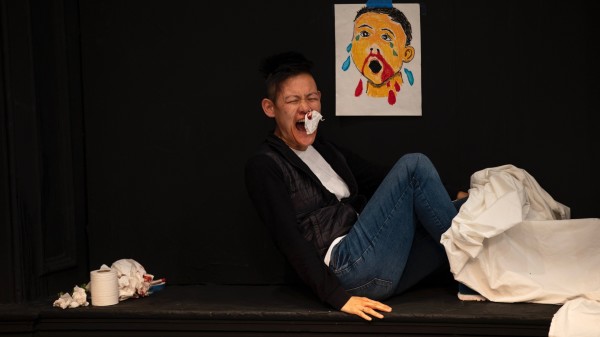
Regina Aquino stars in Round House Theatre’s virtual version of Young Jean Lee’s We’re Gonna Die

WE’RE GONNA DIE
Round House Theatre online
Available on demand through July 25, $32.50
www.roundhousetheatre.org

One of the last in-person plays I saw before the pandemic lockdown was Second Stage’s dynamic, ebullient version of Young Jean Lee’s We’re Gonna Die. Near the end, silver balloons bearing the name of the show were released from the ceiling of the Tony Kiser Theater, gently drifting down on the audience. I brought two home, and, remarkably, one of them is still partially filled, resting on top of a shelf where I see it every day. It is a symbol of the resilience of the human spirit, and of theater itself, which is on its way back after a difficult time.

Sixteen months later, Maryland’s Round House Theatre has mounted a more subdued but still powerful virtual version of the sixty-five-minute show, filmed live with a masked, limited, socially distanced audience and streaming through July 11. We’re Gonna Die consists of a series of first-person true stories and accompanying songs that look at how we approach and deal with impermanence. It was originally staged by Lee and her band, Future Wife, at Joe’s Pub in 2011 and then at Lincoln Center’s Clare Tow Theater in 2013. Raja Feather Kelly tore the roof off with his production at Second Stage, which took place in a hospital waiting room and featured a breakout performance by Janelle McDermoth.

At Round House, Regina Aquino stars as the narrator and singer, who relates the tales as if they all happened to her. (They were actually compiled from friends and relatives of Lee’s.) She runs up the steps, writhes across the floor, and jumps up and down on Paige Hathaway’s two-level set, which features bold colors and graphic symbols, with the musicians of the Chance Club each in their own large, homey cubicle: bassist Jason Wilson, keyboardist Laura Van Duzer, guitarist Matthew Schleigh, and drummer Manny Arciniega. The evening begins with an original composition by the Chance Club, “Wagons and Stars,” to set the mood, and then the show kicks off with the first of six vignettes that cover a wide spectrum of age and health, from the innocence of children to the isolation of growing old, exploring insomnia, the health-care system, family responsibilities, friendship, and generational angst, including “Lullaby for the Miserable,” “Comfort for the Lonely,” “When You Get Old,” and “Horrible Things.”

“I would have horrible nightmares and wake up with this feeling of dread that I was gonna die the exact way my father did,” Aquino says, talking about having trouble sleeping. “And if anyone tried to help me, I would just get angrier and angrier, and no one could do anything.” In the propulsive “I Still Have You,” she declares, “You still have me / I’m in your bed / I’ll hold your hand / until you’re dead / If I die first / you’ll be alone / but until then / you’ll have a home.”

Regina Aquino shares stories of loneliness and loss amid rocking songs in We’re Gonna Die

The show is fluidly directed and choreographed by Paige Hernandez, with cinematography by Maboud Ebrahimzadeh, costumes by Ivania Stack, sound by Mathew M. Nielson, and lighting by Harold F. Burgess II, making it a successful hybrid that is anchored by Aquino’s (The Events, Eureka Day) warm, intimate performance that will have you hanging on her every word.

In the grand finale, “I’m Gonna Die,” everyone joins in for a celebratory chorus that is filled with hope after a year in which more than six hundred thousand American died of Covid-19. The show has always had a positive outlook, but it hits a little deeper now. We all have developed a very different relationship with mortality, so don’t be surprised when you join in, with a smile on your face, as Aquino sings, “I’m gonna die / I’m gonna die someday / Then I’ll be gone / And it’ll be OK.”

In my March 2020 review of Kelly’s production at Second Stage, I wrote, “‘There’s a very good chance you’re not going to die,’ President Trump said when news about the coronavirus crisis was first spreading. While that might be true when it comes to Covid-19, it’s not true in general.” Indeed, what a year and a half it has been, as that balloon can attest.

The stream is available on demand through July 25; you can watch a panel discussion with Aquino, dramaturg Naysan Mojgani, and others here.

TINY HOUSE

Westport Country Playhouse’s virtual Tiny House is streaming through July 18

TINY HOUSE
Westport Country Playhouse
Through July 18, $25 per viewer, $100 per household
www.westportplayhouse.org

In Westport Country Playhouse’s virtual version of Michael Gotch’s first full-length play, Tiny House, Sam (Sara Bues), referring to her childhood, says, “I still hate fireworks.” Her mother, Billie (Elizabeth Heflin), asks, “You do?” Sam responds, “Yeah, they scare me. Like gunshots. Or someone jumping out and yelling boo! They don’t feel like a celebration. They feel like bad surprises.”

There are a lot of fireworks and bad surprises in store for the wisecracking Billie, the ultraserious Sam, Sam’s snarky husband, Nick (Denver Milord), and Billie’s second husband, the goofy but likable Larry (Lee E. Ernst), as the family comes together for the Fourth of July holiday at Sam and Nick’s new, and extremely small, eco-conscious house in the mountains. Billie is used to the finer things in life, which changed when her first husband was sent to prison; she also has very different political views than Nick does, leading to some vicious battles.

“Solar, bio-friendly, 100% recycled materials, tiny carbon footprint, completely self-sustaining. We’re like pioneers, I guess,” Nick explains. “My firm got Interior Design magazine up here after we finished the build, did a shoot; they’re going to follow the story for the first year or so. In installments.”

“Nice,” Larry says.

Nick adds, “Sam’s writing the copy for it —”

“—in monthly installments —” Sam cuts him off.

“Nice!” Larry repeats.

“— like a real-time journal,” Nick says.

“The Donner party kept a journal, too,” Billie snipes. “For a while.”

They are soon joined by neighbors Win (Stephen Pelinski) and Carol (Kathleen Pirkl-Tague), Renaissance Faire veterans who arrive in Medieval (and, later, Middle-Earth) costumes and make such pronouncements as “Hear ye! Hear ye! Kingdoms Major and Kingdoms Minor! Your Monarch
approacheth! Tremble and be amazed!” and “Zounds, he knows! / A fellow traveller!”

Meanwhile, another neighbor, Bernard (Hassan El-Amin), is a Keats-spouting, marmot-offering, well-armed survivalist who believes the end of the world is coming. “My sources are active. Triangulated and triple sourced,” he warns Nick and Sam, continuing, “Verifiable intel, not misdirection. Multiple potential flash points worldwide. Zero Hour feel to it.” Nick responds, “I don’t know, you know? Stuff I’m hearing just feels like garden-variety neo-Cold War saber rattling if you ask me.” As the fireworks approach, so does the sturm und drang as dark family truths emerge amid one key piece of advice for all to heed: “Don’t fuck with an elf.”

The show was originally workshopped with a different cast at Westport in 2018 and performed in January 2019 by the Resident Ensemble Players at the University of Delaware under the title Minor Fantastical Kingdoms, with that cast reuniting for this virtual edition, with playhouse artistic director Mark Lamos helming all three iterations. Part of Westport’s ninetieth anniversary virtual 2021 season, the one-hundred-minute Tiny House is tailor made for this moment in time as we emerge from lockdown, when we faced isolation and loneliness, unable to see friends and family for more than a year as we fought over politics and sought bits of joy in unexpected places.

Tiny House was filmed by Lacey Erb with the actors in different locations, performing in front of green screens, employing methods mastered by the Irish Rep; in fact, the digital design, which includes benches, chairs, and couches that make it appear that the actors are together in the same space and looking out at the forest and a vast mountain landscape, is by longtime Irish Rep designer Charlie Corcoran, based on Hugh Landwehr’s original set. Dan Scully served as editor, with costumes by Tricia Barsamian (Will and Carol’s getups are particularly fun and fanciful) and music and sound by Rob Milburn and Michael Bodeen.

The cast is highlighted by a wickedly delicious turn by Heflin (The Government Inspector, The Odd Couple), who never misses a beat as we learn more about her character’s situation, and Bues (Falling Away, The Sign in Sidney Brustein’s Window) as Billie’s daughter, who is having issues dealing with the sins of her parents. The show will be available on demand through July 18; you can check out a symposium about the work here, and there will be a talkback on July 12. Next up for Westport is John Patrick Shanley’s Doubt: A Parable in November.

THE SHED: OPEN CALL

“Open Call” features eleven immersive installations by emerging NYC-based artists (photo by twi-ny/mdr)

OPEN CALL
The Shed
545 West 30th St. at Eleventh Ave.
Thursday – Sunday through August 1, free with advance RSVP, 11:00 am – 6:00 pm
646-455-3494
theshed.org

In December 2020, I saw Aisha Amin’s Friday, a short film about a historic Brooklyn mosque, as part of the BAM virtual series “Programmers’ Notebook: New York Lives.” Its reinvention as the immersive installation The Earth Has Been Made a Place of Prayer for the fourth iteration of the Shed’s “Open Call” group show is emblematic of the current exhibition, which focuses on works by early-career New York City–based artists that explore ritual, diverse communities of color, and coming together as we emerge from the Covid-19 crisis. Amin’s film is projected on four screens hanging from the ceiling, forming a large “X,” and viewers are encouraged to watch it while sitting on one of thirty-two red and white prayer rugs that face Mecca, as if we’re all members of Masjid At-Taqwa in Bed-Stuy. “My film documents a communal prayer that happens every Friday afternoon in a confined space. It takes place in a room that is small for the amount of people who come to pray,” Amin says in a Shed interview with fellow “Open Call” artist Cindy Tran. “So, I’ve been thinking, too, about what it means to be in such close corners with people. For the audio, I had placed a recorder in the mosque to capture the two-hour prayer, and the amount of coughing and throat-clearing and sniffling and chatter I recorded. . . . Now, it would be a terrifying experience to go there if you didn’t have a mask and weren’t vaccinated, but there’s also something so nice about the closeness of the people in that space.” After I sat down, several other people joined me as we formed our own temporary community.

The exhibition features eleven installations in addition to thirteen live performances that have just concluded, chosen from approximately fifteen hundred applications, dealing with grief, loss, and mourning as well as joy, hope, and public congregation. Ayanna Dozier’s Cities of the Dead is a compelling faux documentary that details Solomon Riley’s (Ricky Goldman) dream of creating “Negro Coney Island” on Hart Island, which was scheduled to open July 4, 1924, before the city stepped in and halted the project. Hart Island was later used as a potters field for victims of AIDS and Covid-19, which disproportionately affected people of color. Kenneth Tam’s video sculpture The Crane and the Snake explores Asian American hazing and assimilation.

Aisha Amin reimagines her film Friday for Shed exhibit (photo by twi-ny/mdr)

Simon Liu invites viewers into a partially enclosed circular space to experience Devil’s Peak, a multichannel audiovisual journey into the troubled city of Hong Kong, a flurry of images with hidden bonuses just outside in one corner. Pauline Shaw’s stunning The Tomb-Sweeper’s Mosquito Bite uses MRI scans, science, memory, and the idea of diaspora in a large, hanging tapestry counterbalanced by objects encased in hand-blown glass vessels. “Autobiographical memory relies very much on the dormant network, so it’s really hard to separate what is happening in your daily life and what is happening in your memory,” she explains in a Shed talk with Liu. “Our notions of self, memory, and everyday experience are completely intertwined. Those are the intricate, scientific details of the MRI process. I’m translating the images that resulted into felt.”

Pauline Shaw explores memory and the diaspora in The Tomb-Sweeper’s Mosquito Bite (photo by twi-ny/mdr)

Emilie Gossiaux takes on anti-disability and anti-animal prejudices and celebrates her relationship with her seeing-eye dog in True Love Will Find You in the End, a pair of life-size sculptures that exhibit both human and canine characteristics shown holding hands. Stand in the middle of Tajh Rust’s Passages to read a quote from Caribbean philosopher Édouard Glissant, “I made an attempt to communicate with this absence,” stenciled repeatedly on two freestanding partially mirrored glass panels, evoking colonialism and migration. You’re encouraged to walk through Anne Wu’s A Patterned Universe, a kind of architectural playground with decorative elements representative of Flushing’s Chinese immigrant neighborhood. Esteban Jefferson pays tribute to a friend who passed away in 2019 with We Love You Devra Freelander, a pair of paintings documenting the passing of one year. Caroline Garcia mourns the loss of her mother in The Headless Headhunt, incorporating the Indigenous Filipino practice of headhunting related to grief, here enhanced with augmented reality.

And Le’Andra LeSeur’s There is no movement without rhythm, consisting of five rectangular screens arranged in a circle so people can stand in the middle, was inspired by jazz and blues and Gnawa male-dominated ceremonial traditions that LeSeur commandeers by filming herself holding objects and grasping her naked body. “I love the idea of thinking about what’s happening right now in this time and how we as artists are really processing and pushing forward with creation as a framework for healing,” LeSeur tells Open Call artist AnAkA in a conversation that gets to the heart of the exhibition as a whole. “And I’m also interested to hear you talk about this kind of collective movement. I think right now, in this time, it’s not necessarily about self, it’s about we and community, how we’re doing things not just for now but for the future. Even if we don’t have the opportunity to celebrate what we’re reclaiming, we’re creating a space for the future to have this opportunity to celebrate. And the beauty in that is really profound.”

EXPLORING SEVEN SACRED NAMES

Who: John Schaefer, Michael Harrison, W. H. S. Gebel, Ashley Bathgate, Tim Fain
What: Online album release party and discussion
Where: Arts Letters & Numbers YouTube
When: Wednesday, June 30, free with RSVP, 7:00
Why: “I wanted to show how beautiful simple harmonies can be, especially in just intonation . . . and [to create a work] that would serve as an introduction inviting listeners and musicians to start perceiving just intonation as an infinite harmonic system encompassing limitless possibilities on a spectrum between simplicity and complexity,” contemporary classical composer and pianist Michael Harrison says about his new album, Seven Sacred Names (Cantaloupe Music, June 2021). On June 30 at 7:00, Harrison, a Guggenheim Fellow, will celebrate the album’s release with an online party and discussion featuring cellist Ashley Bathgate and violinist Tim Fain, who both play on the record, and author, astrophysicist, and modern Sufi mystic W. H. S. Gebel, who wrote the liner notes and whose book Nature’s Hidden Dimension: Envisioning the Inner Life of the Universe served as inspiration to Harrison. Seven Sacred Names is a song cycle consisting of seven compositions and a reprise about “an awakening primal Self,” according to Gebel; the songs include “”Hayy: Revealing the Tones,” “Alim: Polyphonic Raga Malkauns,” “Qadr: Etude in Raga Bhimpalasi,” and “Sami: The Acoustic Constellation,” with such guests as Roomful of Teeth, Ina Filip, violist Caleb Burhans, tabla percussionist Ritvik Yaparpalvi, and composer/dhrupad/vocalist Payton MacDonald.

Harrison writes about one of the songs, “‘Al Mureed’ is the fourth of the seven names and signifies the birth of desire, the motivation needed to direct the will which awakens as a response to the dawning of relationship. The created world has become more interesting because now there is love, lover, and beloved; there is the possibility of relationship and of learning about and understanding the divine qualities as they manifest by sensing their vibration.” The event, which is presented by Arts Letters & Numbers as part of the “SunShip: The Arc That Makes the Flood Possible” exhibition for the CITYX Venice Italian Virtual Pavilion at the seventeenth Venice Architecture Biennale and is free with advance RSVP, will be hosted by John Schaefer of WNYC’s New Sounds.

ASK A CURATOR: DAVID HAMMONS AND GORDON MATTA-CLARK IN THE WHITNEY’S COLLECTION

David Hammons’s Day’s End pays homage to Gordon Matta-Clark’s 1975 deconstruction of an abandoned warehouse (photo by twi-ny/mdr)

Who: Adrienne Edwards, Elisabeth Sussman
What: Live virtual discussion about David Hammons, Gordon Matta-Clark, and Day’s End
Where: Whitney Zoom
When: Wednesday, June 30, free with RSVP, 6:30
Why: The Whitney’s “Ask a Curator” series continues June 30 with “David Hammons and Gordon Matta-Clark in the Whitney’s Collection,” a live Zoom discussion about Hammons’s recently installed permanent work, Day’s End, an homage to Matta-Clark’s 1975 similarly named intervention in an abandoned industrial building on Pier 52 at the southern edge of Gansevoort Peninsula. Whitney curators Adrienne Edwards and Elisabeth Sussman will also explore other works in the museum’s collection by the two artists, some of which were on display last fall in “Around Day’s End: Downtown New York, 1970–1986.”

The Whitney and Hudson River Park collaborated on David Hammons’s Day’s End (photo by twi-ny/mdr)

Over the course of seven years, Hammons created a 325-foot-long brushed-steel outline of the warehouse, placed in its exact same former location, a ghostly reminder of what — and who — is no longer there, a reference to the gay community that congregated in the area in the 1970s and 1980s until the AIDS crisis took so many lives. “I look at it as a statue because I’ve seen so many statues in the city and they’re all about memories,” Hammons says in a Whitney video of the dedication ceremony, which he chose not to attend. Half on land and half in the water, it’s a powerful work — officially part of Hudson River Park, not the Whitney — filled with mystery that draws the attention of passersby, many of whom may think it is the skeleton of a new building, especially since there is construction under way right next to it. Down the pier is Little Island, Barry Diller and Diane von Furstenberg’s lovely oasis, and across the street is the Whitney itself. (The Diller-von Fürstenberg Family Foundation was one of many donors who helped fund Hammons’s piece as well.) Admission is free with advance RSVP; Edwards and Sussman will be taking questions from the audience during the event.

AGAINST THE CURRENT

AGAINST THE CURRENT (Óskar Páll Sveinsson, 2020)
Quad Cinemas
34 West 13th St. between Fifth & Sixth Aves.
Through July 1
212-255-2243
quadcinema.com

After watching Óskar Páll Sveinsson’s Against the Current, you may not want to kayak around the entire island of Iceland, but you’ll probably want to start planning a trip to this extraordinary Scandinavian nation. In May 2019, Veiga Grétarsdóttir set off from her picturesque hometown of Ísafjörð on a three-plus-month, 1,250-mile journey circumnavigating the entire country in a sixteen-foot solo kayak, paddling counterclockwise, against the current, something that had never been done before. Following her along the coastline, in a fishing boat, and using drones, director and cinematographer Oskar Pall Sveinsson documented the hazardous expedition in vivid detail in the new documentary Against the Current, a film that features a barrage of spectacular shots not only of the sea and the topography of Iceland but of humanity’s tiny place in the world, set to a score by Högni Egilsson.

Along the way, Sveinsson also tells the story of Grétarsdóttir’s recent transition to becoming a woman; born male, she participated in rugged sports when she was younger but also hid what she considered a shameful secret: a compulsion to wear women’s clothing. As a man, she married a woman and had a daughter, but she ultimately decided to go through the surgery to change her gender and then prove to herself and others her physical and emotional strength by kayaking around Iceland. Sveinsson cuts between the treacherous trip and photographs and videos from Grétarsdóttir’s childhood and marriage, with her parents, friends, daughter, and doctors sharing stories about her; every single one accepts her transition, although it was perhaps most difficult for her ex-wife. “I often say that switching your gender like that is the biggest and most complex change you can make in your life,” psychiatrist Óttar Guðmundsson, who was part of Grétarsdóttir’s transgender team, explains. “You can’t change your life more drastically than that.”

Against the Current documents Veiga Grétarsdóttir’s remarkable story

Grétarsdóttir was initially joined by three kayakers, including Örlygur Sigurjónsson, who stuck around the longest, but ultimately she was left on her own, as expected. She would paddle for as many as thirteen hours a day, then pull over onto the coast, eat, and sleep in a tent, occasionally coming into contact with local people. One such supporter was sheep farmer Elisabet Petursdottir, who says, “I feel, regarding all the prejudice, that you’re not supposed to discuss things. All talk is shut down. It would be better to talk about things and solve the problems instead of creating them. In my opinion, everybody should have an open mind. Thank God we are all not made from the same mold. People must be allowed to be as they are.”

Grétarsdóttir holds nothing back, delving deep into aspects of her life that involved depression and even suicide attempts. She hopes that completing the circumnavigation will help her as well as others dealing with issues of personal identity. “I’ve dreamed of it for a long time, but having gone through everything, the transitioning, I decided to live my life, make my dreams come true,” she says. And every step of the way, there are visuals that will take your breath away. The film continues at the Quad through July 1; you can watch a Zoom interview with Grétarsdóttir and Sveinsson (Under the Surface, Ransacked) hosted by the Gene Siskel Film Center here.