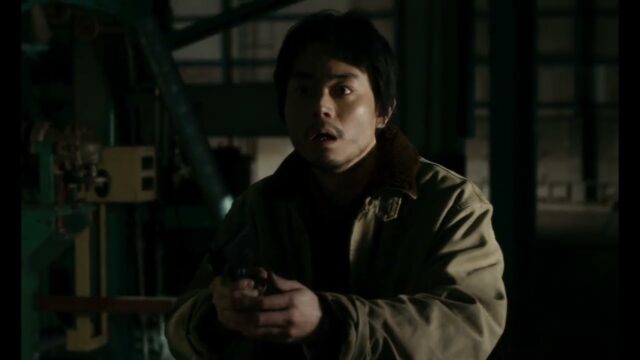
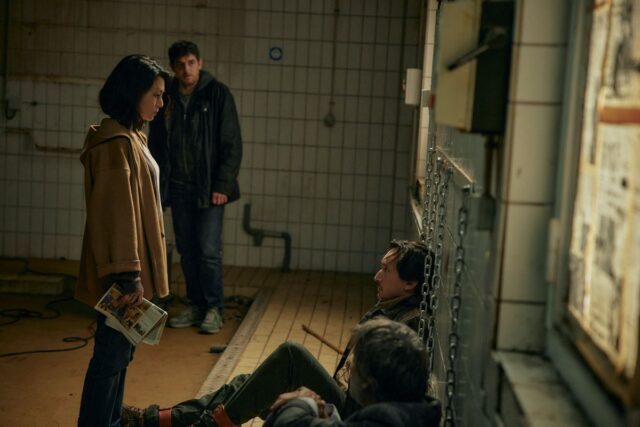
this week in lectures, signings, panel discussions, workshops, and Q&As

LEGACY, MEMORY, AND IMPERMANENCE: CELEBRATING MEREDITH MONK AT IFC

Meredith Monk looks at her past, present, and future in Billy Shebar’s celebratory and deeply affecting documentary

MONK IN PIECES: A CONCEPT ALBUM (Billy Shebar, 2025)
IFC Center
323 Sixth Ave. at West Third St.
July 24–31
www.ifccenter.com
monkinpieces.com

Near the beginning of Billy Shebar’s revelatory documentary, Monk in Pieces, composer Philip Glass explains that Meredith Monk “was a self-contained theater company. She, amongst all of us, I think, was the uniquely gifted one — is the uniquely gifted one.” It’s an important correction because Monk, at eighty-three, is still hard at work, creating live performances and films that defy categorization.

While several of her earliest projects were met with derision in critical circles, today she is revered for her remarkable output, although it is still impossible to put her into any kind of box. At one point in the documentary, a chorus of Monk scholars sings her praises; one says, “She’s achieved so much, has received so many accolades, and yet she’s this unknown,” a second notes, “She kind of falls through the cracks of music history,” and a third admits, “We don’t know how to talk about her.”

Written, directed, and produced by Shebar — whose wife, coproducer Katie Geissinger, has been performing with Monk since 1990 — and David Roberts, Monk in Pieces does a wonderful job of righting those wrongs, celebrating her artistic legacy while she shares private elements of her personal and professional life. Born and raised in Manhattan, Monk details her vision problem, known as strabismus, in which she is unable to see out of both eyes simultaneously in three dimensions, which led her to concentrate on vocals and the movement of her physical self. She studied Dalcroze Eurhythmics: “All musical ideas come from the body; I think that’s where I’m coming from,” she says. All these decades later, her distinctive choreography and wordless tunes are still like nothing anyone else does.
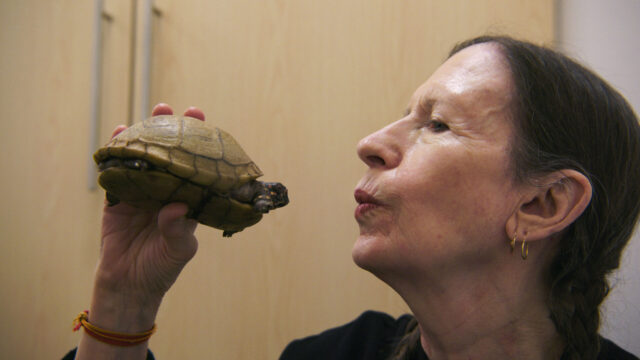
Meredith Monk shares a special moment with her beloved turtle, Neutron

Unfolding at a Monk-like unhurried pace, the ninety-five-minute documentary is divided into thematic chapters based on her songs, including “Dolmen Music,” “Double Fiesta,” “Memory Song,” “Turtle Dreams,” and “Teeth Song,” while exploring such presentations as Juice (1969), the first theatrical event to be held at the Guggenheim; Education of the Girlchild (1973), in which a woman ages in reverse; Quarry (1976), a three-part opera about an American child sick in bed during WWII; Impermanence (2006), inspired by the sudden death of her partner, Mieke von Hook; and her masterwork, Atlas (1991), in which the Houston Grand Opera worries about her numerous requests and production costs, whether the piece will be ready in time, and if it even can be considered opera. There are also clips from Ellis Island, Book of Days, Facing North, and Indra’s Net, her latest show, which was staged at Park Ave. Armory last fall. In addition, Monk reads from her journals in scenes with playful animation by Paul Barritt.

Monk opened up her archives for the filmmakers, so Shebar, Roberts, and editor Sabine Krayenbühl incorporate marvelous photos and video from throughout Monk’s career, along with old and new interviews. “It was her voice that was so extraordinary, not only the different kind of sounds she could make, but the imagination she was using in producing the sound . . . totally individual,” Merce Cunningham says. WNYC New Sounds host John Schaefer gushes, “I don’t know when words like multimedia and interdisciplinary began to become in vogue, but Meredith was all of those things.” Her longtime friend and collaborator Ping Chong offers, “She had to fight to be acknowledged in the performing arts world because critics were saying that what she was doing was nonsensical, was crazy, was not serious; in a way, it’s a fight to survive. Pain is where art comes from. . . . Art has to come out of need. And now she’s an old master.”

And Björk, who recorded Monk’s “Gotham Lullaby,” touts, “Meredith’s melody making is like a timeless door that’s opened, like a gateway to the ancient is found. It definitely affected my DNA. . . . Her loft that she has lived in for half a century is an oasis in a toxic environment.” Among the other collaborators who chime in are longtime company member Lanny Harrison; composer Julia Wolfe; and David Byrne, for whom she created the opening scene of his 1986 film, True Stories, and who says he learned from Monk that “you can do things without words and it still has meaning, it still has an emotional connection.”

Some of the most beautiful moments of the film transpire in Monk’s loft, where she tends to her beloved forty-two-year-old turtle named Neutron, puts stuffed animals on her bed, meditates while staring at windows lined with Tibetan prayer flags, composes a new song, looks into a mirror as she braids her trademark pigtails, and sits at her small kitchen table, eating by herself. Surrounded by plants and personal photographs, she moves about slowly, profoundly alone, comfortable in who she is and what she has accomplished, contemplating what comes next.

“What happens when I’m not here anymore?” Monk, who received the 2014 National Medal of Arts from President Barack Obama, asks while working with director Yuval Sharon, conductor Francisco J. Núñez, and performer Joanna Lynn Jacobs on a remounting of Atlas for the LA Philharmonic in 2019. “It’s very rare that anybody gets it.”

Monk in Pieces goes a long way toward rectifying that, filling in the cracks, helping define her place in music history.

Monk in Pieces runs July 24-31 at IFC Center; there will be Q&As following the 6:45 screenings on July 24 with Monk, Shebar, and producer Susan Margolin, moderated by Schaefer; on July 25 with Monk, Shebar, and Margolin, moderated by violist Nadia Sirota; and on July 26 with Shebar.

[Mark Rifkin is a Brooklyn-born, Manhattan-based writer and editor; you can follow him on Substack here.]


HIDDEN GEMS: BED-STUY STooPS SUMMER FESTIVAL

STooPS 2025 SUMMER FESTIVAL
Stuyvesant Ave. & Decatur St., Brooklyn
Saturday, July 26, free (advance registration recommended), 1:00 – 7:00
www.stoopsbedstuy.org
www.eventbrite.com

The twelfth annual STooPS Arts Crawl and Block Party takes place on July 26 on Decatur St. between Lewis and Stuyvesant Aves. in Brooklyn, with live music and dance, workshops, and visual art on the stoops and shared spaces of Bedford–Stuyvesant. This year’s theme is “Echoes of Greatness: Celebrating Bed-Stuy’s Hidden Gems,” honoring the lesser-known treasures in the neighborhood. The festivities begin at 1:00 with a block party lasting until 7:00, hosted by Koku with ToniBNYC, a Kiddie Korner by Bridges: A Pan-Afrikan Arts Movement, collaborative visual art by Ovila Lemon/Mut’Sun, and healing workshops by Akika Flower Essences & Apothecary and Essence of Ase. There will be art crawls at 1:30 and 4:00, led by Shanna Sabio of GrowHouse NYC, with Carmen Carriker, Courtney Cook, Ariana Carthan/Wukkout!, Brooklyn Ballet, Qu33n Louise, Nia Blue, and Púyaloahí. Kendra J. Ross Works and Soul Science Lab headline the show. This year’s awardees are Ovila Lemon, Richard Cummings, Valerie Ferguson, Monique Scott, Larry Weekes, and Damon Bolden.

“The summer festival is more than a celebration — it’s a bridge between Bed-Stuy’s past and its future,” STooPS founding director Kendra J. Ross said in a statement. “By bringing art to the stoops, we make space for neighbors to connect across generations and experiences. In a time of change, this is how we honor what’s been while shaping what’s next — together.”

All events are free but advance registration is recommended.

[Mark Rifkin is a Brooklyn-born, Manhattan-based writer and editor; you can follow him on Substack here.]
WAVING THE FLAG: ARTIST’S CHOICE AT CHELSEA FOUNDATION

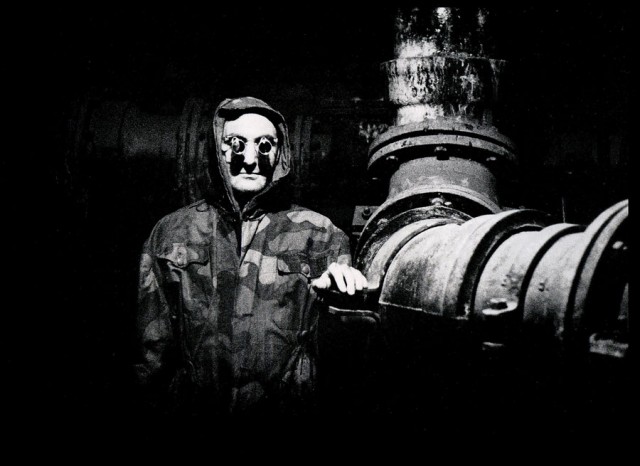
Mark Hogancamp tries to rebuild his life in a carefully constructed alternate reality (photo by Tom Putnam)

ARTIST’S CHOICE: MOVIE NIGHTS
The FLAG Art Foundation
545 West 25th St. between Tenth & Eleventh Aves.
Wednesday, July 23, July 30, August 6, free with advance RSVP, 7:00
www.flagartfoundation.org

For the next three Wednesdays, the FLAG Art Foundation is hosting free screenings of works handpicked by three artists, films that have been meaningful to them in their life and artistic practice. The series begins July 23 with Jeff Malmberg’s Marwencol, selected by New York City–born, Jersey City–based Ana Benaroya, who explores the human body and aspects of herself in colorful characters in manic situations. For July 30, LA-based Ethiopian-American multidisciplinary artist Awol Erizku has chosen three of the most important and influential indie films ever made, Maya Deren and Alexander Hammid’s Meshes of the Afternoon, Chris Marker’s La Jetée, and Ousmane Sembène’s Black Girl. The program concludes August 6 with short films picked by Baltimore-born painter, writer, and musician Cynthia Daignault.

MARWENCOL (Jeff Malmberg, 2010)
Wednesday, July 23, free with advance RSVP, 7:00
www.flagartfoundation.org
www.marwencol.com

Named Best Documentary at numerous film festivals across the country, Marwencol offers a surprising look inside the creative process and the fine line that exists between art and reality. On April 8, 2000, Mark Hogancamp was nearly beaten to death outside a bar in his hometown of Kingston, New York. He spent nine days in a coma and more than a month in the hospital before being released, suffering severe brain damage that has left his memory a blur. To help put his life back together, he began using toys and dolls — Barbies, celebrity replicas, army men — to re-create his personal journey. He makes dolls of his friends and relatives, the people he works with, and others, constructing an alternate WWII-era universe he calls Marwencol, complete with numerous buildings and plenty of Nazis. He captures the detailed story in photographs that are not only fascinating to look at but that also help him figure out who he was and who he can be.

This miniature three-dimensional world is reminiscent of the two-dimensional one carefully fashioned by outsider artist Henry Darger in his fifteen-thousand-page manuscript, The Story of the Vivian Girls, in What is known as the Realms of the Unreal, of the Glandeco-Angelinnian War Storm, Caused by the Child Slave Rebellion, which also features an alternate reality involving military battles set amid stunning artwork. Director, producer, and editor Jeff Malmberg makes no judgments about Hogancamp, and asks the same of the audience. In his first full-length film, Malmberg shares the compelling story of a deeply troubled, flawed man suddenly forced to begin again, using art and creativity to bring himself back to life. He speaks with Hogancamp’s mother, his old roommate, the prosecutor who handled his case, and others who are first seen proudly holding the doll Hogancamp made of them. And Malmberg doesn’t turn away from the more frightening aspects of Hogancamp’s daily existence. Marwencol is an unforgettable portrait of lost identity and the long road to redemption.

Chris Marker

Chris Marker’s La Jetée is a postapocalyptic thriller about movies and memory, told almost exclusively through still images

LA JETÉE (Chris Marker, 1962) / MESHES OF THE AFTERNOON (Maya Deren and Alexander Hammid, 1943) / BLACK GIRL (LA NOIRE DE . . .) (Ousmane Sembène, 1966)
Wednesday, July 30, free with advance RSVP, 7:00
www.flagartfoundation.org

The Flag series continues with an inspired trio of wildly different low-budget, black-and-white works that experiment with the language of cinema. Chris Marker’s La Jetée is a nearly half-hour postapocalyptic dystopian thriller set in a world that calls “past and future to the rescue of the present.” Told almost completely in dark, eerie black-and-white photographs — the camera moves only once, pulling back on the opening establishing shot of the titular pier at Paris’s Orly airport, and at another point a woman opens her eyes in bed — La Jetée explores time and memory as a WWIII survivor (Davos Hanich) in the underground Palais de Chaillot galleries revisits an event that occurred with a woman (Hélène Chatelain) on the jetty. The film, referred to in the credits as “un photo-roman,” is narrated by Jean Négroni, with the only dialogue occasional unintelligible whispering by the German scientists in charge of the mysterious operation; the soundtrack also includes lush music from Trevor Duncan and a repeated thumping that mimics heartbeats. The film explores both art as memory and memory as art as well as the cinema itself; for example, Marker (Sans Soleil, Le joli mai) references Alfred Hitchcock’s Vertigo when the man and woman look at the rings of a Sequoia tree, and it has gone on to influence such films as Terry Gilliam’s 12 Monkeys, the Matrix trilogy, and countless other movies and videos. It’s a mesmerizing work that brings fresh insight upon each viewing.

In 1943, the husband-and-wife team of Maya Deren and Alexander Hammid made the fourteen-minute masterpiece, Meshes of the Afternoon, at their home in Hollywood. The silent work — soundtracks were added by others later — is a celebration of the surreal, filled with shots of shadowy figures and such objects as a flower, a key, a knife in a loaf of bread, and a telephone receiver off its cradle. Stairs and slow motion figure prominently as a black-draped figure with a mirror for a face haunts the proceedings and the protagonist is joined by her doppelgänger. The film stands with such works as Salvador Dalí and Luis Buñuel’s Un Chien Andalou and Ballet Mécanique, René Clair’s Entr’acte, and Jean Cocteau’s The Blood of a Poet as masterpieces of the avant-garde.

Diouana (Mbissine Thérèse Diop) seeks so much more out of life in Ousmane Sembène’s Black Girl

Ousmane Sembène’s debut, 1966’s Black Girl, launched an award-winning career that established the Senegalese author and filmmaker as a leading international storyteller for five decades. In Black Girl, also known as Le noire de . . . , Mbissine Thérèse Diop stars as Diouana, a Senegalese woman who leaves Dakar to work for a wealthy French family in Antibes. Colonialism rules the day as she tries to assert her identity but is treated with dismissive condescension. Early on, a dinner-party guest announces, “I’ve never kissed a black woman,” and pecks her on each cheek as she stares away blankly and the others laugh. “I’ve got a feeling she’s angry,” another guest says, while one of the men adds, “Their independence has made them less natural.” Diouana dreams of a better life as she remembers what it was like in Senegal, but she is thwarted by racism and bigotry every step of the way. Sembène, who would go on to make such films as Mandabi, Faat Kiné, and Moolaadé, incorporates a unique editing style with an often playful silent-film-like score to share Diouana’s longing for something else.

[Mark Rifkin is a Brooklyn-born, Manhattan-based writer and editor; you can follow him on Substack here.]

BREATHING UNDERWATER: DROWNING DRY AT IFC

A summer outing offers multiple traumatic situations in Lithuanian drama Drowning Dry

DROWNING DRY (SESĖS; SISTERS) (Laurynas Bareiša, 2024)
IFC Center
323 Sixth Ave. at West Third St.
July 18-31
www.ifccenter.com
www.dekanalog.com

In 2018, Lithuanian filmmaker Laurynas Bareiša served as one of the cinematographers on Marija Kavtaradzė’s debut feature, Summer Survivors, about young adults dealing with mental illness. Bareiša now follows up his own debut feature, the 2021 crime drama Pilgrims, with the haunting Drowning Dry, which could have also been called Summer Survivors. (The Lithuanian title, Sesės, means “Sisters.”)

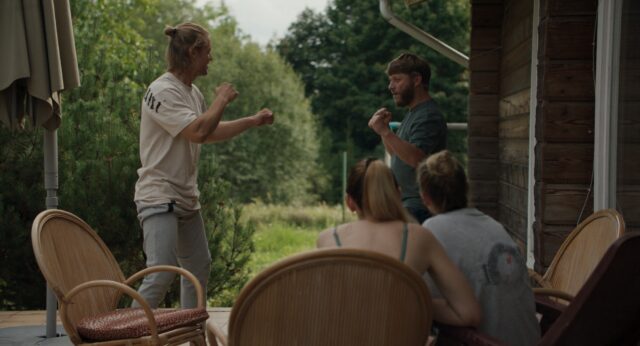
Close siblings Ernesta (Gelminė Glemžaitė) and Justė (Agnė Kaktaitė) have traveled with their families for a weekend getaway at a cabin on a lake. Ernesta is married to Lukas (Paulius Markevičius), an MMA champion, and they have a young son, Kristupa (Herkus Sarapas); Justė is married to Tomas (Giedrius Kiela), a schlubby dude jealous of Lukas’s strength, and they have a young daughter, Urte (Olivija Eva Viliüné). They all go swimming off the pier, but when tragedy strikes, their relationships with one another change — until Bareiša, who wrote, directed, and photographed the film, reverses time and the result of the event is altered, rearranging the dynamics. Bareiša ends up doing this multiple times, as various episodes happen differently from how they occurred originally, so the interaction among the characters keeps shifting as they face alternate forms of grief and trauma.

Drowning Dry is named after the medical term “dry drowning,” an urban myth that instills fear in parents that their children can drown long after they have been rescued from water. “Dry drowning is a symbol of this overprotection of kids because the real medical condition is very rare,” Bareiša told the Hollywood Reporter. Bareiša was inspired to make the film after having to resuscitate his two-year-old son and thinking about four paths the near-tragedy could have taken, represented by the adults in the film. By the end, numerous characters are having breathing difficulties, requiring help.

The film unfurls in long, uncut scenes in which Bareiša barely moves the camera; it is as if we are there with the family, sitting at the table, standing by the pier, waiting for the ambulance — or perhaps seeing it as a memory of our own grief. The repetition, or doubling, of certain scenes puts the audience in the position of questioning what they’re experiencing and wondering about the disparate paths their personal trauma could have led to.

Drowning Dry opens July 18 at IFC Center, with Bareiša on hand for Q&As at the 7:20 shows on Friday, moderated by Ryan Lattanzio, and Saturday, moderated by Sierra Pettengil.

[Mark Rifkin is a Brooklyn-born, Manhattan-based writer and editor; you can follow him on Substack here.]
INHERITANCE & THE AMERICAN DREAM: DEATH & TAXES AT IFC

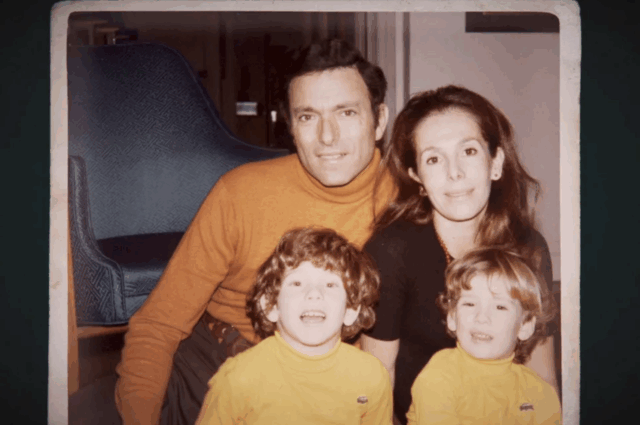
Harvey Schein, Joy Schein, Justin Schein, and Mark Schein pose for a family photo in 1978 (courtesy Schein Family Archives)

DEATH & TAXES: MY FATHER, OUR FAMILY, AND THE COST OF THE AMERICAN DREAM (Justin Schein, 2024)
IFC Center
323 Sixth Ave. at West Third St.
July 17–24
www.ifccenter.com
www.deathandtaxesfilm.com

“If more and more wealth can be accumulated and provided to heirs without ever paying any taxes, then we are on the way to a permanent aristocracy in America,” Clinton Labor secretary Robert Reich says in Justin Schein’s Death & Taxes, a heartfelt and passionate film opening July 17 at IFC.

More than twenty years in the making, the documentary focuses on Justin’s father’s obsession with the estate tax. Harvey Schein was a successful executive in the music industry, landing top jobs at Columbia, Sony in Japan, and Warner, although his famous temper often got him in trouble. Born in 1927 in the Bronx and raised in East New York, Harvey joined the navy, then went to school on the GI Bill and graduated from Harvard Law. He married Joy Gitlin, a dancer and social worker from toney Jamaica Estates, and they had two sons, Mark and Justin.

The film begins in 2003 as the Scheins are in their country home in Connecticut; Harvey has gathered them there to discuss what to do after he is gone.

“Welcome to a Schein family meeting,” Justin narrates in voice-over. “That’s my dad, holding forth on his favorite subject: keeping his hard-earned money from the taxman when he dies. It’s not a bad problem to have, as long as you don’t let it drive you crazy. But unfortunately it did.”

Justin, codirector Robert Edwards, and editors Purcell Carson and Brian Redondo intercut archival news footage, home movies and photos, animation, and new interviews with family members, friends, Harvey’s colleagues, and numerous economists and consultants who offer their thoughts about Harvey and taxes and how things have changed over the years.

Mark Schein talks about how saving money was a “military dictate.” Harvey’s executive assistant Yvonne Johnson calls him “frugal. . . . Everybody knows he had a very, very difficult personality.” Former CBS Records president Clive Davis notes that Harvey “had one Achilles heel in his tendency to be argumentative.”

Harvey’s parents left him nothing, so he was proud of what he built, but he wasn’t about to just hand over millions of dollars to the government to use for welfare and other programs he disagreed with. His disdain for the estate tax even led to his moving to Florida to avoid paying it, jeopardizing his marriage when Joy wanted to head back north and live in New York City.

Meanwhile, Justin, acknowledging the privilege he was born into, speaks with experts on both sides of the estate tax controversy. Republican pollster and strategist Frank Luntz, who renamed the estate tax “the death tax,” considers it “confiscation.” Americans for Tax Reform founder Grover Norquist argues, “I think the death tax does violate people’s sense of the American dream. . . . It’s up to you, and as long as you don’t hurt anybody else, nobody cares.” Heritage Foundation senior fellow Stephen Moore defends Harvey, explaining, “The evidence shows that giving money to the people is not a formula for economic success.”

Justin points out that the estate tax affects only those who are worth at least $13.6 million, a tiny minority of Americans. Institute on Tax and Economic Policy director Amy Hanauer says, “It is 0.1 percent of estates in America that have been subject to the estate tax. It is really the very, very, very wealthy.” Institute for Policy Studies senior scholar Chuck Collins, referring to “the wealth defense industry,” asks, “Should we be ruled by small numbers of wealthy families? Should they dominate our system? So it’s a very American idea to limit the concentration of power.” ProPublica journalist James Bandler posits, “The wealthy have found all sorts of legal ways to reduce their taxes, in some cases to zero.” Discussing government programs, Princeton University sociologist Matthew Desmond offers, “We’re all on the dole.” And Bootstrapped author Alissa Quart contends, “If you think you’re self-made, call your mother.”

While the right-wing news media claims that the death tax is a form of double taxation, Roosevelt Institute president and CEO Felicia Wong, Maven Collaborative economist Anne Price, and New School economist Darrick Hamilton delve into the racial wealth gap. “That kind of passing down of inequalities end up crystalized in wealth inequality,” Wong says. Hamilton adds, “Taxes are used to strategically direct resources in ways to promote economic activity; a big question is for whom.”

Harvey Schein and Joy Schein’s retirement in Sanibel, Florida, did not go as planned (photo by Justin Schein, 1994)

At the heart of the film is the concept of the American dream, something that Justin wants to be available to everyone but is distressed by people like his father who refuse to pay their fair share. Remembering his daily trip to private school, passing through minority communities in disrepair, he recalls, “Looking out the bus window as a kid, I could see that people were hurting.” Showing a map depicting the redlining of New York City, he continues, “My school bus drove right through one of these red areas; each one marks a nonwhite neighborhood excluded from loans. And without a loan, a whole segment of the population was prevented from buying into the American dream of building family wealth.”

Under the current administration, the wealth gap is likely to grow, based on projections surrounding the passage of the One Big Beautiful Bill, and the bickering over the Trump tax cuts will remain as heated as ever. Republicans will battle with Democrats, red states will feud with blue states, the rich will fight with the poor, and fathers will clash with sons.

Since this is Justin’s film, he gets the last word: “When the wealthy are able to avoid paying their share of taxes, the rest of the country gets left behind.”

The US theatrical release of Death & Taxes takes place July 17–24 at IFC. Justin Schein will be on hand for several Q&As, on July 17 at 7:00 with Patriotic Millionaires chair Morris Pearl, New York City comptroller Brad Lander, and New York Working Families Party codirector Ana María Archila, moderated by Strong Economy for All Coalition executive director Michael Kink, on July 18 at 6:35 with Collins, on July 19 at 6:35 with Desmond, and on July 20 at 1:35 with Hamilton and Stronger Together deputy director Charles Khan.

[Mark Rifkin is a Brooklyn-born, Manhattan-based writer and editor; you can follow him on Substack here.]
CLOUD OF THE SERPENT: KIYOSHI KUROSAWA AT JAPAN CUTS FESTIVAL

A disengaged online reseller (Masaki Suda) gets more than he bargained for in Kiyoshi Kurosawa’s Cloud

JAPAN CUTS — FESTIVAL OF NEW JAPANESE FILM 2025: KIYOSHI KUROSAWA
Japan Society
333 East 47th St. at First Ave.
January 10-20
www.japansociety.org

The annual summer Japan Cuts festival is underway at Japan Society, eleven days of new and restored works that began July 10 with Yasuhiro Aoki’s debut feature, ChaO, and continued with Yuya Ishii’s The Real You, Kenichi Ugana’s The Gesuidouz, and Kichitaro Negishi’s Yasuko, Songs of Days Past, prime examples of the wide range of works at the fest, many of them North American premieres and followed by Q&As. Upcoming highlights include Daihachi Yoshida’s Teki Cometh, Takashi Miike’s Blazing Fists, Masashi Iijima’s Promised Land, and the closing night selection, Joseph Overbey’s documentary The Spirit of Japan, complete with a shochu reception.

The 2025 edition celebrates the career of Kiyoshi Kurosawa, who will participate in Q&As and introductions at several screenings. “The very base of cinematic expression is to film the reality in front of you using cameras. So, the similarity with the reality would be the feature of a movie,” Kurosawa told Dirty Movies in 2018. “This could be also its limitation, but anyway, I am particularly interested in the fact that a movie is almost the same as reality, but at the same time is slightly different than reality. This difference or unreality is always my starting point when I create my work.” That quote can be applied to the two Japan Cuts films that are reviewed below.

CLOUD (『クラウド』) (KURAUDO) (Kiyoshi Kurosawa, 2024)
Wednesday, July 16, 6:00
japansociety.org

Kobe-born suspense master Kiyoshi Kurosawa returns to Japan Cuts with a pair of intense revenge thrillers that are not for the faint of heart. Both were made in 2024, both feature torture and violence, and both are tons of fun.

Up first for Kurosawa, who has made such horror faves as Cure, Pulse, and Creepy as well as such psychological dramas as Bright Future and Tokyo Sonata, is Cloud, the centerpiece selection. Masaki Suda stars as Yoshii, a quiet, disengaged young man who works at a cleaning factory, supplementing his income as an online reseller, purchasing goods at cut rates — unethically taking advantage of people — and selling them online at exorbitant prices, with no care whether the items are actually legitimate or fakes. He is upset when the owner, Takimoto (Yoshiyoshi Arakawa), offers him a promotion; Takimoto sees promise in Yoshii, but Yoshii has no interest in taking on more responsibility. When one of his deals makes him a lot of money, he quits his job and dedicates all his time to reselling whatever products he can get his hands on, from designer handbags to anime figures. Yoshii alienates his business partner, Muraoka (Masataka Kubota), and moves with his girlfriend, Akiko (Kotone Furukawa), to a house in a small, faraway town, where a young local man, Sano (Daiken Okudaira), insists on being his assistant. As his deals get more and more lucrative and dangerous, Yoshii builds a well-deserved bad reputation as a ruthless operator, and soon a group of men, armed to the hilt, come after him, determined to get even.

Cloud is a fierce, propulsive trip down the internet rabbit hole, where anonymity might feel safe but reality threatens to blow it all up. Yoshii ruins every relationship he has, with clients, customers, Sano, Akiko, Takimoto, et al., seemingly without any care or regard; he spends hours staring at his computer screen, waiting for his items to start selling, with more concern and passion than he has for any human being. And when the posse finds him, he has no understanding why they want him dead.

Suda (Kamen Rider, Cube) is terrific as Yoshii; we are initially offput by his herky-jerky movement and disengagement from society, but as everything closes in on him, we also feel compassion for his potential fate. The film is beautifully shot by Yasuyuki Sasaki and expertly directed by Kurosawa, who knows just how to make the audience squirm, especially at unexpected moments.

“Grudges, revenge, they’ll only drag you down,” one member of the posse tells another. “Think of this as a game.” It’s a wry comment on how too many people look at the real world these days.

Cloud is screening July 16 at 6:00 and will be followed by a Q&A with Kurosawa, who will also receive the Cut Above Award at a reception afterward.

Kiyoshi Kurosawa’s remake of his own Serpent’s Path is another suspense gem

THE SERPENT’S PATH (『蛇の道』) (HEBI NO MICHI) (Kiyoshi Kurosawa, 2024)
Thursday, July 17, 6:00
japansociety.org

When Kiyoshi Kurosawa was asked by a studio in France to remake one of his earlier films, he opted to revisit his 1998 straight-to-video thriller Serpent’s Path, which was written by Hiroshi Takahashi (Ringu, Sodom the Killer) and starred Show Aikawa and Teruyuki Kagawa. He cowrote the new script with French journalist Aurélien Ferenczi, who passed away in October 2024 at the age of sixty-one. The result is a brutal, gripping white-knuckle shocker that you won’t be able to turn away from, no matter how much you might want to.

Albert Bacheret (Damien Bonnard) is a disheveled, distraught man who is determined to find whoever murdered and dismembered his eight-year-old daughter, Marie (Hélène Caputo). He is helped by Sayoko Mijima (Ko Shibasaki), a calm, composed hospital psychiatrist who is treating Yoshimura (Hidetoshi Nishijima), a Japanese man having trouble adjusting to life in France. Sayoko has also moved from Japan to Paris, leaving behind her partner, Soichiro (Munetaka Aoki).

Albert and Sayoko are not criminal masterminds, but they expertly kidnap Laval (Mathieu Amalric) and chain him to a wall in an abandoned warehouse. Albert accuses Laval of having killed Marie, but Laval adamantly denies he had anything to do with it, claiming he is just an accountant at the Minard Foundation, an institution that we slowly learn more about, none of it good. Deprived of food, drink, and a bathroom, Laval eventually gives up his boss, Pierre Guérin (Grégoire Colin), who Albert and Sayoko decide to capture as well. Like Laval, Pierre is not forthcoming at first, but torture has a way of making people talk, whether it be truth or lies, and the plot thickens, offering more and more surprises along with more and more violence.

Throughout the film, Albert, who became estranged from his wife, Lola (Vimala Pons), after the tragic incident, shows a short video of Marie playing the piano and roller skating as he reads a newspaper report that details exactly what happened to her, making Laval, Pierre, and, later, Christian Samy (Slimane Dazi) watch it — but the audience as well, as if inuring us to the atrocity while also feeling Albert’s torment. Kurosawa and cinematographer Alex Kavyrchine have created a fascinating dichotomy between the kind of violence we see onscreen, whether a movie in a theater or a video on a smartphone or laptop, and the kind we are not shown but only have to imagine, especially when it involves children. We cringe every time Albert narrates the video but not at what Albert and Sayoko do; in fact, we are rooting for them. As the body count rises, so do humorous shots of the victims, eliciting uncomfortable yet necessary laughter.

Albert Bacheret (Damien Bonnard) and Sayoko Mijima (Ko Shibasaki) hunt for a killer in The Serpent’s Path

Bonnard (Staying Vertical, Les Misérables) is terrific in a similar way as Suda is in Cloud, portraying a laser-focused but perhaps misguided man who has disconnected from society, impulsive and restless, turning to screens to redefine his purpose. His unease is so palpable you just want to give him a giant hug — but maybe not when he’s armed. Actress and singer Shibasaki (One Missed Call, xxxHolic) adds just the right amount of mystery to Sayoko, who might be more than she seems. Meanwhile, the mighty Amalric (Kings and Queen, The Grand Budapest Hotel) once again proves why he’s one of the best actors on the planet.

At one point, when Yoshimura talks to Sayoko about facing the end, she replies, “The end? The end of what? Are you afraid of the end? Isn’t the hardest part when there is no end?”

Or, in other words, be careful what you wish for.

The Serpent’s Path is screening July 17 at 6:00 and will be followed by a Q&A with Kurosawa, who had a busy 2024, directing Cloud, The Serpent’s Path, and the forty-five-minute experimental Chime following a four-year pause at least in part because of the pandemic. In addition, you can catch the North American premiere of the 4K restoration of the 1998 original on July 19 at 9:00 as well as Kurosawa’s 1998 License to Live on July 17, a reconstruction of Sam Peckinpah’s 1970 western The Ballad of Cable Hogue.

[Mark Rifkin is a Brooklyn-born, Manhattan-based writer and editor; you can follow him on Substack here.]

FREE LAND FOR FREE PEOPLE: THE RETURN OF COMMUNE

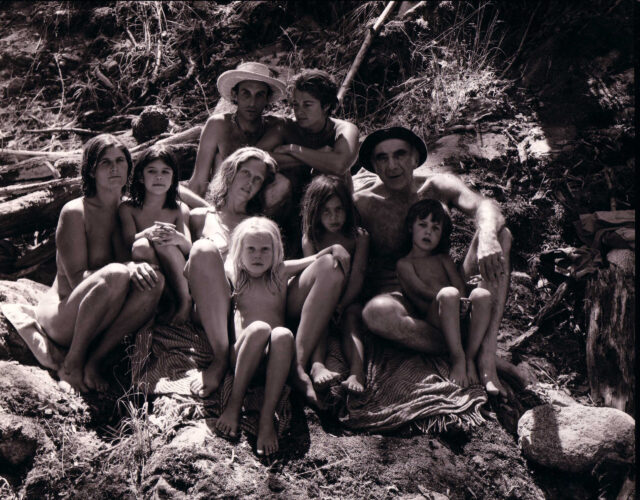
Restored documentary looks at life at Northern California commune from 1968 to 1979 and beyond (photo by Jock Sturges)

COMMUNE (Jonathan Berman, 2005 / restored 2025)
DCTV Firehouse Cinema
87 Lafayette St.
July 11-17
www.dctvny.org

Jonathan Berman’s twentieth anniversary restoration of his documentary Commune could hardly be more timely. The film details the fascinating story of Black Bear Ranch in Siskiyou County in Northern California near Mt. Shasta, where dozens of people left their traditional lives and started their own community to escape what was happening in the country in the wake of the violent Democratic National Convention in Chicago in 1968.

“After going to Washington, DC, for a while and thinking, boy, it’s going to be a long time before all these people retire and get out of here and something changes, I don’t think I can stand to wait around,” Mahaj Seeger says in the film.

Actor Peter Coyote explains, “We thought the government was going to be overthrown in two years and there would be a new culture rising from the ashes, and we wanted to have an alternative, a nonmercantile alternative that offered citizens the options of being something other than a consumer or an employee.”

And Cedar Seeger admits, “I moved there to get away from America; I did not want to be an American as defined by the mainstream, although I guess deep down I’ve always felt proud that I’m an American. But to me those values are represented in open-mindedness and free thinking and tolerance and the ability to do what you want.”

The group purchased eighty acres of woods for twenty-two thousand dollars, with contributions from the Doors, the Monkees, Frank Zappa, and others. The goal was to create a society that played by its own rules, not subject to political parties or any existing set of laws and mores. As Michael Tierra declares in the film, their motto was “Free Land for Free People.”

In addition to all the above, Berman speaks with such commune participants as Creek Hanauer, Martin Linhart, Peter Leaf, and Kenoli Oleari. Elsa and Richard Marley share critical behind-the-scenes information. Tierra relates how he tried to get James Coburn involved. Catherine Guerra preaches free love. Osha Neumann, a member of the anarchist Motherfuckers, says that it “felt like coming home.” Activist Harriet Beinfeld brings up the FBI, which in 1970 reported, “Commune might be a training ground for militants planning insurrection in Northern California.” Geba Greenberg and Allegra Brucker discuss becoming self-trained midwives to help women give birth on the ranch.

We learn what they are doing in 2005 and meet some of the children who grew up in the commune, including Aaron Marley, a scientist who works with experimental lab rats, and Tesilya Hanauer, a writer and massage therapist.

While neighbor Hoss Bennett remembers fondly about how he helped the commune, local resident Mel Kramer declares, “It was shocking,” and public defender Larry Bacon calls it an “invasion of flower children.”

Berman and editors Michael Taylor and Marisa Simpson interweave archival news footage and photos and home movies taken at the ranch, showing the group renovating a ramshackle barn, growing vegetables, preparing food, and prancing about naked, which they did a lot. Ultimately, it was not as idyllic as was hoped, as the concept of free love led to jealousies, and there was debate over how the children were being raised. The beginning of the end might have been the infiltration of the Shivalila cult in 1979, led by Gridley Wright, who had unique and controversial views of child-rearing. A 1987 reunion offers engaging perspective.

In his 2025 director note, Berman (The Shvitz, Calling All Earthlings) points out, “With the very real modern struggles of Trump’s America, people are seeking solutions of every kind to an increasing authoritarianism. As feminist activist Carol Hanisch wrote in 1969, ‘The personal is political,’ and nothing is more personal than how we live and the who, what, and where of the place we call home. . . . In our modern high-tech world, where an Amazon delivery is moments away and there’s less need to leave our dwellings, we face a plague of loneliness. Is coming together the cure? Or perhaps, as Sartre wrote, ‘Hell is other people’!”

Accompanied by a lovely country-bluegrass-groovy-pop soundtrack by Elliott Sharp, Commune makes a compelling case for living off the grid, at least for a little while.

The twentieth anniversary restoration is screening July 11–17 at DCTV Firehouse Cinema, with Q&As with Berman on July 11 at 7:00 with a live performance by Sharp, on July 12 at 7:00 with Taylor, and on July 13 at 4:00; on July 17 at 7:00.

[Mark Rifkin is a Brooklyn-born, Manhattan-based writer and editor; you can follow him on Substack here.]