this week in lectures, signings, panel discussions, workshops, and Q&As

INDEPENDENCE DAY AT FRAUNCES TAVERN: THE PATH TO LIBERTY

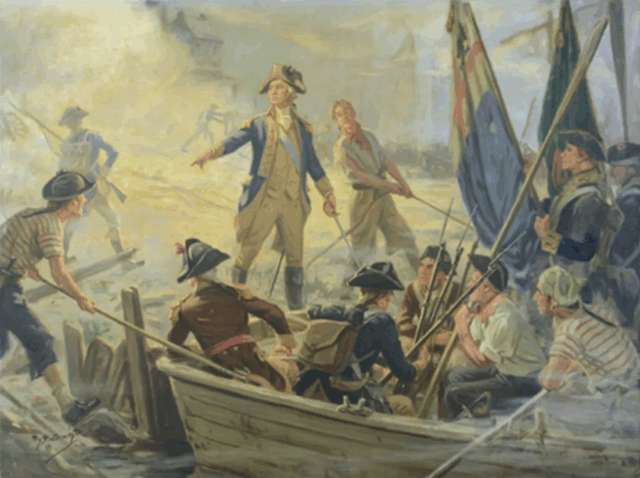
Henry Hintermeister, Retreat to Victory, oil on canvas (gift of Charles Lauriston Livingston, Jr. / courtesy of Fraunces Tavern Museum)

Who: Scott Dwyer, Lisa Goulet, Peter Hein, Seth Kaller, Charles (Chuck) Schwam, Lloyd S. Kramer, Louise M. Joy, George Bruton Delaney, Moses L. Delaney, Richard Sylla, more
What: Independence Day open house and “The 1700s: The Path to Liberty” symposium
Where: Fraunces Tavern Museum, 54 Pearl St.
When: Friday, July 4, $1 in person, free virtually, 1:00 – 5:30
Why: The Lower Manhattan Historical Association’s It Happened Here turns to the founding of America on July 4 with an Independence Day open house and afternoon symposium at Fraunces Tavern Museum, home to a banquet on June 18, 1776, honoring General George Washington’s military victories. “The 1700s: The Path to Liberty,” which can be attended in person or online, features members of the Sons of the Revolution, the American Friends of Lafayette, history professors, collections managers, military veterans, descendants of James Armistead Lafayette, and others. Visitors can explore such exhibitions as “Path to Liberty: The Emergence of a Nation,” “Fraunces Tavern: Over 300 Years of Building History,” and “Lafayette: A Hero’s Return” before attending the symposium prelude “Liss and the Culper Spy Ring in Historic Lower Manhattan” at 1:00, followed at 1:30 by the symposium itself.

[Mark Rifkin is a Brooklyn-born, Manhattan-based writer and editor; you can follow him on Substack here.]

“THE CAMERA WAS ALWAYS PRESENT”: RACHEL ELIZABETH SEED’S A PHOTOGRAPHIC MEMORY

Rachel Elizabeth Seed turns the camera on her mother and herself in A Photographic Memory (courtesy of Capariva Films and Zeitgeist Films in association with Kino Lorber)

A PHOTOGRAPHIC MEMORY (Rachel Elizabeth Seed, 2025)
New Plaza Cinema @Macaulay Honors College
35 West Sixty-Seventh St. between Central Park West & Columbus Ave.
Friday, June 27, through Sunday, June 29
newplazacinema.org
IFC Center
323 Sixth Ave. at West Third St.
Monday, June 30, 7:00
www.ifccenter.com

“I have no memories of my mother. And when I set out to find her a few years back, she was basically a stranger to me,” Rachel Elizabeth Seed explains in her award-winning debut documentary, A Photographic Memory. “My dad never talked much about her except to tell me that she was an accomplished writer and photographer way ahead of her time. But it wasn’t until I became a photographer myself that I started to become curious about the work she created and whether in the pages of her transcripts and contact sheets, her journals and her audio tapes, I might also find her.”

Rachel’s mother, Sheila Turner Seed, was a pioneering photojournalist and filmmaker who died suddenly and unexpectedly in June 1979 at the age of forty-two, when Rachel was eighteen months old. While working on “The Motherless Project” (2004–11), in which she interviewed and photographed forty women who had grown up without a mother, Rachel found, in her father’s attic, a box of reels her mother had made, and decided to go on a journey to learn more about her by investigating her legacy while also dealing with her own sense of loss. “I thought that telling their stories would make me feel less alone. But what do you do when your greatest loss is something you can’t even remember?” she says.

A Photographic Memory is not about having total recall but is a moving and cathartic love letter constructed from family pictures and home movies, journals and letters, and personal remembrances centered around Sheila’s “Images of Man,” an audiovisual project for Scholastic in which she spoke with and photographed some of the most important and influential photographers in the world, compiling fifty hours of audio interviews with Henri Cartier-Bresson, Lisette Model, Gordon Parks, Cecil Beaton, William Albert Allard, Brian Lanker, Cornell Capa, Bruce Davidson, and Eliot Porter in the late 1960s and early 1970s. Rachel also goes through Sheila’s phone book and calls up her old friends and contacts. “Your mother was a remarkable storyteller,” one instantly says.

Rachel visits with ICP founder Capa, Davidson, and Martine Franck, Cartier-Bresson’s widow, who remember Sheila well and talk about the interview sessions fondly. She meets with Scholastic president and CEO Dick Robinson, who was extremely close with Sheila; he happily recalls when Rachel worked there as an intern and how Sheila decided that she did not need a cameraman accompanying her on her Scholastic assignments. Among the others sharing memories are Sheila’s brother, Barry; Sheila’s ex-boyfriend Gabriel Edmont, who gets teary; her father, Joe Turner, a successful photographer himself; and Sheila’s old friend, author Lael Morgan, who refers to her and Sheila as “lifeaholics . . . Sheila had to see the world.”

Sheila’s relatives, including her father and grandfather, had experienced severe oppression in their native Russia and did not want to leave America once they arrived. “Many members of my family will not travel outside of US borders. It is only there that they feel safe. Maybe that’s one reason why I have an insatiable desire to travel everywhere and to see everything,” Rachel reads from her mother’s autobiography. Rachel also re-creates scenes from the interviews, bathed in mysterious black-and-white and filled with memorable quotes.

“I’m tired of being lonely,” Allard tells Sheila in Virginia in 1972. “Photography, it’s what I do, but it is not totally me.”

In his Paris living room in 1971, Cartier-Bresson offers, “Life is very fluid. Sometimes the pictures disappear and there’s nothing you can do. You can’t tell the person, ‘Oh, please smile again. Do that gesture again.’ There’s no repetition. Life is once forever.”

“You have a lot of your mother in you,” Davidson says in the same New York City apartment where he spoke with Sheila in 1971. He also advises, “I think probably one of the most dangerous things that one can do is to look at themselves.”

Rachel admits, “Revealing myself scares me. What am I hiding?” But she is soon turning the lens on herself, not only discussing her relationship with her boyfriend, Joseph Michael Lopez, and whether she wants to have children but also observing herself in the archival footage she finds. Watching home movies, she says as if addressing her mother, “I saw you moving for the first time, family footage of your childhood, and then of your wedding. And then, at the end, I saw the two of us together. I only remember not having a mother, but here is a little girl who has a mother. And in this perfect arc of time, we’re together.”

It’s an intimate moment that gets to the heart of the film, which Rachel directed, wrote, and produced; it was edited and cowritten by Christopher Stoudt, shot by Rachel, Lopez, and Drew Gardner, and scored with a tender gentleness by Mary Lattimore and Troy Herion. A Photographic Memory is a vivid and poignant celebration of craft, of family lost and found, of film and photography and mothers and daughters. It will have you searching through your own albums, slides, and reels, finding long-forgotten gems. It is sad that, with the advent of the internet, smartphones, and social media, future generations will not have these opportunities to establish and reestablish personal connections with the past, as everyone is now a photographer and a filmmaker, posting away online, each picture fading away as soon as the next one is uploaded.

Rachel says, “The camera was always present,” which was a rare thing back then, when each click had to be made carefully, with limited availability on every roll. With A Photographic Memory, Rachel has given us a special treasure grounded in the art forms used by her mother, her father, and her with such joy.

A Photographic Memory is screening June 27–29 at New Plaza Cinema and June 30 at IFC Center; each show will be followed by a Q&A with Rachel Elizabeth Seed, along with Danielle Varga on June 27, Stoudt and Judith Helfand on June 28, Dami Akinnusi, Jill Campbell, and Liz Nord on June 29, and executive producer Kirsten Johnson on June 30 in a special encore from DOC NYC 2024.

[Mark Rifkin is a Brooklyn-born, Manhattan-based writer and editor; you can follow him on Substack here.]

REMAPPING THE UNIVERSE: ENCOUNTERS IN THE MILKY WAY

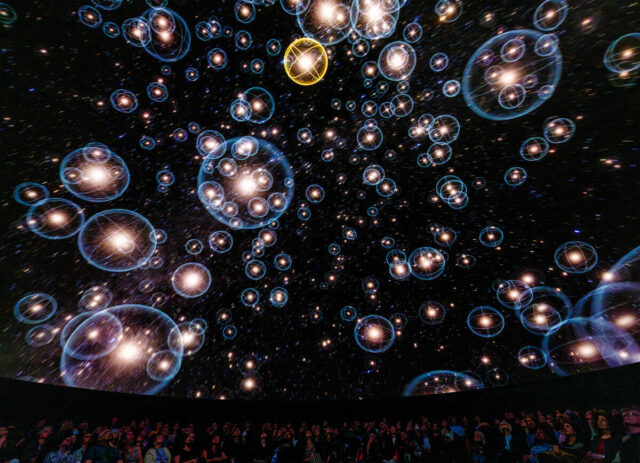
Encounters in the Milky Way expands humanity’s knowledge and understanding of the universe (photo by Alvaro Keding/© AMNH)

ENCOUNTERS IN THE MILKY WAY
American Museum of Natural History
Hayden Planetarium, Rose Center for Earth and Space
Central Park West at 81st St.
Open daily, $18-$30
212-769-5200
www.amnh.org

Everything I know about space I learned from Star Trek, Stanley Kubrick, Carl Sagan, and the American Museum of Natural History. At the Hayden Planetarium, the institution continues to explore the final frontier and push the boundaries of our knowledge of the universe in its space shows, which have included 2000’s Passport to the Universe, narrated by Tom Hanks; 2002’s The Search for Life: Are We Alone? (Harrison Ford); 2006’s Cosmic Collisions (Robert Redford); 2009’s Journey to the Stars (Whoopi Goldberg); 2013’s Dark Universe (Neil deGrasse Tyson); and 2020’s Worlds Beyond Earth (Lupita Nyong’o).

In the brand-new Encounters in the Milky Way, the ubiquitous Pedro Pascal, of The Mandalorian, The Last of Us, and Narcos, takes audiences deep into our galactic neighborhood as scientists uncover surprising aspects of time and cosmic movement so unexpected that it shocked even the filmmakers. To the everyday museum visitor who just hasn’t been thinking about our universe lately, Encounters is a thrilling, jaw-dropping reminder of exactly how small we humans are in space and time, and how much remains to be explored.

“There was this day that happened, I can tell you it’s an actual day, April 25, 2018. That was the day that the European Space Agency’s Gaia Observatory . . . revealed this massive, amazing map, a map that is foundational in astrophysics. On April 24, I gave a talk in here to a sold-out crowd and I told this audience — I don’t know, they thought that I was on the Kool-Aid or something — I was, like, it all changes tomorrow,” AMNH curator Jackie Faherty said at the press preview of the twenty-four-minute film. “It’s all changing because up until that moment we had about 116,000 stars that we measured the distances to and that we knew their motion really well. But the next day we were getting nearly 2 billion. So to me, the most important thing and why this is happening now is because on April 25, 2018, Gaia dropped a map that all humans should be proud of. We mapped the cosmos in a way, and the Milky Way really was the star of it, we had never been able to do before. And because of that, that was the sheer inspiration for starting the conversations about this show. And we could test out some of the material with audiences in here with open space. But because of Gaia — sometimes I call this show a little love letter to Gaia because that map is so phenomenal.”

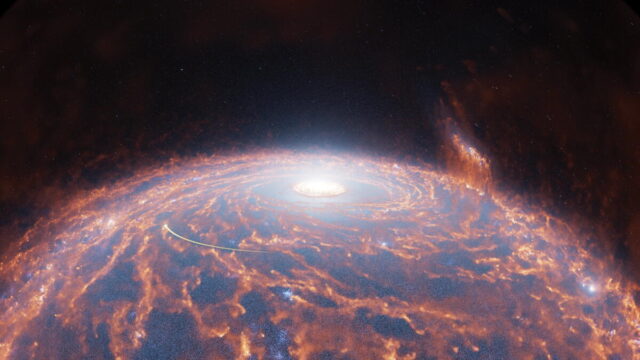
Encounters in the Milky Way was a huge undertaking, made with the participation of a wide range of astronomers, educators, science visualization experts, and artists from the University of Surrey, NASA’s Space Telescope Science Institute, the Southwest Research Institute, the Center for Astrophysics/Harvard & Smithsonian, Technische Universität Berlin, the Institute of Science and Technology Austria, the European Space Agency, and more than a dozen other organizations. Using the Gaia space telescope, the James Webb Space telescope, and complex digital models, the film features the Kuiper Belt, the Oort Cloud, Gliese 710, icy comets, a local bubble, and the Sagittarius Dwarf Galaxy like they’ve never been seen before. As with all space shows, the visuals are spectacular, highlighted by a spiral, found in collaboration with the Czech astronomer David Nesvorný, that jolted all involved.

“There’s this huge universe out there, and this show is concentrating on the Milky Way. . . . Because we’re being parochial, local to the Milky Way, there’s that emphasis of time, but it’s brought home to us in a kind of personal way that just as the solar system is our home, so too is the Milky Way,” director Carter Emmart, helming his seventh and final show, said. “And because we can see it organically behaving in great detail like this, there’s an aspect to it that, yes, it’s so far out there, and the time scales are so large, but then when Pedro tells you that we are twenty galactic years old and that it takes us 230 million years to make one orbit — when we were at this last orbit, it was the Triassic, and dinosaurs were just getting their legs — that’s one of the twenty orbits. It makes you understand that our story is a larger story of life and that while we are single instances, that the DNA of your children and the grandparents and so forth that you come from is a continuum, and that goes back into deep time. . . . I really feel that message comes across in this story; I hope it does. I hope that’s the takeaway, that this is a vast story. . . . For me its been a tremendous exhilaration from being ten years old, my mom bringing me to classes in the basement of this planetarium, to having a career working here. It’s been a great, great pleasure to be here across these various shows but end on something that I think is a pretty special production. It certainly is to me.”

In the film, Pascal explains, “By moving through space to observe from multiple angles, Gaia has built a three-dimensional atlas containing nearly two billion stars. That’s fifteen thousand times more than were ever mapped before, and about a million times more stars than we see with the naked eye. Could the ingredients of life be carried from one star system to another, aboard a comet or asteroid? Scientists are studying the possibilities. For us — for our sun and solar system — one orbit takes 230 million years to complete. So far, we’ve made about twenty orbits. We’re twenty galactic years old!”

The Milky Way’s collision with the Sagittarius dwarf galaxy has never been visualized before (photo © AMNH)

It’s also special to Faherty, whose excitement and sense of wonder are infectious, particularly when it comes to the map.

“I want kids coming here and being like, What’s up with this map? I’d like to see more on that map. What else does that map have? Open up the map; look for stuff,” she continued. “I’m showing you the globe, guys — this is the map, the map of your cosmos. It’s your cosmos as well; it’s humanity’s map. Go play with the map. All Gaia data is available for everybody. Look at where these stars are; look at where they’re going. You can make discoveries — so much science to be had. I hope that people walk away wanting to be scientists when they leave this room.”

On Wednesday, June 25, Faherty and Emmart will be back in the room for “Astronomy Live: The Making of a Space Show,” sharing insights into the creation of Encounters in the Milky Way. Be prepared to reconsider your current career and think about becoming a scientist yourself after you experience their unbounding enthusiasm and childlike joy at expanding our knowledge of the endless universe.

[Mark Rifkin is a Brooklyn-born, Manhattan-based writer and editor; you can follow him on Substack here.]

THE WHOLE MEGILLAH: YIDDISH TOUR OF “THE BOOK OF ESTHER IN THE AGE OF REMBRANDT”

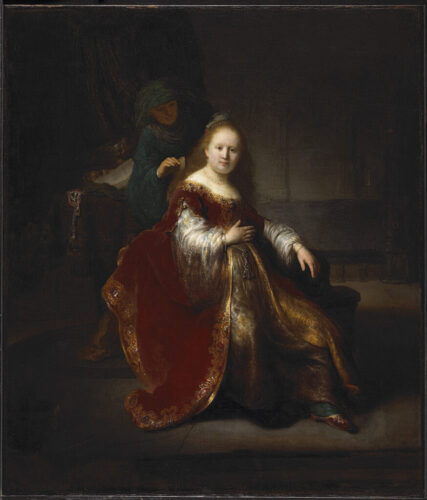
Rembrandt van Rijn, A Jewish Heroine from the Hebrew Bible, oil on canvas, 1632–33 (National Gallery of Canada, purchased 1953)

Who: Rukhl Schaechter, Adina Cimet
What: Yiddish tour of “The Book of Esther in the Age of Rembrandt”
Where: The Jewish Museum, 1109 Fifth Ave. at 92nd St.
When: Friday, June 20, $40.25, 11:30 am
Why: The Jewish Museum exhibition “The Book of Esther in the Age of Rembrandt” is a surprising look at the Dutch fascination with the story of Esther, King Ahasuerus, Queen Vashti, Mordecai, and Haman (boo!!). Artists such as Rembrandt van Rijn, Jan Lievens, Aert de Gelder, and Jan Steen painted depictions of the biblical story that is related in the Megillah, which is read on the holiday of Purim; the show is supplemented with beautifully designed scrolls and contemporary works, including Fred Wilson’s 1992 Queen Esther/Harriet Tubman. Curators Abigail Rapoport and Michele Frederick make a strong case connecting the events surrounding Esther with Jewish immigration to the Netherlands during the Eighty Years’ War (1568–1648); as Rapoport writes in the catalog, “The Dutch, who saw themselves as religiously and politically oppressed by the Spanish monarchy, found in the Book of Esther a viscerally apt analogy for their own liberation and associated their war of independence with the Jewish people’s struggle with, and ultimate triumph over, the ancient Persian Empire.”

The exhibit continues through August 10; on June 20 at 11:30 am, Forverts editor Rukhl Schaechter will lead a one-hour tour of the show in Yiddish, along with sociologist Adina Cimet. Tickets are limited and include general admission to the museum, which is also hosting the terrific “Ben Shahn, On Nonconformity” exhibition.

[Mark Rifkin is a Brooklyn-born, Manhattan-based writer and editor; you can follow him on Substack here.]

IFC CENTER AT TWENTY: ME AND YOU AND EVERYONE WE KNOW

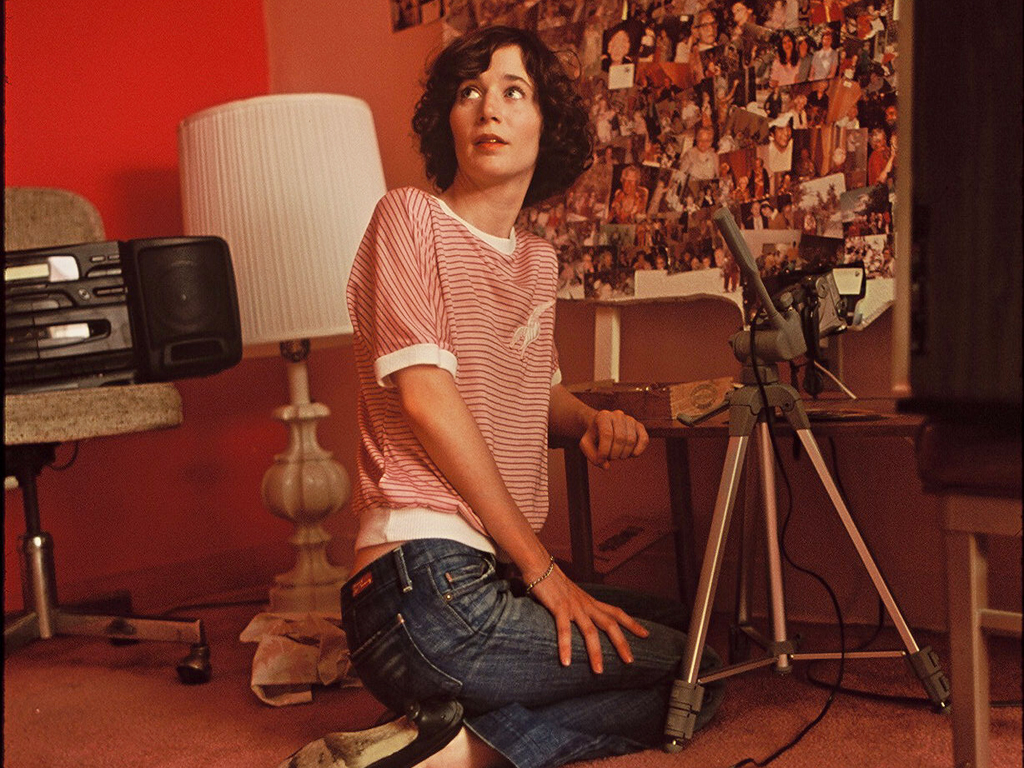
Miranda July’s Me and You and Everyone We Know returns to IFC Center in honor of theater’s twentieth anniversary

ME AND YOU AND EVERYONE WE KNOW (Miranda July, 2005)
IFC Center
323 Sixth Ave. at West Third St.
Tuesday, June 17, 12:40 & 6:50, $12.70
www.ifccenter.com
www.mirandajuly.com

Winner of a Special Jury Prize at Sundance “for originality of vision,” performance artist Miranda July’s feature-film directorial debut is a success from start to finish, an original, engaging, and utterly charming romantic comedy that is as unique as it is familiar. July, who also wrote the screenplay, stars as an idiosyncratic young performance artist who is looking for a relationship in her rather mundane life. She immediately falls for a shoe salesman (John Hawkes) who is separating from his wife and trying to understand his kids (Brandon Ratcliff and Miles Thompson), who are having a strange online dalliance with a mystery e-mailer. Meanwhile, two high school girls (Najarra Townsend and Natasha Slayton) are sexually tormenting a bizarre loner (Brad Henke) who is sexually tormenting them right back, both humorously and dangerously.

It’s nearly impossible to take your eyes off of July, whose innovative audio and visual installations and short films have been shown at the Andy Warhol Museum, the Whitney Biennial, the Kitchen, Lincoln Center, the Museum of Modern Art, Union Square Park, and the Rotterdam International Film Festival, among many other prestigious places. The Vermont native has gone on to make such other features as The Future and Kajillionaire and written such books as No One Belongs Here More Than You, The First Bad Man, and All Fours while also developing a deeply personal and boldly honest online presence.

Me and You and Everyone We Know is screening June 17 at 12:40 & 6:50 as part of IFC Center’s twentieth anniversary celebration of its opening at the old Waverly, with tickets at the 2005 price of $10.75 (plus $1.95 service fee), along with 2005 prices for drinks and popcorn. The one-day party of the theater’s original lineup also includes a 4K restoration of William Lustig’s 1980 slasher sensation Maniac, starring Joe Spinell, with Lustig in conversation with Aimee Kuge after the 7:15 screening; Yasujiro Ozu’s 1932 silent I Was Born, But . . .; and D. A. Pennebaker’s genre-redefining 1967 Bob Dylan documentary, Don’t Look Back. All screenings will be preceded by Joe Stankus’s 2014 five-minute black-and-white Marquee, in which Larry Alaimo talks about the changes in the neighborhood as he updates the IFC Center marquee.

[Mark Rifkin is a Brooklyn-born, Manhattan-based writer and editor; you can follow him on Substack here.]

DON’T STOP THAT PIGEON: CELEBRATING JUNE 14 ON THE HIGH LINE

PIGEON FEST
The High Line
Thirtieth St. & the Spur
Saturday, June 14, free, noon – 8:00
www.thehighline.org

What did you do on Saturday, June 14, 2025? It’s looking to be quite a memorable date.

June 14 is Flag Day, when America pays tribute to the Stars and Stripes. Although it’s not a federal holiday, it is, according to Proclamation 1335, signed in 1916 by President Woodrow Wilson, a day “with special patriotic exercises, at which means shall be taken to give significant expression to our thoughtful love of America, our comprehension of the great mission of liberty and justice to which we have devoted ourselves as a people, our pride in the history and our enthusiasm for the political programme of the nation, our determination to make it greater and purer with each generation, and our resolution to demonstrate to all the world its vital union in sentiment and purpose, accepting only those as true compatriots who feel as we do the compulsion of this supreme allegiance.” The flag was approved by the Continental Congress on June 14, 1777.

June 14 is also unofficially known as Cup Day; on June 14, 1994, the New York Rangers ended their fifty-four-year drought and won the Stanley Cup following a tough seven-game series with the Vancouver Canucks. The Broadway Blueshirts won the finale on goals by Brian Leetch, Adam Graves, and captain Mark Messier; Mike Richter stood tall between the pipes.

On June 14, 1969, German tennis champion Steffi Graf was born.

On June 14, 1963, the Soviets launched the manned spacecraft Vostok 5.

On June 14, 1940, the first train carrying Polish prisoners pulled into Auschwitz.

On June 14, 1928, Che Guevara was born.

On June 14, 1811, Uncle Tom’s Cabin author Harriet Beecher Stowe was born.

Oh, also, on June 14, 1946, Donald John Trump was born in Queens.

President Trump has decided to honor his birthday, Flag Day, and the 250th anniversary of the US Army on June 14, 2025, by holding a military parade along the National Mall in Washington, DC, consisting of 6,600 soldiers with historical weapons, 50 military aircraft, 150 vehicles, tanks, helicopters, several dozen horses, and 2 mules; the total cost is expected to be $145 million. There will be protests around the country, from the Women’s March’s “Kick Out the Clowns” to “No Kings” in nearly two thousand congressional districts.

If you’re looking for something different, your best bet might just be Pigeon Fest, a party celebrating Iván Argote’s seventeen-foot-high Dinosaur, a giant pigeon sculpture at the High Line Spur at Thirtieth St. There will be artist talks, workshops, carnival games, music, a puppet show, a pageant, a bazaar, a science fair, and more, with Maria Assis Silva, Julia Rooney, Stephanie Costello, Tina Pina (Mother Pigeon), Machine Dazzle, Jameson Fitzpatrick, Lee Ranaldo, the Bird Is the Word Ensemble, and others.

Below is the complete schedule.
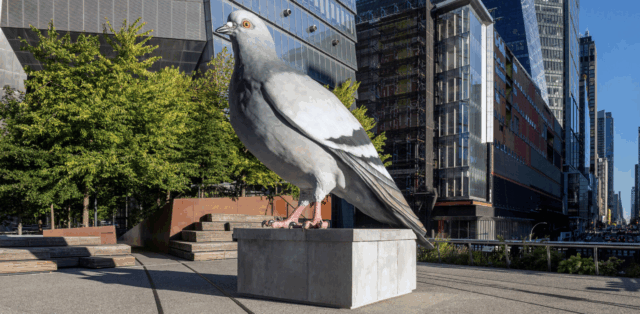
Iván Argote’s Dinosaur is centerpiece of High Line celebration (photo by Timothy Schenck)

The Discovery Fair, with Pop-up Pigeons!, Watercolor Workshop with Food Scraps Ink, the Birdsong Project, the Center for Book Arts, the Cornell Lab of Ornithology, the LES Ecology Center, Lofty Pigeon Books, the Mayor’s Office of Urban Agriculture (MOUA), Monument Lab, Mother Pigeon, NYC Bird Alliance, Pat McCarthy, and the Wild Bird Fund, Eastern Rail Yards, noon – 5:00

Bird Bazaar, with the Coop Carnival, Pigeon Piñata Party, Alternative Monuments for NYC, Pigeon Fan Club, NYPL Bookmobile Station and Storytime, and Best Plants for Birds on the High Line, Coach Passage at Thirtieth St., noon – 5:00

Zumba: Pigeon Dance Party, led by Maria Assis Silva, noon

Mother Pigeon’s Impeckable Puppet Show, 1:00

Pigeon Impersonation Pageant, 2:00

Panel Discussion: Building Bird-Friendly Cities, with Qiana Mickie, Christian Cooper, and Ethan Dropkin, moderated by Richard Hayden, 3:30

Artist Talk: Iván Argote and Cecilia Alemani, 4:15

Musical Concert, with Jameson Fitzpatrick, a string quartet performance by students from the Manhattan School of Music and Juilliard Pre-College Programs, the Bird Is the Word Ensemble organized by Lee Ranaldo, and a special guest headliner, 5:30 – 8:00

[Mark Rifkin is a Brooklyn-born, Manhattan-based writer and editor; you can follow him on Substack here.]
WORD ALCHEMY: XU BING AT CHINA INSTITUTE

Who: Xu Bing, Susan L. Beningson, Owen Duffy
What: Talk and book launch
Where: China Institute in America, 100 Washington St.
When: Tuesday, June 10, free ($49.87 with book), 6:30
Why: Last year, Asia Society Texas hosted “Xu Bing: Word Alchemy,” an exhibition of more than fifty of the Chinese artist’s works from throughout his nearly half-century career, including woodcut prints, videos, drawings, and installations. Born in China in 1955 and based in Brooklyn and Beijing, Bing has displayed “Phoenix” at the Cathedral Church of St. John the Divine, “The Living Word” at the Morgan Library, Square Word Calligraphy: Crossing Brooklyn Ferry, Walt Whitman at the Brooklyn Museum, and The Character of Characters at the Met. On June 10, he will be at China Institute in America — where his work will be featured in the fall exhibit “Metamorphosis: Chinese Memory and Displacement” — to launch the full-color catalog of “Word Alchemy,” joined by exhibition curators Susan L. Beningson and Owen Duffy.

[Mark Rifkin is a Brooklyn-born, Manhattan-based writer and editor; you can follow him on Substack here.]