this week in lectures, signings, panel discussions, workshops, and Q&As

RESTORING CHAOS: JAPAN SOCIETY CELEBRATES YUKIO MISHIMA CENTENNIAL

YUKIO MISHIMA CENTENNIAL SERIES: EMERGENCES
Japan Society
333 East 47th St. at First Ave.
September 11 – December 6
japansociety.org

“Only art makes human beauty endure,” Yukio Mishima wrote in his 1959 novel Kyoko’s House.

In his short life — Mishima died by suicide in 1970 at the age of forty-five — the Japanese author and political activist penned approximately three dozen novels, four dozen plays, five dozen story and essay collections, ten literary adaptations, and a libretto, a ballet, and a film.

Japan Society is celebrating the hundredth year of his birth — he was born Kimitake Hiraoka in Tokyo in January 1925 — with “Yukio Mishima Centennial Series: Emergences,” comprising six events through December 6. The festival begins September 11–20 with Kinkakuji, SITI company cofounder Leon Ingulsrud and Korean American actor Major Curda’s theatrical adaptation of Mishima’s intense 1956 psychological novel The Temple of the Golden Pavilion, based on the true story of extreme postwar actions taken by a young Buddhist monk. Creator and director Ingulsrud cowrote the script with Curda, who stars in the play. The stage design is by Japanese visual artist Chiharu Shiota, whose international installations, featuring red and black yarn structures, include “In the Light,” “My House Is Your House,” and “Memory of Lines.” Her latest, “Two Home Countries,” runs September 12 through January 11 in the Japan Society gallery, consisting of immersive, site-specific works created in commemoration of the eightieth anniversary of the end of WWII.
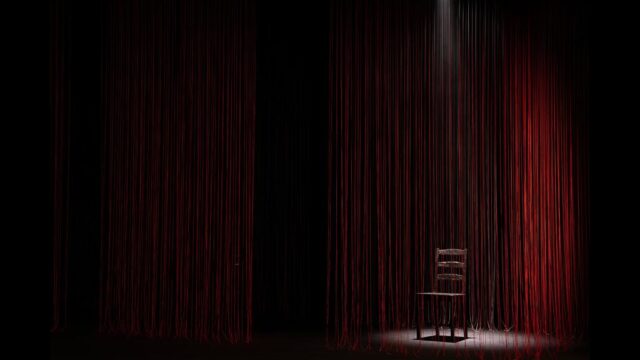
There are unlikely to be many empty seats at Japan Society for Kinkakuji and other Mishima events (photo © Ayako Moriyama)

There will be eleven performances of Kinkakuji, with a gallery-opening reception following the September 11 show, a separate gallery talk on September 12, a lecture preceding the September 16 show, and an artist Q&A on September 17. Each ticket comes with free same-day admission to “Two Home Countries.”

On September 27, Japan Society, as part of the John and Miyoko Davey Classics series, will screen Kon Ichikawa’s 1958 film, Conflagration, based on The Temple of the Golden Pavilion and starring Raizo Ichikawa, Tatsuya Nakadai, and Ganjiro Nakamura.

In conjunction with L’Alliance New York’s Crossing the Line Festival, Japan Society will present Le Tambour de Soie (The Silk Drum) on October 24 and 25, Yoshi Oida and Kaori Ito’s adaptation of Mishima’s 1957 Noh play Aya no Tsuzumi, a dance-theater piece about love and aging featuring downtown legend Paul Lazar and choreographer Ito, with music by Makoto Yabuki. The second show will be followed by an artist Q&A. On November 6, Japanese novelist and cultural ambassador Keiichiro Hirano (Nisshoku, Dawn) and Tufts University Mishima scholar Dr. Susan J. Napier will sit down for a conversation discussing Mishima’s life and legacy.
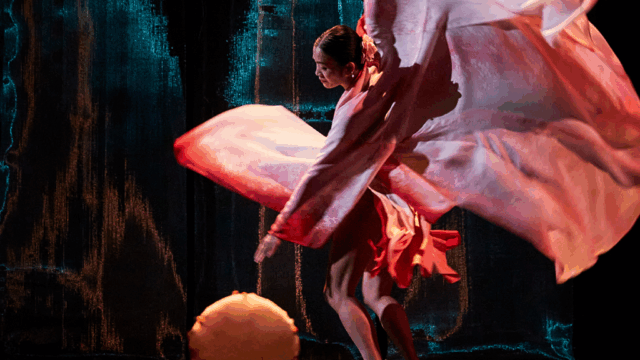
Le Tambour de Soie (The Silk Drum) will be performed October 24 and 25 at Japan Society (photo © courtesy of the Maison de la Culture d’Amiens)

On November 15 and 16, the Tokyo-based company CHAiroiPLIN brings The Seven Bridges (Hashi-zukushi) to Japan Society, a visually arresting adaptation for all ages of Mishima’s short story about four women seeking wishes during a full moon. The series concludes December 4–6 with the US debut of Hosho Noh School and Mishima’s Muse – Noh Theater, three unique programs of noh and kyogen theater comprising performances of works that inspired Mishima: Shishi (Lion Dance), Busu (Poison), Aoi no Ue (Lady Aoi), Kantan, and Yoroboshi. The December 4 performance will be followed by a ticketed soirée, and there will be an artist Q&A after the December 5 show with Kazufusa Hosho, the twentieth grand master of Hosho Noh School, which dates back to the early fifteenth century. In addition, members of Hosho Noh School lead a workshop on December 6.

“This series revitalizes Mishima’s contributions to the world of the arts through a slate of brand new commissions and premieres adapting his writings, as well as a historic US debut for a revered noh company,” Japan Society artistic director Yoko Shioya said in a statement. “This series recognizes not only Mishima’s critical legacy but the ongoing current influence of this essential postwar author on artists today.”

That legacy can be summed up in this line from his 1963 novel Gogo no Eikō (The Sailor Who Fell from Grace with the Sea): “Of course, living is merely the chaos of existence, but more than that it’s a crazy mixed-up business of dismantling existence instant by instant to the point where the original chaos is restored.”


AN APPETIZING TRADITION: NEW RUSS & DAUGHTERS COOKBOOK

Russ & Daughters cookbook is starting a tasty New York City tour

Who: Niki Russ Federman, Josh Russ Tupper, Gabriella Gershenson
What: Book launch and tasting
Where: Temple Emanu-El Streicker Cultural Center, 1 East 65th St. between Madison & Fifth Aves., and online
When: Thursday, September 11, $43 (includes copy of book), 6:00
Why: Latkes, matzo ball soup, smoked whitefish chowder, babka, rugelach, black-and-white cookies, bagels — those are only some of the recipes collected in Russ & Daughters: 100 Years of Appetizing (Flatiron, September 9, $39.99). In 1907, Polish immigrant Joel Russ sold Jewish food in a pushcart on the Lower East Side; seven years later he opened J Russ International Appetizers in an Orchard St. storefront before moving in 1920 to 179 East Houston St., changing the name to Russ & Daughters. The business, currently run by cousins Josh Russ Tupper and Niki Russ Federman, the fourth-generation co-owners, expanded to a popular café at 127 Orchard St. in 2014 and has more recently added an outpost near Hudson Yards. The book, a follow-up to 2013’s Russ & Daughters: Reflections and Recipes from the House That Herring Built, by Mark Russ Federman and featuring a foreword by Calvin Trillin, also includes anecdotes and personal reminiscences from the smoked-fish institution’s storied history.

On September 11, Tupper, Niki Russ Federman, and coauthor Joshua David Stein (Notes from a Young Black Chef, The Nom Wah Cookbook) will be at the Temple Emanu-El Streicker Cultural Center for “A Century of Schmears,” a book launch and tasting with James Beard Award–winning food writer and editor Gabriella Gershenson that kicks off the fall Festival of Jewish Ideas & Culture. You don’t have to grab a number when you enter, as tickets are available in advance and come with a copy of the book. You can also livestream the event at home. The book tour then stops at Platform by JBF at Pier 57 on September 14 with Rozanne Gold, the Center for New Jewish Culture in Brooklyn on September 18 with Daniel Squadron, P&T Knitwear on September 20 with a scavenger hunt, walking tours, and more, and the New York City Wine & Food Festival, where Tupper will host a Smoked Fish Master Class on October 19 at the Institute of Culinary Education.

[Mark Rifkin is a Brooklyn-born, Manhattan-based writer and editor; you can follow him on Substack here.]

A DIFFERENT WORLD: A CELEBRATION OF SONGS SHE WROTE

Who: Michael G. Garber, Miss Maybell, Charlie Judkins
What: Book talk with music
Where: Ceres Gallery, 547 West 27th St. between 10th & 11th Aves., #201
When: Thursday, September 11, free with advance RSVP (suggested donation $15), 6:30
Why: “This book celebrates women who wrote popular songs in the early twentieth century. These female composers and lyricists deserved greater opportunities and fame and to be more highly valued. Generations later, the same could be said for many of their sisters in songwriting in the early decades of the twenty-first century. Hopefully, looking at the past will inspire change in the future. To do this, we must travel in our minds back to what was, in effect, a different world.”

So begins historian, professor, scholar, and artist Michael G. Garber’s Songs She Wrote: 40 Hits by Pioneering Women of Popular Music (Rowman & Littlefield, March 2025, $36), an illustrated journey into that different world, focusing on women’s contributions to popular music, including ragtime, jazz, Broadway, and Hollywood. Featuring a foreword by Janie Bradford and Dr. Tish Oney, the book explores such tunes as Lucy Fletcher’s “Sugar Blues,” Lovie Austin and Alberta Hunter’s “The Down Hearted Blues,” Bessie Smith’s “Backwater Blues,” Dorothy Parker’s “Serenade from The Student Prince,” and Billie Holiday’s “God Bless the Child.”

Charlie Judkins and Miss Maybell will perform as part of book event at Ceres Gallery

On September 11 at 6:30, in conjunction with the Tin Pan Alley American Popular Music Project, Garber (My Melancholy Baby: The First Ballads of the Great American Songbook, 1902–1913) will be at the nonprofit feminist Ceres Gallery for a free book talk with live performances by Jazz Age artists Miss Maybell and Charlie Judkins, surrounded by Carlyle Upson’s nature-based “Submerged” watercolors and Marcy Bernstein’s “Evocative Abstractions” paintings, which Bernstein says “invite viewers to look inward. They’re filled with allusions to the raw energy of creation itself,” a fitting sentiment that applies to Garber’s book as well. Admission is free with a suggested donation of $15.

[Mark Rifkin is a Brooklyn-born, Manhattan-based writer and editor; you can follow him on Substack here.]

NOTHING LASTS FOREVER: TRAVELING IN BARDO WITH ANN TASHI SLATER

Ann Tashi Slater will discuss her new book at Rizzoli with Dani Shapiro on September 10

Who: Ann Tashi Slater, Dani Shapiro
What: Book launch with reading, conversation, and signing
Where: Rizzoli Bookstore, 1133 Broadway & West 26th St.
When: Wednesday, September 10, free with advance RSVP, 6:00
Why: “In a world where nothing lasts forever, how do we live?” writer, speaker, and traveler Ann Tashi Slater asks in her new book, Traveling in Bardo: The Art of Living in an Impermanent World (Balance, September 9, $29). Slater will address that question and more at the book launch at Rizzoli on September 10, where she will sit down with Dani Shapiro, author of such books as Signal Fires and Inheritance and host and creator of the podcast Family Secrets and who provided the foreword to the book.

“In my work, I explore how our personal histories and cultural roots shape us and how we find meaning in a world where everything — including we ourselves — changes and ends,” Slater explains on her website. “Traveling in Bardo interweaves explorations of impermanence in relation to marriage and friendship, parents and children, and work and creativity with stories of my Tibetan ancestors and Buddhist perspectives on the fleeting nature of existence, offering a new way to navigate change and live life fully.”

Slater will also give an in-person and virtual talk on September 12 at Columbia’s Weatherhead East Asian Institute with Lauran Hartley and take part in a Q&A and signing on September 16 at Tibet House.

[Mark Rifkin is a Brooklyn-born, Manhattan-based writer and editor; you can follow him on Substack here. Full disclosure: Mark’s wife is Ann Tashi Slater’s literary agent.]

THE LABOR OF LAUNDRY: LYNNE SACHS, LIZZIE OLESKER, AND FRIENDS AT UNNAMEABLE BOOKS

Who: Lizzie Olesker, Lynne Sachs, Silvia Federici, Veraalba Santa
What: Reading and performance
Where: Unnameable Books, 615 Vanderbilt Ave., Brooklyn
When: Monday, September 8, free, 7:00
Why:This is not a play. It is something else. / Call it a blueprint, a map, a documentation / of something that has already happened / but could happen again — / a rendering in book form of a performance. / Making a mark, words on a page instead of bodies in space. / A book that contains what’s remembered and what could be. / All of it written down and placed here, into this / Hand Book: A Manual,” Lizzie Olesker and Lynne Sachs write in the introduction to Hand Book: A Manual on Performance, Process, and the Labor of Laundry (Punctum, June 2025, 425). “We are a playwright and a filmmaker who discovered a shared interest in making work that magnifies quotidian elements of life in the city where we live. We met years ago in Brooklyn while sitting on a bench waiting for our young daughters to finish their music lessons. A conversation began about our lives as mothers and working artists. We couldn’t yet know that those early encounters would lead to a ten-year theater and film collaboration. Now in our sixties, our daughters fully grown, we continue to build an experimental model for making live performance and film, engaging in a dialogue on how art-making can alter our understanding of urban life.”

Olesker, an actor and playwright who has penned such shows as 5 Stages of Grief, A Kind (of) Mother, and Night Shift, and Sachs, a fiction writer and filmmaker who has directed such works as Which Way Is East, Your Day Is My Night, and Film About a Father Who, are the coauthors and codirectors of Hand Book, which Sachs describes as “a collection of writings and images from a performance and film set within a neighborhood laundromat.” In addition to sections by Olesker and Sachs, the illustrated, colorfully designed book (by Vincent W. J. van Gerven Oei) features contributions from Margarita Lopez (“A Thousand Pieces a Day”), Jasmine Holloway (“Taking on a Role”), Stephen Vitiello (“Shake, Rattle, and . . .”), Amanda Katz (“Sound of a Machine Door Closing”), Emily Rubin (“Loads of Prose: From the Beginning”), Veraalba Santa (“Score for a Folding Dance”), and others. The foreword, “A New Refusal and a New Struggle,” is by feminist historian, author, and activist Silvia Federici.

On September 8, Olesker, Sachs, Federici, and Santa will be at Unnameable Books in Brooklyn for a reading and performance. There will also be a reading and signing September 13 at noon at Printed Matter’s NY Art Book Fair
at MoMA PS1 and a performance, reading, and signing September 28 at 2:00 at Torn Page with Tony Torn and Alvin Eng. Sachs continues, “As authors, Lizzie and I along with our many collaborators construct a model for making art about essential work that often goes unrecognized. Turning a page becomes a quasi-cinematic encounter, calling to mind the intimacy of touching other people’s clothes, almost like a second skin, the textural care for things kept close to the body.”

[Mark Rifkin is a Brooklyn-born, Manhattan-based writer and editor; you can follow him on Substack here.]

YOU’RE A GOOD MAN, CLIFF CASHEN: A CHRISTMAS MOVIE TO REMEMBER

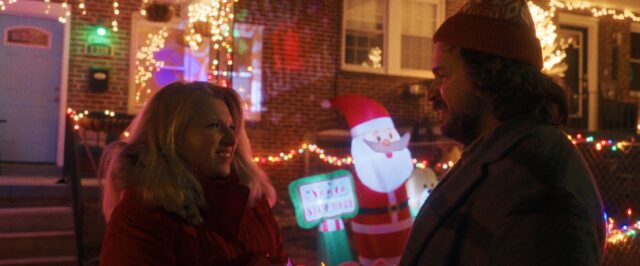
Didi (Liz Larsen) and Cliff (Michael Strassner) have a Christmas Eve to remember in The Baltimorons

THE BALTIMORONS
IFC Center, AMC Lincoln Square, Alamo Drafthouse Downtown Brooklyn
Opens Friday, September 5
www.baltimoronsmovie.com

“What’s wrong with you?” dentist Didi asks her emergency patient, Cliff, early in The Baltimorons. He immediately replies, “Everything.”

What’s right with the film? Just about everything.

The Baltimorons is a bittersweet, hilarious escapade from the Duplass Brothers, directed by Jay Duplass and written by Duplass and Baltimore native Michael Strassner. Strassner stars as Cliff Cashen, who, in the first scene, fails pathetically at trying to hang himself in his attic. Six months later, a sober Cliff is driving with his fiancée, Brittany (Olivia Luccardi), to her mother’s house for Christmas Eve dinner. Cliff is an improv comic, but Brittany is worried when fellow comedian Marvin (Rob Phoenix) texts him about participating in a show that night; Cliff has promised Brittany that, as part of his sobriety, he has given up comedy as well as booze.

On his way into the house, he trips over a loose brick and smashes his face against the side of the door, causing significant damage to his mouth and teeth. He finds Dr. Didi (Liz Larsen), apparently the only dentist working on the holiday, and meets her in her office. Cliff might be a bear of a guy, but he is a sensitive man-child who is afraid of needles; it’s also nearly impossible to know when he is telling the truth or joking around.

Upon leaving Didi’s office, Cliff sees that his Cadillac has been towed; with no other options, he accepts an offer from Didi — a divorced mother and grandmother whose ex-husband (Brian Mendes) just got married that morning — to drive him to the impound lot so he can reclaim his car, which was originally his father’s. That leads to a series of extremely funny, moving, and dangerous adventures in which doctor and patient seem stuck together, facing personal and professional challenges that make them take a hard look at who they are and where they are going.

Duplass, who previously worked with his younger brother, Mark Duplass, on such films as The Puffy Chair and Baghead and the series Togetherness, met Strassner through the latter’s Instagram (@strasshola), where Strassner posts wildly unpredictable short videos. They quickly clicked and were soon writing The Baltimorons, which is loosely based on Strassner’s real life. Duplass cast Tony winner Larsen (The Most Happy Fella, Law & Order) after seeing her play matriarch Shelly Pfefferman in A Transparent Musical; Duplass had portrayed one of that character’s children in the hit streaming series. The role of Didi was then adjusted to reflect some elements from Larsen’s life.

It all combines to give the film a realistic feel, with Baltimore a character unto itself; it’s very much a love letter to the city as Jon Bregel’s camera guides us to the since-collapsed Francis Scott Key Bridge, Federal Hill, the annual Miracle on 34th Street holiday lighting display in Hampden, the Rocket to Venus restaurant, and other locations; there are also several mentions of the Baltimore Ravens and their All-Pro quarterback, Lamar Jackson. (Although the film is not political, it is difficult to think of the National Guard and other military being sent in to save this lovely city.)

Strassner, who played Snoopy in You’re a Good Man, Charlie Brown when he was in the seventh grade, is a veteran of the Groundlings improv group and has appeared on numerous sitcoms, but he instantly takes hold of the film; it’s virtually impossible not to connect with Cliff, a complex gentle giant who went through a bad time and is now trying to reframe his life. Strassner balances solemnity and gravity with humor and Cliff’s infectious world view; although it essentially makes no sense for Didi to keep sticking to Cliff, it’s hard to imagine it wouldn’t be exactly what we would do if we were in her situation, and Larsen (The Most Happy Fella, Law & Order) excels as the distraught doctor, melding her obvious and necessary cautiousness with an inner desire to break free, to gain control of a life that is getting away from her. You don’t have to be a sober comic or a lonely dentist to appreciate, understand, and, most important, want to spend more and more time with these two oddly matched people in search of something else.

The Baltimorons is a Christmas movie to remember, worthy of a place in the holiday canon; Jordan Seigel’s charming score even recalls Vince Guaraldi’s music for A Charlie Brown Christmas. There’s a reason why the film won the Audience Award at four different festivals. See it now, but add it to your annual Christmas list as well.

The Baltimorons opens September 5 at IFC Center, AMC Lincoln Square, and Alamo Drafthouse in downtown Brooklyn; Duplass, Strassner, and Larsen will be at IFC for Q&As following the 7:15 screenings on Friday (moderated by athlete, author, and podcaster Rich Roll) and the 4:40 show on Saturday (moderated by actor David Krumholz); they will also be at Alamo for Saturday’s 7:00 show.

[Mark Rifkin is a Brooklyn-born, Manhattan-based writer and editor; you can follow him on Substack here.]

IDOLATROUS PROCESSIONS, PROVOCATIONS, DEMIURGIC NERVATURES, AND DISTANT PRESENCES: THE QUAY BROTHERS RETURN WITH SANATORIUM

The Quay Brothers return to Film Forum with their first feature-length film in twenty years, another foray into the unknown and unseen

SANATORIUM UNDER THE SIGN OF THE HOURGLASS (the Quay Brothers, 2024)
Film Forum
209 West Houston St.
Opens Friday, August 29
212-727-8110
www.filmforum.org

As if a new film from the Quay Brothers is not already reason enough to celebrate, the rejoicing can escalate because their latest, Sanatorium under the Sign of the Hourglass, is another masterful addition to their forty-year career.

Philadelphia-born, England-based identical twins Stephen and Timothy Quay make unique, complex stop-motion animated works that incorporate elements of German expressionism, silent film tropes, noir, and psychoanalysis, creating dark, heavily atmospheric tales that push the boundaries of storytelling conventions, using eerie, fragile dolls and puppets along with mysterious live action and spectral experimental music. They started out in 1985 with the eleven-minute Little Songs of the Chief Officer of Hunar Louse, or This Unnameable Little Broom, Being a Largely Disguised Reduction of the Epic of Gilgamesh, Tableau II, a dreamlike fantasia involving a creepy, clownlike figure surrounded by doors and drawers that open and close by themselves and windows that offer views into other worlds. They followed that up with the 1986 classic Street of Crocodiles, based on Bruno Schulz’s 1934 short story collection and inspired by the work of Czech filmmaker, artist, and playwright Jan Švankmajer; the twenty-minute opus revolutionized the genre, focusing on a man, dressed like a magician, who looks into a strange contraption that leads him into a portentous alternate universe where inanimate objects move and clocks have no hands.

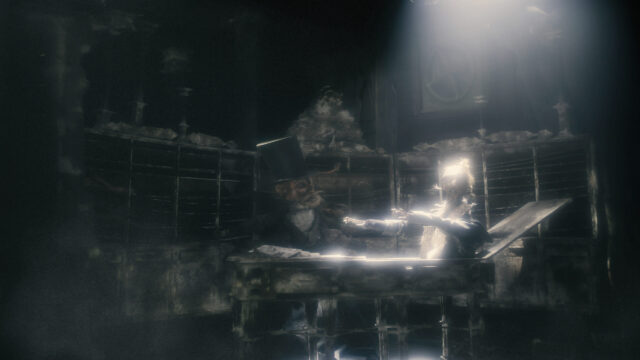
Only their third feature-length film — after 1994’s Institute Benjamenta and 2004’s The Piano Tuner of EarthquakesSanatorium under the Sign of the Hourglass, based on the 1937 novel and other writings by Schulz, is a natural progression from those early days, a kind of summation of everything that came before it. The narrative is set at Sanatorium Karpaty in the foothills of the Karpathian Mountains, where patient J (Zenaida Yanowsky) is convalescing. We first meet Adela I (Allison Bell), a young woman peering around suspiciously, her knee blocking part of her face as we listen to a scratchy 1936 Radio Archive recording of a voice explaining, “Sometimes, at the opening . . . of a street someone turned to the sky half a face, with one frightened and shining eye, and listened to the rumble of space.” Next we see, through the pupil in a large, disembodied eye, three men in top hats, two chimneysweeps (Andrzej Kłak and Leszek Bzdyl) and an auctioneer (Tadeusz Janiszewski). The auctioneer is selling such unusual items as “Twin Quail eggs of supernatural size, laid during the Solar Eclipse . . . of 12 May 1706? Or three petrified ribs of a Siren . . . together with her hands found in the Royal Menagerie of Fredensborg . . . in the year 27 September 1674. Or an Iron Harpoon . . . struck by lightning! Or the Warm Blood of Bees! Or the Hour of your Death!”

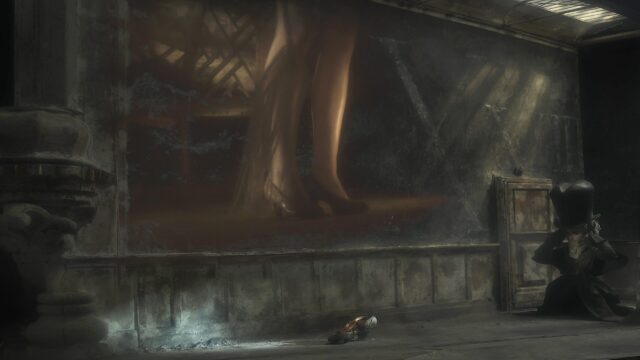
Sanatorium under the Sign of the Hourglass is another audiovisual marvel by the Brothers Quay

The auctioneer, who also refers to himself as a flogger and a pedlar, returns to his sparse office, where his assistant (Wioletta Kopańska) shows him a new item that has been delivered for him to sell; in his booming thespian voice, he reads: “Forbiddingly called Maquette for the Sepulchre of a Dead Retina, it is a singularly decrepit but ornate wooden box having the appearance of a miniature funerary cabinet with a skilfully hidden secret drawer allegedly containing the deceased retina of its original owner. Penetrating the exterior skin of this box are seven randomly placed lenses with tiny adjustable screws. Each lens holds a glimpse of one of the seven final images that the said eye beheld. And when positioned correctly, once a year, on the 19th of November, the sun’s rays are aligned to strike the dead retina — thereby liquefying it, anointing each of the seven images and setting them in motion.”

The box suddenly comes to life, and the auctioneer peers into one of the lenses and sees Józef, a doll in a top hat who wanders through an old, ghostly train, going from coach to coach as doors and secret entrances swing open and closed and ghastly figures appear and disappear. In voiceover, the auctioneer narrates the proceedings as Józef meets the multiarmed Dr. Gotard, who is caring for Józef’s ailing father. Józef encounters a broken hourglass, a dilapidated bridge, a buzzing neon sign in red and blue, used chalk for hire, and old mirrors as he makes his way through netherworld vestibules.

The story occasionally cuts back to live action with real actors, where Józef (Kłak) is told by the chambermaid (Kopańska) that it is always night there. He peers through a keyhole and watches what might be some kind of S&M encounter, bathed in a golden light. A horde of men (Bzdyl, Robert Martyniak, Łukasz Łucjan, Marek Jasek) are tantalized by Adela II (Kopańska). Back in his doll form, Józef is led to a crumbling theater for one person; his seat is Loge 7A, which is restricted view.

It all combines for a storytelling tour de force, zeroing in on the voyeuristic nature of humanity, from how we watch movies and theater to how we interact with one another in real life and fantasy.

Sanatorium under the Sign of the Hourglass unfolds in seven sections, including “Provocations Found in Evening Corridors: Hosanna!,” “Distant Presences Traced Around the Circumference of a Knee,” “The Idolatrous Procession,” and “Travels in the Last World.” It’s a Victorian steampunk dark nightmare that is like an ASMR fan’s dream. The attention to detail in every shot, every sound is remarkable, resulting in a hypnotic audiovisual experience. The Quays are credited with the puppets, décors, animation, and cinematography; the spectacular production design is by Agata Trojak, with sets by Anna Podhajny, props by Mateusz Niedzielak, costumes by Dorothée Roqueplo, live-action cinematography by Bartosz Bieniek, and sound by Joakim Sundström and the Quays.

Timothy Nelson’s original score features electronic noise, propulsive drumming, and spectral tones, accompanied by additional music by Alfred Schnittke performed by the Berlin Radio Symphony Orchestra. The methods employed by the Brothers Quay are so dazzling that their mind-blowing sets were on display in the fall 2009 exhibit “Dormitorium: Film Décors by the Quay Brothers” at Parsons the New School for Design, and they were honored with the wide-ranging 2012–13 MoMA retrospective “Quay Brothers: On Deciphering the Pharmacist’s Prescription for Lip-Reading Puppets.”

Not even the most serious students of Freud and Jung will make sense of everything as the film investigates concepts of time and space, of life and death in ways that both chill and thrill. (In their director comments, the Quays call Sanatorium “an exploration of motifs and themes taken from the mytho-poetic writings of Bruno Schulz integrating both puppets and live-action to score the demiurgic nervature of Schulz’s 13th apocryphal month in the Regions of the Great Heresy.”) As they have done in This Unnameable Little Broom, Street of Crocodiles, and such other shorts as The Comb, The Phantom Museum: Random Forays into the Vaults of Sir Henry Wellcome’s Medical Collection, Metamorphosis, Through the Weeping Glass: On the Consolations of Life Everlasting (Limbos & Afterbreezes in the Mütter Museum), and The Doll’s Breath — some of which are documentaries — they invite viewers into fantastical, unimaginable realms and dimensions that are as confounding as they are beautiful, as unnerving as they are intensely involving and satisfying.

Sanatorium under the Sign of the Hourglass opens August 29 at Film Forum; each screening will be preceded by a specially recorded introduction by the Quay Brothers. The 6:10 show on Friday will be introduced by Literary Hub editor Olivia Rutigliano.

[Mark Rifkin is a Brooklyn-born, Manhattan-based writer and editor; you can follow him on Substack here.]