this week in lectures, signings, panel discussions, workshops, and Q&As

LOUISE BOURGEOIS, FREUD’S DAUGHTER

“Louise Bourgeois, Freud’s Daughter” continues at the Jewish Museum through September 12 (© The Easton Foundation/Licensed by VAGA at Artists Rights Society (ARS), NY. Photo by Ron Amstutz.)

LOUISE BOURGEOIS, FREUD’S DAUGHTER
The Jewish Museum
1109 Fifth Ave. at 92nd St.
Thursday – Monday through September 12, $12-$18 (free on Saturdays)
212-423-3200
thejewishmuseum.org

To paraphrase something Dr. Sigmund Freud most likely never said, sometimes a white marble penis is just a white marble penis. In the exhibition “Louise Bourgeois, Freud’s Daughter,” continuing at the Jewish Museum through September 12, curator Philip Larratt-Smith attempts to explore the French-American artist’s work through a psychoanalytic lens based on her thirty-three years of analysis with Freud disciple Dr. Henry Lowenfeld, beginning in 1952, shortly after the death of her father. The exhibit reverses the standard setup; most of the fifty pieces by Bourgeois are in vitrines, while excerpts from her extensive notes — from personal thoughts to dream diaries — are framed and hanging on the walls. Above the facsimiles and original sheets are dual quotes from Bourgeois and Freud.

“Bourgeois’s psychoanalytic writings profoundly recalibrate our understanding of her artistic trajectory and motivational impulses,” Larratt-Smith, Bourgeois’s literary archivist, said in a statement. “They do not explain or demystify her art but rather represent a freestanding corpus of writing that display her unusual literary gifts and underline her enduring engagement with analysis. They highlight the centrality of her Oedipal deadlock as the traumatic kernel of her psychic organization. And they complicate the narrative of early childhood trauma which the artist herself fostered, encouraging instead a more nuanced appreciation of this relationship which she often spoke about.”

Bourgeois’s writings are extraordinary. “The fear of success is a misconception of the fear of responsibility. Perhaps fear of men. Refusal to accept to grow up / Refusal to accept reality / Refusal to accept what I am / Refusal to accept my lot / Refusal to look at oneself to measure, judge / Refusal to grow up. Refusal to accept being a woman. I accept on my own terms,” one begins. “Guilt is the Product of envy,” she writes in another. “There is essentially no difference between the Penis envy and the Oedipus complex . . . it is not him that I love it is what he has — it is not him that I love it is his money — The only thing that gives me hope is that millions of people women have suffered from this mystery.” And in a screed against her father and the family’s British au pair, Sadie Gordon Richmond, who became her father’s mistress (and was only six years older than Louise), Bourgeois declares, “I can prove that he loves me / that he loves me more than anybody else / that his wife is unbearable / that he doesn’t love her / that I deserve to be loved / that I deserve him more than Sadie does / that Sadie loves me / that Sadie loves him / that Sadie doesn’t want him any longer / so he is free / so there is hope.” You can listen to actress Rachel Weisz reading eighteen of Bourgeois’s selected writings here.

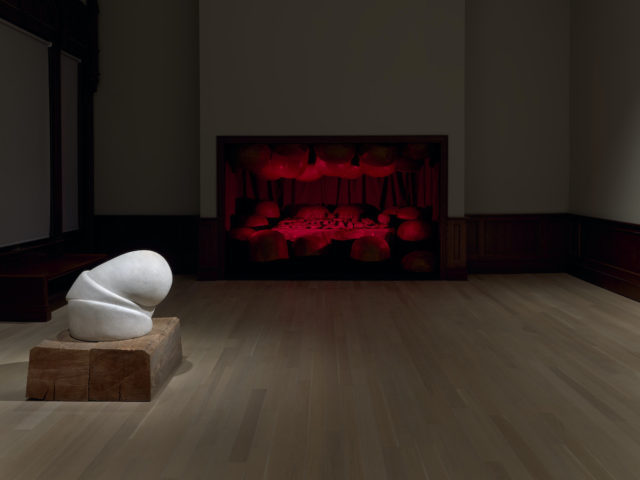
The works on view are equally extraordinary. Couple III entwines two people in fabric and leather, one with a steel prosthetic arm. (“The prosthesis recalls a theme that was important to Louise. Louise saw herself as a survivor but also as radically incomplete,” Larratt-Smith says on the audioguide.) Hysterical is a small sculpture of a nude woman with three heads looking off in different directions. The tomblike Venthouse (Cupping Jar) features two slabs of dark marble, with glass cupping jars on the top one, lit with lights from within, a manifestation of the procedure Louise would perform on her mother to help ease her back pain. (Bourgeois’s mother, Joséphine, died in 1932 when Louise was twenty.) The Destruction of the Father is a large tableaux in a wall, bathed in hellish bloodred lighting, that is essentially the aftermath of a cannibalistic feast, made in 1974, a year after the death of Bourgeois’s husband, Robert Goldwater, at the age of sixty-five. The hanging sculpture Janus Fleuri is a bronze melding of male and female genitalia.

The centerpiece of the show is Passage Dangereux, the largest of Bourgeois’s Cells, a room-size installation that explores memory and desire, with dozens of elements representing sex and death incorporating all five senses, a journey into deep-seated trauma locked behind the bars of a physical and psychological prison. And finally, there’s Sleep II, a 1967 white marble sculpture that strongly resembles the top of an enormous penis, above which hangs Fillette (Sweeter Version), a biomorphic latex-over-plaster depiction of genitalia about which Bourgeois said, “From a sexual point of view I consider the masculine attributes to be extremely delicate. They’re objects that the woman, myself, must protect.” She was famously photographed by Robert Mapplethorpe carrying the sculpture in her right arm, like a treasured pet.

“Life is so funny. Life is so ridiculous,” Bourgeois once said. Throughout her life and career, she revealed a dry sense of humor and had fun with how she was categorized as an artist and a person. “Louise Bourgeois, Freud’s Daughter” delves into the impact decades of psychoanalysis had on her and her art, particularly exposing her writings that emerged from deep inside her soul. But don’t get too caught up in trying to find answers for all her words and images. “Her writings reveal the extent to which Freudian concepts and practices — whether directly or indirectly, whether through his own writings, those of his followers, or Bourgeois’s longstanding analysis — informed and enriched her art making,” Larratt-Smith argues. “To call Bourgeois ‘Freud’s daughter’ is thus to invoke filiation and resistance, likeness and dissent, and to highlight the central importance of psychoanalysis in the making of her mysterious and idiosyncratic oeuvre.” And sometimes a white marble penis is just a white marble penis.

(For more on the exhibit, you can watch the related lectures “Elisabeth Bronfen: Family Entanglements,” “Gary Indiana: The Artist as Writer and Analysand,” and “Jamieson Webster: Louise Bourgeois’s Hysterical Love of Psychoanalysis.”)

MOGUL MOWGLI

Riz Ahmed plays a rapper searching for his identity in Mogul Mowgli

MOGUL MOWGLI (Bassam Tariq, 2020)
Film Forum
209 West Houston St.
Opens Friday, September 3
212-727-8110
filmforum.org

There may be no more riveting, multidimensional actor, rapper, and activist working today than Oscar nominee and Emmy winner Riz Ahmed. Born and raised in London in a British Pakistani family, Ahmed rose to prominence as a suspected murderer in the HBO series The Night Of and made a major breakthrough playing a drummer who suddenly loses his hearing in the Academy Award–nominated Sound of Metal. For more than fifteen years, Ahmed has been releasing music, with his band, Swet Shop Boys (as Riz MC, with Heems), and as a solo act. It all comes together in his latest film, Mogul Mowgli, which opens September 3 at Film Forum.

Ahmed stars in and cowrote the tense drama with Karachi-born American director Bassam Tariq. Ahmed plays Zaheer, a rapper who goes by the name Zed and has just scored a huge gig opening for a popular rapper. But shortly before the tour kicks off, he gets hit with a baffling debilitating illness. With his career in jeopardy, he battles his hardworking religious father, Bashir (Alyy Khan); receives unconditional tenderness from his caring mother, Nasra (Sudha Bhuchar); is criticized by his brother, Bilal (musician, poet, and activist Hussain Manawer); reaches out to an ex-girlfriend, Bina (Aiysha Hart); argues with his friend and manager, Vaseem (Anjana Vasan); and is stupefied by the rising success of fellow rapper RPG (Nabhaan Rizwan), whose silly video “Pussy Fried Chicken” has gone viral.

All the while, Zed is haunted by memories from his childhood and hallucinations of a mysterious figure known as Toba Tek Singh (Jeff Mirza), whose face is covered by a ritual crown of rows of colorful fabric flowers. “People pay attention,” Toba Tek Singh tells him. “They drew a line in the sand. India and Pakistan. East and West. Us and them. I was born from this rupture. And I am the sickness from this separation. I am Toba Tek Singh!” The name refers to a city in Punjab and the title of a short story by Saadat Hasan Manto, about the troubles between India and Pakistan and a “Sikh lunatic” with a “frightening appearance” who “was a harmless fellow.” Ahmed also has a song called “Toba Tek Singh” on his March 2020 album, The Long Goodbye, in which he declares, “She wanna kick me out / but I’m still locked in / What’s my fucking name? / Toba Tek Singh.”

Riz Ahmed is a force to be reckoned with in Bassam Tariq’s debut narrative feature

Named after the Swet Shop Boys’ 2016 song “Half Moghul Half Mowgli,” Mogul Mowgli is a gripping film that deals with various dichotomies as laid out by Toba Tek Singh as Zed tries to find his place in a world that keeps letting him down. “The song’s about being torn between different sides of your identity, being descended from moguls and rich heritage, but living as Mowgli, lost in the urban jungle far away from the village that was once home,” Ahmed says in the film’s production notes. “That’s our experience in diaspora.”

In a concert scene, Zed raps, “Legacies outlive love,” which is at the center of his search for personal meaning, a concept he also explored in his arresting one-man show The Long Goodbye: Online Edition, livestreamed by BAM and the Manchester International Festival last December. (“I don’t belong here,” he says in the piece.) In addition, Ahmed gave a 2017 speech to the House of Commons on the importance of diversity and representation and has written about being typecast as a terrorist and profiled at airports.

Ahmed (Nightcrawler, ) and Tariq (These Birds Walk, Ghosts of Sugar Land), in his debut narrative feature, don’t make room for a lot of laughs in Mogul Mowgli, which passes the five-part Riz Test evaluating Muslim stereotypes in film and on television. It’s a powerful, personal work, made all the more poignant by Ahmed’s semiautobiographical elements and Tariq’s background as a documentary filmmaker. Ahmed is a force to be reckoned with; Anika Summerson’s camera can’t get enough of him, from his dark, penetrating eyes to his shuffling bare feet. Ahmed delivers a monumental performance that avoids clichés as it blazes across the screen. The 6:45 show at Film Forum on September 3 will be followed by a Q&A with Tariq in person and Ahmed on Zoom, moderated by filmmaker, critic, and curator Farihah Zaman; Tariq will also be at the 6:45 show on September 4 (moderated by Oscar nominee Shaka King) and the 4:40 screening on September 5.

ART ALIVE IN THE FISHER DOLLHOUSE

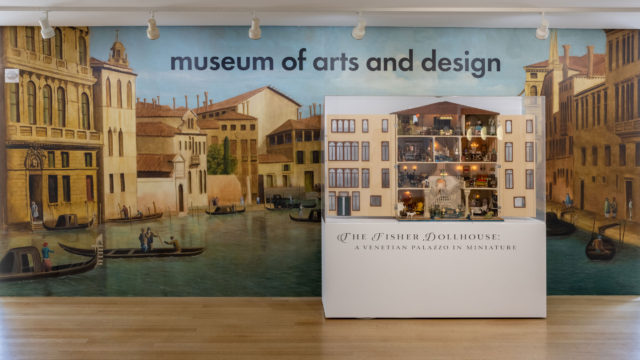
The Chocolate Genius will lead an interactive demonstration at MAD in conjunction with new chocolate bar inspired by Fisher Dollhouse (photo courtesy Museum of Arts & Design)

Who: Paul Joachim, the Chocolate Genius
What: Chocolate-making demonstration and hands-on activity
Where: Museum of Arts & Design, 2 Columbus Circle
When: Saturday, September 4, free with museum admission of $12-$18, noon–2:00
Why: Paul Joachim, the Florida-based artist known as the Chocolate Genius, has a simple but critical mission: “to transform one billion people or more through chocolate.” Joachim believes that “chocolate creates a visceral, personal response in everyone. It’s a bridge between classes, gender, religion, races — all labels of culture. In other words, chocolate creates a deep human connection — often missing in our divisive world.” Joachim will increase that deep human connection on September 4 when he he will lead an in-person, interactive chocolate-making demonstration at the Museum of Arts & Design, launching a new chocolate bar in conjunction with the exhibition “The Fisher Dollhouse: A Venetian Palazzo in Miniature.”

Chocolate demo takes place in Fisher Dollhouse exhibit at MAD (photo by Jenna Bascom)

On view through September 26, the dollhouse was created by New York–based arts patron and collector Joanna Fisher during the pandemic as a place of refuge; it was designed and built by dozens of craftspersons, with miniature works of art by Dustin Yellin, Ryan McGinness, Hunt Slonem, and others. On September 4 at noon, Joachim will show visitors how to make silicone molds, cast edible works, and temper chocolate at home, along with discussing the history of chocolate and cacao. The milk chocolate bars feature the facade of the dollhouse on their front. “When most people think of chocolate, it’s simply a chocolate bar,” Joachim’s mission statement continues. “I have the gift of transforming chocolate into a mystifying, inspirational experience, live and in front of audience’s eyes. Inspiring them with joy, awe, and love, disrupting the status quo, and pushing the boundaries of what is possible within each viewer’s point of view and own life.” Entry to this “Art Alive” presentation is free with museum admission. Also on view at MAD are “Craft Front & Center,” “Carrie Moyer and Sheila Pepe: Tabernacles for Trying Times,” “Beth Lipman: Collective Elegy,” and “45 Stories in Jewelry: 1947 to Now.”

NI MI MADRE

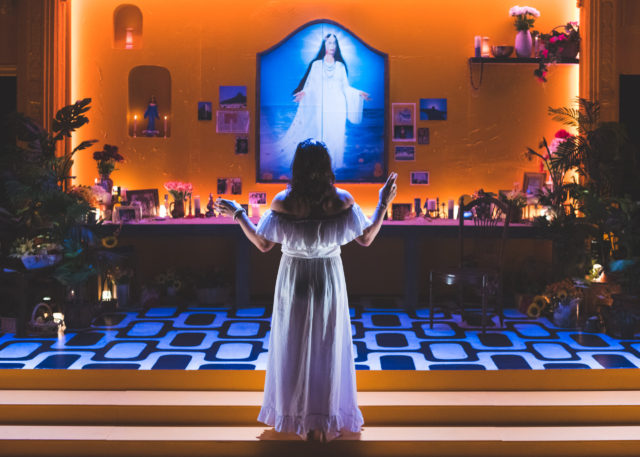
Stephanie Osin-Cohen’s set design is a highlight of new play at Rattlestick (photo by Andrew Soria)

NI MI MADRE
Rattlestick Playwrights Theater
224 Waverly Pl. between Eleventh & Perry Sts.
Tuesday – Sunday through September 19, $40
866-811-4111
www.rattlestick.org

“Gender’s confusing in our family,” Bete (pronounced “BET-chi”) says in Arturo Luís Soria’s one-person show, Ni Mi Madre, performed live at Rattlestick and streaming online through September 19. In the sixty-minute play, writer-star Soria portrays his domineering Brazilian mother, zeroing in on their complicated relationship.

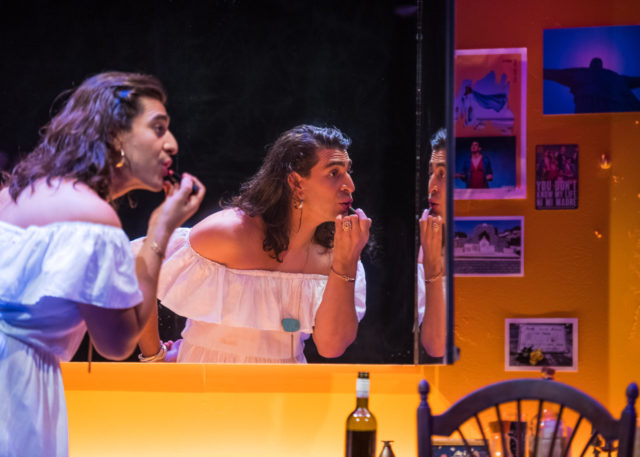
Ni Mi Madre, which means “not (or “nor”) my mother,” begins with Soria, in a long white gown (by Haydee Zelideth) that bares his hirsute chest, walking onstage carrying a row of ritual candles and flowers. He puts the objects down carefully and pulls the top of the dress over his chest and voilà, he is now his mother. He spends the remainder of the show acting and speaking like her as she discusses life and love, family and children, with a particular focus on her queer Latino son, Arturo.

“You know, he had the right idea going gay,” she says. “I just don’t think he executed it properly, because when he came out . . . He. Came. Out! I mean, it was like the Fourth of July on New Year’s, okay. Then he tells me he’s not just gay, he’s bisexual. So I say, ‘Listen, bisexuals are greedy, okay. The world is gay and it’s straight; it’s black and it’s white; it’s in and it’s out, so figure it out.’”

Arturo Luís Soria portrays his mother in one-person show (photo by Andrew Soria)

Elegant and proud, Bete talks about her three marriages, to Inebriated Jew, Ecuadorian Commie, and Gay Dominican; how it’s okay for her to beat her children; her dedication to Meryl Streep; and her own difficult mother. “My mother never wanted to be a mother. Never,” she explains. “You only get one mom. And my mother didn’t want me.” However, she’s not seeking sympathy but instead defends her treatment of her children.

“My kids don’t know how lucky they are to have a mother like me. I am their inspiration and they don’t even know it and I went through a lot of trouble to raise them,” she says. “I was a good mother to them. And I never abandoned them nor shipped them off to boarding school. I thought about it. Arturo was such a maniac as a kid I used to pray to God that he would go to sleep and not wake up until college, but those were only empty prayers. Kind of. Arturo thinks I was a bad mother to him. I wasn’t bad. He was a fuckin’ lunatic.” She might be harshly critical of him, but she also loves and supports him. “He’s following his dreams,” she adds. “He’s doing what I always wanted but never could because I didn’t have a mother like me.’

The night I saw the show, it was followed by a talkback with Soria and director Danilo Gambini (The Swallow and the Tomcat, An Iliad), a native Brazilian who has been working with Soria on the play since their Yale days going back to 2017 (in addition to other collaborations); Soria began writing Ni Mi Madre in 2008, and it has gone through numerous iterations before opening in New York City on August 25, when Soria’s mother was present in the audience. The postshow discussion lent further insight into mother and son, especially how the latter came to better understand and humanize the former through forgiveness and love as the play developed and he grew in the role. (There will be a free Zoom community conversation with Soria, Gambini, and Sam Morreale on September 2 at 5:00, and if you bring your own mother to the play, you can use code HIMOM to get her in for free September 2-6.)

The show, which features songs by Cher, Cyndi Lauper, Gloria Estefan, and Maria Bethania, lip-synced in drag finery by Soria, takes place on Stephanie Osin-Cohen’s gorgeous stage, a kind of shrine room with ritual objects, including candles galore, a bedecked vanity, and a large depiction of Iemanjá, the Umbanda (Candomblé) goddess of the sea, protector of fishermen and pregnant women — and who looks suspiciously like Cher. The floor is patterned like an Ipanema sidewalk of twisting black-and-white designs in the style of Roberto Burle Marx, which was highlighted in 2019 at the New York Botanical Garden. The walls are “persuasive papaya,” as Bete believes that “you have to paint the colors of your walls something that has to do with suggestive foods.” Krista Smith’s lighting shines brightly on Soria and casts long shadows on either side of the stage in one scene when Bete confronts her own parents.

Bold and barefoot, Soria (The Inheritance, Hit the Wall) fully inhabits the character of his mother. Too many of the lines fall flat and it can feel a bit repetitive even at only an hour, but Ni Mi Madre is a potent and poignant observation of first-generation immigrants, queer Latinidad, and the importance of family, despite the headaches.

“No matter how hard I try / You keep pushing me aside / And I can’t break through / There’s no talking to you,” Cher sings in “Believe,” which Bete mistakenly thinks is by Madonna. With Ni Mi Madre, Soria has taken a very public platform and touching way to break through to his mother.

WU TSANG: ANTHEM

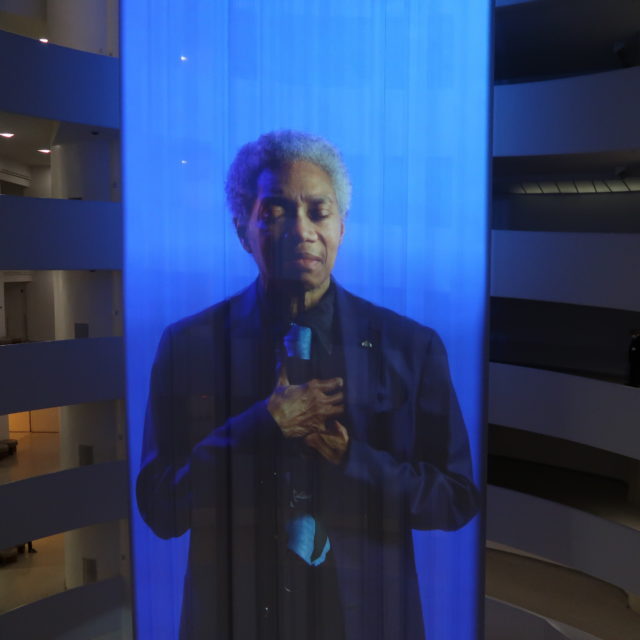
Beverly Glenn-Copeland bares his heart and soul in Guggenheim installation Anthem (photo by twi-ny/mdr)

RE/PROJECTIONS: VIDEO, FILM, AND PERFORMANCE FOR THE ROTUNDA
Solomon R. Guggenheim Museum
1071 Fifth Ave. at 89th St.
Thursday – Monday through September 6, $18 – $25 (pay-what-you-wish Saturday 5:45-7:45)
212-423-3587
www.guggenheim.org
anthem online slideshow

Philly-born Canadian composer and Black trans activist Beverly Glenn-Copeland has had quite a wild ride the last few years. In 2017, his 1986 cassette, Keyboard Fantasies, melding ambient, jazz, classical, folk, world, and New Age sounds, was rediscovered and rereleased, followed by his 2004 album, Primal Prayer, originally recorded under the name Phynix. In 2019, Posy Dixon’s documentary Keyboard Fantasies: The Beverly Glenn-Copeland Story came out, followed by a brief tour that brought Glenn-Copeland and his band, Indigo Rising, to MoMA PS1 that December. Despite the newfound popularity, in 2020, shortly after the pandemic lockdown began, Glenn-Copeland — the musician added the last part of his name in honor of American composer Aaron Copland, and he prefers to go by Glenn — and his wife, artist Elizabeth Paddon, were nearly homeless, resorting to a GoFundMe page to raise nearly $100,000.

This year, a projection of the seventy-seven-year-old musician is appearing on an eighty-four-foot diaphanous curtain hanging from the top of the Guggenheim Museum to nearly the base of the rotunda, like an enormous living tapestry. Glenn-Copeland, a Buddhist, performs the century-old spiritual “Deep River” along with additional a cappella vocalizations; he also plays percussion and keyboards in the film-portrait, titled Anthem. A live version of the song appears on his 2020 compilation, Transmissions; it has previously been sung by Marian Anderson, Paul Robeson, Johnny Mathis, Bobby Womack, and many others — Chevy Chase delivered an excerpt in the first Vacation movie, and Denyce Graves sang an operatic version at the Capitol memorial service for Ruth Bader Ginsburg. Anthem is one of several projects in the Guggenheim series “Re/Projections: Video, Film, and Performance for the Rotunda,” which has also featured works by Ragnar Kjartansson, Christian Nyampeta, and others as the institution reconsiders how to present shows to the public during the coronavirus crisis and beyond.

Tsang bathes Glenn-Copeland in a warm blue light as she depicts the performer in full view as well as in close-up, singing into an old-fashioned microphone, playing the piano, and holding out his hands as if trying to embrace us. The Guggenheim’s bays are empty except for occasional small vertical speakers, which broadcast different sections of the music, and in a few places the projection passes through the translucent curtain and can be seen against the back wall. (Musician Kelsey Lu and DJ, producer, and composer Asma Maroof collaborated on the piece, with assistant curator X Zhu-Nowell.) Thus, as you make your way up and down the Guggenheim’s twisting path, you get different audio and visual perspectives, like Glenn-Copeland is wrapping his arms around you with a spiritual lullaby: “Deep River / My home is over Jordan / Deep River, Lord / I want to cross over into campground,” he sings.

“When I first heard Glenn’s music, I remember thinking to myself, it sounded like an anthem. And then I was — I immediately corrected myself,” Tsang, who calls the installation a “sonic sculptural space,” says in a Guggenheim video. “Like, oh, what kind of — it’s not that I’m so patriotic. It’s just his voice was sort of conjuring a place I wish I lived. It was giving me this tonal quality of, like, I wish that there was an anthem of a place that we could all exist in. And that, for me, is the world that Glenn kind of puts out there as a possibility.”

Continuing through September 6, Anthem is accompanied by a documentary that concentrates on the intimate personal relationship between Glenn and Elizabeth, but it doesn’t feel organic in conjunction with the installation. Also on view at the Guggenheim are “Off the Record,” consisting of works by Sarah Charlesworth, Glenn Ligon, Lisa Oppenheim, Adrian Piper, Lorna Simpson, Hank Willis Thomas, Carrie Mae Weems, and others inspired by official documentation; “The Hugo Boss Prize 2020: Deana Lawson, Centropy,” featuring the Rochester native’s sculpture, holograms, and photography exploring the African diaspora; and “Away from the Easel: Jackson Pollock’s Mural,” anchored by Pollock’s 1943 Mural, his largest painting ever, commissioned for Peggy Guggenheim for her East Sixty-First St. townhouse.

FRICK MADISON AND THE SLEEVE SHOULD BE ILLEGAL

Jean-Auguste-Dominique Ingres, Comtesse d’Haussonville, oil on canvas, 1845 (Purchased by the Frick Collection, 1927)

FRICK MADISON AND THE SLEEVE SHOULD BE ILLEGAL
945 Madison Avenue at 75th Street
Thursday – Sunday, $12-$22 (includes free guide), 10:00 am – 6:00 pm
www.frick.org/madison

For the first twelve months of the pandemic, the Frick, my favorite place in New York City, was my “virtual home-away-from-home” when it came to art. And I mean that in a different way than Lloyd Schwartz does in his piece on Johannes Vermeer’s Officer and Laughing Girl in the recently published book The Sleeve Should Be Illegal & Other Reflections on Art at the Frick, in which the poet and classical music critic uses that phrase to describe what the museum, opened to the public in 1935 at Fifth Ave. and Seventieth St., meant to him when he was growing up in Brooklyn and Queens. The book features more than sixty artists, curators, writers, musicians, and philanthropists waxing poetic about their most-admired work in the Frick Collection.

A native of Brooklyn myself, I am referring specifically to the institution’s online presence during the coronavirus crisis. It had closed in March 2020 for a major two-year renovation, moving its remarkable holdings to the nearby Breuer Building on Seventy-Fifth and Madison, the former home of the Whitney from 1966 to 2014, then host to the Met Breuer for an abbreviated four years. Starting in April 2020 and continuing through last month, chief curator Xavier F. Salomon (and occasionally curator Aimee Ng) gave spectacular prerecorded illustrated art history lectures on Fridays at 5:00 focusing on one specific work in the museum’s holdings; thousands of people from around the world tuned in live to learn more about these masterpieces. Two questions added a frisson of excitement for devoted fans: What cocktail would the curator select to enjoy with the painting, sculpture, or porcelain/enamel object that week? And which smoking jacket would Xavier be rocking? These sixty-six marvelous “Cocktails with a Curator” episodes can still be seen here.

For more than half my life, the Frick has been the spot I go to when I need a break from troubled times, a respite from the craziness of the city, a few moments of peace amid the maelstrom. Going to the Frick, which was designed by Carrère and Hastings and served as the home of Pennsylvania-born industrialist Henry Clay Frick from 1914 until his death in 1919 at the age of sixty-nine, was like visiting old friends, reflecting on my existence among familiar and welcoming surroundings. There is still nothing like sitting on a marble bench in John Russell Pope’s Garden Court, with its lush plantings, austere columns, and lovely fountain, in between continuing my intimate, personal relationships with cherished canvases. In Sleeve, philanthropist Joan K. Davidson writes about Giambattista Tiepolo’s Perseus and Andromeda, “Entering the Frick, the visitor tends to head to the galleries where the Fragonards, Titians, El Greco, the great Holbeins, and other Frick Top Treasures are to be found. Or, perhaps, you turn left to the splendid English portraits in the Dining Room. But not so fast, please. You could miss my picture!” I am not nearly so generous as Davidson, not at all ready to share my prized works with others, preferring alone time with each.

After being teased by Salomon’s discussion of Rembrandt’s impossibly powerful 1658 self-portrait, which gave a glimpse of where it is on display at Frick Madison, it was with excitement and more than a little trepidation that I finally ventured toward Marcel Breuer’s Brutalist building, worried it would feel like seeing friends in a hotel where they’re staying while their kitchen is being remodeled. As artist Darren Waterston admits in his piece on Giovanni Bellini’s St. Francis in the Desert, about his first pilgrimage to the museum, “I remember feeling a nervous anticipation as I approached the Frick, as if I were meeting a lost relative or a new lover for the first time.” He now makes sure to return at least once every year.

In addition, I was poring over Sleeve, a cornucopia of Frick love. Many of the rapturous entries are just as much about the institution itself and how the pieces are arranged as the chosen object. Writing about the circle of Konrad Witz’s Pietà, short story writer and translator Lydia Davis explains, “Because of the reliable permanence of the collection — the paintings usually hanging where I knew to find them — they became engraved in my memory. Over time, of course, I changed, so my experience of the paintings also changed.” Fashion designer Carolina Herrera, praising Goya’s Don Pedro, Duque de Osuna, notes, “I would love to move in. And, as one does, I would like to move the furniture around, hang the paintings in different places, and put some of the objects away, to change them from time to time.”

While I had contemplated moving in, I had never considered rearranging anything, although I was blown away when, after decades of seeing Hans Holbein the Younger’s portrait of Sir Thomas More in the Living Hall, where it looks over at Holbein’s portrait of More’s archnemesis, Sir Thomas Cromwell, well above eye level and separated by a fireplace and El Greco’s exquisite painting of St. Jerome, I was able to belly up to the canvas at my height when it was displayed temporarily in the Oval Room, leaving me, as curator Edgar Munhall pointed out on the audio guide, “weak in the knees.” Entering Frick Madison, my thoughts zeroed in on my impending rendezvous with Holbein and More.
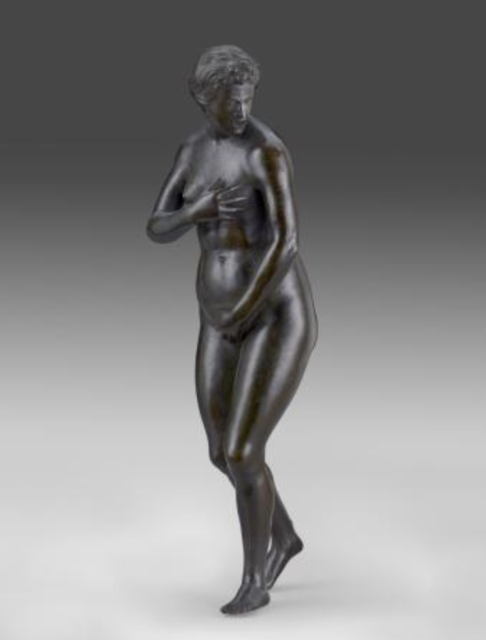
Unknown artist (Mantua?), Nude Female Figure (Shouting Woman), bronze with silver inlays, early 16th century (Henry Clay Frick Bequest)

Five people melt over the More portrait in Sleeve; in fact, the title of the book comes from novelist Jonathan Lethem’s foray into the work. Nina Katchadourian raves, “Every time I visit the Frick, I go to the Living Hall to look at Holbein’s portrait of Sir Thomas More. I love it as a painting, but I also see it as the first spark in a series of chain reactions that happen among objects in the room. . . . It is a staging of masterpieces that is itself a masterpiece of staging.” I quickly found the canvas, in its own nook with Cromwell, as if there were nothing else in the world but the two of them. You can get dangerously close to the breathtaking canvases, glorying in Holbein’s remarkable brushwork, his unique ability to capture the essence of each man in a drape of cloth, a ring, a stray hair, a bit of white fabric sticking out from a fur collar.

Utterly pleased and satisfied with the placement of the Holbeins — while I did miss all the finery usually surrounding them, seeing them both so unencumbered just felt right — I continued my adventure to track down other old friends and make new ones. St. Francis in the Desert, a work that demands multiple viewings, with new details emerging every time, usually hangs across from More, but here it has its own well-deserved room. Referring to St. Francis’s position in the painting, hands spread to his sides, looking up at the heavens, artist Rachel Feinstein writes, “That moment of isolation is fascinating in the context of the situation we are in now because of COVID-19. Our family of five may not be living alone in a cave right now, but due to the current circumstances, we have turned more inward, like St. Francis. Looking at this image and its sharp clarity during this time of fear and uncertainty is very soothing and inspirational.”

Trips to the Frick bring up childhood memories for many Sleeve contributors (Lethem, Moeko Fujii, Bryan Ferry, Stephen Ellcock, Julie Mehretu); describing seeing Rembrandt’s Polish Rider for the first time in high school, novelist Jerome Charyn remembers, “He could have been a hoodlum from the South Bronx with his orange pants and orange crown. . . . I left the Frick in a dream. I had found a mirror of my own wildness on Fifth Avenue, a piece of the Bronx steppe.” Donald Fagen and Abbi Jacobson recall lost love, while Frank, Edmund De Waal, and Adam Gopnik bring up Marcel Proust. Arlene Shechet and Wangechi Mutu find the feminist power in the early sixteenth century sculpture Nude Female Figure (Shouting Woman). “Making a small work is an unforgiving process,” Shechet writes. “There is no room for missteps, and the Shouting Woman is an example of exquisite perfection, her bold demeanor wrought with great feeling and delicacy. The plush palace that is the Frick becomes eminently more compelling when I visit with this giant of a sculpture.”

Artist Tom Bianchi gets political when delving into Goya’s The Forge, a harrowing canvas that depicts blacksmiths hard at work as if in hell. “The presence of The Forge in the collection is an anomaly,” Bianchi explains. “Frick’s fortune was built on the labor of steelworkers, whose union he infamously opposed. His reduction of the salaries of his workers resulted in the Homestead strike in 1892, in which seven striking workers and three guards were killed and scores more injured. Ultimately, Frick replaced the striking workers, mostly southern and eastern European immigrants, with African American workers, whom he paid a 20 percent lower wage. One wonders if Frick appreciated the irony of the inclusion of this painting among his Old Masters.”
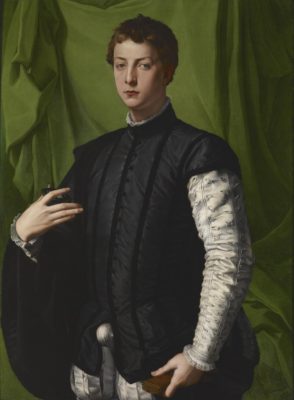
Agnolo Bronzino (Agnolo di Cosimo di Mariano), Lodovico Capponi, oil on panel, 1550–55 (The Frick Collection; Henry Clay Frick Bequest)

I’ve always had a minor issue with how the Frick’s three Vermeers, Officer and Laughing Girl, Mistress and Maid, and Girl Interrupted at Her Music, are displayed; two of the three can usually be seen in the South Hall, above furniture, in a narrow space that is easy to pass by, especially if you are checking out the opposite Grand Staircase, which will at last be open to the public when the Frick reopens in mid-2023.

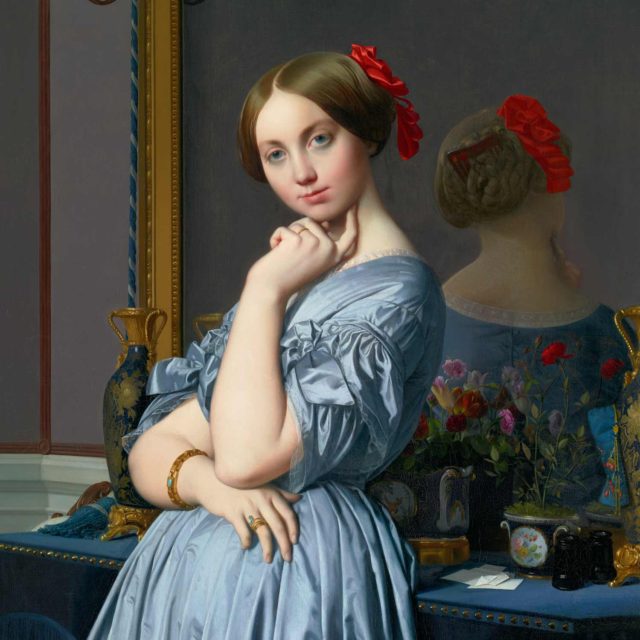
There are no such obstacles at Frick Madison, where all three are in the same room on the second floor. Together the Vermeers are feted by Fujii, Frank, Vivian Gornick, Gregory Crewdson, Susan Minot, Judith Thurman, and Schwartz. Meanwhile, various artists are completely shut out of Sleeve accolades, including Hans Memling (Portrait of a Man), Frans Hals (Portrait of an Elderly Man and Portrait of a Woman), François Boucher (The Four Seasons), Edgar Degas (The Rehearsal), John Constable (Salisbury Cathedral from the Bishop’s Grounds), Carel Fabritius (The Goldfinch), François-Hubert Drouais (The Comte and Chevalier de Choiseul as Savoyards), Paolo Veronese (Wisdom and Strength), and Pierre-Auguste Renoir (La Promenade). Rembrandt’s aforementioned self-portrait receives five nods (Roz Chast, Rineke Dijkstra, Diana Rigg, Jenny Saville, Mehretu), while Ingres’s Comtesse d’Hassuonville nets three (Jed Perl, Firelei Báez, Robert Wilson).

But the biggest surprise for me was the popularity of Bronzino’s Lodovico Capponi, chosen by Susanna Kaysen, David Masello, Daniel Mendelsohn, Annabelle Selldorf, and Catherine Opie. When I saw it at Frick Madison, I had no recollection whatsoever of the 1550s vertical oil painting of a page with the Medici court; it felt like I was seeing it for the very first time. It’s an arresting picture, highlighted by loose background drapery, the curious position of the fingers of each hand, the privileged look in his eyes, and, of course, the ridiculously funny codpiece/sword. As I stood in front of it, it did not strike me the way other portraits at the Frick do; in her “Cocktails with a Curator” entry on the piece, Ng says with a big smile, “This one really is one of my most favorite, if not favorite, works at the Frick. . . . I know I’m not the only one. . . . This is a painting that’s at the heart of many people who are close to the Frick.” When I go back to Frick Madison, which will be very soon, I’m going to spend more time with Lodovico, and I am already preparing myself to make a beeline for it when the original Frick reopens. I clearly must be missing something, as Lodovico has taken a brief sojourn to the Met, where it is not only included in the major exhibition “The Medici: Portraits and Politics, 1512–1570,” which runs through October 11, but is the cover image of the catalog.

Selldorf writes in her piece on Lodovico, “Art informs the space, but the space also informs the art.” Whether it’s the Frick Madison or the Frick on Fifth, “The genius, beauty, and mystery behind its doors may change your life,” Herrera promises. It’s changed myriad lives over its nine-decade existence, from other artists’ to just plain folks’ like you and me. You’re bound to fall in “love at first sight” — as New York Philharmonic principal cellist Carter Brey describes his initial encounter with George Romney’s Lady Hamilton as “Nature” — with at least one work at the Frick, something that will stay with you for a long time, an objet d’art you’ll visit again and again and develop a meaningful relationship with over the years. Just be sure to stay out of my way when I’m reconnecting with Sir Thomas More.

THE MAGNIFICENT MEYERSONS

Kate Mulgrew and Barbara Barrie play mother and daughter in NYC-set The Magnificent Meyersons

THE MAGNIFICENT MEYERSONS (Evan Oppenheimer, 2021)
Marlene Meyerson JCC Manhattan
334 Amsterdam Ave. at West Seventy-Sixth St.
On demand: August 20-26, $15
Rooftop screenings with Q&As: August 22 & 24, $15, 8:00
argotpictures.com

The dysfunctional Manhattan family in Evan Oppenheimer’s new drama The Magnificent Meyersons might not be quite as quirky and off the beaten path as the off-the-wall dysfunctional NYC clan in Wes Anderson’s dark-comedy cult favorite The Royal Tenenbaums, but the trials and tribulations of brothers, sisters, and mothers in each are set in motion by a long-absent father.

Available on demand August 20-26 from the Marlene Meyerson JCC in addition to a pair of in-person rooftop screenings on August 22 and 24 featuring Q&As with writer-director Oppenheimer and several of the stars, The Magnificent Meyersons consists of a series of two-character discussions, examining love and loss, responsibility and faith, until the family ultimately comes together to face some hard truths. Oldest daughter Daphne (Jackie Burns) and her husband, Alan (Greg Keller), talk about whether they want more than one child; later, Daphne examines her career with friend and publishing colleague Joelle (Kate MacCluggage). Oldest son Roland (Ian Kahn), a successful businessman, shares his bleak pessimism about the state of the world with his finance pal Percy (T. Slate Gray). Youngest son Daniel (Daniel Eric Gold), who is studying to become a rabbi, delves into the existence of a supreme being first with his friend Lily (Lilli Stein), then with Father Joe (Neal Huff).

Youngest daughter Susie (Shoshannah Stern), a rising real estate agent, meets with her girlfriend, Tammy (Lauren Ridloff), in a cafe. And the siblings’ mother, Dr. Terri Meyerson (Kate Mulgrew), an oncologist, goes for a walk with her mother, the widowed Celeste (Barbara Barrie). Seen in flashbacks is Terri’s husband and the kids’ father, Morty (Richard Kind), who left the family he loves decades ago for a hard-to-explain reason involving his mental well-being. He has been missing from their lives ever since, though his psychological presence hovers over everyone.

Oppenheimer (A Little Game, Alchemy) avoids making heroes or villains, culprits or victims out of any of his characters; they are all complex individuals who, above all else, have ordinary problems over the course of an ordinary day. One of the concepts that is central to the narrative is that no one is special and that nothing is extraordinary; in fact, a major event, breaking news that pings across the city (and the world), does not create the impact one would expect. It’s just another thing in people’s lives.

Several of the subplots go nowhere, including one involving Roland’s wife, Ilaria (Melissa Errico), and their daughter, Stefania (Talia Oppenheimer, Evan’s daughter), or are unfulfilling. Most of the action takes place in and around Union Square Park, City Hall Park, and other familiar outdoor locations, with repetitive drone shots introducing new scenes. Oppenheimer seems to go out of his way to make sure nothing of too much consequence ever happens; even when Dr. Meyerson tells a couple that their young child has only three months to live, the father refuses to accept it, and Terri can only watch, offering nothing further. Don’t expect fireworks, because you’re not going to get them. Even when confrontation appears to be inevitable, when the finale tosses yet one more twist at us, Oppenheimer does not even try to close it all up neatly. It’s just another average day for an average family in a grand city.

“Why would a reviewer make the point of saying someone’s not a genius? Do you especially think I’m not a genius?” Eli Cash (Owen Wilson) says over the phone in The Royal Tenenbaums, which is a work of genius. “You didn’t even have to think about it, did you?” The same can be said about the characters in The Magnificent Meyersons.