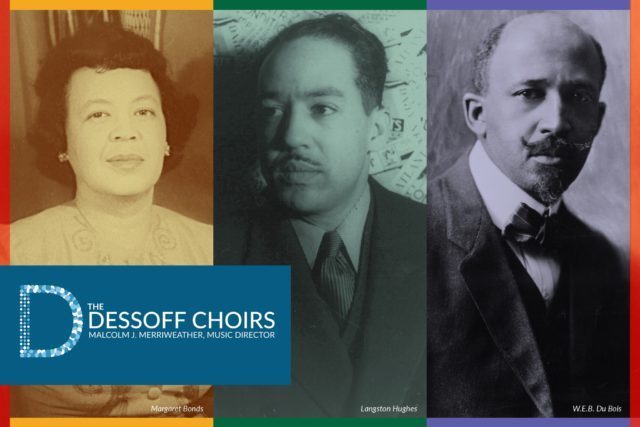
The Dessoff Choirs presents a cantata by Margaret Bonds made in collaboration with Langston Hughes and inspired by the words of W E B. Du Bois
Who:The Dessoff Choirs What: New York premieres of cantatas by Margaret Bonds Where:Church of the Heavenly Rest, 1085 Fifth Ave. at Ninetieth St. When: Thursday, April 28, $20-$40, 6:45 talk, 7:30 concert Why: “I believe in God who made of one blood all races that dwell.” So begins W. E. B. Du Bois’s 1904 prose poem Credo, which served as inspiration for African American composer, pianist, teacher, and Chicago native Margaret Bonds’s piano/vocal score that is part of the Dessoff Choirs’ presentation of a pair of New York premieres of cantatas by Bonds, taking place April 28 at the Church of the Heavenly Rest. The company, which was founded in 1924 by Margarete Dessoff, previously released the recording The Ballad of the Brown King & Selected Songs, centered around Bonds’s 1954 collaboration with Langston Hughes about Balthazar, one of the three kings who visited the baby Jesus. At the Heavenly Rest, the Dessoff Choirs, joined by a full orchestra, Grammy-winning bass-baritone Dashon Burton, soprano soloist Janinah Burnett, and the Carter Legacy Singers, will perform I Believe: Credo and Simon Bore the Cross, the latter also a collaboration with Hughes.
“Dessoff is dedicated to performing rarely heard choral masterpieces,” Dessoff music director Malcolm J. Merriweather said in a statement. “We are thrilled to cast a spotlight on Margaret Bonds’s neglected but important contribution to the American music canon. She is a forgotten voice for civil rights that must be remembered, appreciated, and cherished. It seems the time has come for Bonds’s voice to be heard.” The program begins with a preconcert talk at 6:45, followed at 7:30 by Dr. Rollo Dilworth’s seven-movement choral symphony version of Credo and Bonds’s Easter cantata, about Simon of Cyrene, who carried Jesus’ cross; the work was found in a dumpster at a book fair, along with other scores of hers.
An all-star cast celebrates the power of poetry in online benefit for Literacy Partners
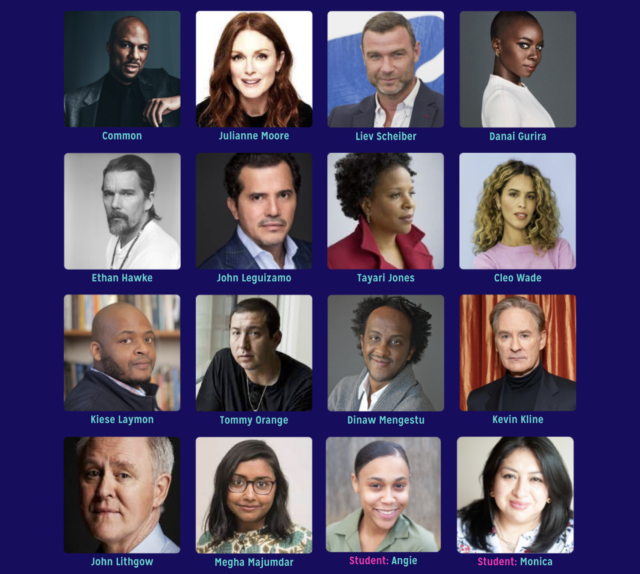
Who: Common, Julianne Moore, Liev Scheiber, Danai Gurira, Ethan Hawke, John Leguizamo, Tayari Jones, Cleo Wade, Kiese Laymon, Tommy Orange, Dinaw Mengestu, Kevin Kline, John Lithgow, Megha Majumdar, Zibby Owens, Mira Jacob, more What: Online poetry reading benefiting Literacy Partners Where:Literacy Partners online When: Thursday, April 28, free with RSVP (donations accepted), 8:00 Why: On April 28 at 8:00, Literacy Partners will stream an encore presentation of “I Love This Poem: An Online Reading,” consisting of short works read by such actors as Common, Julianne Moore, Liev Scheiber, Danai Gurira, Ethan Hawke, John Leguizamo, Kevin Kline, and John Lithgow, hosted by Zibby Owens and Mira Jacob. Part of the organization’s literary and social justice series, the event, which was held on May 20, 2021, also features favorite poems read by two students, Angie and Monica. “We present this public reading in celebration of the power of poetry to heal, connect, and inspire us to advocate for a more just and equitable world,” Literacy Partners explains.
The evening includes poems by Fion Lim, Langston Hughes, Natalie Diaz, Billy Collins, Rabindranath Tagore, Lucille Clifton, John Keats, Alice Walker, William Shakespeare, Kim Addonizio, Pablo Neruda, Adrienne Rich, Rodolfo Gonzalez, and Maya Angelou. Literacy Partners was founded in 1973 to “emphasize support for individuals excluded from education because of racial or ethnic segregation and discrimination, economic challenges, sexism, or immigration status.”
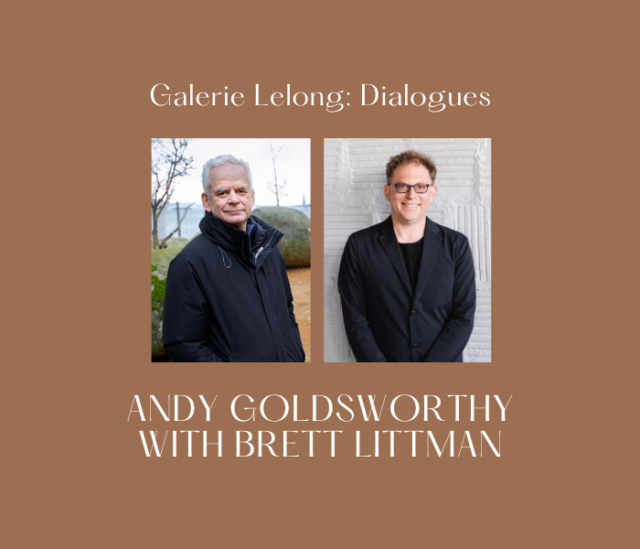
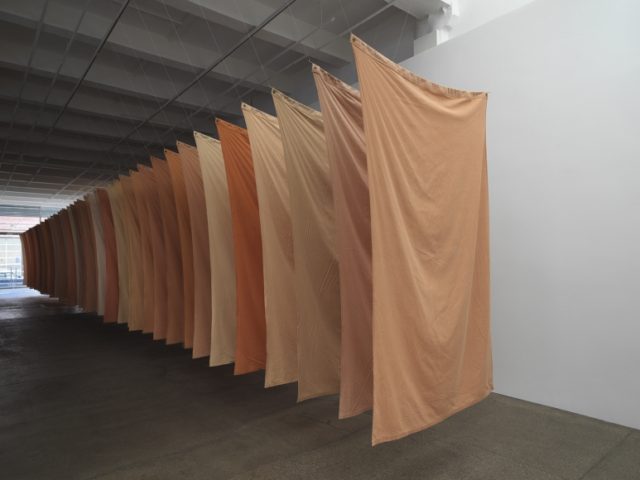
Who: Andy Goldsworthy, Brett Littman What: Live and livestreamed discussion about new Andy Goldsworthy exhibition, “Red Flags” Where:Galerie Lelong, 528 West Twenty-Sixth St. between Tenth & Eleventh Aves., and Zoom When: Saturday, April 23, free, 11:00 am (exhibition continues through May 7) Why: In September 2020, Cheshire-born, Scotland-based environmental artist Andy Goldsworthy installed 109 hand-painted “Red Flags” in Rockefeller Center, replacing state flags and now featuring the color of the earth from each state. “Collectively I hope they will transcend borders,” he said when he started the project. “The closeness of one flagpole to another means that in certain winds the flags might overlap in a continuous flowing line. My hope is that these flags will be raised to mark a different kind of defense of the land. A work that talks of connection and not division.” He also compared the red earth to the blood running through our veins.
Installation view, Andy Goldsworthy, Red Flags, 2020 (courtesy Galerie Lelong & Co., New York)
The installation has now been reconfigured as an indoor exhibit at Galerie Lelong in Chelsea — whittled down to fifty flags and accompanied by two related videos — where it will be on view through May 7. Goldsworthy’s work with natural materials is well documented, in such films as Thomas Riedelsheimer’s 2001 Rivers and Tides and 2016 Leaning into the Wind as well as Goldsworthy’s permanent Garden of Stones at the Museum of Jewish Heritage. “Red Flags may not have been conceived as a response to recent events, but it is now bound up with the pandemic, lockdown, division, and unrest,” Goldsworthy added back in September 2020. “However, I hope that the flags will be received in the same spirit with which all the red earths were collected — as a gesture of solidarity and support.”
In conjunction with Earth Day, the gallery is hosting a free conversation with Goldsworthy and Isamu Noguchi Foundation and Garden Museum director Brett Littman, taking place in Chelsea and Zoom on April 23 at 11:00; admission is free in person and online. You can also check out a September 2020 virtual interview Goldsworthy did with the Brooklyn Rail about his flags project and career here.
Who: Pamela Adlon, Isaac Mizrahi What: Advance screening and discussion of Better Things (92Y Recanati-Kaplan Talks) Where:92nd St. Y, Buttenwieser Hall, 1395 Lexington Ave. between 91st & 92nd Sts., and online When: Saturday, April 23, $25 in person, $20 online (talk only), 7:00 Why: One of the best virtual talks during the pandemic was 92Y’s conversation between Better Things cocreator, producer, director, cowriter, and star Pamela Adlon and actor and comedian Mario Cantone. Emmy winner Adlon, who plays Sam Fox, a single mother of three girls and a former child star still working in the business, and Cantone, who plays her agent, Mal Martone, cracked up each other, and the online audience, as they talked about the hit comedy and dealt with Zoom issues. After five seasons that began in 2016, Better Things is concluding its run on April 25 with its final, fifty-second episode, entitled, “We Are Not Alone.”
But on April 23 at 7:00, you can say goodbye to Sam; her daughters, Max (Mikey Madison), Frankie (Hannah Riley), and Duke (Olivia Edward); Sam’s expat mother, Phil (Celia Imrie); Rich (Diedrich Bader), Sam’s best friend; Mal; and other characters when the 92nd St. Y presents an advance, in-person-only screening of the finale, followed by a live discussion between Adlon (King of the Hill,Louie), herself a single mother of three daughters, and Brooklyn-born fashion designer and television presenter Isaac Mizrahi, that can also be accessed online. Better Things is an extraordinarily funny and moving show that is, first and foremost, about family, dealing with familiar issues in unique ways as three generations of women face the challenges of daily existence with charm and humor. If you haven’t been watching, start bingeing now.
Gillian Wearing, Self-Portrait, framed chromogenic print, 2000 (collection of Sherry and Joel Mallin, New York)
GILLIAN WEARING: WEARING MASKS
Solomon R. Guggenheim Museum
1071 Fifth Ave. at 89th St.
Panel discussion: Thursday, April 21, free with RSVP, 2:00
Thursday – Monday through June 13, $18-$25, 11:00 am – 6:00 pm
212-423-3500 www.guggenheim.org
In her five-minute 2018 short film Wearing, Gillian, British artist Gillian Wearing repeats, “I’m Gillian Wearing.”
But who is Gillian Wearing? In the revealing exhibition “Gillian Wearing: Wearing Masks,” continuing at the Guggenheim through June 13, the fifty-eight-year-old Turner Prize winner explores the idea of “Gillian Wearing” through film, sculpture, photography, painting, and installation, putting viewers in the position of asking themselves who they are as well.
Part of the Young British Artists movement of the late 1980s and early ’90s, Wearing focuses on self-portraiture very differently from such near-contemporaries as Cindy Sherman, who disguises herself as real and fictional characters in cinematic and art-historical tableaux as she explores gender and identity, and Lucas Samaras, whose vast output includes an endless array of self-imagery in multiple formats.
Wearing often uses masks — the show was conceived well before the Covid-19 pandemic — on herself and others to challenge who we are and how we are seen. “I do not like to be on this side of the camera. I’d much rather be on the other side of the camera,” she says in Wearing, Gillian. “Watching me being me alienates me from me, and I don’t recognize myself.” In the film, performers, and Wearing herself, wear AI digital masks of her face. “It’s really about putting myself on the line, and that comes from the risk of being judged and laying myself bare to people’s judgments, but . . . such is life.” Those kinds of feelings are not unique to Wearing, particularly in the social media age, when so many people can engage in sophisticated self-display, creating whatever image they want and hiding behind it for myriad reasons.
Gillian Wearing, 60 Minutes Silence, color video projection, with sound, 1996 (Arts Council Collection, Southbank Centre, London)
Spread across four galleries, the exhibition welcomes you into Wearing’s intriguing world, where nothing is quite what it seems. For Signs that Say What You Want Them to Say and Not Signs that Say What Someone Else Wants You to Say, Wearing asked strangers on London streets to write down something about themselves on sheets of paper and then photographed them holding up the signs, which now evoke early Facebook posts. “Everything is connected in life,” one man writes. “The point is to know it and to understand it.”
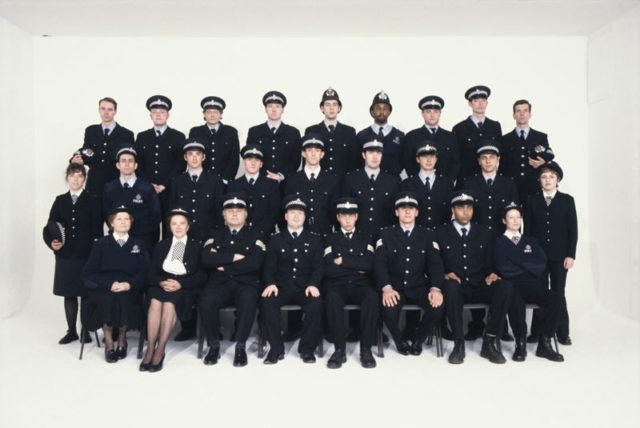
At first, 60 Minutes Silence might appear to be a photograph of twenty-six uniformed police officers arranged in three rows, but it is actually an hourlong video in which the cops try to maintain their position, moving as little as possible. It’s a kind of reversal, since part of a police officer’s job is to keep a close eye on the public, but now we’re watching them. In addition, seeing the 1996 piece in 2022 makes us think not only of the raging controversy over police brutality but also of diversity: We also can’t help but notice that there are only five women and two people of color. In Confess All on Video. Don’t Worry, You Will Be in Disguise. Intrigued? Call Gillian . . . , people in masks and wigs share extremely personal stories on a split screen in a large booth, again presaging social media.
But Wearing most often is looking at herself. Me and My Ideal Self features photographs of Wearing placed under glass in a custom frame; on the front panel is an elongated photo of Wearing standing in heels on a wooden box, as if not wanting anyone to see what’s inside. She takes self-portraits of herself as her grandparents, her brother, and other family members, of herself at three, seventeen, and twenty-seven (portraits from fifty to seventy appear on the wallpaper), and of herself as seminal photographers Andy Warhol, Diane Arbus, Robert Mapplethorpe, Weegee, Claude Cahun, Henry Fox Talbot, and August Sander, the photographer who set out to document German society in People of the Twentieth Century.
There are also video portraits, a collection of masks, a pair of busts of Wearing nearly kissing each other, a prosthetic Wearing head dangling on an immense charm bracelet with other body parts, and Polaroids she took of herself in the 1990s, sans masks. Throughout it all, her eyes, or the eyes of others in masks of her face, are always visible, looking right at the viewer, a performative take on personal identity, memory, and connection.
On April 21 at 2:00, the Guggenheim will host the free, livestreamed panel discussion “Wearing Masks: The Performance of Identity in Contemporary Art,” with senior curator Jennifer Blessing, photographer and musician Farah Al Qasimi, visual artist Malik Gaines, and multimedia artist Colette Lumiere, moderated by Dr. Ksenia M. Soboleva.
Given the coronavirus crisis and the ongoing debate over mask mandates as variants keep emerging, Wearing has revisited her 2013 Me as Mask, now taking that wax mask of her face, placing a black-bordered blue mask over it, and having it held up on a stick by a disembodied hand, hollow eye holes staring back at us.
“We all wear masks. We’re all actors,” she says in Wearing, Gillian. “Do you feel that you know me a bit now?” The answer is a rousing yes and no.
DIANE ARBUS
Scholars’ Gate, Doris C. Freedman Plaza
Central Park entrance, 60th St. & Fifth Ave.
Through August 14, free www.publicartfund.org online slideshow
In conjunction with the Guggenheim retrospective, Gillian Wearing has gone one step beyond her 2008 self-portrait as photographer Diane Arbus, using the existing photo of Arbus that inspired her picture and transforming it into a life-size statue for the Public Art Fund. The work stands at the Scholars’ Gate entrance to Central Park, in Doris C. Freedman Plaza, on the pavement, not a plinth; she is one of us. The photo of Arbus is part of what Wearing refers to as her “spiritual family,” comprising artists that she has photographed herself in digital masks. As in the photo, the statue depicts Arbus with her medium-format Rolleiflex hanging from around her neck, looking for subjects; she is wearing a dark jacket and white shoes. “A photograph is a secret about a secret. The more it tells you the less you know,” Arbus said in 1971. Wearing now asks what kind of secrets a statue of a photo might hold.
In “An Interview with Myself,” Wearing’s catalog contribution to the Guggenheim show — which includes a thirteen-inch model of the statue and the Arbus quote “If you scrutinize reality closely enough, if in some way you really, really get to it, it becomes fantastic” — she writes about portraying herself as others, “The whole process takes several months, and I liken it to how an actor gets into character. By the time I am in full costume, I lose my actual self a bit. It can be disappointing when the mask comes off and it’s my face again.”
In this case, the mask comes off and it is Arbus, a New York City native who specialized in capturing the daily reality of ordinary folk as well as sideshow performers, strippers, female impersonators, freaks, and others on the fringe. “For me the subject of the picture is always more important than the picture. And more complicated,” Arbus said. That statement relates to Wearing’s work, and specifically her portrayals of Arbus, in beautifully complex ways.
Who: Tracie Thoms, Taylor Schilling, John Turturro, Ato Blankson-Wood, Keith David, Craig Manbauman, Sandy Cayo, Elizabeth Hazlewood, Jumaane Williams, Bryan Doerries What: Dramatic reading and community discussion Where:Theater of War Zoom When: Thursday, April 21, free with RSVP, 6:00 Why: Theater of War Productions teams up with the Greater NYC Black Nurses Association for its latest live, interactive presentation, exploring caregiving and death. On April 21 at 6:00, an all-star cast will deliver a dramatic reading of Sophocles’s Antigone, about one of the daughters of Oedipus and Jocasta who is determined to give a proper burial to her brother Polynices, who has been branded a traitor, his body left to rot.
The fifth-century play will be performed by actors Tracie Thoms, Taylor Schilling, John Turturro, Ato Blankson-Wood, and Keith David, joined by frontline nurses Craig Manbauman, Sandy Cayo, and Elizabeth Hazlewood and New York City public advocate Jumaane Williams; the discussion, which explores the themes of the play as they relate today to the coronavirus crisis and other health issues, will be facilitated by Theater of War artistic director Bryan Doerries and held in conjunction with the Johns Hopkins School of Nursing, the Johns Hopkins Berman Institute of Bioethics, and the Resilient Nurses Initiative — Maryland.
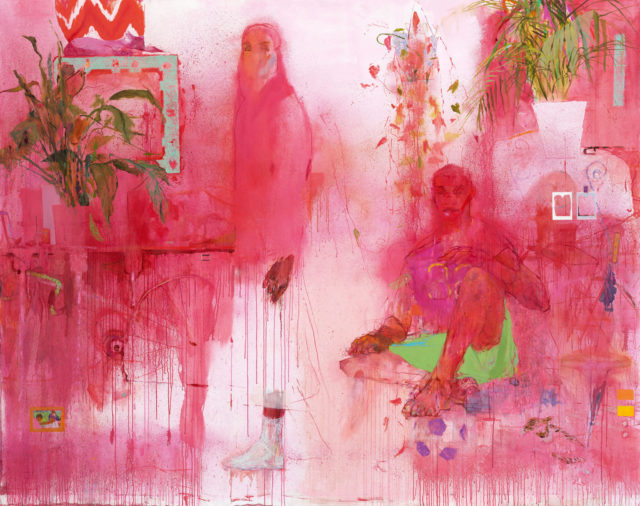
Who: Jane Panetta, Jennifer Packer What: Video tour of “Jennifer Packer: The Eye Is Not Satisfied with Seeing” Where:Whitney Museum of American Art YouTube When: Exhibition continues through April 17 Why: While everyone else is crowding into the Whitney Biennial, you should break away from the pack and check out one of the best exhibitions in the city over the last six months, the revelatory “Jennifer Packer: The Eye Is Not Satisfied with Seeing,” on view at the museum through April 17. The Philadelphia-born, New York City–based artist uses painting and drawing to explore communal and personal memory through dramatic use of color while incorporating art historical tropes associated with portraiture and still-lifes.
In an interview with Hans Ulrich Obrist in the catalog, Packer explains, “I like the idea that I’m the only one who can make a certain painting, and I tend to want to push that, whether it’s technically, conceptually, or emotionally. What I also like about painting is, if I say a word, I can make an image that pertains to that word, and that’s my ideal version. I can paint anything and see anything I’d like to see, even things that I’m not sure I want to see. I saw Titian’s The Flaying of Marsyas (c. 1570–1576) when I was in Rome, where he’s strung upside down, and I was thinking about Titian painting this body and deciding how much care to give to Marsyas. I feel the same way: the idea of painting as an exercise in tenderness.”
In paintings such as The Body Has Memory,The Mind Is Its Own Place,Say Her Name,Blessed Are Those Who Mourn (Breonna! Breonna!),Vision Impaired, and A Lesson in Longing, Packer creates eye-catching imagery that demands careful attention from the viewer, as some mysteries are answered but many remain.
Packer, who had two works in the 2019 Whitney Biennial, continues in the interview, “I feel a kind of responsibility. Painting can go where photography cannot. I think my task as an artist is to be more attentive. Everyone should be attentive, but I ask myself to look and reap the benefits and witness pain with that consciousness. I think it’s impossible not to talk about politics, even in the most casual way. I’m thinking about Black representation in portraiture. I’m thinking about walking through the Met and looking at the Rubens, or any other large paintings of that nature, which are about a decadence that was funded through procuring riches from other parts of the world in questionable ways.”
Even if you can’t make it to the Whitney this weekend, there are several worthwhile videos available on YouTube that delve into the exhibit, including a thirteen-minute walkthrough with curator Jane Panetta and an hourlong conversation between Packer and Panetta from February. The title of the show comes from a quote from Ecclesiastes: “All things are full of weariness; a man cannot utter it; the eye is not satisfied with seeing, nor the ear filled with hearing.” Packer’s extraordinary work goes well beyond both those senses.