this week in lectures, signings, panel discussions, workshops, and Q&As

OUR LAUNDRY, OUR TOWN: MY CHINESE AMERICAN LIFE FROM FLUSHING TO THE DOWNTOWN STAGE AND BEYOND

Who: Alvin Eng
What: Book launch of Our Laundry, Our Town: My Chinese American Life from Flushing to the Downtown Stage and Beyond
Where: City Lore, 56 East First St., Yu & Me Books, 44 Mulberry St., Hudson Park Library, 66 Leroy St.
When: Friday, May 20, free, 5:30 webinar, 7:00 in person; Wednesday, June 8, 5:00; Saturday, June 25, 2:00
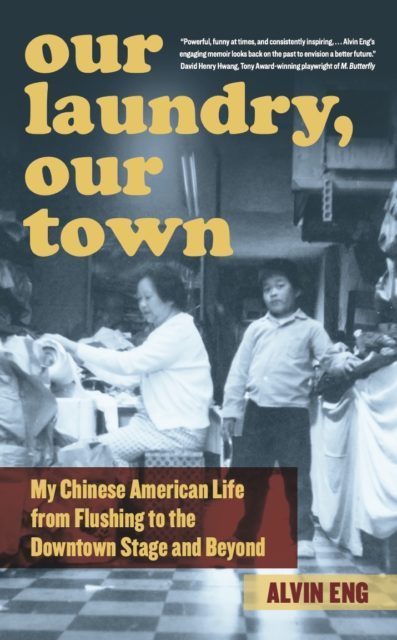
Why: “While I have been blessed to have always had a roof over my head and the honor of living with loved ones, when I was growing up, homelessness was a constant spiritual state. A child’s longing to belong is one of the most powerful forces and relentless muses on Earth. In every culture, belonging has many different nuances of meaning and resonance. What and who exactly constitutes that destination of longing changes with every age and, in childhood, with every grade. What never seems to change is the feeling that we never quite arrive, and when or if we do, it only lasts for a fleeting time and was never quite what we expected. These memoir portraits are an attempt to decode and process the urban oracle bones from growing up as the youngest of five children in an immigrant Chinese family that ran a hand laundry. Our family was born of an arranged marriage, and our laundry was in the Flushing, Queens, neighborhood of that singular universe that was New York City in the 1970s. Like many children of immigrant or ‘other’ family origins in late-twentieth-century America, I was constantly seeking American frames of reference with which to contextualize my own ‘outsider’ experiences and sensibilities.”

So begins Alvin Eng’s Our Laundry, Our Town: My Chinese American Life from Flushing to the Downtown Stage and Beyond (Fordham University Press | Empire State Editions, May 17, $27.95), in which the New York City–based playwright, performer, acoustic punk rock raconteur, and educator explores the history of his family, immigration and assimilation, and the Chinese American experience and makes pilgrimages to his ancestral homeland. The book features such chapters as “The Urban Oracle Bones of Our Laundry: Channeling China’s Last Emperor and Rock ’n’ Roll’s First Opera,” “Everybody Was Kung Fu Fighting . . . or Faking It,” “A Sort of Homecoming: But Where Are You Really From,” and “Life Dances On: Our Town in China.” Eng, whose previous work includes such solo shows as Here Comes Johnny Yen Again (or How I Kicked Punk) and The Last Emperor of Flushing and such plays and musicals as Portrait Plays and The Goong Hay Kid, will be launching Our Laundry, Our Town with a series of free events around the city.

On May 20 at 5:30, Eng will lead a webinar hosted by CUNY’s Asian American / Asian Research Institute, followed at 7:00 by an in-person appearance at City Lore on First St., where he will read from the new book and speak with City Lore codirectors Molly Garfinkel and Steve Zeitlin, then sign copies. On June 8 at 5:00, Eng will give a talk and sign books at Yu & Me on Mulberry St., and on June 25 at 2:00 he will at the Hudson Park Library on Leroy St. for an author talk.

HBO’s SCENES FROM A MARRIAGE: SPECIAL SCREENING AND CONVERSATION

Jessica Chastain and Oscar Isaac will talk about their HBO series at the 92nd St. Y

Who: Jessica Chastain, Oscar Isaac, Hagai Levi, Amy Herzog, Michael Ellenberg
What: Screening and discussion
Where: 92nd St. Y, Kaufmann Concert Hall, 1395 Lexington Ave. at Ninety-Second St.
When: Thursday, May 19, $27-$45, 7:00
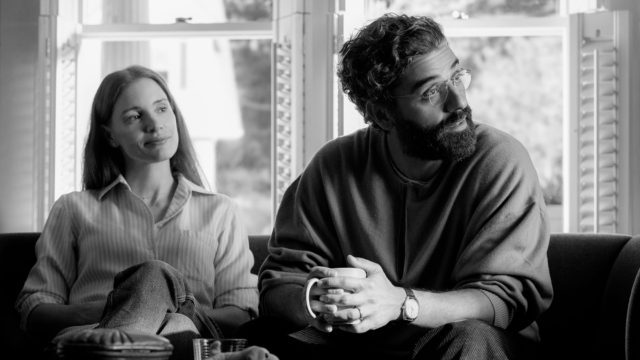
Why: If you missed HBO’s English-language adaptation of Ingmar Bergman’s six-part Scenes from a Marriage, you can get a special chance to watch one of the 2021 episodes on the big screen, followed by a conversation with members of the creative team, at the 92nd St. Y on May 19. Bergman’s 1973 miniseries detailed the slow, heart-wrenching fracture of the relationship between Marianne (Liv Ullmann) and Johan (Erland Josephson). Directed and executive produced by Hagai Levi (The Affair, In Treatment) and written by Levi and playwright Amy Herzog (4000 Miles, Mary Jane), the remake turns the tables on such issues as infidelity, truth, gender, responsibility, and identity, with Oscar Isaac as Jonathan and Jessica Chastain as Mira. The 92Y screening will be followed by a discussion with Isaac, Chastain, Levi, Herzog, and producer Michael Ellenberg that goes behind the scenes of the making of the almost painfully intimate show.

STEPHEN PETRONIO COMPANY AT THE JOYCE

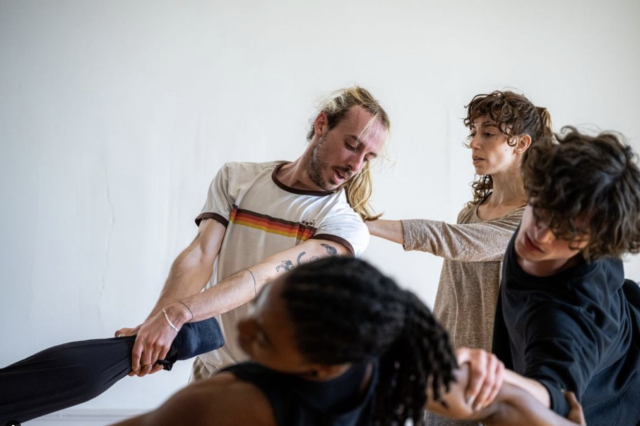
Stephen Petronio Company rehearses at Snug Harbor for Joyce season (photo by Lance Reha)

STEPHEN PETRONIO COMPANY
Joyce Theater
175 Eighth Ave. at 19th St.
May 17-22, $10-$71
212-645-2904
www.joyce.org
petron.io

“What does it mean to be out in front of you tonight, to show up for you after so long?” Stephen Petronio asks in a program note for his company’s upcoming season at the Joyce, running May 17-22. “SPC has been coming to the Joyce each spring for almost forty years — a rite, a contract as celebration. To have that interrupted by Covid is like having our oxygen taken away. We are back and breathing now! We come before you tonight to show you that we have survived, that we are still here, in some ways stronger than ever, and that dance is a kind of social glue that keeps us all connected.”

SPC’s Joyce program begins with the world premiere of New New Prayer for Now, created as a virtual piece for the company during the lockdown to celebrate online collaboration, set to original music by Monstah Black and renditions of “Balm in Gilead” and “Bridge Over Troubled Water” recorded with the Young People’s Chorus of New York City (YPC), directed by Francisco J. Nuñez; the costumes are by Marine Penvern, with lighting by Ken Tabachnick. Following a pause, SPC continues its “Bloodlines” series honoring important choreographers who influenced Petronio with his mentor Trisha Brown’s 1973 Group Primary Accumulation, restaged by Shelley Senter. The online version with four dancers in white on a wooden bridge was breathtaking, so it will be fascinating to see it now live indoors.

After an intermission, the company presents a restaging of Petronio’s Bloom, which premiered at the Joyce in 2006 and features music by Rufus Wainwright based on the poetry of Walt Whitman (“Unseen Buds,” “One’s-Self I Sing”) and Emily Dickinson (“‘Hope’ is the thing with feathers”) and the Latin Mass, sung live by YPC, with choral arrangements by Nuñez; the costumes are by Rachel Roy, with lighting by Tabachnick. The May 19 performance will be followed by a Curtain Chat with members of the company, which consists of Jaqlin Medlock, Kris Lee, Larissa Asebedo, Liviya England, Mac Twining, Nicholas Sciscione, Ryan Pliss, Tess Montoya, and Tiffany Ogburn. “It’s an emotional time,” Petronio says in the above preview of the Joyce season. If you haven’t yet seen this extraordinary company, you have only yourself to blame.

VOICES FROM THE GREAT HALL WITH SAM WATERSTON

Who: Sam Waterston, the New York Philharmonic, the Resistance Revival Chorus, Harold Holzer
What: A celebration of the Cooper Union’s new Voices from the Great Hall Digital Archive
Where: The Cooper Union, 7 East Seventh St. between Third & Fourth Aves.
When: Tuesday, May 17, free with advance RSVP, 7:00
Why: The Cooper Union celebrates the opening of its Voices from the Great Hall Digital Archive with a special free program on May 17 at 7:00, hosted by actor Sam Waterston; several times, the Emmy winner and Oscar nominee has portrayed Abraham Lincoln, who delivered one of his most memorable speeches in the Great Hall on February 27, 1860, in which he declared, “Let us have faith that right makes might, and in that faith, let us, to the end, dare to do our duty as we understand it.” Waterston reprised that speech in the Great Hall in 2004. The program will feature multimedia excerpts of original recordings of politicians, Supreme Court Justices, and others, with live presentations from the New York Philharmonic, the Resistance Revival Chorus, and Lincoln expert and author Harold Holzer. The archive goes back as far as 1859 with a copy of Frederick Douglass’ Paper and includes lectures, commencement addresses, music exhibitions, political pamphlets, campaign speeches, memorials, drawings, forums, audio and video recordings, and much more.

VISIONS OF OKINAWA: CINEMATIC REFLECTIONS

Go Takamine’s Paradise View kicks off Japan Society series about the Okinawan transition

VISIONS OF OKINAWA: CINEMATIC REFLECTIONS
Japan Society
333 East 47th St. at First Ave.
May 13 – June 3, $15 in-person screenings, $10 online rentals (three-film pass $24)
www.japansociety.org

“Did you have your fortune told?” a character asks in Go Takamine’s Paradise View. “Yes, things are looking good” is the answer.

On June 17, 1971, the last of the Ryukyu Islands was returned to Japanese control. Japan Society began its celebration of that pivotal event in March with “Waves Across Time: Traditional Dance and Music of Okinawa.” The tribute continues May 13 to June 3 with “Visions of Okinawa: Cinematic Reflections,” consisting of five in-person screenings and three streaming films, all set around the transition of power. Part of the “Okinawa in Focus: Globus Film Series,” the festival begins May 13 at 7:00 with the North American premiere of the 2021 edit of Go Takamine’s Paradise View, followed by a reception; the 1985 work, which deals with a funeral, a wedding, dangerous snakes, and painful dentistry, will be available for streaming starting May 14.

Chris Marker’s 1996 Level Five, a French film involving a computer game restaging the Battle of Okinawa as part of an investigation into the Japanese tendency to bury the past, will be shown May 14 at 4:30, followed at 7:00 by a rare archival 35mm print of Nagisa Oshima’s 1972 Dear Summer Sister, in which Oshima, who appears in Level Five, takes viewers on an unusual tourist trip across Okinawa. Sadao Nakajima’s 1976 Terror of Yakuza, inspired by actual gang warfare on Okinawa and starring the great Sonny Chiba, screens May 20 at 7:00; an imported 35mm print of Go Takamine’s 1989 Untamagiru, an adaptation of the uchina shibai play and featuring John Sayles as a US military commander who really loves his dog, will be shown May 21 at 7:00.

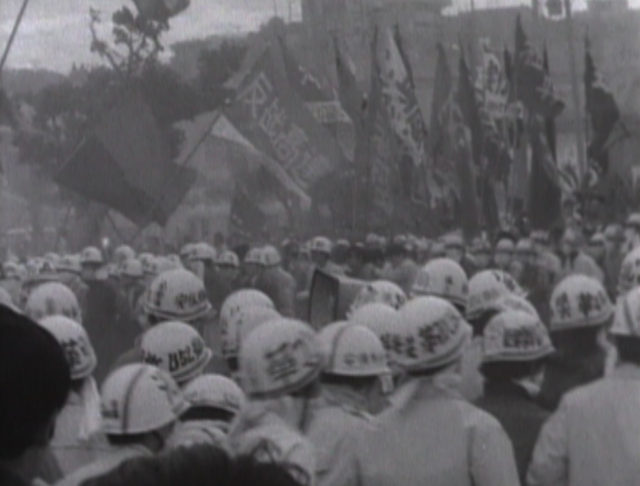
Motoshinkakarannu explores the complicated transition of power on Okinawa

The virtual screenings also include the special “Focus on the Nihon Documentarist Union (NDU),” a pair of black-and-white guerrilla-style nonfiction works by the NDU, which was founded in 1968 at Waseda University. The 1971 Motoshinkakarannu and 1973 Asia Is One are screening for the first time outside of Japan, with new English subtitles, taking on immigration, socioeconomic issues, labor protests, and other complex issues.

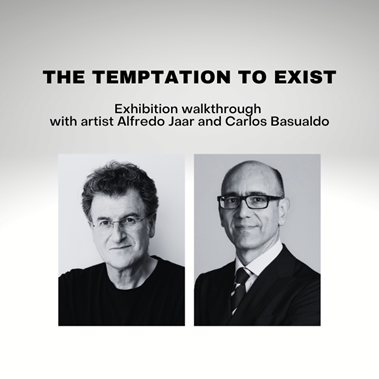
ALFREDO JAAR EXHIBITION WALKTHROUGH: THE TEMPTATION TO EXIST

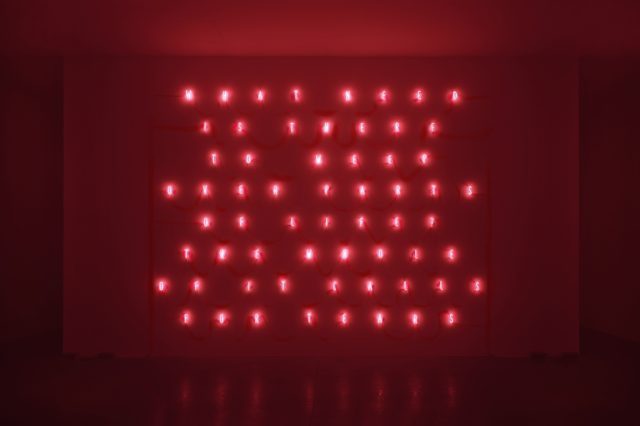
Alfredo Jaar, What Need Is There to Weep Over Parts of Life? The Whole of It Calls for Tears, neon, 2018 (photo courtesy Galerie Lelong)

Who: Alfredo Jaar, Carlos Basualdo
What: Exhibition walkthrough of “The Temptation to Exist”
Where: Galerie Lelong & Co., 528 West Twenty-Sixth St. between Tenth & Eleventh Aves.
When: Saturday, May 14, free with advance RSVP, 4:00
Why: Alfredo Jaar is one of the most provocative and innovative artists working today. Born in Santiago, Chile, in 1956 and based in New York City since 1982, the artist, architect, and filmmaker uses multimedia works to immerse viewers in the images and sounds of sociopolitical strife across the globe, exposing the lies associated with war, government control, rampant capitalism, and other issues. At the Whitney Biennial, people wait on line to experience his 06.01.2020 18.39, a video installation comprising footage from a Black Lives Matter protest in Washington, DC, on June 1, 2020, incorporating a bonus element that makes visitors feel like the helicopters are coming for them. His 2011 installation Three Women made a trio of female activists the focus of the media; it has since been expanded to thirty-three women. Neon projects declare, “I Can’t Go On / I’ll Go On,” “Be Afraid of the Enormity of Possibility,” and “This Is Not America.” Other potent projects include The Skoghall Konsthall, Culture = Capital, Shadows, and Lament of the Images.

His 2018 installation, What Need Is There to Weep Over Parts of Life? The Whole of It Calls for Tears, a quote from the Roman stoic philosopher Seneca, makes its New York debut on May 13 at Galerie Lelong as part of the exhibition “The Temptation to Exist.” The name of the show is inspired by Emil Cioran’s 1956 book of the same name; the Romanian philosopher wrote, “The universe is one big failure, and not even poetry can succeed in correcting it.” Dedicated to Italian photojournalist Letizia Battaglia, who passed away in April at the age of eighty-seven, “The Temptation to Exist” features lightboxes, ink prints, and such neon phrases as “Gesamtkunstwerk” and “Other People Think.”

For the exhibit, Jaar has also curated works from more than sixty-five artists seeking change in the world, creating what he calls “a space of resistance, a space of hope.” Among those included are Dawoud Bey, Luis Camnitzer, Lygia Clark, Valie Export, LaToya Ruby Frazier, Félix González-Torres, Hans Haacke, David Hammons, Lyle Ashton Harris, Mona Hatoum, Jenny Holzer, Emily Jacir, Joan Jonas, On Kawara, Glenn Ligon, Piero Manzoni, Gordon Matta-Clark, Ana Mendieta, Shirin Neshat, Yoko Ono, Adam Pendleton, Michelangelo Pistoletto, Gerhard Richter, Carolee Schneemann, Nancy Spero, Hank Willis Thomas, Kara Walker, Carrie Mae Weems, Lawrence Weiner, and Francesca Woodman.

There will be an opening reception on May 13 at 6:00; on May 14 at 4:00, Jaar will hold a public walkthrough of the exhibition, joined by Philadelphia Museum of Art senior curator Carlos Basualdo. Admission is free with advance registration. Don’t miss this rare chance to witness art history in the making.

WEDDING BAND: A LOVE/HATE STORY IN BLACK AND WHITE

Brittany Bradford is sensational as a Black woman in love with a white man in Alice Childress’s Wedding Band (photo by Henry Grossman)

WEDDING BAND: A LOVE/HATE STORY IN BLACK AND WHITE
Theatre for a New Audience, Polonsky Shakespeare Center
262 Ashland Pl. between Lafayette Ave. & Fulton St.
Tuesday – Sunday through May 15, $90-$125
866-811-4111
www.tfana.org

Alice Childress is finally having her moment. Born in South Carolina in 1916 and raised in Harlem, the playwright, actress, columnist, and novelist made her posthumous Broadway debut last fall with Trouble in Mind, which was heading for the Great White Way in 1957 until producers pulled it after Childress would not make any changes. A rare revival of her 1966 play, Wedding Band: A Love/Hate Story in Black and White, opens tonight at Theatre for a New Audience’s Polonsky Shakespeare Center. While it’s exciting to see Childress at last receive acclaim, both productions turned out to be disappointing.

The back story as to why these plays had nearly disappeared is primarily that Childress ultimately stood by her scripts, refusing to touch a single word. However, after having now seen both of them, I’m of the belief that each could have used at least a little revision in certain places to avoid repetition and overwrought melodrama; Childress is a master at building characters, but too many of her scenes languish. You can read my take on Trouble in Mind here; my thoughts on Wedding Band continue below.

First staged at the New York Shakespeare Public Theater in 1972 (and not seen again in the city till now), codirected by Joseph Papp and Childress (Papp initially insisted that the author direct but he stepped in, giving them both credit) and starring Ruby Dee and James Broderick (with Albert Hall, Polly Holliday, and Clarice Taylor), Wedding Band centers on the controversial relationship between a Black seamstress, Julia Augustine (Brittany Bradford), and her partner of ten years, a white baker named Herman (Thomas Sadoski). Julia has to move around a lot to avoid the racism the two of them encounter when their situation becomes known, no matter how careful they try to hide it.

It’s the summer of 1918, just a few months till the end of WWI and a year before Red Summer, during which white mobs of civilians and veterans attacked Blacks in twenty-six cities, at least in part because of the Great Migration. Julia has rented a small house in a tiny community for Blacks on the outskirts of Charleston, South Carolina, run by Fanny Johnson (Elizabeth Van Dyke), a faux-elegant landlord who keeps a close watch on her handful of down-on-their-luck tenants.

TFANA’s Wedding Band features a gorgeous open set (photo by Hollis King)

Jason Ardizzone-West’s gorgeous set is a long, open rectangular space with a bed and night table at one end leading to a dirt path flanked by rows of tallgrass; the audience sits on opposite sides behind the knee-high grass. There are no actual doors, so all the characters can see one another whenever they are onstage, entering through the aisles, or wandering across the upper levels of the theater. Stacey Derosier’s lighting keeps most of the audience at least partially illuminated at all times, and Rena Anakwe’s sound design immerses the small crowd in the goings-on. It’s a powerful effect, particularly since the audience members are predominantly white and wearing masks, while onstage the 1918 influenza pandemic is raging across the country.

Among those at Mrs. Johnson’s establishment are Mattie (Brittany-Laurelle), a candy maker who is waiting for her husband, October, to come back from the Merchant Marine with much-needed funds, and their delightful eight-year-old daughter, Teeta (Phoenix Noelle), who plays with the white girl, aptly named Princess (Sofie Nesanelis), whom Mattie cares for; and the widowed Lula Green (Rosalyn Coleman), whose adopted son, Nelson (Renrick Palmer), is home from the war to march in a parade and chase down some women.

When Julia first arrives, she begs for peace and quiet, but Mrs. Johnson and the other residents want to find out everything about her, thumping the Bible as they seek out her sins. Childress points out their poverty from the very beginning; Teeta has lost something, and Mattie is desperate to find it. “Gawd, what’ve I done to be treated this way! You gon’ get a whippin’ too,” Mattie tells her. She explains to Mrs. Johnson, “Dammit, this gal done lost the only quarter I got to my name.”

Julia introduces herself to her new, nosy neighbors, who are taken aback when she quickly reaches into her purse and gives Teeta twenty-five cents. A few moments later the Bell Man (Max Woertendyke) shows up with his traveling salesman’s suitcase of random items; Lula owes him three dollars and ten cents but can’t pay anything now. Julia asks if he has any sheets, and soon the Bell Man, who recognizes her and knows that she is with a white man, is sitting on her bed, implying that she should fulfill his needs if she wants him to remain silent.

She throws him out, saying to the others, “I hate those kind-a people.” Lula responds, “You mustn’t hate white folks. Don’tcha believe in Jesus? He’s white.” Julia replies, “I wonder if he believes in me.”

When her lover, Herman, shows up, Julia is excited to see him. He’s upset because his mother (Veanne Cox) and sister, Annabelle (Rebecca Haden), are being harassed because they’re German, even though they’re American citizens. “It’s the war. Makes people mean,” Julia, who is always understanding of everyone, says. But Herman knows the truth about his family. “A poor ignorant woman who is mad because she was born a sharecropper . . . outta her mind ’cause she ain’t high class society. We’re red-neck crackers, I told her, that’s what.”

When Herman falls ill, it’s not as easy as simply calling a doctor, for their interracial relationship, in an era of anti-miscegenation laws, complicates everyone’s situation.

Bradford (Fefu and Her Friends, Bernhardt/Hamlet, Mac Beth) is spellbinding as Julia, her every move filled with the constant heavy weight on her heart. She portrays her with a gentle compassion until she explodes during Julia’s unforgettable confrontation with Herman’s racist mother.

Herman (Thomas Sadoski) battles illness as his sister (Rebecca Haden), mother (Veanne Cox), and longtime partner (Brittany Bradford) look on (photo by Hollis King)

The stage setup allows every audience member to follow Bradford’s riveting eyes, depicting the pain of being an independent-thinking Black woman in love with a white man, a relationship that nearly everyone looks down on. It takes on additional meaning as privacy rights are under attack again in the United States in 2022.

The rest of the cast is solid, but director Awoye Timpo (In Old Age, The Loophole, Carnaval), who so smoothly guided the show through the first half, gets too caught up in the mawkishness of the later plot developments, leading to a head-scratching magic-realist finale that feels as tacked on as it is.

Wedding Band is part of TFANA’s CLASSIX residency, which was founded by Timpo with Bradford, A. J. Muhammad, Dominique Rider, and Arminda Thomas to focus on Black performance and works by Black writers across the African diaspora. On May 14 at 4:30, TFANA will host the panel discussion “CLASSIX: In Search of Alice Childress,” with the CLASSIC collective, moderated by Jonathan Kalb. And on May 15 at 4:30, the TFANA Talk “Reflections, with Bianca Vivion Brooks” pairs Bradford with Juliana Canfield, who starred in Adrienne Kennedy’s He Brought Her Heart Back in a Box at TFANA in 2018, a show that also deals with interracial relationships.

I hope to see more plays by Childress, who died in New York City in 1994 at the age of eighty-one and also wrote such novels as A Hero Ain’t Nothing but a Sandwich, Like One of the Family, and A Short Walk. Even in productions that fall short, there are compelling, prescient moments and important, beautifully drawn characters.

As she wrote in a letter to Dee, “Wedding Band is about yesterday and today . . . far away and right at hand . . . old and ever present. It is the past, present, and future . . . recollection, attention, and anticipation . . . It is about the humiliation of an entire nation . . . not a tale of star-crossed lovers. My play is about manless women. Women in need of love, name, protection. It concerns itself with love and the seeking of love in a racist society . . . the love of country, the love of material things, and spiritual love.” Childress is clearly a playwright for these troubled times.