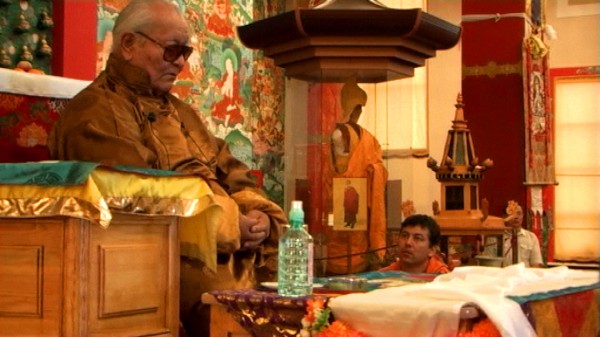
Documentary looks at the complex relationship between a father and son
MY REINCARNATION (Jennifer Fox, 2010)
Cinema Village
22 East 12th St. between University Pl. & Fifth Ave.
Opens Friday, October 28
212-924-3363
www.myreincarnationfilm.com
www.cinemavillage.com
 More than twenty years in the making, Jennifer Fox’s My Reincarnation tells the fascinating story of a very unusual father-son relationship amid the modern world of tulkus, or reincarnated Tibetan lamas. World-renowned high Tibetan Buddhist Master Chögyal Namkhai Norbu travels around the world teaching meditation and Dzogchen practice. He meets with the Dalai Lama, advises students and fans, signs copies of his many books, and builds support for his beleaguered native land, Tibet. But his son, Yeshi Silvano Namkhai, who was born in 1970 in Italy (where Rinpoche Namkhai Norbu taught at university from 1964 to 1992), had no desire to follow in his father’s footsteps and instead went into the computer business, starting a family and rejecting nearly everything his father believes in — including that Yeshi might just be the reincarnation of his great-uncle, Khyentse Rinpoche Chökyi Wangchug, and so is destined for a life of service and tradition. “Everybody knows about me and nobody knows me at all,” Yeshi says about trying to establish his own identity. Father and son and the rest of the family allowed Fox remarkable access, holding nothing back as they talk about their lives and each other; Yeshi is particularly vocal about his father’s treatment of him over the years. But soon Yeshi has a change of heart, and the documentary takes an unexpected turn. Fox, who has previously made such films as Beirut: The Last Home Movie, Flying: Confessions of a Free Woman, and An American Love Story, shot more than one thousand hours of footage, which she edited down to a tight seventy-five-minutes, including archival and newsreel footage as well. As much as it is about a father and a son, My Reincarnation is also about the old vs. the new, tradition vs. modernization, private love vs. public responsibility, the spiritual vs. the technological, and, above all, familial legacy. My Reincarnation opens at Cinema Village on October 28; Fox and Yeshi will participate in several Q&As and/or introductions on October 28 and 29, with Fox also taking part in Q&As following the 7:00 screenings on November 2 and 3.

 The classic horror story The Shining has been back in the news of late, first with a wrongly rumored special screening that was said to include the two-minute finale that Stanley Kubrick cut out immediately after the film opened in 1980 — one that we thought we had imagined seeing for many years until we discovered the truth, which also involved the iconoclastic director riding his bicycle to various theaters, armed with a pair of scissors — and then with Stephen King’s “announcement” that he was writing a sequel to the original 1977 book, this time focusing on a grown-up Danny Torrance. Anyway, Kubrick’s film is one of the all-time-great frightfests, a truly scary movie about a writer named Jack Torrance (Jack Nicholson at his overacting best) who has agreed to become the caretaker of the old Overlook Hotel in Colorado during the snowy winter when the enormous mountain resort closes down for the season. He is joined by his perpetually nervous wife, Wendy (Shelley Duvall), and their young son, Danny (Danny Lloyd), who seems to have brought along his invisible friend, Tony, who speaks through Danny’s finger. Between taking care of the Overlook and working on his novel, Jack finds a whole bunch of other folks to hang out with, people who have populated the place during the ritzy establishment’s golden age, including a strange woman in room 237. Kubrick plays with horror conventions as he seeks to scare the crap out of the audience, something he accomplishes time and time again as Jack grows more disturbed, Wendy’s shrieks become more and more ear piercing and annoying, and Danny’s visions get more and more bloody. No matter how many times you’ve seen it, it still gets you, even when you know exactly what’s lurking around that corner. The Shining is screening on Saturday night at 7:00 as part of the Museum of the Moving Image’s Halloween Weekend programming and the “See It Big!” series, which also includes Ridley Scott’s Alien on Friday night at 7:00 and Sunday afternoon at 4:00. (You might not want to see that one on a full stomach.) On Saturday at 1:00 & 4:00 and Sunday at 1:00, Frank Oz’s Little Shop of Horrors will be shown, in conjunction with the “Henson Screenings and Programs” series, and on Sunday afternoon at 2:30, “Movie Monsters and More: A Master Class with Special Effects Makeup Artist Mike Marino” will be held. The weekend concludes Sunday night at 7:30 with an eightieth anniversary screening of Frankenstein (James Whale, 1931) with Sara Karloff, Boris’s daughter, who will discuss her father’s life and career and show home movies.

 Screening at 92YTribeca as part of the third annual Doomsday Film Festival — which promises “Deserted streets! Blood-red skies! Total social breakdown!” — Stanley Kubrick’s Dr. Strangelove is one of the grandest satires ever made, the blackest of black comedies. With the threat of nuclear annihilation looming over the United States and the Soviet Union, General Jack D. Ripper (Sterling Hayden) has a meltdown, becoming obsessed with protecting the country’s “precious bodily fluids” and threatening to launch the bombs. While President Merkin Muffley (Peter Sellers) tries to make nice with the Soviets, General Buck Turgidson (George C. Scott) gets caught up in all the military excitement, Colonel Bat Guano (Keenan Wynn) defends the Coca-Cola company, Group Captain Lionel Mandrake (Sellers) can’t get anyone to listen to him, and Major T. J. “King” Kong (Slim Pickens) prepares for the ride of his life. Based on Peter George’s novel Red Alert and written by George, Kubrick, and Terry Southern, Dr. Strangelove or: How I Learned to Stop Worrying and Love the Bomb is hysterically funny and wickedly prescient, an absolute hoot from start to finish, featuring razor-sharp dialogue, inspired slapstick, and just enough truth to scare the hell out of you. (Be sure to watch for Peter Bull not being able to stop laughing as Sellers goes crazy in a wheelchair at the end.) The screening will be followed by a “Doomsday on the Brain” panel discussion with Joseph Le Doux, Dr. Mark Siegel, Lee Quinby, Keith Uhlich, and Mark Asch, moderated by Paul W. Morris from, of course, BOMB magazine. The Doomsday Film Festival also includes Steve De Jarnatt’s 1988 WWIII flick Miracle Mile, followed by a Q&A with star Anthony Edwards and the director; Don McKellar’s 1999 Y2K nightmare Last Night; Joseph Sargent’s classic Colossus: The Forbin Project, followed by “The Singularity Is Nigh,” a panel discussion with Maggie Jackson, Joshua Rothkopf, Jason Zinoman, Chris Bregler, and Roger Schank, moderated by Michael Byrne; Tobe Hooper’s 1985 exploitation fave Lifeforce, preceded by complimentary sexy alien zombie makeup; a collection of short films; and schlockmeister Larry Cohen’s 1976 cop drama God Told Me To, followed by a Skype Q&A with Cohen. If the end of the world is coming, this is a fine way to say goodbye.