John Jasperse’s CANYON should delight audiences at BAM this week
NEXT WAVE FESTIVAL
Brooklyn Academy of Music
BAM Harvey Theater
651 Fulton St. between Ashland & Rockwell Pl.
November 16-19, $16-$45, 7:30
718-636-4100
www.bam.org
In works such as Becky, Jodi and John at Dance Theater Workshop, Truth, Revised Histories, Wishful Thinking, and Flat Out Lies at the Joyce, and Misuse Liable to Prosecution at BAM’s 2007 Next Wave Festival, New York City–based choreographer John Jasperse has shared intimate moments with the audience in creating unusual and often challenging evenings of dance theater. This week Jasperse and his Thin Man Dance company return to BAM to present the New York premiere of Canyon, which deals with “the transformative power of losing oneself in visceral experience.” Running November 16-19, the seventy-minute piece features dancers Lindsay Clark, Erin Cornell, Kennis Hawkins, Burr Johnson, and James McGinn, a live score by Hahn Rowe, visual design by Tony Orrico, and lighting by James Clotfelter. There will be an artist talk with Jasperse and his collaborators following Thursday night’s performance, moderated by Mary-Jane Rubenstein, whose book Strange Wonder: The Closure of Metaphysics and the Opening of Awe influenced the making of Canyon.
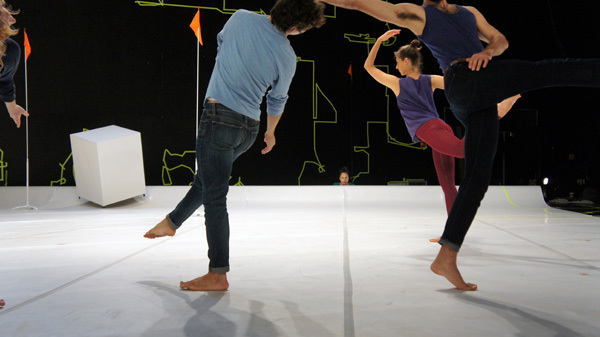
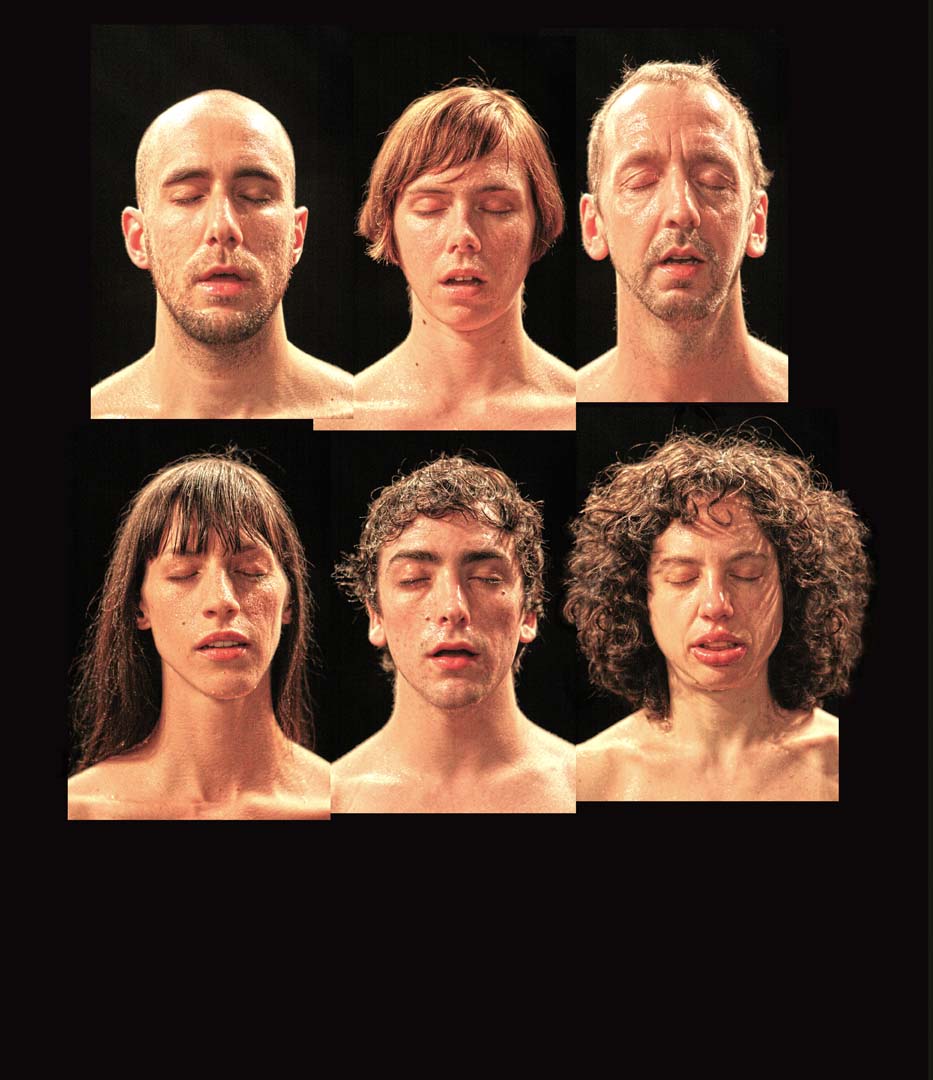
John Jasperse’s CANYON celebrates the thrill of the dance (photo by Tony Orrico)
Updated: Dance does not always have to be about something. In such previous works as Becky, Jodi and John, Truth, Revised Histories, Wishful Thinking, and Flat Out Lies, and Misuse Liable to Prosecution, John Jasperse dealt with a number of themes, from personal relationships and environmentalism to the fine line between fantasy and reality. In his latest evening-length piece, Jasperse eschews high concept in favor of, quite simply, the thrill of the dance. The seventy-minute Canyon puts Jasperse’s breathtaking choreography front and center, a celebration of the joy of movement, with Jasperse, Lindsay Clark, Erin Cornell, Kennis Hawkins, Burr Johnson, and James McGinn running, jumping, twisting, and rolling to an exciting score composed by Hahn Rowe and performed live by Olivia De Prato on violin, Ha-Yang Kim on cello, Doug Wieselman on bass clarinet, and Rowe on violin, guitar, and electronics. Because this is Jasperse, there are odd elements as well, courtesy of visual designer Tony Orrico, that include yellow tape that begins outside on the street and wends its way through the BAM Harvey lobby and bathrooms and into the theater, down the steps, across the stage, and onto the back wall, where they resemble an abstract map. Meanwhile, a large white box continually roams the space, adding to the fun. And what fun it is.