this week in lectures, signings, panel discussions, workshops, and Q&As

NEW YORK FESTIVAL OF SONG: A GOYISHE CHRISTMAS TO YOU!

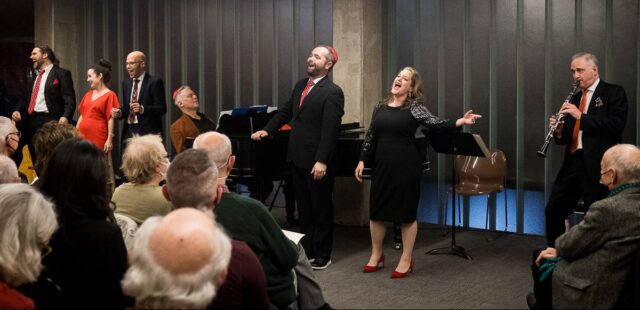
Christmas songs by Jews take center stage at NYFOS concert (photo by Cherylynn Tsushima)

Who: Lauren Worsham, Donna Breitzer, Rebecca Jo Loeb, Alex Mansoori, William Socolof, Cantor Joshua Breitzer, Steven Blier, Alan R. Kay
What: Holiday concert
Where: Merkin Concert Hall, Kaufman Music Center, 129 West 67th St.
When: Wednesday, December 14, $45, 7:00
Why: Everyone knows that the Jewish Irving Berlin wrote “White Christmas,” but there are lots of other seasonal favorites and lesser-known holiday gems that were also penned by Jewish composers. On December 14 at 7:00 in Merkin Hall’s Upper Lobby at the Kaufman Music Center, New York Festival of Song will present its thirteenth iteration of “A Goyishe Christmas to You!,” featuring Christmas songs — with a twist — written by Jews. Soprano Lauren Worsham, mezzo-sopranos Donna Breitzer and Rebecca Jo Loeb, tenor Alex Mansoori, bass-baritone William Socolof, and Cantor Joshua Breitzer, with clarinetist Alan R. Kay and pianist and host Steven Blier, will perform such holiday tunes as Roy Zimmerman’s “Don’t Let Gramma Cook Christmas Dinner,” Johnny Marks’s “Rockin’ Around the Christmas Tree” and “Rudolph the Red-Nosed Reindeer” (in Yiddish arrangements), David Friedman’s “My Simple Christmas Wish,” Mel Tormé’s “The Christmas Song” (with new lyrics by Adam Gopnik), Frank Loesser’s “Baby, It’s Cold Outside” and “What Are You Doing New Year’s Eve?” and David Javerbaum and Adam Schlesinger’s “Can I Interest You in Hanukkah?” It might be worth it just for Joan Javits and Phil and Tony Springer’s “Santa Zaydee.” The concert will be followed by a wine reception with the artists.

BABY DOLL: ACTORS STUDIO SCREENING AND DISCUSSION WITH CARROLL BAKER

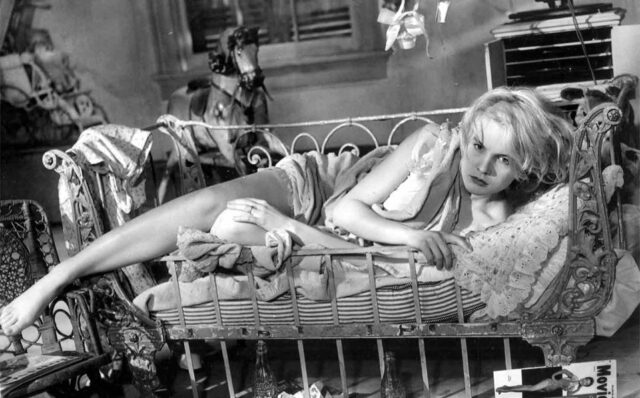
Carroll Baker will be at the Actors Studio to discuss the making of Baby Doll

Who: Carroll Baker, Katherine Wallach, Foster Hirsch
What: Film screening and discussion
Where: The Actors Studio, 432 West Forty-Fourth St.
When: Thursday, December 8, free with RSVP, 7:00
Why: The Actors Studio continues celebrating its seventy-fifth anniversary with a fabulous special event, a free screening of Elia Kazan’s 1956 drama Baby Doll, followed by a discussion with the one and only Carroll Baker, who portrayed the title character. Adapted by Tennessee Williams from his one-act play 27 Wagons Full of Cotton, the film is set in the Mississippi Delta, where Baby Doll Meighan is about to turn twenty and finally have relations with her significantly older husband, Archie Lee (Karl Malden), much to the chagrin of Archie’s chief rival, Silva Vacarro (Eli Wallach). The steamy movie, which popularized the babydoll nightgown, received four Oscar nominations, including Baker for Best Actress, Mildred Dunnock for Best Supporting Actress, Williams for Best Adapted Screenplay, and Boris Kaufman for Best Black-and-White Cinematography.

The ninety-one-year-old Baker, who also appeared in such works as The Carpetbaggers, The Greatest Story Ever Told, Andy Warhol’s Bad, Star 80, and Ironweed, will be at the Actors Studio on December 8 for the screening and to talk about Baby Doll with Katherine Wallach, the daughter of Eli Wallach and Anne Jackson, moderated by Brooklyn College film professor Foster Hirsch. Admission is free with advance RSVP.

LUIZA PRADO DE O. MARTINS: THE SERMON OF THE WEEDS

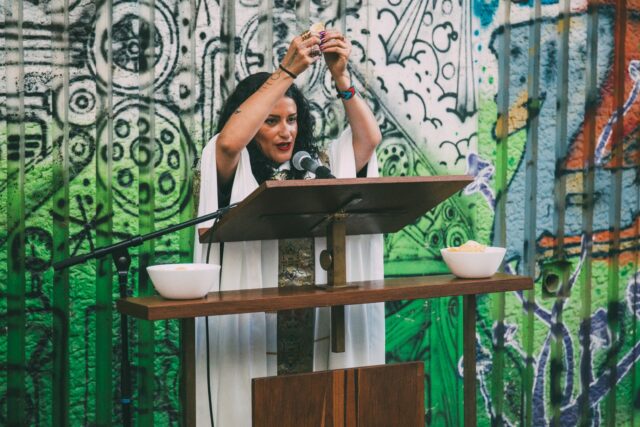
Luiza Prado de O. Martins will perform The Sermon of the Weeds at the 8th Floor on December 8 (photo by MeetFactory)

Who: Luiza Prado de O. Martins
What: Live performance installation activation
Where: The 8th Floor, Shelley & Donald Rubin Foundation, 17 West 17th St.
When: Thursday, December 8, free with RSVP, 6:00
Why: Continuing at the 8th Floor at the Shelley & Donald Rubin Foundation through January 21, the powerful exhibition “El Corazón Aúlla (Heart Howls): Latin American Feminist Performance in Revolt” features photography, painting, video, sculpture, and installation focusing on gender-based violence, with works by more than a dozen female and nonbinary artists from Peru, Costa Rica, Guatemala, Mexico, El Salvador, Chile, Brazil, and Argentina. Jazmín Ra’s Falo X Falo — El Estado de Chile nos viola y nos mata (“The State of Chile rapes and kills us”), Flavia Marcus Bien’s From Night to Earth, and Elina Chauvet’s My Hair for Your Name explore misogyny, racism, and LGBTQ hate through documentation and performance, revealing serious issues and attempting to take the power back. Curators Alexis Heller and Tatiana Muñoz-Brenes explain, “These performances, their aesthetic decisions, and their particular social contexts answer questions that other artistic media cannot answer, or that could not establish an alliance with the viewer in the search for social justice. . . . Gender violence, reaching its highest peaks in feminicide and state violence, is a topic that should be howled when shouting is not enough, and that should go through political corporality and affections when common sense fails to bring about change.”

On December 8 at 6:00, Brazil-born, Berlin-based artist and activist Luiza Prado de O. Martins will activate The Sermon of the Weeds, a ritualistic circle of dirt on a white plinth, with a Jesus infinity sign on top of the small mound; the materials consist of paper, soil, Caesalpinia pulcherrima (peacock flower), Ruta graveolens (rue), Artemisia vulgaris (mugwort), Mentha pulegium (pennyroyal), and Cimifuga racemose (Black cohosh). The performance is a response to the current attacks on women’s reproductive rights in America and Brazil; Prado de O. Martins will dress as a priest, deliver a liturgical mass, and offer communion to the audience, specially made wafers (with natural ingredients used in traditional forms of birth control) and libations that equate humans and plants. (The menu includes parsley pesto; crisps; carrot, mint, and pistachio salad; seeded crackers; aged sheep’s cheese with grapes and pomegranate; fresh soft sheep’s cheese with balsamic and juniper; guava and cinnamon compote squares; pennyroyal liqueur; and artemisia iced tea.) The performance will be followed by a discussion with Prado de O. Martins and Heller. On December 10, Heller will give a curatorial tour of the exhibition, which also features works by Nayla Altamirano, Denise E. Reyes Amaya, Elina Chauvet, Cristina Flores, Regina José Galindo, Fernanda Laguna and Cecilia Palmeiro, Rossella Matamoros-Jiménez, Bárbara Milano, Wynnie Mynerva, and Berna Reale.

TANTURA

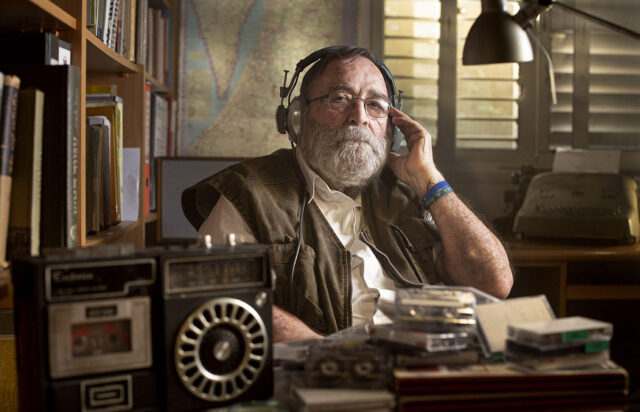
Teddy Katz listens to damning audiotapes about a 1948 massacre in Tantura

TANTURA (Alon Schwarz, 2022)
IFC Center
323 Sixth Ave. at West Third St.
Opens Friday, December 2
212-924-7771
www.ifccenter.com

There’s a deeply disturbing theme that runs through Alon Schwarz’s shocking, must-see documentary, Tantura, about one specific incident during what Palestinians refer to as Al Nakba, “the Catastrophe” that took place during the 1948 Arab-Israeli war.

In the late 1990s, a graduate student named Teddy Katz researched a possible Israeli army massacre that occurred in the Palestinian village of Tantura. When filmmaker Schwarz interviews members of Israel’s Alexandroni Brigade about it, they smile and laugh as they either flat-out deny that such war crimes happened or basically tell Schwarz, so what if it did?

“In the War of Independence, we knew one simple thing: It’s either me or them,” Amitzur Cohen says. “What would I tell [my wife]? That I was a murderer?” he easily admits with a laugh. “If you killed, you did a good thing,” Hanoch Amit says with a smile. Henio-Tzvi Ben Moshe, head of the Alexandroni Veteran’s Association, lets out a disturbing laugh when he declares, “We’re done with Teddy Katz.”

In the late 1990s, for his master’s thesis at the University of Haifa, Katz interviewed 135 people about the massacre, compiling 140 hours of recordings about the Tantura atrocities, centered around the alleged cold-blooded murder of some two hundred Palestinians whose bodies were then dumped into a mass grave. He received a high grade on the paper, but it was soon submerged in controversy, resulting in a defamation lawsuit and claims that it was all a lie.

“You can take the tapes and listen to them, but if you want to make a movie out of it, be careful, because you’ll be hunted down like I was,” Katz tells Schwarz.

But that warning doesn’t deter Schwarz, who speaks with Alexandroni Brigade vets — who are now in their nineties — university professors, engineers, and Arabs who survived the massacre as he puts together what actually happened at Tantura and how Prime Minister David Ben-Gurion began the cover-up, which is still going on.

“My whole life I thought, and I still think, that the root of the disaster, including the part . . . that can be called the contamination, is 1948,” explains Katz, who was named after Theodor Herzl, the founder of Zionism. “To this day the vast majority of what happened in 1948 is not only hushed up but also destroyed.”

Schwarz intercuts archival footage from the war — in which hundreds of Palestinian towns and villages were demolished and some three quarters of a million refugees fled their homes — with scenes from a staged propaganda reenactment and clips of Ben-Gurion and the establishment of the State of Israel. As the evidence mounts, so does the refusal to acknowledge the Catastrophe.

“It’s forbidden to tell. I’m not going to talk about it . . . because . . . it could cause a huge scandal. I don’t want to talk about it,” brigade vet Yossef Diamant says. “That’s it. But it happened; what can you do? It happened. . . . [Katz] told the truth,” he adds with a dismissive laugh.

Casually sitting in a chair outside with a woman on either side of him, Mulik Sternberg proudly says, “The Arabs are an evil, cruel, vindictive enemy, but we were better, in battle. Always. . . . Of course we killed them. We killed them without remorse.” He is clearly unafraid of any possible repercussions.

Mustafa Masri, who lives in Fureidis, where many of the Tantura survivors were relocated, describes seeing the bodies of his murdered father and brother piled on a cart of victims. Professor Yoav Gelber comes right out and says, “I don’t believe witnesses.”

Professor Ilan Pappe puts it all in perspective when he says, “I think the self-image of Israel as a moral society is something I haven’t seen anywhere else in the world. How important it is to be exceptional. We are the Chosen People. This is part of the Israeli self-identification as a very superior moral people. . . . I think it’s very hard for Israelis to admit that they commit war crimes.”

Schwarz is an Israeli-born Jew who worked as a high-tech software entrepreneur before turning to documentaries, making Narco Cultura and Aida’s Secrets with his brother Shaul. Alon, who considers himself “a member of the moderate left side of Israel’s political system,” initially set out to make a film about young human rights activists who are trying to end the 1967 occupation and are labeled by many as traitors — much as Katz is. Schwarz stumbled on Katz’s dilemma by accident.
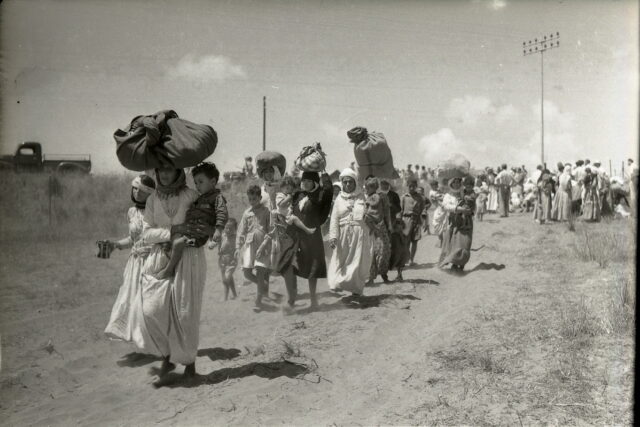
Documentary seeks to uncover the truth of what happened in Tantura in May 1948

Schwarz is no mere fly on the wall in the film but is actively investigating numerous aspects of the case, putting himself in the story. Tantura is reminiscent of Joshua Oppenheimer’s 2012 The Act of Killing and 2014 follow-up, The Look of Silence, as the director confronts the perpetrators of the 1965–66 genocide in Indonesia, who are proud of what they did. It also recalls the 1968 Mỹ Lai massacre led by US Lt. William Calley Jr. in Vietnam.

Katz, who has had three strokes and uses a motorized scooter to get around, is determined to not give up until justice wins out, despite all that’s happened to his career and his family. “You feel like the country is against you,” his wife, Ruth, tells Schwarz. But none of it might matter in the long run.

“What we remember are the good memories,” says Drora Varblovsky, one of four remaining original residents of Kibbutz Nachsholim, which was started in June 1948 on the former site of Tantura.

“Yes, exactly. I have only good memories,” Tereza Carmi adds. “Because I’m fed up with remembering bad things.”

Tantura opens at IFC on December 2, with Schwarz on hand for Q&As after the 7:50 shows on December 2 and 3.
KEEN ON NEW WORK: 2022 KEEN PLAYWRIGHTS LAB READINGS

Who: Keen Company
What: Free readings of three new plays
Where: ART/NY Conference Room, 520 Eighth Ave. at Thirty-Sixth St., third floor
When: Friday, December 2, free with RSVP, 3:00; Monday, December 12, free with RSVP, 3:00; Monday, January 9, free with RSVP, 3:00
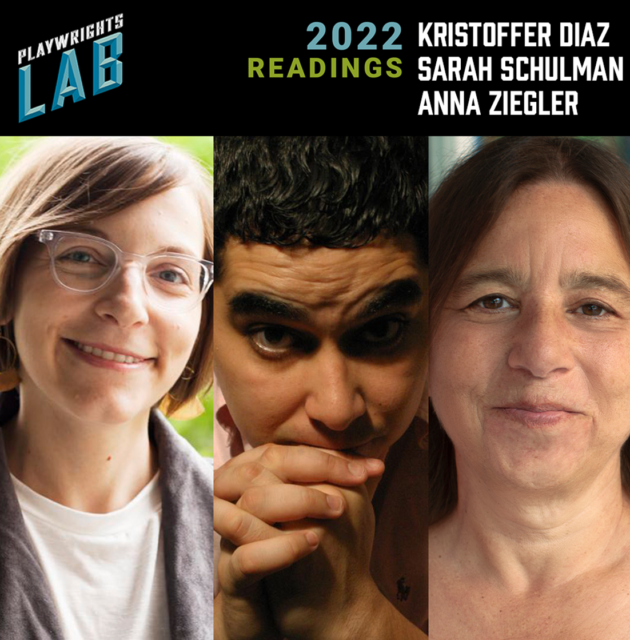
Why: Started in October 2013, Keen Company’s “Keen on New York” features readings of works-in-progress by three midcareer playwrights, with impressive casts. The 2022 edition begins on December 2 with Anna Ziegler’s (Photograph 51, Boy) Antigones, a contemporary reimagining of Sophocles’s family and political drama, directed by Tyne Rafaeli and read by Santino Fontana, Celia Keenan-Bolger, Maria-Christina Oliveras, Marianne Rendón, and Armando Riesco. On December 12, Things with Friends, written and directed by Kristoffer Diaz (Hercules, The Elaborate Entrance of Chad Deity), invites guests into a fateful dinner party. And on January 9, Sarah Schulman’s (Manic Flight Reaction, The Lady Hamlet) Free Ali! Free Bob! takes on political hierarchies surrounding a gay art clique.

“I am thrilled to announce the details for this year’s Playwrights Lab readings, the first in-person sharing from our lab since the pandemic,” Keen artistic director Jonathan Silverstein said in a statement. “It has been an honor to be in the room with these three exceptional and seasoned artists throughout the year, under the leadership of Keen’s director of new work, Jeremy Stoller. Anna, Kris, and Sarah are all unique voices, yet they share a common sense of compassion and a deep understanding of the world we live in while also reveling in the joy of the human condition.” The readings take place in the ART/NY Conference Room in the Garment District and are free with advance registration.

ALVIN AILEY AMERICAN DANCE THEATER AT NEW YORK CITY CENTER

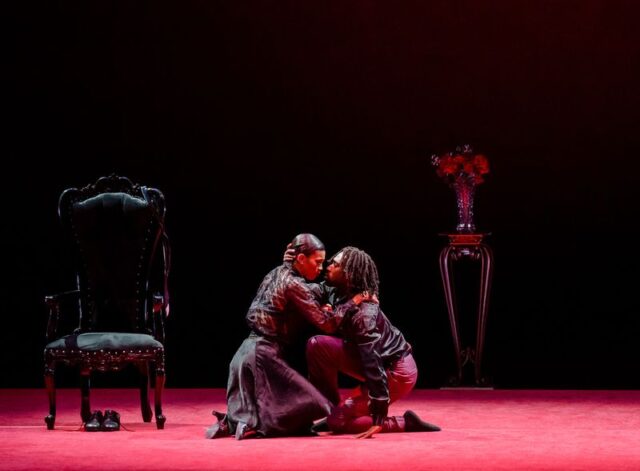
Jamar Roberts’s In a Sentimental Mood will make its work premiere at AAADT season at City Center (photo by Paul Kolnik)

ALVIN AILEY AMERICAN DANCE THEATER
New York City Center
131 West 55th St. between Sixth & Seventh Aves.
November 30 – December 24, $39-$169
www.alvinailey.org
www.nycitycenter.org

I don’t know about you, but I’ve had a rough coupla weeks. Thankfully, Alvin Ailey American Dance Theater returns to New York City Center this week just in time to give me just the break I need, something I look forward to every year.

AAADT’s 2022 fall/winter season at City Center runs November 30 to December 24, featuring fifteen works presented in various groupings, beginning with an opening night gala consisting of an excerpt from Mauro Bigonzetti’s Festa Barocca (with Constance Stamatiou and students from the Ailey School), a romantic duet from Twyla Tharp’s Nine Sinatra Songs, and excerpts from Alvin Ailey’s classic Night Creature along with artistic director Robert Battle’s Unfold, with live vocals by soprano Brandie Sutton, before concluding with Ailey’s standard-bearer, Revelations.

If you haven’t been paying attention to former Ailey dancer Jamar Roberts’s growth as a choreographer, you’ve been missing a special progression. The world premiere of his In a Sentimental Mood, the exploration of a young couple’s love and desire, set to music by Duke Ellington and Rafiq Bhatia’s spin on a quartet of jazz standards, is sure to be a highlight at City Center. The other world premiere is Kyle Abraham’s Are You in Your Feelings?, a celebration of Black culture with songs by the Flamingos, Jazmine Sullivan, Lauryn Hill, Erykah Badu, and others. The troupe will present the company premieres of Paul Taylor’s 1964 short, motionless DUET and Tharp’s 1997 Roy’s Joys, a nine-part piece honoring trumpet legend Roy “Little Jazz” Eldridge. There will also be a new production of Ailey and Mary Barnett’s 1986 Survivors, a tribute to Nelson and Winnie Mandela with music by drummer Max Roach and singer Abbey Lincoln, restaged by former AAADT associate artistic director Masazumi Chaya.

Fan favorite BUSK by Aszure Barton is part of AAADT presentation at City Center (photo by Paul Kolnik)

The repertory pieces offer a wide range of consistent delights from throughout the company’s sixty-four-year existence. “All Ailey A” encompasses Night Creature, Reflections in D, Pas de Duke, and The River, “All Ailey B” brings together Memoria, Survivors, and Revelations, “All Ailey C” comprises Blues Suite, Reflections in D, Cry, and Revelations, and “All Ailey D” boasts The River, Blues Suite, and Revelations.

Future of Jazz Orchestra will perform live December 16-18 to Night Creature, Reflections in D, For Four, and Pas de Duke. Two “All New” programs team up In a Sentimental Mood, DUET, Survivors, and Roy’s Joys or Roy’s Joys, Survivors, and Are You in Your Feelings?

I always make sure to see one of the “All New” evenings, a glorious way to say goodbye to one year and welcome the next one, filled with hope and promise and great dancing.

COMPLEXIONS CONTEMPORARY BALLET AT THE JOYCE

Who: COMPLEXIONS Contemporary Ballet
What: Twenty-eighth anniversary season
Where: The Joyce Theater, 175 Eighth Ave. at Nineteenth St.
When: November 22 – December 4, $61-$81
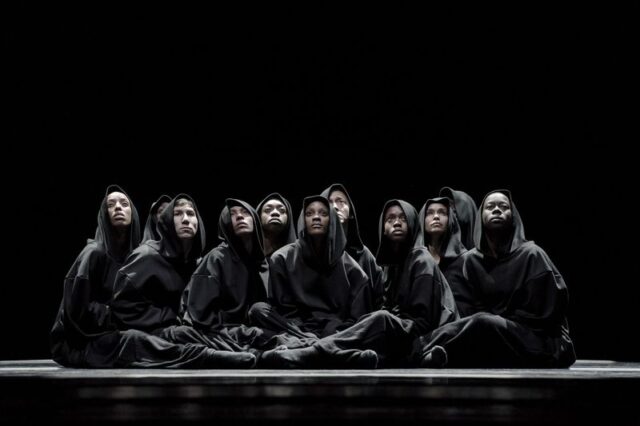
Why: Founded in 1994 by artistic directors Dwight Rhoden and Desmond Richardson, COMPLEXIONS Contemporary Ballet (CCB) espouses its own “nique,” which “uses a classical ballet structure as its foundation yet allows momentum and the integration of a fully mobile torso, weight shift, and dynamics to enhance the outcome. Contemporary in its perspective, nique places a special emphasis on coordination, physical integration, precision, efficiency, and clarity of form.” CCB will exhibit that discipline in its upcoming season at the Joyce, running November 22 to December 4.

The New Rochelle–based troupe will be presenting two programs plus a gala. The first program (November 23-27) consists of Rhoden’s twenty-eight-minute Hissy Fits, a work for ten dancers set to music by J. S. Bach, and his 2021 Snatched Back from the Edges, which began life as a series of Black Is Beautiful films made during the pandemic lockdown, taking on racial injustice, with spoken word and music by Terrell Lewis, Tye Tribbett, Shirley Caesar, and Jon Batiste. The second program (November 29 – December 4) includes an excerpt from Snatched Back from the Edges, Jae Man Joo’s Serenity, William Forsythe’s Slingerland Pas de Deux, and the world premieres of Francesca Harper’s System and Rhoden’s Endgame/Love One. (The works will be performed by Christian Burse, Jacopo Calvo, Kobe Atwood Courtney, Jasmine Cruz, Jillian Davis, Thomas Dilley, Vincenzo Di Primo, Joe Gonzalez, Harrison Knostman, MaryAnn Massa, Marissa Mattingly, Tatiana Melendez, Miguel Solano, Lucy Stewart, Candy Tong, April Watson, Elijah Mack, and Angelo De Serra.)

The gala, hosted by Whoopi Goldberg, will be held on November 22, with highlights from the company’s twenty-eighth season and its collaboration with the American Ballet Theatre Jacqueline Kennedy Onassis School. There will be a Curtain Chat following the November 30 performance and a family matinee on December 3 at 2:00.