this week in lectures, signings, panel discussions, workshops, and Q&As

OLIVIA HARRISON AND MARTIN SCORSESE IN CONVERSATION: CAME THE LIGHTENING: TWENTY POEMS FOR GEORGE

Who: Olivia Harrison, Martin Scorsese
What: New York City book launch
Where: Kaufmann Concert Hall, 92nd St. Y, 1395 Lexington Ave. between Ninety-First & Ninety-Second Sts., and online
When: Sunday, November 20, in person $31.50 – $55, livestream $25, 8:00
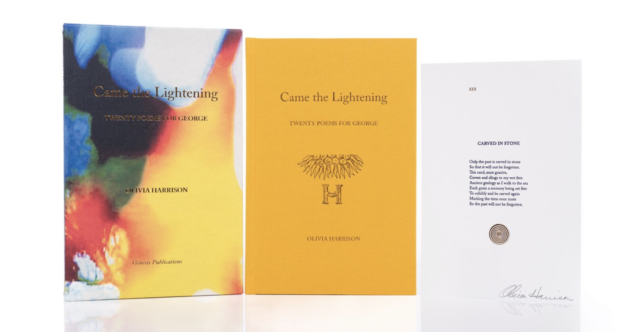
Why: “Only the past is carved in stone / So that it will not be forgotten. / This sand, once granite, / Covers and clings to my wet feet. / Ancient geology as I walk to the sea / Each grain a memory being set free / To solidify and be carved again / Marking the time once more / So the past will not be forgotten.” In her new book, Came the Lightening: Twenty Poems for George (Genesis, June 2022, $35), Olivia Harrison, the widow of beloved musician George Harrison, remembers her husband through twenty poems, photographs, drawings, and more, in honor of the twentieth anniversary of his death from cancer in 2001 at the age of fifty-eight. (The book includes contributions from Henry Grossman, Sue Flood, Mary McCartney, Marcus Tomlinson, Klaus Voormann, and Brian Roylance.) Among the poems are “End of the Line,” “My Arrival,” “Without Hummingbirds,” “Keepsakes,” and the aforementioned “Carved in Stone.” Olivia, who married George in 1978, writes, “Here on the shore, twenty years later / my message in a bottle has reached / dry land. Words about our life, his death / but mostly love and our journey to the end.”

On November 20 at 8:00, Olivia Harrison will be joined by Oscar-winning director Martin Scorsese at the 92nd St. Y’s Kaufmann Concert Hall for the New York City launch of the book, celebrating the life and career of the Quiet Beatle. (A special-edition signed book-and-print edition will be available December 6 for £125.) If you can’t make it to the event, it will also be livestreamed. As George Harrison sang more than fifty years ago, “Sunrise doesn’t last all morning / A cloudburst doesn’t last all day / Seems my love is up and has left you with no warning / It’s not always gonna be this grey / All things must pass / All things must pass away.”

FINALE — LATE CONVERSATIONS WITH STEPHEN SONDHEIM: AN EVENING WITH D. T. MAX

Who: D. T. Max, Michael Schulman
What: Book launch
Where: The National Arts Club, 15 Gramercy Park South
When: Thursday, November 17, free with RSVP, 8:00
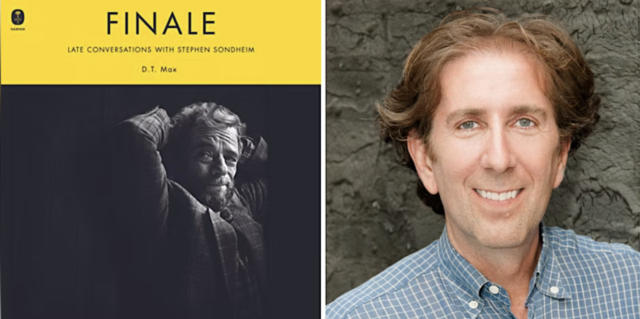
Why: “I always wanted to write about Stephen Sondheim. Actually, long before writing about him was a possibility, I just wanted to meet Stephen Sondheim. In the spring of that long-ago year 1977, my mother went to a benefit for the Phoenix Theatre, a repertory company that pioneered off-Broadway theater. The event included a performance of Side by Side by Sondheim, a revue of the composer-lyricist’s songs. Going to benefits was not the sort of thing my mother usually did, but my uncle was a playwright whom the Phoenix had championed, and he might have persuaded her. Sondheim at the time was exactly the sort of creator the Phoenix wanted to associate itself with. He was remaking the American musical in the same way the Phoenix was trying to remake the theatrical landscape.”

So begins D. T. Max’s new book, Finale: Late Conversations with Stephen Sondheim (Harper, November 22, $20.99), which collects three years of interviews he conducted with Sondheim, including discussions about technology, boring books, pop music, movies, New York City, the joys of live theater, and more. It was initially going to be for a profile for the New Yorker, focusing on a new musical Sondheim was writing, but the pandemic and the maestro’s death changed things. On November 17 at 8:00, Max (The Family That Couldn’t Sleep: A Medical Mystery, Every Love Story Is a Ghost Story: A Life of David Foster Wallace) will be at the National Arts Club to launch Finale with the help of fellow New Yorker scribe Michael Schulman; admission is free with advance RSVP.

STEVE MARTIN, HARRY BLISS, AND NATHAN LANE: NUMBER ONE IS WALKING

Who: Steve Martin, Harry Bliss, Nathan Lane
What: Book launch
Where: The Town Hall, 123 West Forty-Third St. between Sixth & Seventh Aves.
When: Tuesday, November 15, $68, 8:00
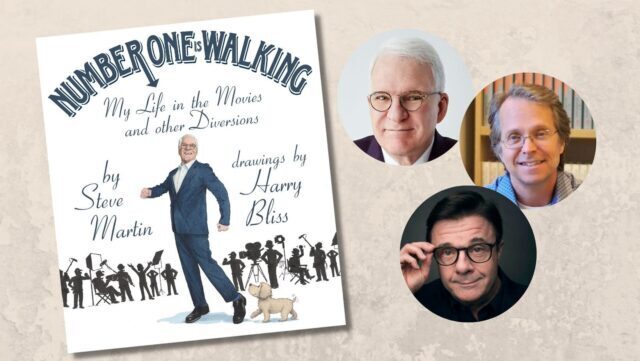
Why: Multihyphenate Steve Martin has made films and records and written plays, movie scripts, novels, children’s books, and tongue-in-cheek self-help tomes. He has now entered the graphic novel field with Number One Is Walking: My Life in the Movies and Other Diversions (Celadon, November 15, $30), with the help of black-and-white illustrations by cartoonist Harry Bliss. A follow-up to their 2020 cartoon collection A Wealth of Pigeons, the new book features scenes in which Martin looks back at his career for the first time in print. The title comes from a Hollywood trope; in one panel, Martin explains, “On a movie call sheet, the actors are listed numerically. The lead is number one, the second lead is number two, etc. I was slightly embarrassed on my first film, The Jerk, when I would head toward the set and the assistant director would trail me, transmitting into his walkie talkie . . . ‘Number one is walking.’” Martin points out that he was also “number one” on Bowfinger, Cheaper by the Dozen, and Bringing Down the House, but when he did Nancy Meyers’s It’s Complicated with Meryl Streep and Alec Baldwin, each time he came on set he was horrified to hear: “Number three is walking.”

Longtime New Yorker cartoonist Bliss has illustrated such books as Joanna Cotler’s Sorry (Really Sorry), Doreen Cronin’s Diary of a Worm, and Alison McGhee’s Countdown to Kindergarten as well as writing and illustrating Bailey and Luke on the Loose. On November 15 at 8:00, Martin and Bliss will be at the Town Hall to discuss their collaboration; serving as moderator will be the one and only Nathan Lane, who appears with Martin in Only Murders in the Building. All audience members will receive a signed copy of Number One Is Walking: My Life in the Movies and Other Diversions, courtesy of the Strand.

BLACK NOTEBOOKS: RONIT

Shlomi Elkabetz documents the making of Gett: The Trial of Viviane Amsalem with his sister, Ronit

BLACK NOTEBOOKS: RONIT (CAHIERS NOIRS: RONIT) (Shlomi Elkabetz, 2021)
New Plaza Cinema @Macaulay Honors College
35 West Sixty-Seventh St. between Central Park West & Columbus Ave.
Opens Friday, November 11
panoramafilmsus.com
newplazacinema.org

About halfway through his award-winning documentary Black Notebooks: Ronit, director Shlomi Elkabetz says in a gentle voice-over, “And so it happened. And I just observe. The parting and final conversations, and last words, if there were any, passed us by, like in a film, above and beneath life, and silence in life is the same as the silence of death.”

Shlomi is talking about his relationship with his sister, Israeli film star Ronit Elkabetz, who can be heard saying, “It’s over.” Shlomi, pensively looking out a window, turns to face the camera and continues, “And the same silences are still there. You and I still speak.” Shlomi then switches to a close-up of Ronit as he concludes, “And we never parted.” He next cuts back and forth between his and his sister’s faces before he gets up and walks away, then shows Ronit sitting by herself at a table with an empty chair.

The companion piece to Black Notebooks: Viviane, Black Notebooks: Ronit is a powerful and often uncomfortably intimate behind-the-scenes story about the making and marketing of the 2014 film Gett: The Trial of Viviane Amsalem, the final work of a trilogy that began with To Take a Wife and Shiva. The three films were cowritten and codirected by the siblings and star Ronit (Late Marriage, The Band’s Visit) as the unhappily married Viviane Amsalem. In Gett, Viviane has filed for divorce in a religious court, the three-man beit din, seeking to obtain a gett, which will grant her freedom from her husband (Simon Abkarian), who refuses to let her go.

Fighting the lung cancer that will eventually kill her in 2016 at the age of fifty-one, Ronit is having difficulty with the movie. She forgets her lines and prefers to spend time with her two young children rather than do yet another take of a scene. “I can’t stand being so exposed anymore,” she tells her brother, explaining that she has lost her desire to act. But Shlomi is determined to finish the film, helping Ronit do the work any way he can, bringing family to visit the set, feeding her dialogue, and giving her extra time between shots. Her costar Menashe Noy, who plays her advocate, Carmel Ben-Tovim, watches her closely, not always sure what to do.

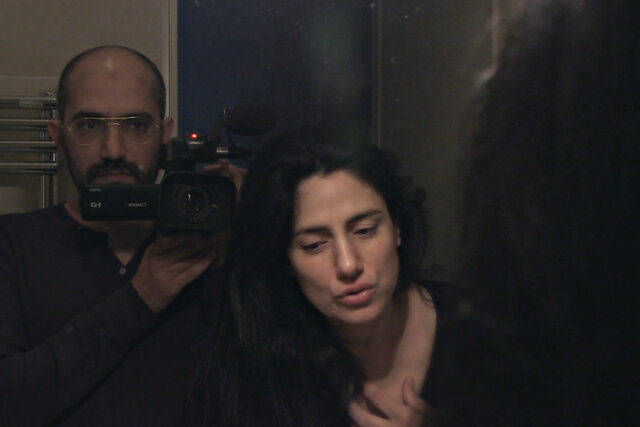
At one point, on the media tour supporting Gett, Ronit is standing in front of a mirror as Shlomi, visible in the reflection, films her with a small handheld camera. “Why not give an interview? Am I afraid? Yes, I’m afraid,” she says. “And I don’t want my fear to run my life. I don’t want that to happen; right away I say to myself: Okay, I don’t want to cooperate with fear.” Through it all, Shlomi holds the camera at chest level as he gazes at his sister, neither looking through the lens nor worrying about the angle. Duality, mirroring, and life versus the depiction of life are the inescapable themes.

“We’ll do the most amazing things, despite and because of the limitations!” Ronit tells her brother, although it’s clear that it won’t be easy. As Ronit becomes sicker, Shlomi grows more poetic, but neither will give up the fight.

Directed by Shlomi and cowritten with frequent collaborator Joelle Alexis, Black Notebooks: Ronit does a beautiful job of paralleling Viviane’s battle to obtain a gett with Ronit’s real-life struggle against cancer. When one of the beit din judges says to her, “Accept your fate. There’s nothing more I can do,” Ronit, as Viviane, shakes her head and covers her face with her hands, a reaction that could be Ronit being given a fatal diagnosis. The audience roots for both women, fictional and real; one melds into the other, lending a hybrid nature to the storytelling.

When Shlomi speaks of casting Noy, he points out, “Here, Menashe plays Carmel Ben-Tovim, who tries to save Viviane. And what I see is myself fighting alongside you. And now, when I look at the two of you” — Shlomi cuts to a shot of Noy looking over at a solemn yet steadfast Viviane — “I see me and you. But when I try to plead for you . . . It’s too much for me.” It’s almost too much for us as well, especially with the sweeping melodramatic score, featuring original music by Dikla and Yiftach Shahaf in addition to the Israel Symphony Orchestra performing Bernard Herrmann’s “Vertigo: Suite,” from the Alfred Hitchcock film in which Kim Novak plays two different women whom Jimmy Stewart’s character tries to make the same.

Winner of the Israeli Ophir Award for Best Documentary, Black Notebooks: Ronit opens November 11 at New Plaza Cinema, with Shlomi Elkabetz participating in Q&As on November 11 at the 7:45 show with American actor John Turturro (Miller’s Crossing, Barton Fink), on November 12 at the 7:30 screening with American novelist Nicole Krauss (Forest Dark, The History of Love), and on November 13 at the 4:30 show with Israeli actress Mili Avital (Dead Man, Prisoners of War).

ACTION SONGS / PROTEST DANCES

Who: Edisa Weeks, Taína Asili, Spirit McIntyre, Martha Redbone, Noni Byrd-Gibbs, Steven Jeltsch, Johnnie Cruise Mercer, Devin Oshiro, Brittany Stewart, Marýa Wethers
What: Action Songs/Protest Dances
Where: Kupferberg Center for the Arts, 153-49 Reeves Ave., Flushing
When: Saturday, November 12, 8:00, and Sunday, November 13, 3:00, $20
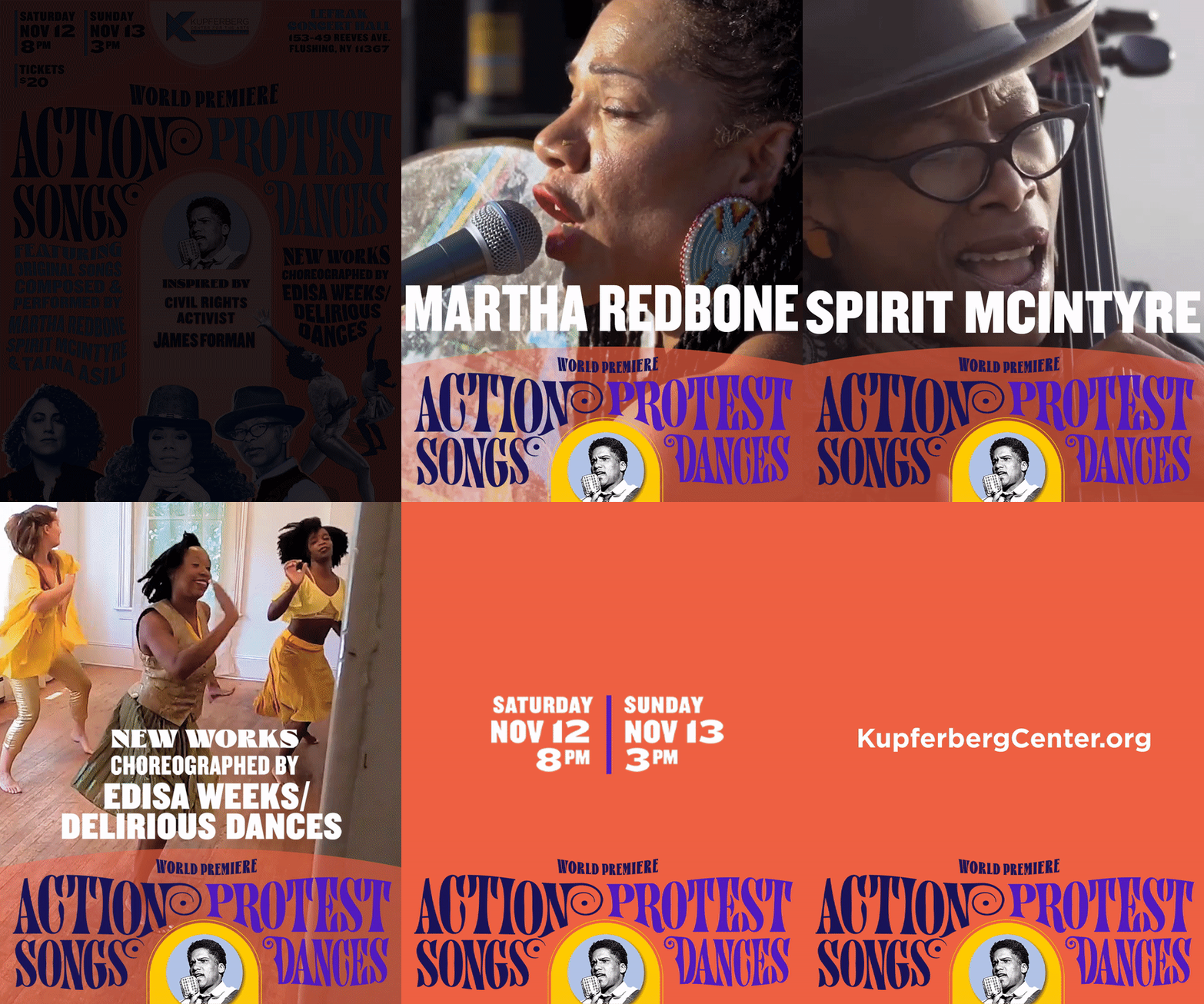
Why: Given the state of the nation, particularly following the midterm elections, it is a time for action and protest. On November 12 and 13, Queens College will be hosting the timely program “Action Songs/Protest Dances,” featuring an impressive lineup of musicians and dancers. The event was conceived by director and choreographer Edisa Weeks in honor of civil rights activist James Forman (1928-2005), who wrote such books as The Making of Black Revolutionaries, Self Determination: An Examination of the Question and Its Application to the African American People, and High Tide of Black Resistance and Other Political & Literary Writings.

“I started teaching at Queens College in 2010, which is also when the QC Rosenthal Library Civil Rights Archives acquired James Forman’s personal papers,” Weeks said in a statement. “I was incredibly excited as Forman was the first person I heard criticize capitalism as an exploitive economic system. I was a kid at the time, and remember feeling shocked, as I grew up playing Monopoly and believing that capitalism was good and the ‘American Way.’ Since 2010 I’ve been wondering how I can lift up James Forman’s voice, work, advocacy, and sacrifices during the civil rights movement in the 1960s. Then in 2020 the pandemic happened, followed by the murder of George Floyd and Brianna Taylor. I began wondering how as a choreographer I can engage with the protests that were happening across the nation and help address injustices in America. The Kupferberg Center for the Arts Incubator Project provided the opportunity to create ‘Action Songs/Protest Dances,’ which celebrates the life and words of James Forman, and through music and dance advocates for America to be a truly great nation.”

The event features original songs by Taina Asili, Spirit McIntyre, and Martha Redbone, with dancers Noni Byrd-Gibbs, Steven Jeltsch, Johnnie Cruise Mercer, Devin Oshiro, Brittany Stewart, and Marýa Wethers. Each show will be followed by a discussion with the composers and performers, moderated by Miles Grier on November 12 and Natanya Duncan on November 13.

MY BROKEN LANGUAGE

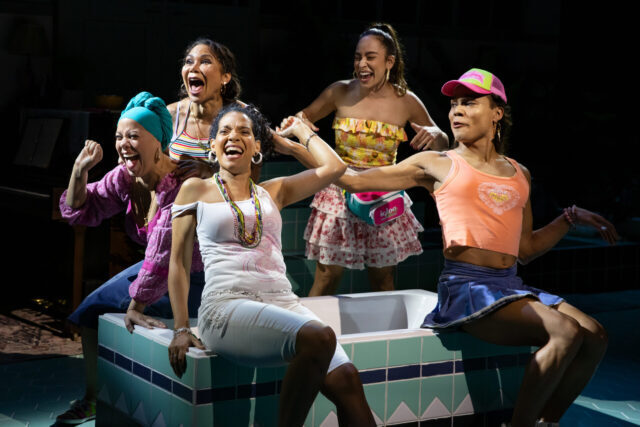
A cast of five extraordinary women share roles in Quiara Alegría Hudes’s My Broken Language (photo by Julieta Cervantes)

MY BROKEN LANGUAGE
The Pershing Square Signature Center
The Romulus Linney Courtyard Theatre
480 West 42nd St. between Tenth & Eleventh Aves.
Tuesday – Sunday through November 27, $49-$159
212-244-7529
www.mybrokenlanguage.net

Quiara Alegría Hudes’s My Broken Language is an exhilarating ninety minutes of love and loss among a close Puerto Rican family in North Philly over the course of sixteen years.

During the pandemic, Hudes, who won the Pulitzer Prize in 2012 for her play Water by the Spoonful, about an Iraq War veteran returning to his home in Philadelphia, published a memoir, My Broken Language, detailing her childhood from 1988, when she was ten, to 2004, when she went to the Brown University Grad School for Playwriting. The book is divided into four parts: “I Am the Gulf between English and Spanish,” “All the Languages of My Perez Women, and Yet All This Silence . . . . ,” “How Qui Qui Be?,” and “Break Break Break My Mother Tongue.” At a public reading, Hudes, also known as Qui Qui, invited a group of actors to read different chapters, which sparked the development of the book into a play with multiple women sharing the lead role. The stirring result is at the Romulus Linney Courtyard Theatre at the Signature, where it opened tonight for a limited run through November 27. Get your tickets now.

The audience sits on three sides of Arnulfo Maldonado’s beautifully bright, intimate set, a tiled courtyard with three porcelain bathtubs filled with plants, a shower, and steps leading to the door of a house with a facade of two long rows of windows, behind which is greenery, as if life is growing inside. Tucked next to the steps is a piano where Ariacne Trujillo Duran occasionally plays Chopin and original music by Alex Lacamoire.

The play, which Hudes calls “a theater jawn,” begins with Zabryna Guevara, Yani Marin, Samora la Perdida, Daphne Rubin-Vega, and Marilyn Torres declaring in unison, “My Broken Language. North Philly. 1988. I’m ten years old.” Each “movement” of the jawn kicks off with similar declarations as time passes, with a different actor taking over the lead role of Qui Qui, complete with singing, dancing, and poignant and prescient monologues; the rest of the cast play other roles as well.
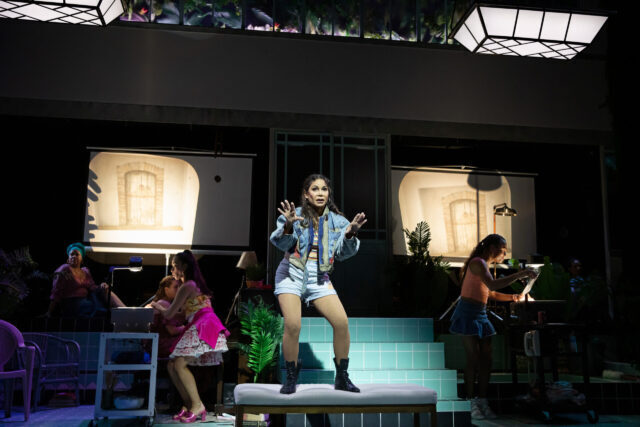
Daphne Rubin-Vega plays the ten-year-old author in Signature world premiere (photo by Julieta Cervantes)

“Cousinhood in my big-ass family was a swim-with-the-sharks wonderland,” ten-year-old Qui Qui says on the way to an amusement park in New Jersey. “When Cuca invited me to Six Flags with the big cousins, I was Cinderella being invited to the ball. These weren’t the rug rats of the family, my usual crew. Five to ten years my elder, my big cousins were gods on Mount Olympus, meriting study, mythology, even fear.” A moment later, she adds, “Cuca, Tico, Flor, and Nuchi. Saying their names filled me with awe. They had babies and tats. I had blackheads and wedgies. They had curves and moves. I had puberty boobs called nipple-itis. They had acrylic tips in neon colors. I had piano lessons and nubby nails. They spoke Spanish like Greg Louganis dove — twisting, flipping, explosive — and laughed with the magnitude of a mushroom cloud.”

As 1988 becomes 1991 in West Philly, 1993 in North Philly, 1994 in Center City, 1995 back in West Philly, and 2004 in Providence, Qui Qui, identified as “Author” in the script, has her period, is fascinated by her mother’s mysterious Yoruba religious rituals, discovers great literature (Flannery O’Connor, Ralph Ellison, Toni Morrison, Lawrence Ferlinghetti, Sandra Cisneros, Esmeralda Santiago) and art (Marcel Duchamp’s Bicycle Wheel, Nude Descending a Staircase No. 2, Fountain), and learns too much too quickly about death.

“One day I would dream of a museum, a library I might fit into. One with space to hold my cousins, my tías, my sister, mi madre. An archive made of us, that held our concepts and reality so that future Perez girls would have no question of our existence or validity,” sixteen-year-old Qui Qui fantasizes. “Our innovations and conundrums, our Rashomon narratives could fill volumes, take up half a city block. Future Perez girls would do book reports amid its labyrinthine stacks, tracing our lineages through time and across hemispheres. A place where we’d be more than one ethnic studies shelf, but every shelf, the record itself. And future Perez girls would step into the library of us and take its magnificence for granted. It would seem inevitable, a given, to be surrounded by one’s history.”

That soliloquy gets to the heart of My Broken Language, which is an inclusive celebration of who the Perez family is and what they can be. Despite the constant adversity, Hudes focuses on the individuality of the characters and the author herself, portrayed by five distinct women who represent the vast range of Puerto Rican women, in mind and body, washing away ethnic and gender stereotypes. Even as “asterisks” point out future tragedy, the play is life-affirming as the actors stand firm and bold, singing Lacamoire’s “La Fiesta Perez” and “Every Book, a Horizon,” Ernesto Grenet’s “Drume Negrita,” and Joni Mitchell’s “Hejira” and moving to Ebony Williams’s engaging choreography in Dede Ayite’s colorful, dramatic costumes that trace the development of young women. (Yes, that’s Daphne Rubin-Vega in pigtails!)
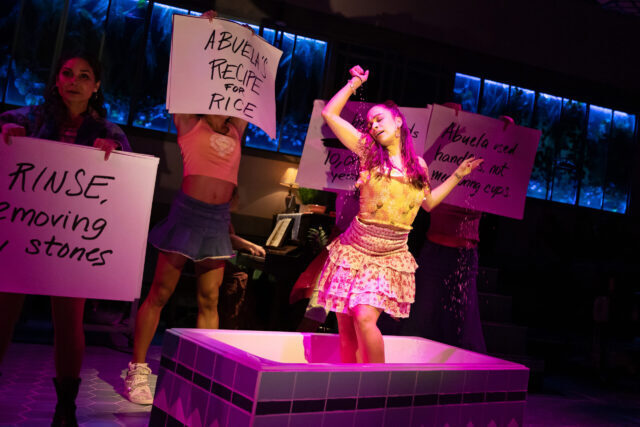
Tiled bathtubs figure prominently in My Broken Language (photo by Julieta Cervantes)

In her directorial debut, Hudes allows each actor the freedom to incorporate their own realities into their characters, including a wonderful moment in which all five line up on the steps and, one by one, grab the person next to them in their own way. Although a scene about Qui Qui’s favorite books feels didactic — the listing in the digital program, which also includes a glossary of terms and pop-culture references, would have sufficed — everything else flows together organically, immersing the audience in the story of the Perez family. Jen Schriever’s lighting never goes completely dark, allowing the audience to see the actors, the actors to see the audience, and audience members to see themselves, all part of an intimate, caring community.

The cast, led by the fabulous Rubin-Vega, who has also appeared in Hudes’s Daphne’s Dive at the Signature and Miss You Like Hell at the Public, and Guevara, who starred in the playwright’s Water by the Spoonful at Second Stage and Elliot, a Soldier’s Fugue at 45 Below, revels in the flexibility Hudes gives them; in the script, she notes, “No need for them to act, speak, or move like one cohesive character. The point is a multiplicity of voices, bodies, and vibez.” That advice works for the audience as well, during the play and as they exit back into real life.

[On November 13 at 5:00, the Bushwick Book Club will hold a special free event at the Signature, hosted by Guevara and featuring readings from Hudes’s memoir along with original music and movement by spiritchild, Patricia Santos, Anni Rossi, Susan Hwang and Troy Ogilvie.]
BITTERSWEET: THE DARK SIDE OF THE CHOCOLATE INDUSTRY

Terry Collingsworth will discuss the evils of the chocolate industry in special MOFAD event

Who: Terrence Collingsworth, Clay Gordon
What: MOFAD discussion of the history of the chocolate industry and tasting
Where: Chelsea Market Maker’s Studio, 75 Ninth Ave. between Fifteenth & Sixteenth Sts.
When: Tuesday, November 8, $45 (including chocolate three bars and beverage), 6:00
Why: Every night before we go to bed, my wife and I have several pieces of dark chocolate. We’re hoping an upcoming discussion sponsored by the Museum of Food and Drink doesn’t change our ritual. On November 8 at 6:00, International Rights Advocates founder and executive director Terry Collingsworth and Discover Chocolate author and TheChocolateLife.com and chocophile.com founder Clay Gordon will be at the Chelsea Market Maker’s Studio for “Bittersweet: The Dark Side of the Chocolate Industry,” which examines labor issues and child trafficking in the production and distribution of chocolate. The event was originally scheduled to include journalist Simran Sethi, who wrote in a June 2021 article for The Counter, “Chocolate brought Americans sweet respite in 2020 — more than usual, according to recent research into pandemic purchasing. But the great irony in our chocolate indulgence is that it’s also a product borne out of great suffering.”

Collingsworth and Gordon will examine specific human rights cases and screen a clip from Miki Mistrati’s 2022 documentary The Chocolate War, which follows Collingsworth over a five-year court battle. The evening will conclude with a tasting of three bars from Missouri-based small-batch purveyors Askinosie Chocolate.