this week in lectures, signings, panel discussions, workshops, and Q&As

RONALD K. BROWN/EVIDENCE: OPEN DOOR/THE EQUALITY OF NIGHT AND DAY/GRACE

Ronald K. Brown’s The Equality of Night and Day makes its stunning NYC premiere at the Joyce this week (photo by Rose Eichenbaum)

Ronald K. Brown/EVIDENCE, a Dance Company
The Joyce Theater
175 Eighth Ave. at 19th St.
January 17-22, $51-$71
212-691-9740
www.joyce.org
www.evidencedance.com

“When I work, in all situations, people meet me and they say, ‘You create family wherever you go,’ and so I think I have a nurturing side but I demand a lot,” Brooklyn-based choreographer Ronald K. Brown explains in an Alvin Ailey video about the making of Open Door, a piece Brown made for Alvin Ailey American Dance Theater in 2015. “Why do you have to open the door, how do you open the door, this whole thing of easing, pushing through the door . . .”

Brown created a sense of family and community yet again when his troupe, EVIDENCE, a Dance Company, kicked off its home season at the Joyce on January 17. The program started, appropriately enough, with the company premiere of Open Door, which was inspired by Brown’s travels to Cuba. In front of a screen that changes colors (the lighting is by Tsubasa Kamei), Arturo O’Farrill’s eight-piece Afro Latin Jazz Ensemble performs Luis Demetrio’s “La Puerta,” Tito Puente’s “Picadillo,” and O’Farrill’s “All of the Americas” (from his “Afro Latin Jazz Suite”) and “Vaca Frita” as nine dancers move about the stage, led by solos and duets by Shaylin D. Watson and Isaiah K. Harvey. Originally commissioned for AAADT in 2015, it’s an uplifting twenty-six minutes, with the dancers often putting out their palms in gestures of welcome, beckoning not only fellow dancers but immigrants from Cuba and around the globe.

Open Door is just the right aperitif for the world premiere of The Equality of Night and Day (TEND), a sizzling emotional work in which Brown gets more explicit as he tackles his recurrent themes of social injustice and racism. Five men (Demetrius Burns, Austin Coats, Randall Riley, Christopher Salango, Harvey) and five women (Watson, Shayla Caldwell, Joyce Edwards, Stephanie Chronopoulos, Breana Moore), in loose-fitting flowing blue costumes by Omotayo Wunmi Olaiya, gather and separate to a powerful original score by pianist Jason Moran and the rallying words of activist and writer Angela Davis, who declared in a 2017 speech at Brown, “During the coming period, our primary job will be to build community, to create community — in ways that allow us to understand that the work that we do now does matter, even if we cannot see in an immediate sense the consequences of the work we are doing. It will matter eventually.”

Photos of protests from the last half century and more, curated by Debra Wills, are projected on the back screen, instilling a sense of immediacy in the proceedings, which are highlighted by poignant movement by Burns, Caldwell, and Edwards, the men at one point covering their faces and letting out primeval screams. Later the dancers remove their tops and walk around in a kind of memorial prayer for Black bodies, reacting to Davis’s facts about the racial imbalance in crime and punishment.

The evening concludes with Brown’s half-hour classic, Grace, an appropriate finale providing subtle elegance following the exuberance of Open Door and the psychological intensity of TEND. Commissioned for AAADT in 1999, the deeply spiritual piece begins with Edwards standing in a large doorway at the back of the stage; as opposed to the first two works, where the dancers often came onto the stage with a swagger, here they mostly walk on and off calmly, five women and six men in lovely white or red costumes by Olaiya. They strut out their elbows and their hands reach for the sky to songs by Duke Ellington, Roy Davis Jr., and Fela Kuti, spreading the energy to the audience.

Some years back, I saw Grace at the Joyce with Brown himself dancing a major role. The Bed-Stuy native saved one final, exhilarating moment for the curtain call on January 17, cementing the loving community he had built over the course of the program. He came onstage to uproarious applause, walking gently with a four-pronged cane and being helped by his partner and associate artistic director, Arcell Cabuag. Brown suffered a debilitating stroke in April 2021, at the age of fifty-four, shortly after a residency at Jacob’s Pillow to develop TEND, but has vowed to walk again on his own, and he is ahead of his doctors’ prognosis. The smile on his face was infectious, assuring everyone that there is a promising future to look forward to for all of us.
THEASTER GATES: YOUNG LORDS AND THEIR TRACES — SPECIAL EVENTS

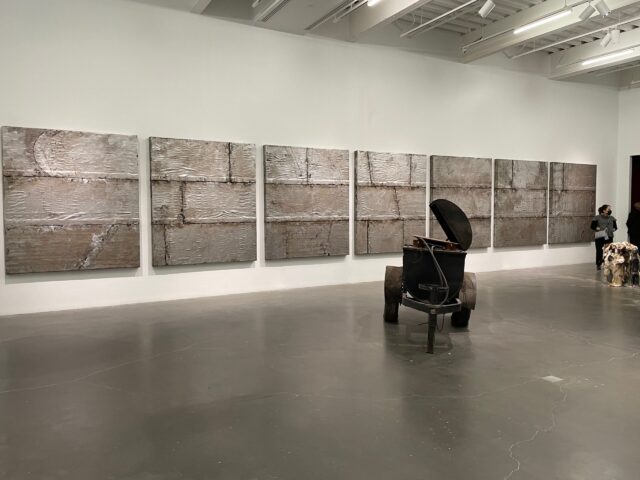
Theaster Gates pays homage to his father and his own childhood in Sweet Chariot and Seven Songs for Black Chapel #1–7 at the New Museum (photo by twi-ny/mdr)

THEASTER GATES: YOUNG LORDS AND THEIR TRACES
New Museum
235 Bowery at Prince St.
Tuesday – Sunday through February 5, $12-$18
www.newmuseum.org
online slideshow

“I make designations between a thing that I made that’s art, a thing I had fabricated that’s art, and a thing that was a preexisting thing that I put alongside other things that were made or fabricated. I don’t necessarily say, ‘Oh, this is all art,’ even though it’s all art, but I think that there are moments when I’m just trying to put things alongside each other like you would in your house or like you would in a shrine,” Chicago-born multidisciplinary artist Theaster Gates says in a video for his elegiac, beautiful, deeply moving “Theaster Gates: Young Lords and Their Traces,” continuing at the New Museum through February 5. “This show is about people who I’ve lost and the things that they left for me, or people who I love and the monument of love that I want to show for them.”

In the three-floor exhibition, curated by Massimiliano Gioni and Gary Carrion-Murayari, Gates pays homage to curator Okwui Enwezor, writer bell hooks, fashion designer Virgil Abloh, scholar Robert Bird, and enslaved potter David Drake (Dave the Potter) as well as his mother (Bathroom Believer), a devout Christian, and his father, a roofer (Roof Strategies for Museum Corridor, Sweet Chariot). Gates repurposes found objects gathered from demolished buildings and construction, including from St. Laurence Church on the South Side of Chicago and Park Avenue Armory in Manhattan, where he hosted “Black Artists Retreat 2019: Sonic Imagination.” Among the highlights of the show are Black Madonna, encased in a vitrine; the short film A Clay Sermon; a music video of Gates and the Black Monks of Mississippi performing an extended improvisational “Amazing Grace”; the fifty-foot-long Roof Strategies for Museum Corridor; and the silver monochrome Seven Songs for Black Chapel, which harkens back to Gates’s childhood.

There are still several special events being held at the New Museum in conjunction with this first-ever museum retrospective of the work of Gates, who turns fifty this year. On January 19 at 6:30 ($10), the panel discussion “Resurrections: Theaster Gates” features curators Jessica Bell Brown and Dieter Roelstraete and LAXART director Hamza Walker, moderated by Carrion-Murayari. On January 21 at noon (free with museum admission), independent archivist and memory worker Zakiya Collier will facilitate an “Out of Bounds” gallery talk about Gates’s archiving practices. On January 21-22 and from January 31 to February 3 (except January 30; free with museum admission), keyboardist and composer Shedrick Mitchell will activate the Hammond B3 organ in A Heavenly Chord, performing his unique mix of Gospel, reggae, R&B, jazz, and new age music. From February 3 to 5, Gates and the Black Monks will play impromptu performances in the fourth-floor gallery. And on February 4 at 4:00 ($8), Gates will be in conversation with writer and scholar Saidiya Hartman. But you needn’t rely on a special event to get you to the New Museum to see this well-designed, uncluttered, intimate exhibit, which also deals with social injustice, racism, and faith.

RONALD K. BROWN/EVIDENCE AT THE JOYCE

Ronald K. Brown/EVIDENCE presents New York premiere at the Joyce next week (photo by Rose Eichenbaum)

Ronald K. Brown/EVIDENCE, a Dance Company
The Joyce Theater
175 Eighth Ave. at 19th St.
January 17-22, $51-$71
212-691-9740
www.joyce.org
www.evidencedance.com

Discussing “the grief and the weight of everything that we feel,” choreographer Ronald K. Brown says, in a Jacob’s Pillow behind-the-scenes video of the making of his latest work, The Equality of Night and Day (TEND), “I want us to find that joy and make sure that everyone understands that this is the destination in the word equality. That it’s the destination of this kind of . . . serenity.”

Since 1985, Bed-Stuy native Brown has been choreographing illuminating works for his Brooklyn-based troupe, EVIDENCE, melding classical ballet and traditional West African movement to create powerful and exhilarating contemporary pieces steeped in social justice, honoring the ancestors, and celebrating community. Through January 15, Brown is curating American Dance Platform at the Joyce, featuring Les Ballet Afrik, B. Moore Dance, and waheedworks. “I remember the first time EVIDENCE, a Dance Company was on the Joyce stage over twenty years ago,” Brown writes in the program. “It was a monumental moment for us and I hope that these three companies will benefit from the exposure that the platform provides.”

Following American Dance Platform, EVIDENCE returns to the Joyce stage for its 2023 home season, presenting three works. Commissioned for Alvin Ailey American Dance Theater in 1999 and added to the EVIDENCE repertory in 2004, Grace is a rapturous tribute to Ailey’s legacy, set to music by Duke Ellington, Roy Davis Jr., and Fela Anikulapo Kuti. Also choreographed for AAADT, 2015’s Open Door will have its company premiere, a twenty-six-minute piece with live music by Arturo O’Farrill’s Afro Latin Jazz Ensemble.

The centerpiece is the New York premiere of TEND, which explores balance, equity, and fairness, with a score by pianist and visual artist Jason Moran, spoken word by Angela Davis, flowing costumes by Omotayo Wunmi Olaiya, set design and lighting by Tsubasa Kamei, and photographs curated by Debra Wills; the company consists of associate artistic director Arcell Cabuag, rehearsal directors Demetrius Burns and Shayla Caldwell, assistant rehearsal director Joyce Edwards, Stephanie Chronopoulos, Austin Coats, Isaiah Harvey, and Breana Moore, with guest artists Randall Riley, Christopher Salango, Shaylin D. Watson, Kirven Douthit-Boyd, Daniel Harder, Hannah Alissa Richardson, Annique S. Roberts, and Keon Thoulouis. There will be a Curtain Chat following the January 18 performance and a family matinee on January 21.

Don’t miss what is sure to be one of the highlights of the dance year. Brown/EVIDENCE knows how to get the crowd going like no other company; every time I see them feels monumental.

NEW YORK JEWISH FILM FESTIVAL 2023

Cecilia Suárez stars in NYJFF closing night selection, Violeta Salama’s Alegría

THIRTY-SECOND ANNUAL NEW YORK JEWISH FILM FESTIVAL
Walter Reade Theater, Film at Lincoln Center
165 West 65th St. between Broadway & Amsterdam Aves.
January 12-23, $15 in person, $10 virtual (bundle $15)
212-875-5050
www.filmlinc.org
thejewishmuseum.org

The thirty-second annual New York Jewish Film Festival comes along at a time with rising anti-Semitism in America and around the world, disarray in the Israeli government amid the controversial return of a former leader, and continuing battles in the Middle East over human rights and land possession. Why should this year be different from any other year?

Running January 12-23 at Film at Lincoln Center, the series comprises twenty-one feature-length narrative films and documentaries and a program of six shorts by women that explore the past, present, and future of Judaism and the diaspora. The festival kicks off with the New York premiere of Fred Cavayé’s Farewell, Mr. Haffmann, in which Daniel Auteuil plays the title character, a jeweler in Nazi-occupied Paris trying to preserve his family. The opening-night selection is Ofir Raul Graizer’s America, about an Israeli swimming coach (Michael Moshonov) who returns to Tel Aviv after living in Chicago, a reunion that doesn’t go quite as planned; the screening will be followed by a Q&A with writer, director, and editor Graizer.

Hannah Saidiner’s My Parent, Neal is part of special shorts program at NYJFF

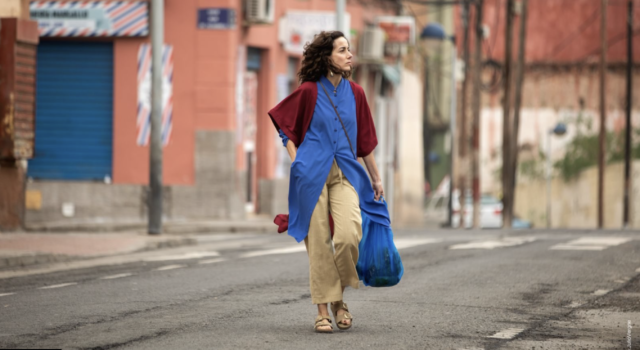
The centerpiece film is Delphine Coulin and Muriel Coulin’s Charlotte Salomon: Life and the Maiden, a documentary about the German-Jewish artist who was murdered at Auschwitz at the age of twenty-six but left behind a remarkable legacy; the film includes the voices of Vicky Krieps, Mathieu Amalric, and Hanna Schygulla, and both screenings on January 18 will be followed by a Q&A with the directors. The festival closes with Violeta Salama’s Alegría, about a single mother (Cecilia Suárez) wrestling with her own faith and the patriarchy as she ventures from Mexico to her hometown in the autonomous North African city of Melilla for her niece’s Orthodox wedding. Salama will discuss her debut feature after both screenings on January 22.

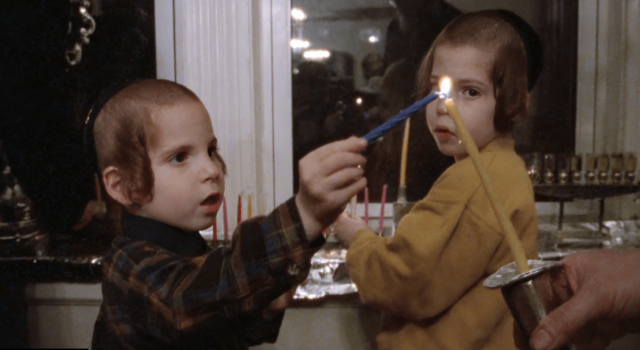
A Life Apart: Hasidism in America returns to the New York Jewish Film Festival in a twenty-fifth anniversary 4K restoration

Among the other highlights are Sylvie Ohayon’s Haute Couture, starring Nathalie Baye as a Dior seamstress in Paris; the New York premiere of Tomer Heymann’s I Am Not, a documentary about boarding school student Oren Levy, who shuns human contact, which will be followed by a hybrid Q&A with Heymann and several of the film’s subjects; the New York premiere of octogenarian Ralph Arlyck’s I Like It Here, a personal film about aging; Jake Paltrow’s June Zero, a fictionalized retelling of the 1961 trial of Adolf Eichmann from three different perspectives; and a pair of revivals, Joseph Green and Leon Trystand’s 1939 Yiddish film A Letter to Mother, and the world premiere of the twenty-fifth anniversary 4K restoration of Oren Rudavsky and Menachem Daum’s A Life Apart: Hasidism in America, a seminal documentary narrated by Sarah Jessica Parker and Leonard Nimoy and with a score by Yale Strom, followed by a panel discussion with Daum, Rudavsky, Ayala Fader, Marcus Allison, Pearl Gluck, and Rabbi Mayer Schiller.

(Keep watching this space for full and capsule reviews throughout the festival.)

Farewell, Mr. Haffmann offers a unique perspective on the Nazi occupation of Paris

FAREWELL, MR. HAFFMANN (Fred Cavayé, 2021)
Walter Reade Theater
Monday, January 16, 8:30
www.filmlinc.org

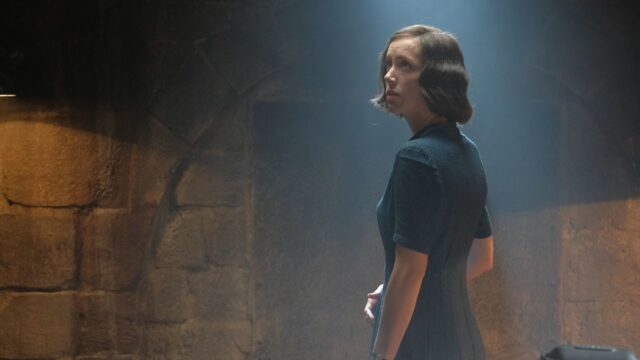
Fred Cavayé’s stunning Farewell, Mr. Haffmann offers several unique twists on the Holocaust drama, resulting in a breathtaking microcosm of so much of what happened, particularly during the Nazi occupation of France. The film is adapted from a play by Jean-Philippe Daguerre, with nearly all the action taking place in Joseph Haffmann’s jewelry shop, where Haffmann lives with his wife and three children. After getting his family out in May 1941, Haffmann finds himself trapped in Paris, cutting a deal with his assistant (Gilles Lellouche) and his wife (Sara Giraudeau) that grows ever-more dangerous as Nazi leaders start coming to the shop to buy jewelry for their wives and mistresses. Daniel Auteuil (Jean de Florette, Girl on the Bridge) is riveting as Haffmann, who experiences anti-Semitism and war from a fascinating perspective, both psychologically and physically.

Two men are at odds over religion and love in Ady Walter’s Shttl

SHTTL (Ady Walter, 2022)
Walter Reade Theater
Monday, January 16, 5:30, and Tuesday, January 17, 1:00
www.filmlinc.org

On the eve of Operation Barbarossa, the German invasion of the Soviet Union in June 1941, a small Yiddish-speaking village on the Polish border teeters on the edge as the citizens debate war, collaboration, religion, women’s roles in society, and true love. In the tense, gripping Shttl, Ady Walter pulls off quite an impressive directorial debut, shooting the 110-minute film in one continuous take, shifting between black-and-white and color as the narrative unfolds: Mendele (Moshe Lobel) joins the military, promising to come back for Yuna (Anisia Stasevich), but while he is gone she is wooed/harassed by the mean-spirited Folie (Antoine Millet), whose father (Saul Rubinek) is the community’s spiritual leader. The strange spelling of the title is an homage to Georges Perec’s 1969 novel, La Disparition (A Void), which never uses the fifth letter of the alphabet, its loss a symbol of profound absence. (Both of French novelist Perec’s parents were killed during the Holocaust, his father on the field of battle, his mother in Auschwitz.) The village, or shtetl, was built for the film and is being turned into a Jewish-Ukrainian museum. The screening on January 16 will be followed by a Q&A with Walter, New Yiddish Rep veteran Lobel, award-winning German-born Canadian actor Rubinek, and producer Jean-Charles Lévy.

Barren is a chilling look at faith and ritual

BARREN (Mordechai Vardi, 2022)
January 23-28, virtual only
www.filmlinc.org/films/barren

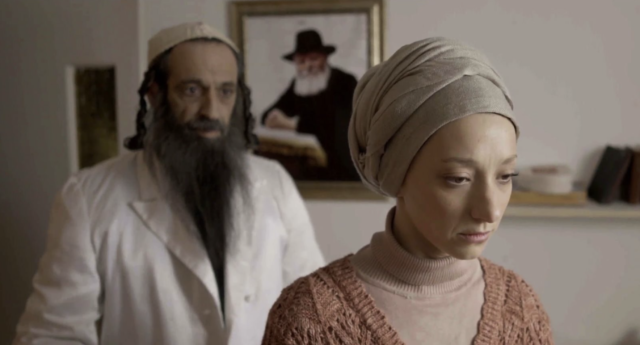
An intense melding of Unorthodox and Shtisel, Mordechai Vardi’s Barren is a heart-wrenching drama about an Orthodox couple, Naftali (Yoav Rotman) and Feigi (Mili Eshet), desperate to have a child. They live with his mother, a matchmaker (Ilanit Ben-Yaakov), and his father, a Torah scribe (Nevo Kimchi), both of whom were secular before becoming Orthodox. When Naftali goes on a pilgrimage to Uman for Rosh Hashanah to pray for fertility, his father invites over a mysterious man who has nowhere to spend the holiday. Rabbi Eliyahu (Gil Frank) claims to be able to heal by blowing the shofar; he offers to do so for Feigi, but their encounter turns terribly wrong, leading every member of the family to reconsider their faith and their personal responsibilities.

Eshet (Take the “A” Train, Beyond the Mountains and Hills) is haunting as Feigi, her eyes filled with yearning for what she imagined her life would be like. Based on actual events, the film focuses on the unjust treatment of women in Orthodox society, their rights determined by men, including local tribunals made up of supposedly wise scholars following religious doctrine, who decide what women should and should not do and whether they should remain married or get divorced. It’s a harrowing tale anchored by a powerful lead performance. The film will be available virtually January 23-28.

UNDER THE RADAR 2023

A Thousand Ways (Part Three): Assembly brings strangers together at the New York Public Library (photo courtesy 600 Highwaymen)

UNDER THE RADAR FESTIVAL
Public Theater and other venues
January 4-22, free – $60
publictheater.org

The Public Theater’s Under the Radar Festival is back and in person for its eighteenth iteration, running January 4-22 at the Public as well as Chelsea Factory, NYU Skirball, La MaMa, BAM, and the New York Public Library’s Stavros Niarchos Foundation branch. As always, the works come from around the world, a mélange of disciplines that offers unique theatrical experiences. Among this year’s selections are Jasmine Lee-Jones’s seven methods of killing kylie jenner, Annie Saunders and Becca Wolff’s Our Country, Roger Guenveur Smith’s Otto Frank, Rachel Mars’s Your Sexts Are Shit: Older Better Letters, Kaneza Schaal’s KLII, and Timothy White Eagle and the Violet Triangle’s The Indigo Room.

In addition, “Incoming! — Works-in-Process” features early looks at pieces by Mia Rovegno, Miranda Haymon, Nile Harris, Mariana Valencia, Eric Lockley, Savon Bartley, Raelle Myrick-Hodges, and Justin Elizabeth Sayre, while Joe’s Pub will host performances by Eszter Balint, Negin Farsad, Julian Fleisher and his Rather Big Band, Salty Brine, and Migguel Anggelo.

Below is a look at four of the highlights.

600 HIGHWAYMEN: A THOUSAND WAYS (PART THREE): AN ASSEMBLY
The New York Public Library, Stavros Niarchos Foundation Library
455 Fifth Ave. at Fortieth St., seventh floor
January 4-22, free with advance RSVP
publictheater.org

At the January 2021 Under the Radar Festival, the Obie-winning 600 Highwaymen presented A Thousand Ways (Part One): A Phone Call, a free hourlong telephone conversation between you and another person, randomly put together and facilitated by an electronic voice that asks both general and intimate questions, from where you are sitting to what smells you are missing, structured around a dangerous and lonely fictional situation that is a metaphor for sheltering in place. The company followed that up with the second part, An Encounter, in which you and a stranger — not the same one — meet in person, sitting across a table, separated from one another by a clear glass panel, with no touching and no sharing of objects. In both sections, I bonded quickly with the other person, making for intimate and poignant moments when we were all keeping our distance from each other.

Now comes the grand finale, Assembly, where sixteen strangers at a time will come together to finish the story at the New York Public Library’s Stavros Niarchos Foundation branch in Midtown. Written and created by Abigail Browde and Michael Silverstone, A Thousand Ways innovatively tracks how the pandemic lockdown influenced the ways we interact with others as well as how critical connection and entertainment are.

Palindromic show makes US premiere at Under the Radar Festival (photo courtesy Ontroerend Goed)

ONTROEREND GOED: Are we not drawn onward to new erA
BAM Fishman Space
321 Ashland Pl.
January 4-8, $45
publictheater.org
www.bam.org

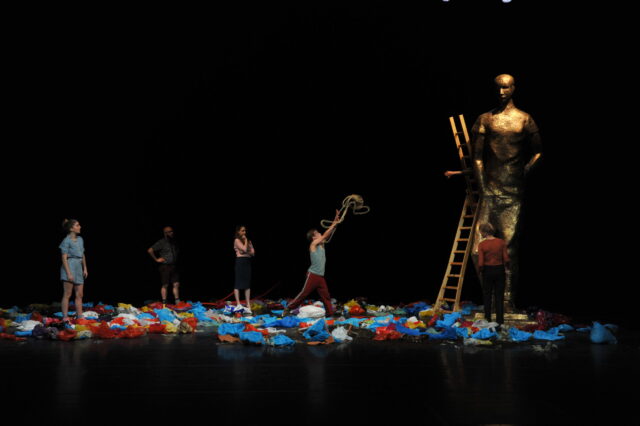
What do the following three statements have in common? “Dammit, I’m mad.” “Madam in Eden, I’m Adam.” “A man, a plan, a canal – Panama.” They are all palindromes, reading the same way backward and forward. They also, in their own way, relate to Ontroerend Goed’s Are we not drawn onward to new erA, running January 4-8 at BAM’s Fishman Space. Directed by Alexander Devriendt, the Belgian theater collective’s seventy-minute show features a title and a narrative that work both backward and forward as they explore climate change and the destruction wrought by humanity, which has set the Garden of Eden on the path toward armageddon. But maybe, just maybe, there is still time to save the planet if we come up with just the right plan.

PLEXUS POLAIRE: MOBY DICK
NYU Skirball
566 LaGuardia Pl.
January 12-14, $40
publictheater.org
nyuskirball.org

The world is obsessed with Moby-Dick much the way Captain Ahab is obsessed with the great white itself. Now it’s Norwegian theater company Plexus Polaire and artistic director Yngvild Aspeli’s turn to harpoon the story of one of the most grand quests in all of literature. Aspeli (Signaux, Opéra Opaque, Dracula) incorporates seven actors, fifty puppets, video projections, a drowned orchestra, and a giant whale to transform Herman Melville’s 1851 novel into a haunting ninety-minute multimedia production at NYU Skirball for four performances only, so get on board as soon as you can.

Brian Mendes and Jim Fletcher get ready for NYCP’s Field of Mars (photo courtesy New York City Players)

NEW YORK CITY PLAYERS: FIELD OF MARS
NYU Skirball
566 LaGuardia Pl.
January 19-22, 24-29, $60
publictheater.org
nyuskirball.org

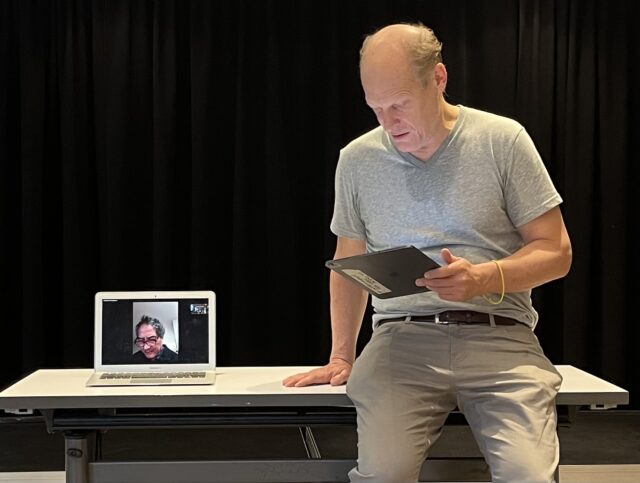
I’ll follow Richard Maxwell and New York City Players anywhere, whether it’s on a boat past the Statue of Liberty (The Vessel), an existential journey inside relationships and theater itself (The Evening, Isolde) and outside time and space (Paradiso, Good Samaritans), or even to the Red Planet and beyond. Actually, his newest piece, Field of Mars, playing at NYU Skirball January 19-29, refers not to the fourth planet from the sun but to the ancient term for a large public space and military parade ground. Maxwell doesn’t like to share too much about upcoming shows, but we do know that this one features Lakpa Bhutia, Nicholas Elliott, Jim Fletcher, Eleanor Hutchins, Paige Martin, Brian Mendes, James Moore, Phil Moore, Steven Thompson, Tory Vazquez, and Gillian Walsh and that the limited audience will be seated on the stage.

Oh, and Maxwell noted in an email blast: “Field of Mars: A chain restaurant in Chapel Hill is used as a way to measure the progress of primates, from hunter/gatherer to fast casual dining experience. Topics covered: Music, Food, Nature, and Spirituality. . . . I also wanted to take this opportunity to tell parents regarding the content of Field of Mars: my kids (aged 11 and 15) will not be seeing this show.”

AN EVENING WITH ERIC BOGOSIAN: MONOLOGUES, DIGRESSIONS, AND AIR GUITAR

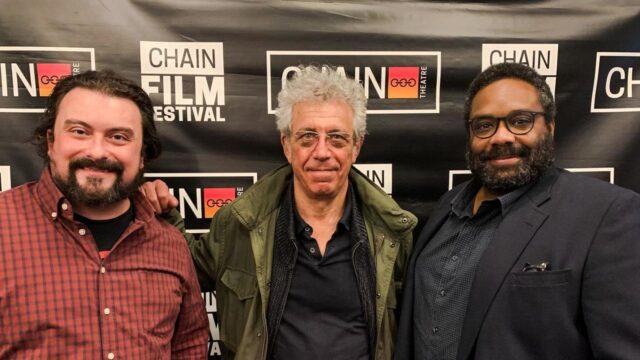
Eric Bogosian (between Chain artistic director Kirk Gostkowski and playwright G.D. Kimble) returns to the Chain for a solo benefit (photo courtesy Chain Theatre)

Who: Eric Bogosian
What: One-night-only benefit for Chain Theatre
Where: The Chain Theatre, 312 West Thirty-Sixth St. between Eighth & Ninth Aves., third floor
When: Saturday, January 21, $30-$50+, 8:00
Why: Founded in 2010 and based on West Thirty-Sixth St. since 2018, the Chain Theatre is a nonprofit whose mission is “to create artistic work that is accessible, relatable, and invokes a visceral response in the audience through the mediums of theater and film. . . . A deep respect for the narrative is the driving force behind the cultivation of original texts, the further investigation of recently produced work, and the reclaiming of existing classics for a modern audience. The material chosen focuses on the cyclical nature of history and complexity of the human spirit.” The Chain has presented works by such writers as Arthur Miller, David Rabe, Dale Wasserman, Neil LaBute, Sam Shepard, Martin McDonagh, and Edgar Allan Poe in addition to hosting the annual One Act Festival and Chain Film Festival. In 2014, the Chain staged Obie, Drama Desk, and Silver Bear—winning actor and writer Eric Bogosian’s 1988 Pulitzer finalist, Talk Radio, and this past summer featured the New York City premiere of Black Box PAC’s new production of Bogosian’s 2008 show 1+1 as part of its Play Festival.

On January 21, the Boston-born, New York City–based Bogosian will be at the Chain for the one-night-only benefit “An Evening with Eric Bogosian: Monologues, Digressions, and Air Guitar,” mixing recent work with older favorites. Tickets are $30 for general admission and $50 for priority seating to support the Chain. Bogosian has also written such other solo plays as Drinking in America, Pounding Nails in the Floor with My Forehead, and Notes from Underground as well as subUrbia and Sex, Drugs, Rock & Roll, which he adapted into films, and the novels Mall, Wasted Beauty, and Perforated Heart and the nonfiction Operation Nemesis: The Secret Plot that Avenged the Armenian Genocide. His acting career is highlighted by Interview with the Vampire, Billions, Law & Order: Criminal Intent, Uncut Gems, and Succession, so basically, you can expect just about anything from him at this ninety-minute charity event. Perhaps he’ll even include “Benefit” from 100 Monologues, in which a rock star discusses why his band is participating in a benefit for — well, you’ll have to discover that for yourself.

GOING ALL THE WAY: THE DIRECTOR’S EDIT

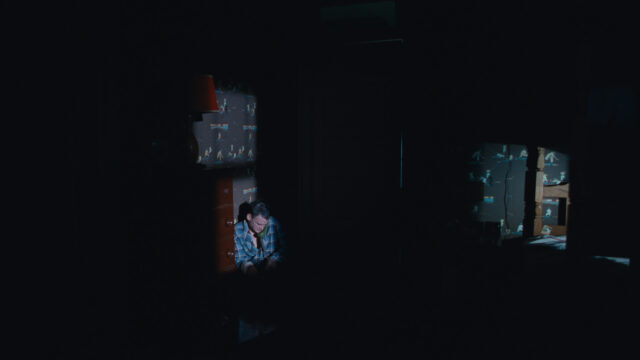
Willard “Sonny” Burns (Jeremy Davies) often finds himself in the dark in Going All the Way: The Director’s Edit

GOING ALL THE WAY: THE DIRECTOR’S EDIT (Mark Pellington, 1997/2022)
Quad Cinema
34 West 13th St. between Fifth & Sixth Aves.
Opens Friday, December 16
212-255-224
goingalltheway.oscilloscope.net
quadcinema.com

During the pandemic lockdown, filmmaker Mark Pellington found the original three-hour-plus cut of his 1997 debut, Going All the Way, a little-known, rarely shown coming-of-age tale with a fabulous young cast set in small-town Indianapolis in 1954. He and editor Leo Trombetta “were just bored in Covid,” so they decided to take another stab at the film, which had previously gone through several iterations nearly a quarter century ago, ranging from 98 to 112 to more than 180 minutes.

The project was mostly to just give them something to do, but soon they had trimmed the first 40 minutes, added 50 minutes of previously unused material and new, gentle voice-over narration by Trombetta, commissioned 50 minutes of new music from composer Pete Adams, and installed an ominous title sequence by Sergio Pinheiro that recalls David Lynch, with images of Main Street, rural America, Jesus, sexuality, and a bleeding razor. The result is a very different 126-minute film, darker, more introspective and character-driven, more attuned to Dan Wakefield’s 1970 bestselling autobiographical novel, which was adapted by the author himself. (Wakefield, who is now ninety, created the late-’70s television series James at 15 and appears as farmer #2 in Going All the Way.)

“I’ve always kinda been more of an outer-directed guy. Right?” Korean War veteran Tom “Gunner” Casselman (Ben Affleck) tells high school classmate Willard “Sonny” Burns (Jeremy Davies) at a bar. “And now, as time goes on, I’m kinda becoming more inner-directed, not giving a shit so much what the crowd thinks. You’ve always been kind of more of an inner-directed guy.” It’s a keen metaphor for the revised film.

Gunner is everybody’s all-American, a classically handsome high school sports star who came back from Korea with gleaming medals on his uniform. Sonny is the kid no one remembers, a wallflower who blends in with the background, a soldier and photographer who spent the war in public information in Kansas City. Gunner is a doer, while Sonny is a watcher, yet each of them wants to be more like the other, almost as if they are two sides of the same person, ego and id. In fact, the name of the high school paper that featured Sonny’s memorable picture of Gunner on the gridiron is named the Echo.

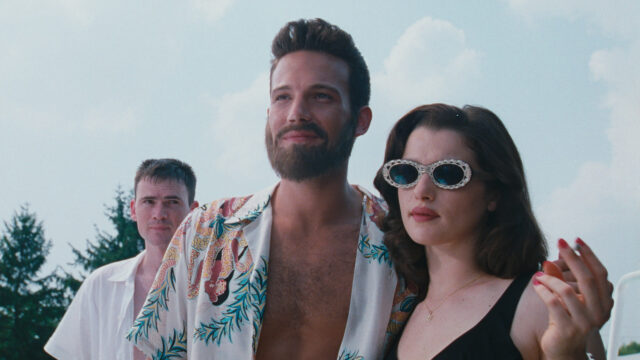
Sonny (Jeremy Davies) watches from behind as Gunner (Ben Affleck) and Marty (Rachel Weisz) stop by the club in Going All the Way

Both men live at home with their family. Gunner’s mother is a sexually attractive, outgoing divorcée who Gunner calls Nina (Lesley Ann Warren); the first time we see them together, it looks like they’re lovers. Sonny’s Bible-thumping mother, Alma (Jill Clayburgh), treats her boy like an innocent fawn unable to make his own decisions or know what’s best for him; Sonny’s father, Elwood (John Lordan), hardly ever speaks while always agreeing with his wife.

Gunner lives life minute to minute, ready to try just about anything since he was reawakened to so many possibilities during his time in Japan, especially if it involves women. When he is immediately taken by Marty Pilcher (Rachel Weisz), a Jewish woman interested in art and who wants to move to New York, Gunner goes with her to a museum, joined by Sonny, and Sonny’s sort-of girlfriend, Buddy Porter (Amy Locane), who is in love with him even though he gives her no reason to be. She has decided that she is going to marry him and start a family in her hometown, but Sonny is not so sure. He uses her, but she lives up to her name, being more of a friend (with benefits) who is willing to carry Sonny’s (heavy psychological) load.

When Gunner and Marty set up Sonny with the unfettered and liberated Gale Ann Thayer (Rose McGowan) at a fancy party, Sonny finally lets loose, but it comes with a price that makes him reconsider what path he wants to follow.

Filmed on location in Indianapolis in thirty days and now available in a 4K restoration opening December 16 at the Quad, Going All the Way: The Director’s Edit might have disappeared among the spate of 1990s coming-of-age movies (Dazed and Confused, Varsity Blues, This Boy’s Life, Rushmore), but it is now getting a much-deserved second chance in this reimagined update.

The cast is outstanding, with Affleck, in his first lead role, self-possessed and charming as Gunner, and Davies a bundle of uncomfortable nerves as Sonny, who often mutters unfinished sentences that can barely be heard. His constant jitteriness balances Affleck’s strong confidence. Cinematographer Bobby Bukowski often shoots Affleck with bright lighting, focusing on the upper half of his body, while Davies is often seen in darkness, shot from above to make him look small and insignificant. Clayburgh and Warren play two very different kinds of mothers who get to duke it out in one of the film’s best scenes. Rising stars Weisz, McGowan, Locane, and Nick Offerman (a bit part in his film debut) are a joy to watch.

Prior to Going All the Way, Pellington was primarily a director of music videos (U2, Public Enemy, Pearl Jam, Nine Inch Nails, Foo Fighters, Bruce Springsteen) and commercials. He has clearly learned a lot in the intervening years, helming such productions as Arlington Road, I Melt with You, and The Mothman Prophecies, and the new edit benefits from his experience, even if most of his films have not been met with critical acclaim. Going All the Way: The Director’s Edit also offers a lesson in how existing footage can be reconstructed into a more complex and intriguing narrative.

Pellington will be at the Quad for Q&As at the 7:00 show on Friday with Alex Ross Perry, 7:00 on Saturday with Bilge Ebiri, and 4:20 on Sunday with Dan Mecca.