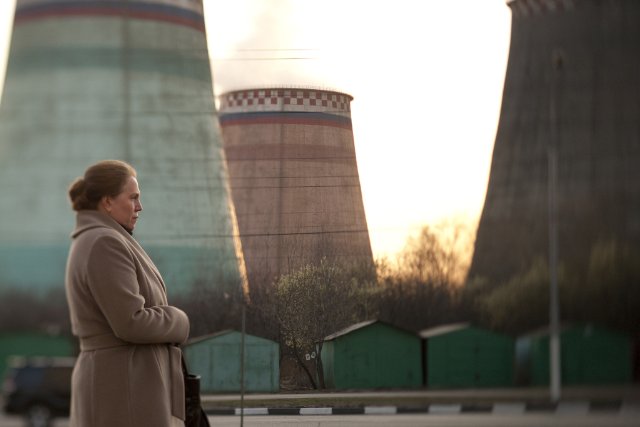
Nadezhda Markina gives a marvelously understated performance in Andrey Zvyagintsev’s ELENA
ELENA (Andrey Zvyagintsev, 2011)
Film Forum
209 West Houston St.
May 16-29
212-727-8110
www.filmforum.org
www.zeitgeistfilms.com
 Winner of a Special Jury Prize in the Un Certain Regard section of the 2011 Cannes Film Festival, Andrey Zvyagintsev’s Elena is a poignant character study and family drama set in Vladimir Putin’s post-Communist Russia. Nadezhda Markina gives a marvelously understated performance as Elena, a former nurse now married to her second husband, the successful and very direct Vladimir (Andrey Smirnov). Elena’s son from her first marriage, the unemployed Sergey (Alexey Rozin), is in need of money to support his wife, Tatyana (Evgenia Konushkina) and send his son, Sasha (Igor Ogurtsov), to university, but Vladimir is reconsidering helping them out, believing that it’s about time that Sergey got a job and took care of things himself. Vladimir’s hesitation extremely disappoints Elena, especially when Vladimir continues to support his daughter, Katerina (Elena Lyadova), a free spirit who barely acknowledges his existence. After Vladimir suffers a heart attack, Elena fears for her future and that of her family, suddenly facing some hard questions. Zvyagintsev has followed up the critical smash successes The Return and The Banishment with another superbly told tale that makes expert use of the tools of his trade, from the strong, assured script, which he cowrote with Oleg Negin, and the gorgeous cinematography by Mikhail Krichman to the solid acting and the haunting music. Elena is this generation’s Jeanne Dielman, a deliberate, methodical woman who finds herself caught up in a complex situation with no easy way out. The slow pace of the film, which is filled with lingering shots and Philip Glass’s modern-noir score (from 1995’s Symphony No. 3), moves intoxicatingly to the beat of Elena’s heart. Zvyagintsev, who was just celebrated at BAM with a three-day “Next Director” retrospective, will be at Film Forum for a discussion following the 8:00 screening on May 16.
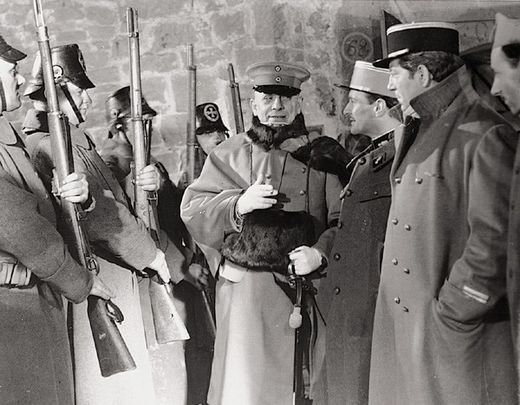
 If you’ve never seen this remarkable cinematic achievement, prepare to be overwhelmed by Jean Renoir’s antiwar masterpiece, screening through May 24 at Film Forum in an all-new 35mm restored print in honor of the film’s seventy-fifth anniversary. The first foreign film to be nominated for a Best Picture Oscar, Grand Illusion is set in a POW camp during WWI, where everyman pilot Lieutenant Maréchal (Jean Gabin), by-the-book Captain de Boieldieu (Pierre Fresnay), lovable Rosenthal (Marcel Dalio), and others are being held by the aristocratic Captain von Rauffenstein (an unforgettable Erich von Stroheim). Proclaimed “cinematic public enemy no. 1” by Joseph Goebbels, Grand Illusion takes on anti-Semitism, class structure, and religion in addition to war, a humanist film that is as relevant as ever seventy-five years after its initial release. Illustrator Paul Davis will be at Film Forum on May 15 following the 7:45 show to sign copies of his specially created poster celebrating the anniversary.

 Photographer Edward Burtynsky has been traveling the world with his large-format viewfinder camera, taking remarkable photographs of environmental landscapes undergoing industrial change. For Manufactured Landscapes, cinematographer Peter Mettler and director Jennifer Baichwal joined Burtynsky on his journey as he documented ships being broken down in Chittagong, Bangladesh; the controversial development of the Three Gorges Dam Project in China, which displaced more than a million people; the uniformity at a factory in Cankun that makes irons and the Deda Chicken Processing Plant in Dehui City; as well as various mines and quarries. Burtynsky’s photos, which were on view at the Brooklyn Museum in late 2005 and often can be seen in Chelsea galleries, are filled with gorgeous colors and a horrible sadness at the lack of humanity they portray. As in the exhibit, the audience is not hit over the head with facts and figures and environmental rhetoric; instead, the pictures pretty much speak for themselves, although Burtynsky does give some limited narration. Baichwal lets the camera linger on its subject, as in the remarkable opening shot, a long, slow pan across a seemingly endless factory. She is also able to get inside the photographs, making them appear to be three-dimensional as she slowly pulls away. Manufactured Landscapes is screening May 11 at the Maysles Cinema as part of the Beyond the Image series, which examines how photography is used in documentary film, and will be followed by a Skype Q&A with Baichwal, moderated by photographer Katie Murray. Curated by Clara Bastid, Maira Nolasco, and Zack Taylor, the series continues May 12 with Cheryl Dunn’s Everybody Street and Albert Maysles and Bradley Kaplan’s Close Up: Photographers at Work, followed by a reception and panel discussion with Maysles, Dunn, and photographers Ricky Powell and Clayton Patterson, moderated by Taylor, and May 13 with Christian Frei’s War Photographer, followed by a Q&A with Nolasco and journalist Jimmie Briggs.