Fernando Bezerra gives a mesmerizing performance as an innocent bystander in his own life in Eryk Rocha’s TRANSEUNTE
TRANSEUNTE (PASSER-BY) (Eryk Rocha, 2010)
MoMA Film, Museum of Modern Art
11 West 53rd St. between Fifth & Sixth Aves.
Saturday, July 14, 8:00, and Friday, July 20, 7:00
Series runs July 12-24
Tickets: $12, in person only, may be applied to museum admission within thirty days, same-day screenings free with museum admission, available at Film and Media Desk beginning at 9:30 am
212-708-9400
www.moma.org
 Brazilian filmmaker Eryk Rocha’s feature narrative debut, Transeunte (Passerby), is a beautifully poetic, lyrical examination of loneliness and connection. Fernando Bezerra gives a brilliant performance as Expedito, a sixty-five-year-old man who spends his days in Rio de Janeiro walking the streets and riding buses as he puts flowers on his mother’s grave, picks up his benefits check, takes a nap on his couch, goes to the doctor, listens to his old-fashioned transistor radio, and stops by a bar for a few drinks. A simple man who seems to be content in his small life, Expedito is an innocent bystander in the world; Rocha often cuts to extreme close-ups of Expedito’s eyes as the character watches and listens to other people singing, dancing, preaching, celebrating a birthday, and just having regular conversations as he takes it all in from a distance. He rarely even speaks, saying only what is absolutely necessary as he goes about his daily business. Yet he does all this with a quiet confidence, his deeply chiseled face, rigid brow, and slow gait (in opposition to his name) revealing him to be a simple man with simple pleasures instead of a sad, lonely man leading a nowhere life. Rocha, who has made such documentaries as Rocha que Voa and Pachamama and has also been an editor, actor, composer, and cinematographer (though still only in his thirties), uses that varied background to create a mesmerizing tale that mixes fiction and reality, set to a lively score and shot in a lush black-and-white, recalling such seminal films as Charles Burnett’s Killer of Sheep and Lionel Rogosin’s On the Bowery. A magical cinematic experience, TRANSEUNTE is screening July 14 at 8:00 and July 20 at 7:00 as part of MoMA’s annual Premiere Brazil! series, with Rocha on hand to talk about the film on July 14. The festival runs through July 24 with such other works as Breno Silveira’s À Beira do Caminho (Roadside), Vicente Amorim’s Corações Sujos (Dirty Hearts), Kiko Goifman and Claudia Priscilla’s Olhe pra Mim de Novo (Look at Me Again), and Selton Mello’s O Palhaço (The Clown).
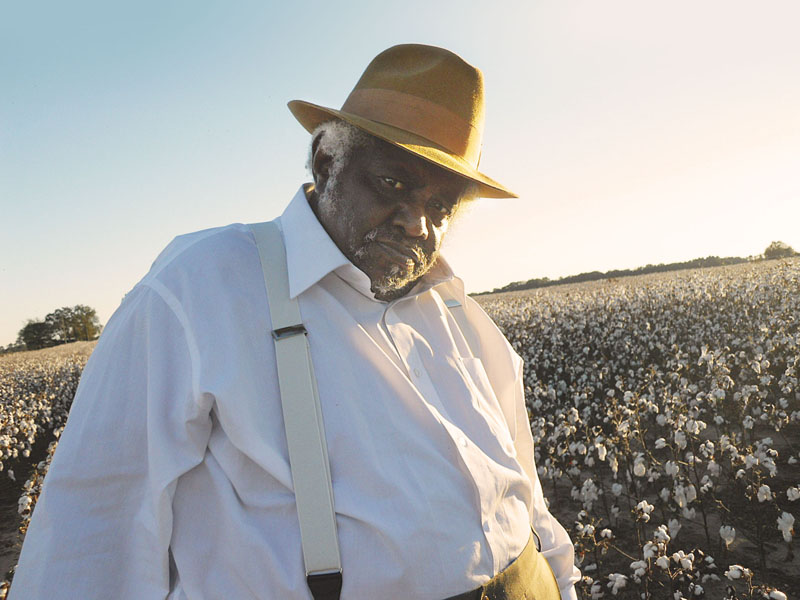
 Born in 1945 in rural Georgia to a mother who abandoned him when he was three months old, Winfred Rembert grew up picking cotton, dropped out of high school, spent time in jail and on a chain gang, and lost nearly all his teeth. But it was his years behind bars that turned him into a new man, as he learned to read and write and developed a unique art style that soon had him carving out the tales of his life on leather. Longtime journalist, producer, and writer Vivian Ducat tells Rembert’s amazing story in her engaging feature-length debut, All Me: The Life and Times of Winfred Rembert. Ducat follows the oversized Rembert, who regularly bubbles over with joy, as he returns for a show in Cuthbert, Georgia, and prepares for a big opening in New York City. “I know he’s here for a reason,” his sister Lorraine says in the film. “To help people and to be a witness through his art.” Throughout All Me, Rembert discusses many of his works, in which he uses indelible dyes on carved leather, in great detail, each one representing a part of his life, focusing on being a poor black man in a white-dominated society. It is quite poignant late in the film when he points out that his art seems to be most appreciated by whites even though it is meant as a visual history for blacks. But what really makes the documentary work is not just that Rembert is such an enigmatic, larger-than-life figure but that his art is exceptional, his self-taught, folksy style reminiscent of such forebears as Romare Bearden and Jacob Lawrence, capturing a deeply personal, intensely intimate part of the black experience in twentieth-century America. The film was previously shown at the Maysles Institute this past January, but it’s now back for a return engagement July 11, with Rembert and Ducat participating in a Q&A following the screening of this extraordinary story.
 A soap-opera melodrama that morphs into an erotic thriller, Secret Love tells the intense story of a complex and dangerous love triangle in modern-day Korea. Shortly after a whirlwind courtship, Yeon’s (Yoon Jin-seo) new husband, Jin-woo (Yoo Ji-tae), lapses into a coma that he might never awake from. Yeon is soon shocked to meet Jin-woo’s twin brother, Jin-ho (also played by Yoo Ji-tae), who recently emerged from a coma himself. As Yeon and Jin-ho grow closer, their relationship threatens to go to the next level — but when Jin-woo suddenly and unexpectedly arises from his coma, the love triangle becomes overwhelmed by betrayal, uncontrollable passion, and mistaken identity. Directed by Kwon Ji-yeon and cowriter Ryoo Hoon-I (who penned the screenplay with Park Hyun-soo), Secret Love, which is also known as The Secret River, uses water as an underlying motif, with many scenes taking place over a river, in the shower or bath, or at an aquarium. Although it begins slowly and sappy, the film picks up speed as hidden passions explode and danger lurks at every twist and turn. Secret Love is screening for free July 10 at