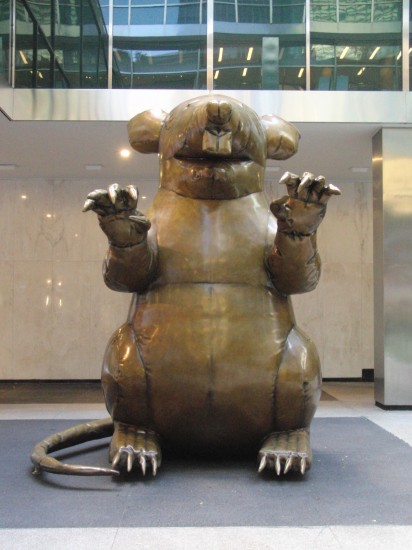
Bronze rat watches over Bruce High Quality Foundation installation in Lever House (photo by twi-ny/mdr)
Lever House
390 Park Ave. at 54th St.
Through October 1
Admission: free
www.leverhouseartcollection.com
When we were photographing the latest display in the Lever House lobby a few days before the official opening, a young man in a suit, seemingly on his way to lunch, stopped us and asked, “What is this?” When we told him it was an art installation by the Bruce High Quality Foundation, he just looked blankly around and said, “Is it finished?” We said that we thought it was probably pretty close to completion, if not done yet, and he sneered. “What the hell! I gotta walk through this every day?” And he stormed off, shaking his head. An arts collaborative formed eight years ago and named for a fictional character, Bruce High Quality, who supposedly died in the September 11 terrorist attacks, BHQF creates multimedia installations and performances that comment on the state of art, politics, and the world. Indeed, “Art History with Labor” at first appears unfinished, with working materials all around the lobby, including a bucket with a mop, a wheelbarrow with a bag of soil, a floor polisher, a ladder, a trash can, and other elements that make it look like a construction site. Meanwhile, outside in the plaza, a giant rat faces the gallery, growling, but instead of his being another blow-up Scabby the Rat seen at so many city construction sites that employ nonunion workers, this twelve-foot-high bronze casting is called “The New Colossus,” directly evoking the 1883 Emma Lazarus poem that is on a plaque within the Statue of Liberty (“‘Give me your tired, your poor, your huddled masses yearning to breathe free’”).
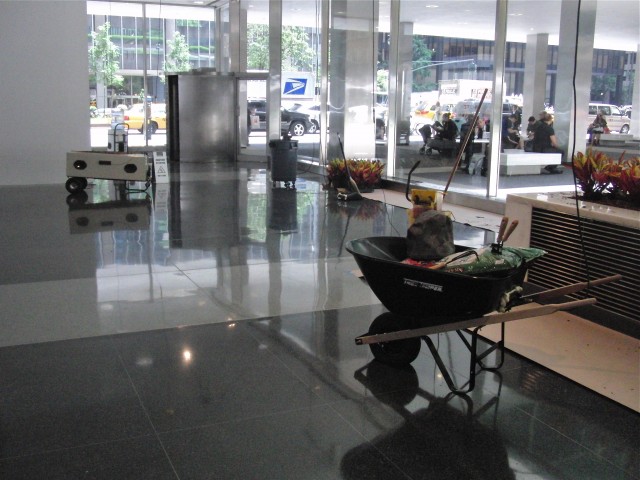
The Bruce High Quality Foundation reimagines Martin Luther’s 95 Theses for the modern age (photo by twi-ny/mdr)
But everything is part of the exhibition, along with a lone briefcase, an old watercooler, and a knocked-over filing cabinet spilling out printouts of “Art History with Labor: 95 Theses.” Free for the taking, the stapled-together four pages mimic Martin Luther’s 1517 document, a major force in the arrival of the Protestant Reformation, with quotes from Luther as well as Jean-Luc Godard, Roland Barthes, Andy Warhol, Bruce Nauman, Oscar Wilde, Jean-Paul Sartre, Jamie Dimon, Thomas Edison, and Sun Tzu in addition to facts about Ayn Rand, the Art Workers Guild, Auschwitz, Nikola Tesla, Paul Robeson, Iwo Jima, and the Lever Brothers, who built the company town Port Sunlight in 1888 for the men and women working in their soap factory. Each object in the lobby is equipped with a speaker pronouncing the theses, accompanied by a video, examining the nature of art and labor and how they have intertwined through the ages. The exhibit also includes “Double Iwo Jima,” a two-panel painting that raises questions about art, truth, propaganda, and labor by re-creating multiple images of Joe Rosenthal’s Pulitzer Prize-winning photograph. So, is the installation actually finished? One could argue that it’s only a start to further investigation on the part of the visitor. You can find out more about the Bruce High Quality Foundation and their unaccredited art university (a self-described “‘fuck you’ to the hegemony of critical solemnity and market-mediocre despair”) on Sunday, September 9, when they host an open house at their headquarters at 34 Ave. A, and there will be a closing reception for “Art History with Labor” at Lever House on October 1.
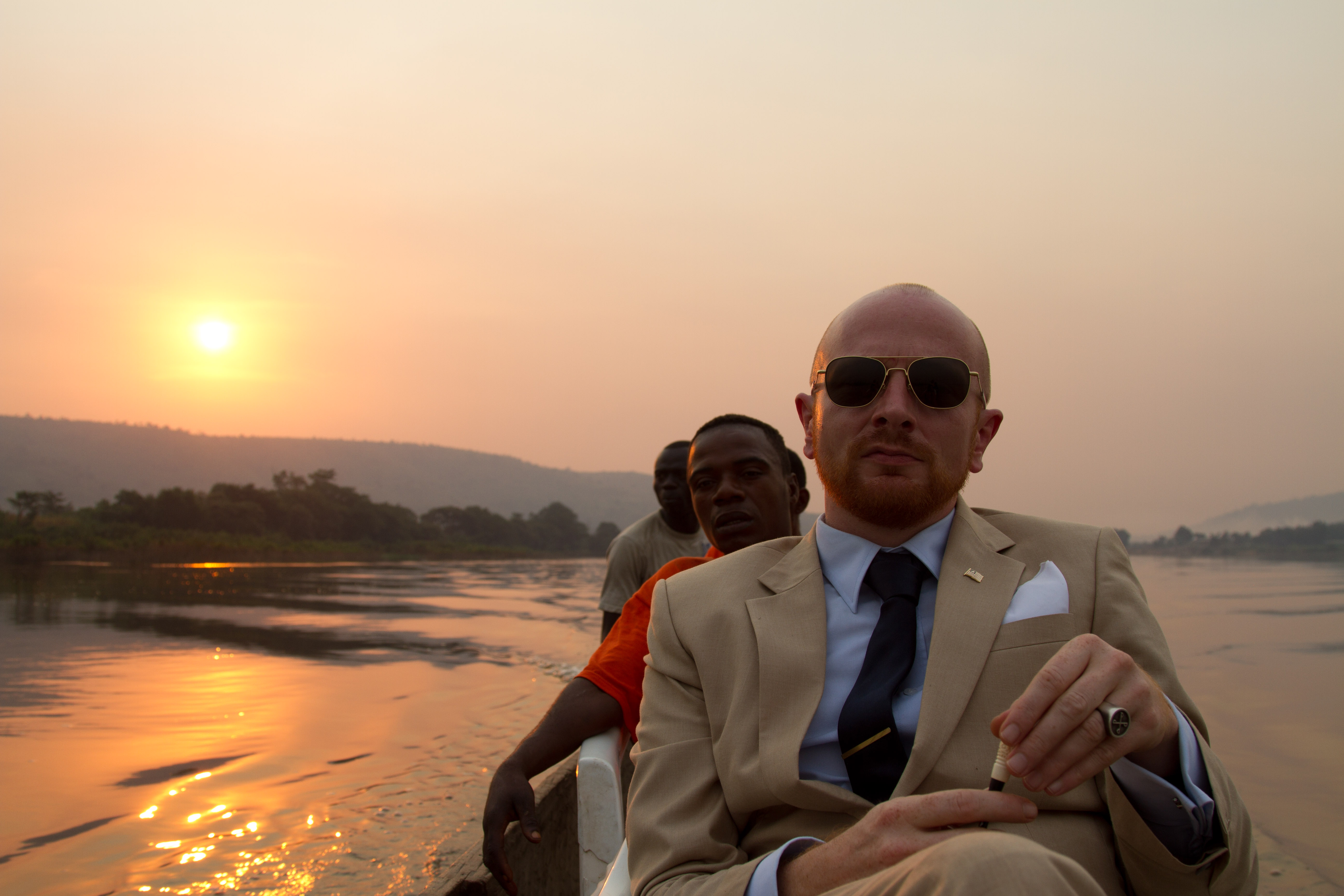
 Danish journalist Mads Brügger risked a lot more than just his career in making The Ambassador; he put his life on the line as well. “If you do it the way we will set you up to do it, you have a very high probability of success,” he is told by Colin Evans, who works for a company that can allegedly make anyone a diplomat of a diamond-rich African nation for the right price. “If you do it any other way, the best that you can hope for is to be arrested and go to jail and lose everything you’ve got. That’s the best you can hope for. The worst you can hope for is that you end up dead in a ditch in Africa.” Using his full name, Mads Johan Brügger Cortzen seeks to become a Liberian diplomat to the Central African Republic, meeting with powerful, important, and dangerous people on his fascinating journey, handing out “envelopes of happiness” filled with cash while claiming to want to build a match factory with the help of native pygmies. As Brügger’s story gets more and more ridiculous, he gains greater access, with soon only President Ellen Johnson Sirleaf’s signature necessary to achieve his absurd goal. An intriguing mix of Sacha Baron Cohen’s Borat and Ali G characters and controversial filmmaker and activist Michael Moore, Brügger, whose previous film, The Red Chapel, found him leading a bizarre experimental theater troupe into North Korea, goes about his business with a sly confidence, balancing the serious nature of the proceedings with humorous moments that threaten to reveal his ruse, but nobody seems to catch on as the money keeps flowing. (The film was financed by Lars Von Trier’s Zentropa studio.) Primarily using hidden cameras that he keeps rolling even after being told that filming is not allowed, Brügger employs his unique brand of what he calls “performative journalism,” a blend of performance art and investigative journalism that results in an outrageously entertaining film that exposes surprisingly blatant international corruption and has led to a firestorm of debate. The film opens August 29 at the IFC Center, with Brügger on hand for a Q&A following the 8:20 screenings on August 29 and 30.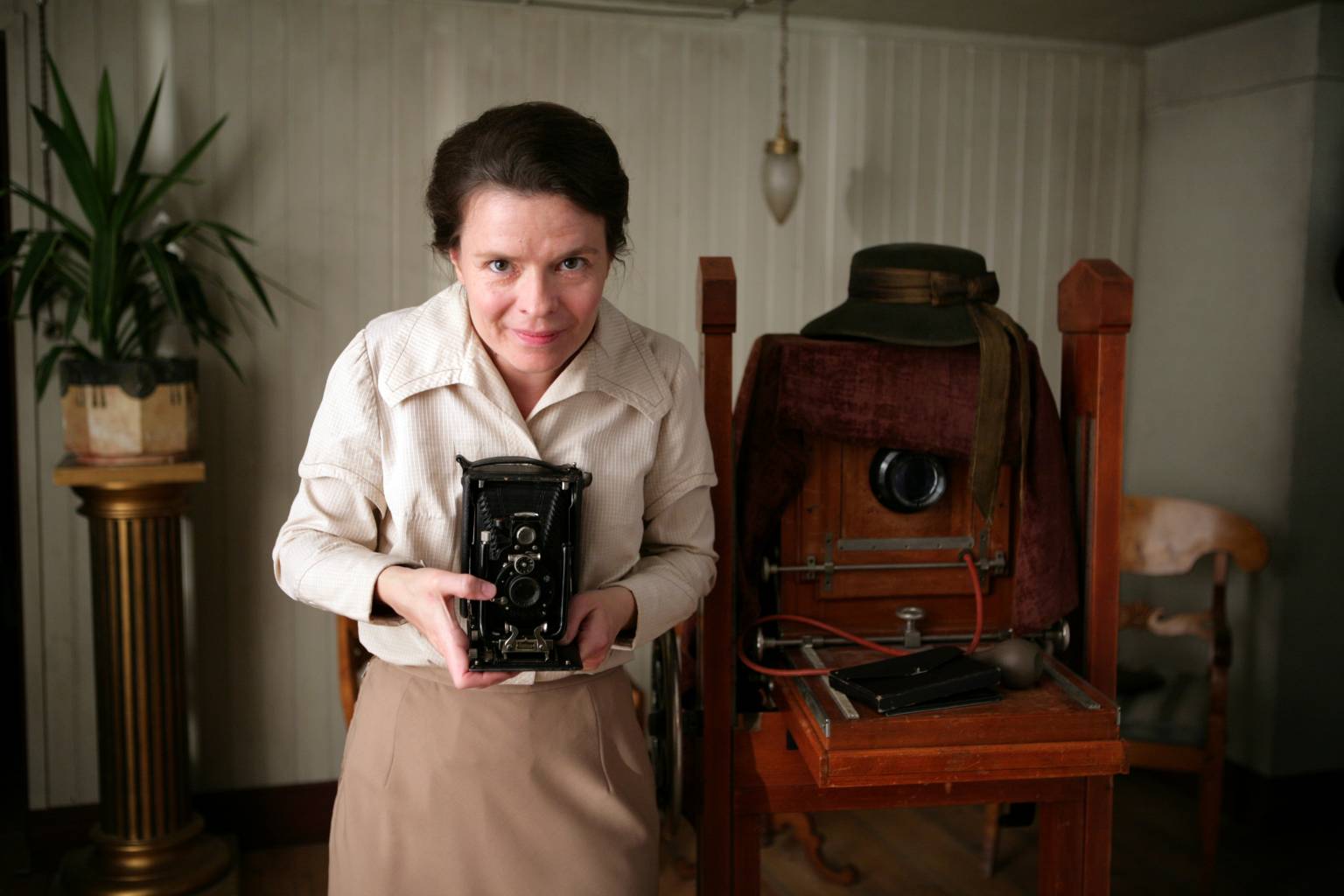
 Inspired by a book written by his wife, Agneta Ulfsäter-Troell, based on part of her family history, Jan Troell’s Everlasting Moments captures a pivotal time of change in Sweden. In a small town in 1907, Maria Larsson (Maria Heiskanen) is struggling to keep her growing family together as her brutish oaf of a husband, Sigge (Mikael Persbrandt), regularly comes home drunk, cheats on her, and goes on strike with the rest of the local dockworkers. Maria scrubs floors and sews for extra money, but she dreams of her own independence and freedom. When she enters Mr. Pedersen’s (Jesper Christensen) photography studio one day, she has every intention of selling a camera that she had won in a lottery years before. But Pedersen instead convinces her to try out the camera first, and she is soon documenting the world around her. As Sigge becomes more and more ornery — and more and more dangerous, threatening the future of the family — Maria has discovered a whole new way of looking at things, both literally and figuratively, but still needs to find the inner strength to improve her lot. Seen through the eyes of eldest daughter Maja (first played by Nellie Almgren, then by Callin Öhrvall), Everlasting Moments is a beautiful, bittersweet personal tale told by one of Sweden’s greatest filmmakers. In his late seventies at the time, director Troell (The Emigrants, Hamsun) also cowrote the script with his wife and Niklas Rådström and served as cinematographer with Mischa Gavrjusjov; the film was nominated for a Golden Globe and won five Guldbagge (Golden Beetle) Awards from the Swedish Film Institute, including Best Film, Best Actor, Best Actress, Best Supporting Actor, and Special Achievement (composer Matti Bye). Everlasting Moments is screening August 24 at 9:30 as part of the Rubin Museum series “Women and Their Cameras,” in conjunction with the exhibition “Candid,” and will be introduced by photographer Victoria Sambunaris. Admission to the Rubin is free on Friday nights, so you should also check out such other exhibitions as “Illuminated,” “Modernist Art from India,” and the outstanding “Casting the Divine.” The series concludes August 31 with Philip Kaufman’s The Unbearable Lightness of Being, introduced by Sophie Elgort.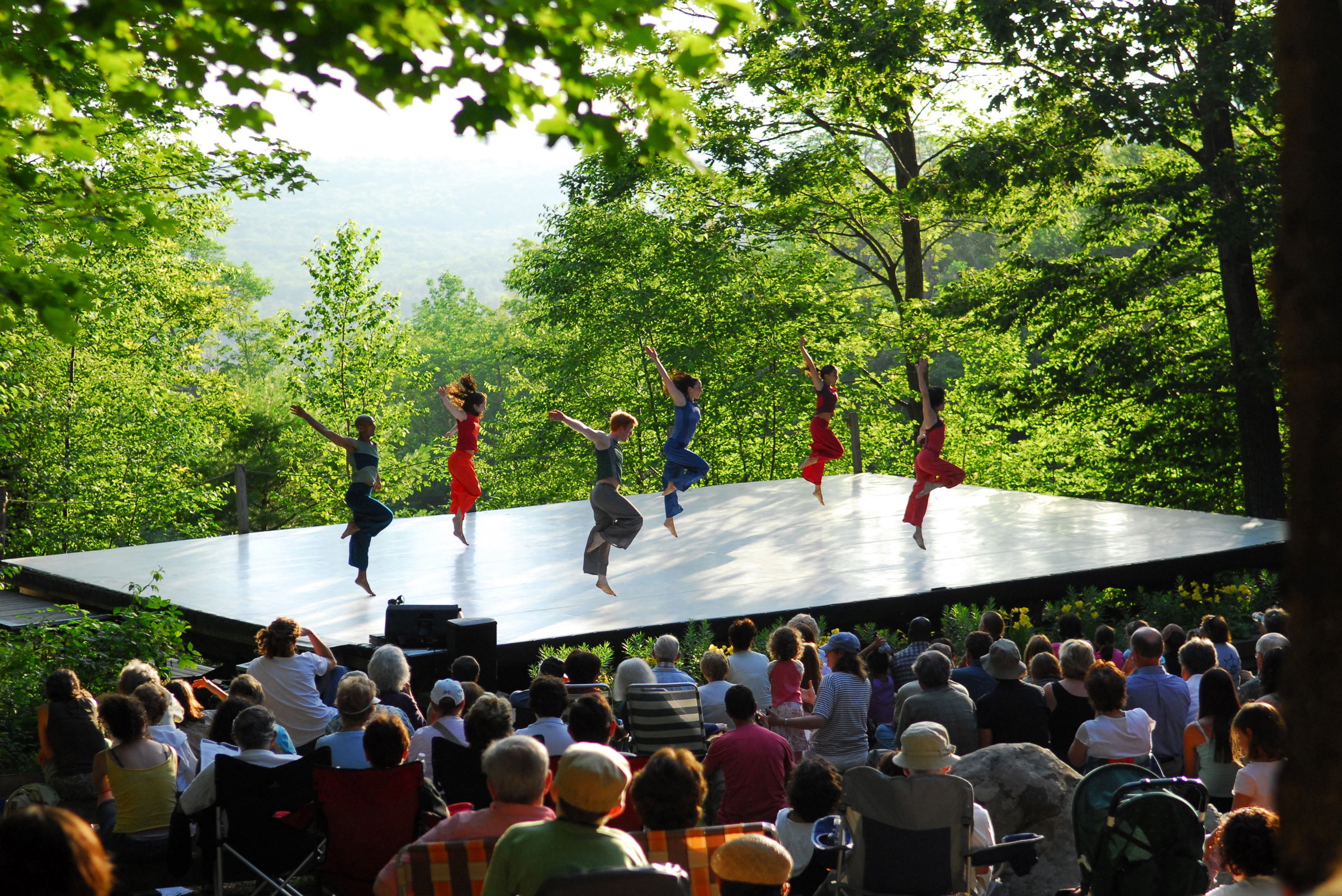
 In conjunction with the eightieth anniversary of the Jacob’s Pillow Dance Festival, Ron Honsa has made Never Stand Still, a documentary that celebrates the long history of the national historic landmark dedicated to the art of movement. Narrated by