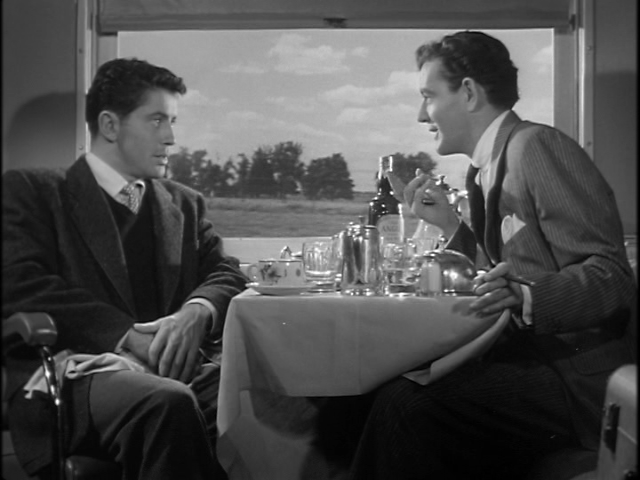
Opposites attract in strange ways in Hitchcock classic STRANGERS ON A TRAIN
CABARET CINEMA: STRANGERS ON A TRAIN (Alfred Hitchcock, 1951)
Rubin Museum of Art
150 West 17th St. at Seventh Ave.
Friday, September 28, free with $7 bar minimum, 9:30
212-620-5000
www.rmanyc.org
 The Rubin Museum’s Cabaret Cinema series “Happiness Is . . .” continues with one of Alfred Hitchcock’s most multilayered, complex tales, the 1951 psychological double-murder thriller Strangers on a Train. Shortly after introducing himself to amateur tennis star Guy Haines (Farley Granger) on a train, mama’s boy Bruno Anthony (an appropriately creepy Robert Walker) concocts a supposedly foolproof plan in which Bruno will kill Guy’s unfaithful wife, Miriam (Laura Elliott), so Guy can marry his socialite girlfriend, Anne Morton (Ruth Roman), one of the daughters of a U.S. senator (Leo G. Carroll). In return, Guy will kill Bruno’s father (Jonathan Hale). Bruno believes he has devised the perfect crisscross murder, with neither man having a clear motive and nothing for the cops to find to link them together. While Bruno is serious, Guy thinks he’s just a loon (Walker had in fact been recently released from a psychiatric clinic after suffering a nervous breakdown and died at the age of thirty-two before the film even opened), but after the psychopathic Bruno actually does kill Miriam — photographed in an unforgettable way by cinematographer Robert Burks, shown in a pair of broken eyeglasses — he starts shadowing Guy, insisting he keep his part of the bargain and kill Mr. Anthony, something Guy never intended on doing. Soon the cops are involved, along with a broken alibi, a key, and a critical cigarette lighter, leading to a spectacular conclusion on a merry-go-round. Loosely based on Patricia Highsmith’s debut novel and featuring an early screenplay written by Raymond Chandler (whose name was kept in the credits for marquee value despite Hitchcock’s famous — and literal — trashing of his contribution), Strangers on a Train is a powerful, tense mystery built around the idea of the double; from the opening scene of two pairs of shoes — immediately equating, and differentiating between, the two protagonists, as if they were two parts of the same person — to Hitchcock’s appearance carrying a double bass, to Anne’s younger sister, Babs (Patricia Hitchcock, Alfred’s daughter), wearing the same glasses as Miriam, to Bruno’s declaration, upon ordering two double scotches and relating them to tennis, “The only kind of doubles I play,” the film is filled with mirroring or directly opposing elements. As with Hitchcock’s Rope, which also starred Granger, Strangers on a Train also has a clear homosexual subtext; in real life Walker was straight while Granger was bisexual. Shot in a dark black-and-white that adds to the chilling effects, Strangers on a Train is one of Hitchcock’s best, a fully realized, frightening film that ends in a big way. The Rubin Museum screening on September 29 will be introduced by chef and musician Molly Neuman. “All in all,” Granger wrote in his 2007 autobiography, Include Me Out: My Life from Goldwyn to Broadway, “working on Strangers on a Train was my happiest filmmaking experience,” giving it extra reason to be included in this series that looks at different kinds of happiness in the movies.



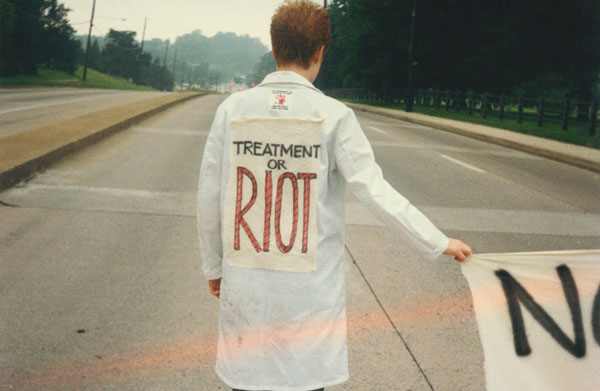
 Contemporary activists stand to learn a lot from the gripping documentary How to Survive a Plague. For his directorial debut, longtime journalist David France, one of the first reporters to cover the AIDS crisis that began in the early 1980s, scoured through more than seven hundred hours of mostly never-before-seen archival footage and home movies of protests, meetings, public actions, and other elements of the concerted effort to get politicians and the pharmaceutical industry to recognize the growing health epidemic and do something as the death toll quickly rose into the millions. Focusing on radical groups ACT UP and TAG (Treatment Action Group), France follows such activist leaders as Peter Staley, Mark Harrington, Larry Kramer, Bob Rafsky, and Dr. Iris Long as they attack the policies of President George H. W. Bush, famously heckle presidential candidate Bill Clinton, and battle to get drug companies to create affordable, effective AIDS medicine, all while continuing to bury loved ones in both public and private ceremonies. France includes new interviews with many key activists who reveal surprising details about the movement, providing a sort of fight-the-power primer about how to get things done. The film also shines a light on lesser-known heroes, several filled with anger and rage, others much calmer, who fought through tremendous adversity to make a difference and ultimately save millions of lives. France will be at the IFC Center to talk about How to Survive a Plague at numerous screenings on Friday, Saturday, and Sunday of opening weekend.