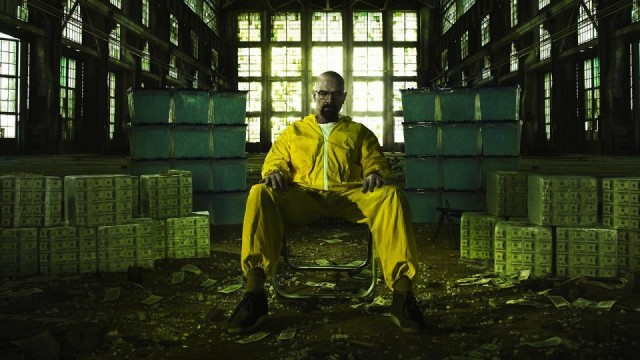
Bryan Cranston and BREAKING BAD break out all over the place in anticipation of the final eight episodes of the daring hit season
LONG COOK: A BREAKING BAD MARATHON
Film Society of Lincoln Center
Elinor Bunin Munroe Film Center
144 West 65th St. between Broadway & Amsterdam Aves.
July 26 -30, free, 1:00 or 5:00
212-875-5600
www.filmlinc.com
www.amctv.com
According to a February 2013 MarketCast study on binge TV watching, fifty-six percent of bingers do it alone, seventy-one percent do it unplanned, and ninety-eight percent do it at home. All three of those will change July 26-30, when the Film Society of Lincoln Center presents “Long Cook: A Breaking Bad Marathon,” with each of the first five seasons of the AMC show screened in their entirety, one per day. “There is a sort of dark side to binge-viewing that makes many of us want to do it by ourselves and away from public scrutiny,” said senior director and study author Chris Rethore. “As with bingeing on anything — food, sweets, alcohol — there are often feelings of guilt that result and a sense that we’ve done something wrong or bad after we have indulged.” Breaking Bad offers a completely different take on what’s wrong or bad and feeling of guilt, as mild-mannered chemistry teacher Walter White (Bryan Cranston) goes into business with former student Jesse Pinkman (Aaron Paul), cooking up amazing batches of crystal meth so Walter, who is dying of cancer, can leave behind some money for his wife, Skyler (Anna Gunn), and son, Walter Jr. (RJ Mitte). But soon Walter and Jesse find themselves in the middle of all kinds of danger as they mix it up with drug kingpin and chicken purveyor Gus Fring (Giancarlo Esposito), hit man and cleaner extraordinaire Mike Ehrmantraut (Jonathan Banks), sleazy lawyer Saul Goodman (Bob Odenkirk), and other sketchy characters, all while Skyler’s brother-in-law, DEA agent Hank Schrader (Dean Norris), is trying to uncover who is behind the new strand of meth — and the impressive string of related deaths and disappearances. Created by Vince Gilligan, Breaking Bad was rejected by just about every network before landing at AMC, which used to concentrate primarily on American Movie Classics but not also is responsible for Mad Men. It’s absolutely fascinating watching Bryan Cranston transform Walter from a sort of everyman into a cold-blooded — well, we don’t want to give anything away, but it’s an epic tale of family, morality, obsession, power, and addiction, and it’s surprisingly believable as each season takes things to new levels. The screenings take place in the Elinor Bunin Monroe Film Center amphitheater, and admission is free, first come, first served. The final eight episodes begin airing on AMC on August 11.
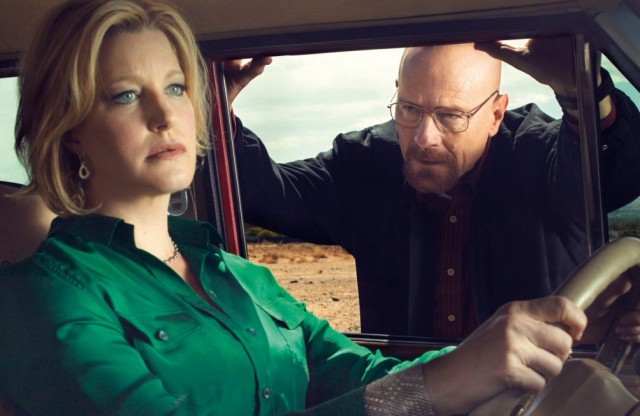
Skyler (Anna Gunn) can only take so much from her husband (Bryan Cranston) as things heat up in BREAKING BAD
THE PERFECT BATCH: BREAKING BAD CAST FAVORITES
Film Society of Lincoln Center
Walter Reade Theater
165 West 65th St. between Broadway & Amsterdam Aves.
August 1-2, $15, 6:15 & 9:00
212-875-5600
www.filmlinc.com
Once the Lincoln Center amphitheater marathon ends, the festivities move into the Walter Reade Theater, where four panels will be held August 1-2, as some of the stars of the show present their favorite episodes and then discuss them. On August 1 at 6:15, Gunn, Mitte, and Odenkirk will show two episodes, then sit down for a Q&A with Matt Zoller Seitz of New York magazine, followed at 9:00 with Cranston, who has directed several episodes, showing two more and then talking with Zoller Seitz. August 2 at 6:15 features Betsy Brandt (who plays Skyler’s sister and Hank’s wife, Maria Schrader) and Norris, who will discuss their favorite episodes with Emily Nussbaum of the New Yorker, followed at 9:00 with Gilligan and Nussbaum getting down to the nitty-gritty. If you can’t make it to the theater, the Q&As will be streamed live at www.filmlinc.com.
Pink teddy bear will be among the BREAKING BAD items on view in special exhibit
BEHIND THE SCREEN — FROM MR. CHIPS TO SCARFACE: WALTER WHITE’S TRANSFORMATION IN BREAKING BAD
Museum of the Moving Image
36-01 35th Ave.
July 26 – October 27, Wednesday – Sunday, $12 (free Fridays 4:00 – 8:00)
718-777-6888
www.movingimage.us
Gilligan will also be at the Museum of the Moving Image on July 28 at 7:00, where he will take part in a “Making Bad” conversation with Charlie Rose in conjunction with the institution’s new exhibit, “From Mr. Chips to Scarface: Walter White’s Transformation in Breaking Bad.” Opening July 26 in the “Actors” section of the core “Behind the Screen” installation, the exhibit will feature costumes, props, behind-the-scenes footage, and other paraphernalia from the series, which has been nominated for twenty-one Emmys and has won five so far, including three Outstanding Lead Actor in a Drama Series victories for Cranston and two Supporting wins for Paul, who was supposed to be gone early in the run but whose character quickly turned into a mainstay. Be on the lookout for Walter’s tighty whities, hazmat suits, aprons, the pink teddy bear, hair strands, a copy of Walt Whitman’s Leaves of Grass, and other familiar items. The exhibit continues through October 27.



 Back in 2000, documentarian Nina Davenport made Always a Bridesmaid, in which she shared her views on being single and nearly thirty as she worked as a wedding videographer. A dozen years later, in the deeply personal First Comes Love, she turns the camera on her private life once again as she contemplates being single, childless, and forty-one — and takes matters into her own hands, deciding to have a baby on her own. With her best friend, Amy, by her side and her college friend, Eric, agreeing to be the sperm donor, Nina details every critical moment and more as she goes on this intimate journey, opening up her life for all to see. She discusses things with her family, particularly her adoring mother and her distant, hard-to-please father, as well as other relatives and friends, who give their opinions on whether they think it’s a good idea. Several of her acquaintances have also either recently had a baby on their own or are considering it as well, revealing the changing patterns of the American family in the twenty-first century, especially in New York City. Serving as writer, director, producer, editor, cinematographer, and principal subject, Davenport, in the style of one of her Harvard mentors, Ross McElwee (Sherman’s March), holds nothing back, which at times becomes overly self-indulgent and a bit much to take, but the combination of her eagerness and her fears, along with her willingness to show it all, ultimately makes First Comes Love the most human of stories. The film is running July 24-30 at the IFC Center, with Davenport participating in Q&As following the 7:35 screenings on July 24 and 25; it also premieres on HBO on July 29.
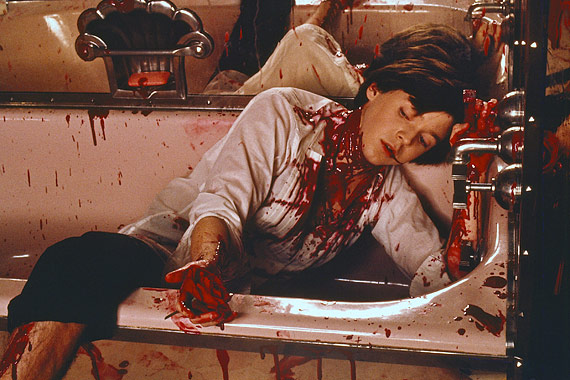
 Bud Cort (Harold) and Ruth Gordon (Maude) are magnificent in this glorious black comedy from director Hal Ashby (The Last Detail, Shampoo, Being There) and writer Colin Higgins (Foul Play, 9 to 5). Harold is an eighteen-year-old rich kid obsessed with death, regularly flirting with suicide. Maude is a fun-loving, free-spirited senior citizen approaching her eightieth birthday. Ashby throws in just the right amount of post-1960s social commentary, including a very funny antiwar scene, without becoming overbearing, as this could have been a maudlin piece of sentimental claptrap, but instead it’s far from it. Even the Cat Stevens soundtrack (“If You Want to Sing Out, Sing Out,” “Tea for the Tillerman,” “Where Do the Children Play?”) works. Harold and Maude is a tender, uproarious, bittersweet tale that is one of the best of its kind, completely unforgettable, enlightening, and, ultimately, life-affirming in its own odd way. Harold and Maude is screening in a DCP projection July 22 at 8:00 as part of the IFC Center series “Queer/Art/Film” and will be followed by a discussion with Chilean multidisciplinary artist, musician, and director Sebastián Silva (Crystal Fairy, Iwannawin & Friends). The monthly series, which consists of films selected by gay New York City artists, concludes August 19 with Stephen Frears’s My Beautiful Laundrette, picked by Brooklyn-born visual artist Chitra Ganesh.
 Joshua Oppenheimer’s The Act of Killing is one of the most disturbing, and unusual, films ever made about genocide. In 1965-66, as many as a million supposed communists and enemies of the state were killed in the aftermath of a military coup in Indonesia. Nearly fifty years later, many of the murderers are still living in the very neighborhoods where they committed the atrocities, openly boasting about what they did, being celebrated on television talk shows, and even being asked to run for public office. While making The Globalization Tapes in Indonesia in 2004, the Texas-born Oppenheimer met some of these self-described gangsters and, struck by their brash, bold attitudes, decided to create a different kind of documentary. In addition to following them around as they go bowling, play golf, sing, and dance, proudly showing off how happy their lives are, Oppenheimer offered them the opportunity to tell their story as if it were a Hollywood movie. The men, whose love of American noir and Westerns heavily influenced the stylized killings they perpetrated, loved the idea and began to restage torture and murder scenes in great detail for the camera, getting in period costumes, putting on makeup, going over script details, reviewing the dailies, and playing both the violent criminals and their victims. The leader is master executioner Anwar Congo, who is perhaps the only one haunted by his deeds; although on the surface he is proud of what he did, he is tormented by constant nightmares. Such is not the case for the others, who laugh as they go over the gory details, especially paramilitary leader Herman Koto, Congo’s protégé and a man seemingly without a conscience. Meanwhile, fellow executioner Adi Zulkadry wonders whether telling the truth will actually negatively impact their legendary status. “Human rights! All this talk about ‘human rights’ pisses me off,” Congo says in one scene. “Back then there was no human rights.” Oppenheimer also depicts how frighteningly powerful the three-million-strong, government-connected Pancasila Youth is, ready to fight for the very same things that led to the genocide in the first place. It’s hard to comprehend how these men continue to walk free, and one can argue whether Oppenheimer should indeed be giving them the platform that he does. Watching these gangsters — or “free men,” as they like to call themselves, since the Indonesian word for gangster is “preman,” derived from the Dutch “vrijman” — artistically re-create scenes of horrific violence is both illuminating and infuriating on multiple levels that will leave viewers angry and incredulous. After playing at last month’s Human Rights Watch Film Festival, The Act of Killing opens July 19 at the Landmark Sunshine Cinema, with Oppenheimer on hand to discuss the film at the 7:30 and 10:30 screenings on July 19 and the 4:50, 7:30, and 10:30 shows on July 20.