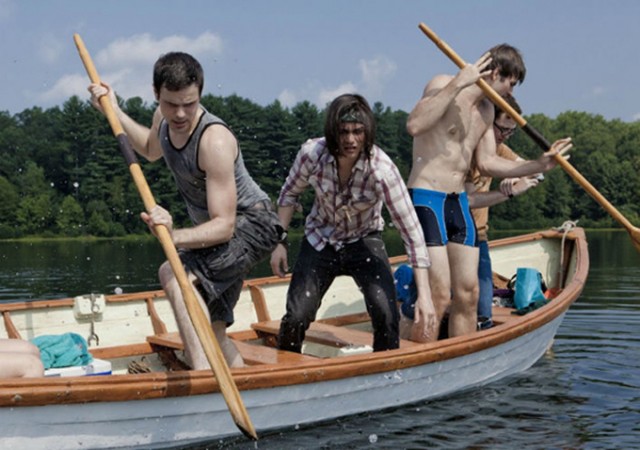
A group of teenagers are going to need a much bigger boat in Larry Fessenden’s tense thriller BENEATH
BENEATH (Larry Fessenden, 2013)
IndieScreen, 2899 Kent Ave. at South Second St., 347-227-8030, July 16, 19, 20, 9:00
IFC Center, 323 Sixth Ave. at West Third St., 212-924-7771, opens Wednesday, July 17
www.beneaththewater.com
 Jaws and Friday the 13th meet Lifeboat and Lord of the Flies in indie filmmaker Larry Fessenden’s latest thriller, Beneath. Made for Syfy’s Chiller TV channel, where it will be available on demand beginning July 16 — it is also being released theatrically in New York City this week — Beneath is the first feature film Fessenden (The Last Winter, Habit, Wendigo) has directed but did not write; the occasional actor and musician also served as producer and editor, while the script is by Tony Daniel and Brian D. Smith. The story takes place on a Connecticut lake, where a group of teenagers have gone to celebrate high school graduation. Sexy blonde Kitty (Bonnie Dennison), athletic meathead brothers Matt (Chris Conroy) and Simon (Jonny Orsini), camera-obsessed nerd Zeke (Griffin Newman), demure brunette Deb (MacKenzie Rosman), and pouty townie Johnny (Daniel Zovatto) head out on a rowboat to cross the Black Lake, but they soon learn that they’re going to need a much bigger boat, as there’s something lurking in the water that prefers not to be disturbed. As the teens battle the evil, giant piranha/monkfish, deep, dark secrets float to the surface, leading the kids to fight amongst themselves as much as their mechanical tormentor. Fessenden clearly has fun playing with genre clichés, although there are still plenty of moments in which viewers will find themselves yelling at the screen because of stupid decisions or gigantic plot holes, but he does a good job given his restrictions — because this is essentially a basic-cable movie, there is no cursing or nudity, and the tense action has to have carefully timed pauses built in to allow for eventual commercials. Still, Beneath is an involving, claustrophobic tale in which the characters’ true individual natures emerge as their fear of death grows. To find out more about the history of the lake, a prequel comic book is available, written by Daniel and Smith and illustrated by Brahm Revel. Beneath opens July 17 at the IFC Center and will also be shown July 16, 19, and 20 at IndieScreen in Williamsburg, with Fessenden participating in a Q&A following the July 16 screening.
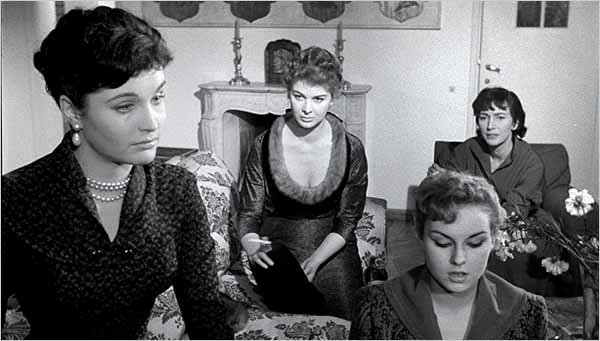
 Winner of the Silver Lion at the 1955 Venice Film Festival, Michelangelo Antonioni’s sublimely marvelous Le Amiche follows the life and loves of a group of oh-so-fabulous catty, chatty, and ultra-fashionable Italian women and the men they keep around for adornment. Returning to her native Turin after having lived in Rome for many years, Clelia (Eleonora Rossi Drago) discovers that the young woman in the hotel room next to hers, Rosetta (Madeleine Fischer), has attempted suicide, thrusting Clelia into the middle of a collection of self-centered girlfriends who make the shenanigans of George Cukor’s The Women look like child’s play. The leader of the vain, vapid vamps is Momina (Yvonne Furneaux), who carefully orchestrates situations to her liking, particularly when it comes to her husband and her various, ever-changing companions, primarily architect Cesare (Franco Fabrizi). As Rosetta falls for painter Lorenzo (Gabriele Ferzetti), who is married to ceramicist Nene (Valentina Cortese), Clelia considers a relationship with Cesare’s assistant, Carlo (Ettore Manni), and the flighty Mariella (Anna Maria Pancani) considers just about anyone. Based on the novella Tra Donne Sole (“Among Only Women”) by Cesare Pavese, Le Amiche is one of Antonioni’s best, and least well known, films, an intoxicating and thoroughly entertaining precursor to his early 1960s trilogy, L’Avventura, La Notte, and L’Eclisse. Skewering the not-very-discreet “charm” of the Italian bourgeoisie, Antonioni mixes razor-sharp dialogue with scenes of wonderful ennui, all shot in glorious black and white by Gianni Di Venanzo. Recently restored in 35mm, Le Amiche is a newly rediscovered treasure from one of cinema’s most iconoclastic auteurs. The film will have a special screening July 15 at 7:00 as part of Film Forum’s ongoing celebration of the fiftieth anniversary of the New York Review of Books and will be introduced by frequent NYRB contributor Luc Sante (Low Life, The Factory of Facts). The NYRB edition of The Selected Works of Cesare Pavese, which will be available at Film Forum, includes Among Only Women in addition to Pavese’s The Beach, The House on the Hill, and The Devil in the Hills.
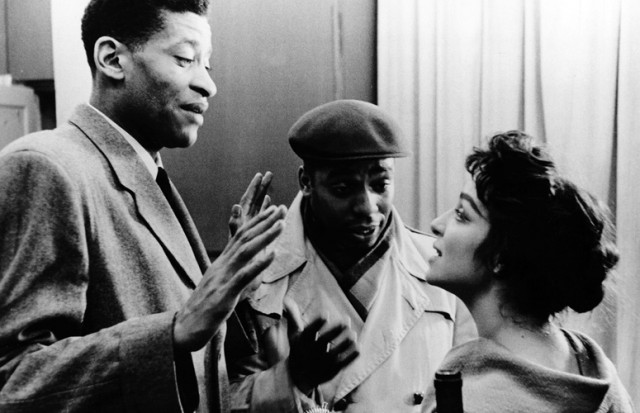
 John Cassavetes’s directorial debut, Shadows, is a landmark moment in the history of independent cinema and one of the most influential films ever made. Shot in black-and-white with a 16mm handheld camera on a modest budget of $40,000, much of which was raised following Cassavetes’s appearance on Jean Shepherd’s radio show — the credits include the line “Presented by Jean Shepherd’s Night People” — Shadows is a gritty, underground examination of race in New York City, one of the first major anti-Hollywood American movies. Although the script is credited to Cassavetes, the film is primarily improvised by a group of mostly nonprofessional or first-time actors using their real first names, set to a jazzy, moody score by Charles Mingus saxophonist Shafi Hadi. Lelia Goldoni stars as twenty-year-old Lelia, a confused young woman who loses her virginity to Tony (Anthony Ray), who thought it was a one-night stand but then decides they should start dating after she becomes clingy. However, Tony freaks out when he meets one of Lelia’s brothers, singer Hugh (Hugh Hurd), who is black. Meanwhile, their other brother, trumpeter Ben (Ben Carruthers), spends his nights with his two buddies, Dennis (Dennis Sallas) and Tom (Tom Reese), bumming money and trying to pick up chicks. Amid Bohemian parties, street fights, and visits to Central Park, Port Authority, Grand Central Terminal, and MoMA’s sculpture garden, Cassavetes and the cast explore life, love, and racism in realistic ways, even if some of the actors are a lot better than others and certain scenes fall flat. Gordon is particularly annoying through much of the film; the most interesting relationship exists between Hugh and his devoted agent, Rupert (Rupert Crosse, who spent the next thirteen years appearing in myriad television series). Look for Cassavetes in the scene in which a stranger harasses Lelia in Times Square. Shadows, which comes alive with the rhythm and energy of late 1950s New York, is being shown July 9 at 7:00 and 9:30 as part of the BAMcinématek series “Cassavetes”; the 7:00 screening will be followed by a Q&A with Goldoni, who appeared in only a few more films after Shadows (Alice Doesn’t Live Here Anymore, The Day of the Locust, the 1978 remake of Invasion of the Body Snatchers). The “Cassavetes” series runs July 6-31 with films that Cassavetes either directed and/or starred in, opening, appropriately enough, with Opening Night and continuing with such wide-ranging works as The Dirty Dozen, Edge of the City, The Killers, Machine Gun McCain, Faces, Husbands, Rosemary’s Baby, and Tempest.