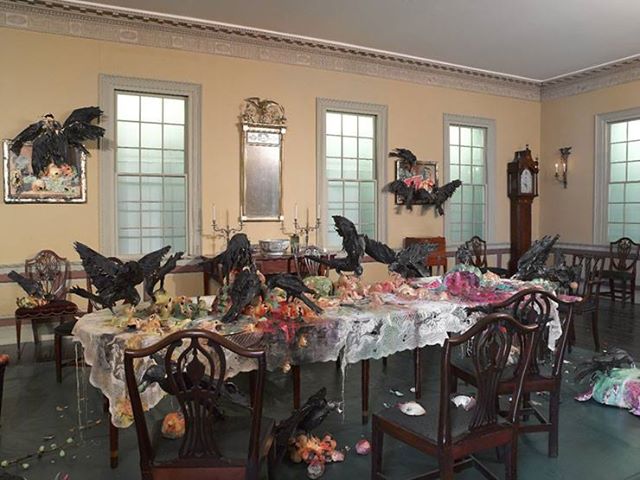
Valerie Hegarty, “Still Life with Peaches, Pear, Grapes and Crows”; “Still Life with Watermelon, Peaches and Crows”; and “Table Cloth with Fruit and Crows,” canvas, stretcher, paper, acrylic paint, foam, papier-mâché, wire, glue, gold foil, epoxy, fabric, thread, dimensions variable, in “Dining Room, Cane Acres Plantation, Summerville, South Carolina” (photo by Brooklyn Museum)
Brooklyn Museum
200 Eastern Parkway at Washington St.
Saturday, July 6, free, 5:00 – 11:00 (some events require free tickets distributed in advance at the Visitor Center)
212-864-5400
www.brooklynmuseum.org
For its free First Saturday program during the July 4 weekend, the Brooklyn Museum looks back at American history through dance, music, art, literature, and film. “Remixing the American Story” includes live performances by the Hungry March Band, Michael Hill’s Blues Mob, Frankie Rose, the Brown Bag All Stars, and the Redhawk Native American Arts Council, pop-up gallery talks, a dance workshop, a Forum Project discussion on current events, a poetry slam with the Nuyorican Poets Café, a photo booth, sketching of live models based on portraits in the “American Identities: A New Look” exhibition, and screenings of Michael and Timothy Rauch’s StoryCorps’ animated shorts, celebrating the tenth anniversary of the organization that is collecting an oral history of the country. In addition, artist Valerie Hegarty will give a talk about “Alternative Histories,” her fascinating interventions into three of the museum’s period rooms, which have been seemingly destroyed by a murder of crows. The galleries will remain open late so visitors can also check out “John Singer Sargent Watercolors,” “The Bruce High Quality Foundation: Ode to Joy,” “LaToya Ruby Frazier: A Haunted Capital,” “Käthe Kollwitz: Prints from the ‘War’ and ‘Death’ Portfolios,” “‘Workt by Hand’: Hidden Labor and Historical Quilts,” “Gravity and Grace: Monumental Works by El Anatsui,” “Raw/Cooked: Caitlin Cherry,” and other exhibitions.


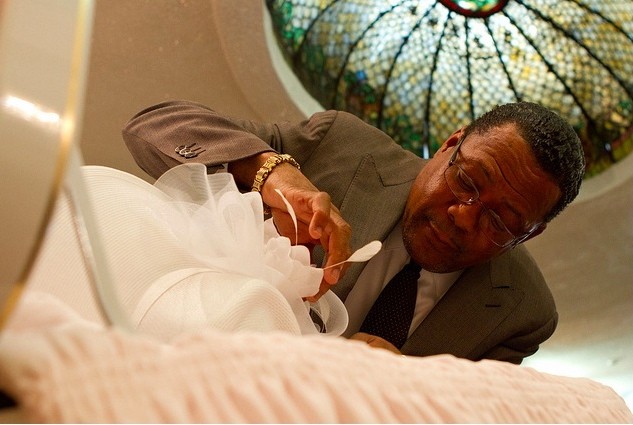
 Ever since he was a boy growing up on a farm in South Carolina, Isaiah Owens, the son of a sharecropper, has been burying the dead, beginning with small animals. As a teenager, he moved to New York City to train to become a funeral director, and for the last forty years, he has run the Owens Funeral Home in Harlem, where he continues to be a longtime pillar of the community, known for the great care and consideration he gives each family as they deal with the loss of a loved one. His company motto is “Where Beauty Softens Your Grief,” and that is evident throughout Christine Turner’s new documentary, Homegoings. Turner followed Owens over the course of four years as he and his staff — his wife, son, daughter, and mother all work in the family business — set up funerals for such clients as Walter Simons, whose octogenarian grandparents died within two days of each other; Queen Petra’s children, who want something special for their mother, including a horse and carriage; and Linda “Redd” Williams-Miller, who is planning her funeral in advance, wanting to get every detail right. And details are what Owens is all about, not only working hard to make sure the deceased look their best in their coffin but guaranteeing that every aspect of the funeral is handled with great thought and humanity. Owens narrates the documentary, sharing his views on life and death as well as the history of mourning in the African-American community. He is an inspiring man who is not what most people expect in funeral directors, who are often portrayed as being dark and morose. Williams-Miller says that homegoings should be “a happy occasion,” and Owens is ready, willing, and able to ensure that the experience is precisely what each individual family wants and needs. Homegoings, which was made in conjunction with PBS’s POV program and features an original score by Daniel Bernard Roumain, is having its U.S. theatrical premiere June 24-30 at the Maysles Cinema in Harlem, not very far from the Owens Funeral Home itself, as part of guest curator Livia Bloom’s continuing “Documentary in Bloom” series. The hour-long film will be preceded by StoryCorps Shorts: A Tenth Anniversary Program, a twenty-minute collection of animations the Rauch Brothers have made with the organization that has been amassing an oral history of America for a decade. The June 25 and 28 screenings of Homegoings will be followed by a Q&A with Turner and members of the cast, with a reception as well on June 28.
 The 2013 Human Rights Watch Film Festival comes to a close on June 23 with Jeremy Teicher’s heart-wrenching Tall as the Baobab Tree, an involving, powerful, yet gentle drama about a Senegalese family trapped by tradition in a modernizing world. Real-life sisters Dior and Oumoul Kâ star as Coumba and Debo, close siblings who live in the tiny rural village of Sinthiou Mbadane (where they actually are from). When their older brother, Silèye (Alpha Dia), falls out of a baobab tree and breaks his leg, their father (Mouhamed Diallo) doesn’t have enough money to pay for the necessary medical care so he instead sends Coumba out to do Silèye’s job of herding the cows and decides to sell off eleven-year-old Debo to suitors for marriage. Their mother (Mboural Dia) is unwilling to stand up to her husband, so Coumba hatches a plan in which her friend Amady (Cheikh Dia), who has a crush on her, will watch the herd for her secretly while she heads into the city and gets a job until she makes enough money to help Silèye heal and prevent Debo from having to marry so young. Unfortunately, not everything goes quite as planned. But through it all, no matter how difficult things get, all of the characters maintain their faith, praising peace and continually saying, “God is great.”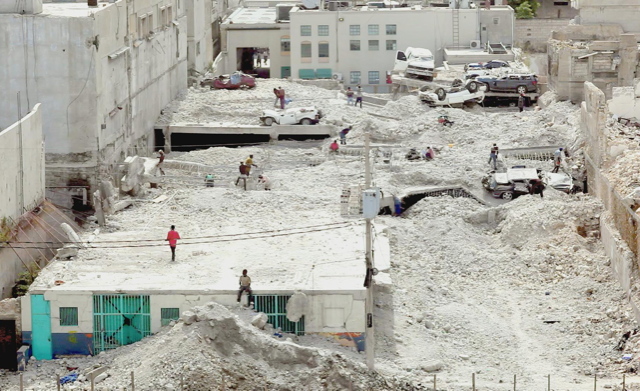
 Award-winning Haitian filmmaker Raoul Peck’s Fatal Assistance begins by posting remarkable numbers onscreen: In the wake of the devastating earthquake that hit his native country on January 12, 2010, there were 230,000 deaths, 300,000 wounded, and 1.5 million people homeless, with some 4,000 NGOs coming to Haiti to make use of a promised $11 billion in relief over a five-year period. But as Peck reveals, there is significant controversy over where the money is and how it’s being spent as the troubled Haitian people are still seeking proper health care and a place to live. “The line between intrusion, support, and aid is very fine,” says Jean-Max Bellerive, the Haitian prime minister at the time of the disaster, explaining that too many of the donors want to cherry-pick how their money is used. Bill Vastine, senior “debris” adviser for the Interim Commission for the Reconstruction of Haiti (CIRH), which was co-chaired by Bellerive and President Bill Clinton, responds, “The international community said they were gonna grant so many billions of dollars to Haiti. That didn’t mean we were gonna send so many billions of dollars to a bank account and let the Haitian government do with it as they will.” Somewhere in the middle is CIRH senior housing adviser Priscilla Phelps, who seems to be the only person who recognizes why the relief effort has turned into a disaster all its own; by the end of the film, she is struggling to hold back tears. A self-described “political radical,” Peck doesn’t play it neutral in Fatal Assistance, instead adding mournful music by Alexei Aigui, somber English narration by a male voice (Peck narrates the French-language version), and a female voice-over reading melodramatic “Dear friend” letters that poetically trash what is happening in Haiti. “Every few decades, the rich promise everything to the poor,” the male voice-over says. “The dream of eradication of poverty, disease, death remains a perpetual fantasy.” Even though Peck (Lumumba, 2010 Human Rights Watch Film Festival centerpiece