FAME HIGH (Scott Hamilton Kennedy, 2012)
Quad Cinema
34 West 13th St. between Fifth & Sixth Aves.
June 7-13
212-255-2243
www.quadcinema.com
www.famehighmovie.com
“Fame High is where ambition and reality suffer a high-speed collision with no one walking away unscathed,” documentarian Scott Hamilton Kennedy writes in his director’s statement about his latest film. In Fame High, the Berkeley-raised Kennedy explores the hopes and dreams of students at the Los Angeles County High School for the Arts (LACHSA), known as the Fame High School of the West Coast, focusing on actress Ruby McCollister, jazz pianist Zak Astor, dancer Grace Song, and singer-songwriter Brittany Hayes. Kennedy, whose previous work includes OT: Our Town and the Oscar-nominated The Garden, serves as director, editor, and writer in addition to being one of the producers and cameramen for the film, in which he talks with the students as well as their parents and teachers, delving into such themes as talent, desire, fear, motivation, education, and responsibility. Fame High, which continues this week at the Quad, where Kennedy participated in a series of Q&As over the weekend, is no mere big-screen reality show; instead, it is the real deal, capturing the essence of what it takes to become an artist. Back in April 2009, Kennedy was featured in one of the very first twi-ny talks, in which he said about The Garden, “I learned a lot about never giving up when you believe in your heart what you are struggling for,” a statement that can also be applied to Fame High, which he discusses further below.
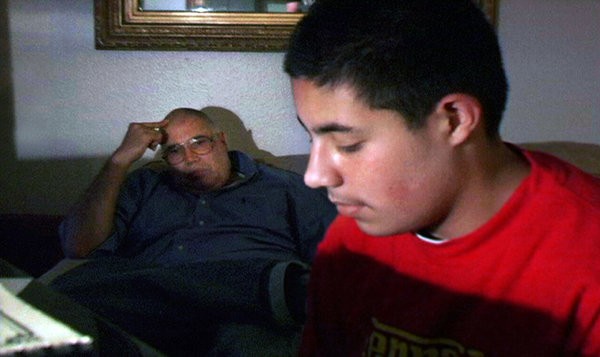
Jazz pianist Zak Astor and his father talk about their goals in FAME HIGH
twi-ny: What initially drew you to the project? Were you a fan of the original Fame movie and TV show?
Scott Hamilton Kennedy: As you can probably see in the title, I am definitely paying a bit of homage to Alan Parker’s wonderful Fame from 1980. But I had not seen that type of film done in a vérité format. I also had a great love for musicals (West Side Story, Guys and Dolls, and A Chorus Line, to name a few) from a very young age. I then had the pleasure of beginning my career as a filmmaker with music videos (including Jimmy Cliff’s great cover of “I Can See Clearly Now” for the John Candy film Cool Runnings). And I came to documentaries quite a bit later in my career. So with Fame High I wanted to try and mix these two seemingly disparate styles: the raw, soulful realism of vérité with the more magical world of musical and music videos. So, forgiving the long answer, that was the seed.
twi-ny: In the film, the protagonists have to audition over and over, in class, in a theater, at clubs, etc. How did you choose which kids to focus on? Did you have auditions?
Scott Hamilton Kennedy: In vérité documentary, there are a lot of things you can’t control, things that you take a leap of faith and hope blossom in an interesting way. One of the most important things you can control is casting, who you are going to follow, who is going to help bring this idea to fruition. So, yes, we interviewed lots of students on camera before deciding on the ones you see in the film.
twi-ny: When you were a kid, did you already know you wanted to be a filmmaker? If not, what were your dreams back then?
Scott Hamilton Kennedy: Unlike the incredibly talented and driven kids in Fame High, I came to my art of filmmaking much later in life. I loved, and you could even say I was addicted to, the complex emotional high that a good film could make me feel, but aside from a couple of hack video projects in college, my first directing experience was with my PA (production assistant) buddies all getting together to make an AIDS Public Service Announcement a year after graduating college. So I guess the “dream” of making movies was there from an early age, but the “doing” part came later.
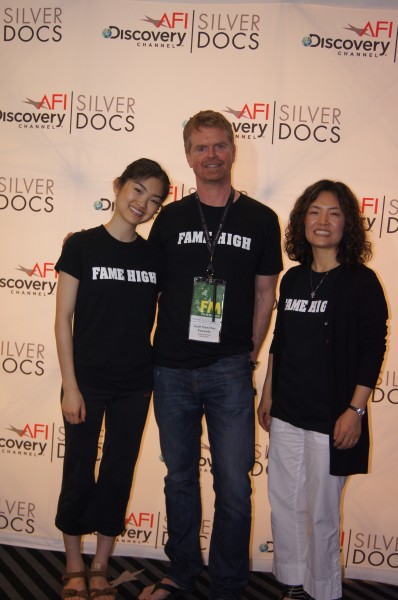
Director Scott Hamilton Kennedy poses with subject Grace Song and her mother at Silverdocs, where FAME HIGH was among the Best of the Fest winners
twi-ny: Several of the parents are featured in the film. You and your wife have two girls. Are either of them interested in the arts? What would you tell them if they wanted to become dancers, musicians, actresses, or filmmakers?
Scott Hamilton Kennedy: At seven and three and a half, our daughters (Tessa and Eden, respectfully) are still quite young, but they sure love things like our kitchen “dance parties” while making dinner, or creating puppet shows. And they both have a flare for the dramatic, I guess you could say, so we will see. I think my wife, Catherine, and I would try to support them in anything they showed a passion for. That said, I would try and be as clear-eyed as possible with them about the complexities and Sisyphean qualities of this wonderful and trying business. And from a simple accessibility front, they are already learning to operate a camera, and even some of the basic aspects of storytelling and editing.
twi-ny: Since you’re a parent, did you ever want to jump out from behind the camera and counsel any of the kids, parents, or teachers, particularly if you thought they were being treated unfairly or were treating others unfairly?
Scott Hamilton Kennedy: I have been asked this a lot, and it is a difficult question. The simple answer is no, I did not interfere, but it is a bit more complex than that. As a documentary filmmaker, I don’t see it as my job to get involved, and, more importantly, not judge in any way their journey. So while it is complicated sometimes, I do really try to stick to that. Not that I don’t have honest conversations about all aspects of the journey with both parents and children; I try very hard not to judge them or in any way make them think that I might have any better ideas than them on how to navigate this crazy journey called life.
twi-ny: Cuts in education often seem to start with the arts, and there are only so many schools like LACHSA. What do you see as the future of arts education?
Scott Hamilton Kennedy: The importance and benefits of arts education are undeniable, even if the individual has no inkling of wanting to pursue that art professionally. Playing an instrument, learning to act, perfecting dance skills are not just after-school activities; they are lifelong skills that teach students to think creatively, experience focused attention, and embrace risk — all necessary skills for the twenty-first century. Seeing the arts being the first thing cut is frustrating and confusing. While there are many aspects of American society and its education system that I greatly respect, I do think that — mostly because of our obsession with money — our value systems could be truly overhauled. Not to discount in any way the security that comes with knowing that your essential needs are covered financially, but it seems we are made to believe that money could solve all our problems, and that is just not the case. Money will never satisfy your soul, where art, without seeing it as any crazy “cure-all,” has far more potential to help us navigate and enjoy this “sad and beautiful world.”
And, if I may, I would love to point out an exciting and dauntingly ambitious aspect to our website, famehighmovie.com, and that is our Community page. There, anyone can fill out a form and share with us any art organization, school, class, performance in their community. We are especially asking people to share with us classes and performances that are available for free or greatly reduced prices to help democratize access to the arts. With a solid search tool as well, we hope this will become a sort of Wiki meets Yelp clearinghouse for an immense variety of art.
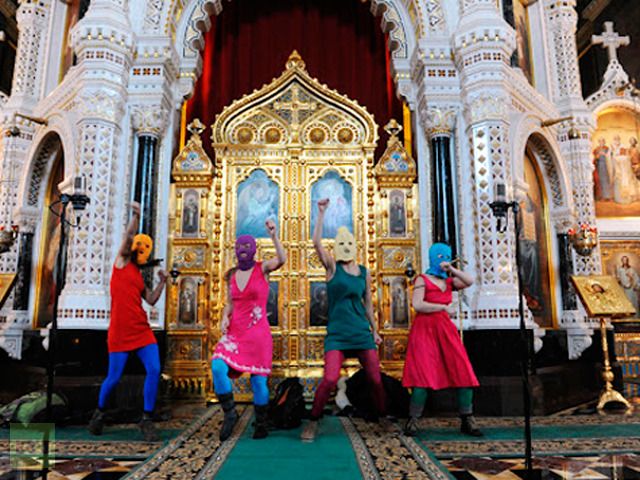
 The slogan “Free Pussy Riot!” is being shouted around the world — and was even seen on Madonna’s back — ever since the Russian government arrested three members of punk collective Pussy Riot after they staged an anarchic performance of less than one minute of “Mother Mary, Banish Putin!” at Christ the Savior Cathedral in Moscow on February 21, 2012. British documentary producer Mike Lerner and Russian filmmaker Maxim Pozdorovkin follow the sensationalistic trial of Pussy Riot leaders Maria “Masha” Alyokhina, Nadezhda “Nadia” Tolokonnikova, and Yekaterina “Katia” Samutsevich as they each face years in prison for social misconduct and antireligious behavior for what some consider a sacriligious crime and others view as freedom of speech. The three women do a lot of eye rolling and smiling in court as they are enclosed in a glass booth, proud and unashamed of what they did, continuing to make their points about the separation between church and state, feminism, freedom, and the seemingly unlimited power of Vladimir Putin. Lerner and Pozdorovkin speak with Masha’s mother and Nadia’s and Katia’s fathers, all of whom fully support their daughters’ beliefs and discuss what their children were like growing up. Meanwhile, other members of Pussy Riot and men and women across the globe take to the streets and airwaves to try to help free the incarcerated trio, who are responsible for such songs as “Kill the Sexist,” “Death to Prison, Freedom to Protests,” and “Putin Lights Up the Fires.” Pussy Riot: A Punk Prayer, which can currently be seen on HBO, is screening June 17 at Lincoln Center and June 18 at the IFC Center as part of the Human Rights Watch Film Festival and will be followed by Q&As with the directors.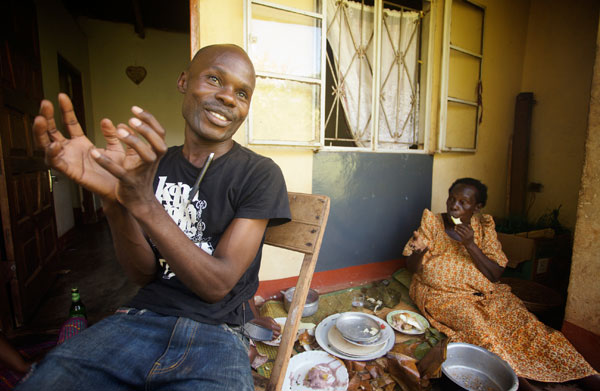
 Later this month, New York, Chicago, San Francisco, and other cities will celebrate gay pride as millions of marchers and spectators come together in parades, marches, and other events in which no one has to hide their sexuality. Such is not the case in Uganda, where many believe that being gay should lead to being executed — and that not turning in a gay friend or relative should result in life in prison. In the heartbreaking yet stirring Call Me Kuchu, codirectors Katherine Fairfax Wright, who also served as editor and photographer, and Malike Zouhali-Worrall, who also produced the award-winning documentary, go deep inside the LGBT community in Kampala, meeting with such gay and lesbian LGBT activists as Naome Ruzindana, Stosh Mugisha, John “Longjones” Abdallah Wambere, and movement leader David Kato, the first openly gay man in Uganda, who risk their lives on a daily basis as they fight for freedom and battle against the Anti-Homosexuality Bill, a draconian measure being strongly pushed by Member of Parliament David Bahati that threatens the lives of anyone and everyone involved in homosexual acts. As white American evangelicals come to Uganda to support the so-called Kill the Gays legislation, expelled Anglican Church bishop Senyonjo becomes a staunch defender of the LGBT community, the only religious leader to do so. Meanwhile, Giles Muhame, managing editor of Uganda’s popular Rolling Stone newspaper, proudly explains his mission of outing gays on the front cover of his publication, hoping that they get arrested, tried, convicted, and hanged by the government. But the activists won’t let that stop them. “If we keep on hiding,” Kato says, “they will say we are not here.” When tragedy strikes, everything is put into frightening perspective. Call Me Kuchu is a powerful examination of personal freedom and individual sexuality, a film that delves into the scary nature of repression, homophobia, and mob violence in an unforgiving, bigoted society. Call Me Kuchu, which was the closing-night selection of last year’s Human Rights Watch Film Festival, opens June 14 at the Quad, with many of the screenings followed by Q&As with Fairfax Wright and Zouhali-Worrall along with such special guests as Sanctuary NYC reverend Karen Osit, activist Frank Mugisha, Judson Memorial Church’s Micah Bucey, Believe Out Loud’s Joseph Ward, and others.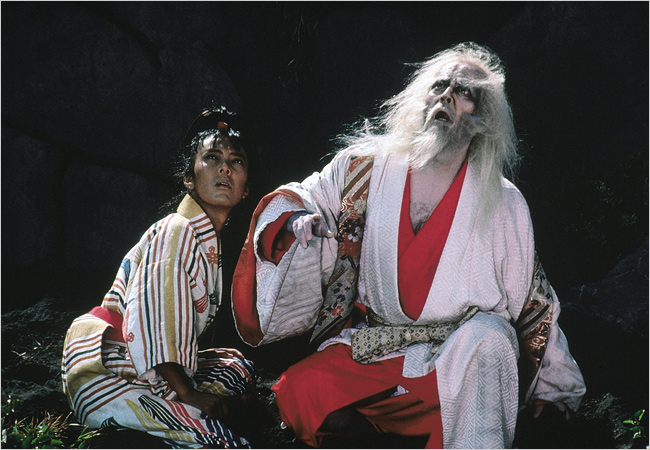
 Inspired by the story of feudal lord Mori Motonari and Shakespeare’s King Lear, Akira Kurosawa’s Ran is an epic masterpiece about the decline and fall of the Ichimonji clan. Aging Lord Hidetora (Tatsuya Nakadai) is ready to hand over his land and leadership to his three sons, Taro (Akira Terao), Jiro (Jinpachi Nezu), and Saburo (Daisuke Ryû). But jealousy, misunderstandings, and outright deceit and treachery result in Saburo’s banishment and a violent power struggle between the weak eldest, Taro, and the warrior Jiro. Hidetaro soon finds himself rejected by his children and wandering the vast, empty landscape with his wise, sarcastic fool, Kyoami (Peter), as the once-proud king descends into madness. Dressed in white robes and with wild white hair, Nakadai (The Human Condition), in his early fifties at the time, portrays Hidetaro, one of the great characters of cinema history, with an unforgettable, Noh-like precision. Kurosawa, cinematographers Asakazu Nakai, Takao Saitô, and Masaharu Ueda, and Oscar-winning costume designer Emi Wada bathe the film in lush greens, brash blues, and bold reds and yellows that marvelously offset the white Hidetaro. Kurosawa shoots the first dazzling battle scene in an elongated period of near silence, with only Tôru Takemitsu’s classically based score playing on the soundtrack, turning the film into a thrilling, blood-drenched opera. Ran is a spectacular achievement, the last great major work by one of the twentieth century’s most important and influential filmmakers. A restored 35mm print of Ran will be screening at 2:00 on June 15 at the Museum of the Moving Image as part of the continuing “See It Big!” series and will be introduced by former Orion Classics president Michael Barker, with the great Nakadai present as well.