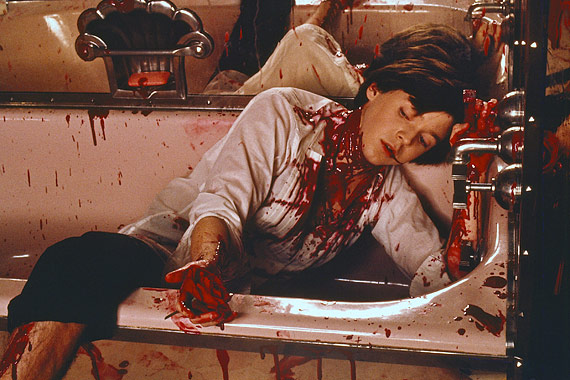
Harold (Bud Cort) has a little bit of an obsession with death in very different kind of romantic comedy
HAROLD AND MAUDE (Hal Ashby, 1971)
IFC Center
323 Sixth Ave. at West Third St.
Monday, July 22, 8:00
212-924-7771
www.ifccenter.com
 Bud Cort (Harold) and Ruth Gordon (Maude) are magnificent in this glorious black comedy from director Hal Ashby (The Last Detail, Shampoo, Being There) and writer Colin Higgins (Foul Play, 9 to 5). Harold is an eighteen-year-old rich kid obsessed with death, regularly flirting with suicide. Maude is a fun-loving, free-spirited senior citizen approaching her eightieth birthday. Ashby throws in just the right amount of post-1960s social commentary, including a very funny antiwar scene, without becoming overbearing, as this could have been a maudlin piece of sentimental claptrap, but instead it’s far from it. Even the Cat Stevens soundtrack (“If You Want to Sing Out, Sing Out,” “Tea for the Tillerman,” “Where Do the Children Play?”) works. Harold and Maude is a tender, uproarious, bittersweet tale that is one of the best of its kind, completely unforgettable, enlightening, and, ultimately, life-affirming in its own odd way. Harold and Maude is screening in a DCP projection July 22 at 8:00 as part of the IFC Center series “Queer/Art/Film” and will be followed by a discussion with Chilean multidisciplinary artist, musician, and director Sebastián Silva (Crystal Fairy, Iwannawin & Friends). The monthly series, which consists of films selected by gay New York City artists, concludes August 19 with Stephen Frears’s My Beautiful Laundrette, picked by Brooklyn-born visual artist Chitra Ganesh.

 Joshua Oppenheimer’s The Act of Killing is one of the most disturbing, and unusual, films ever made about genocide. In 1965-66, as many as a million supposed communists and enemies of the state were killed in the aftermath of a military coup in Indonesia. Nearly fifty years later, many of the murderers are still living in the very neighborhoods where they committed the atrocities, openly boasting about what they did, being celebrated on television talk shows, and even being asked to run for public office. While making The Globalization Tapes in Indonesia in 2004, the Texas-born Oppenheimer met some of these self-described gangsters and, struck by their brash, bold attitudes, decided to create a different kind of documentary. In addition to following them around as they go bowling, play golf, sing, and dance, proudly showing off how happy their lives are, Oppenheimer offered them the opportunity to tell their story as if it were a Hollywood movie. The men, whose love of American noir and Westerns heavily influenced the stylized killings they perpetrated, loved the idea and began to restage torture and murder scenes in great detail for the camera, getting in period costumes, putting on makeup, going over script details, reviewing the dailies, and playing both the violent criminals and their victims. The leader is master executioner Anwar Congo, who is perhaps the only one haunted by his deeds; although on the surface he is proud of what he did, he is tormented by constant nightmares. Such is not the case for the others, who laugh as they go over the gory details, especially paramilitary leader Herman Koto, Congo’s protégé and a man seemingly without a conscience. Meanwhile, fellow executioner Adi Zulkadry wonders whether telling the truth will actually negatively impact their legendary status. “Human rights! All this talk about ‘human rights’ pisses me off,” Congo says in one scene. “Back then there was no human rights.” Oppenheimer also depicts how frighteningly powerful the three-million-strong, government-connected Pancasila Youth is, ready to fight for the very same things that led to the genocide in the first place. It’s hard to comprehend how these men continue to walk free, and one can argue whether Oppenheimer should indeed be giving them the platform that he does. Watching these gangsters — or “free men,” as they like to call themselves, since the Indonesian word for gangster is “preman,” derived from the Dutch “vrijman” — artistically re-create scenes of horrific violence is both illuminating and infuriating on multiple levels that will leave viewers angry and incredulous. After playing at last month’s Human Rights Watch Film Festival, The Act of Killing opens July 19 at the Landmark Sunshine Cinema, with Oppenheimer on hand to discuss the film at the 7:30 and 10:30 screenings on July 19 and the 4:50, 7:30, and 10:30 shows on July 20.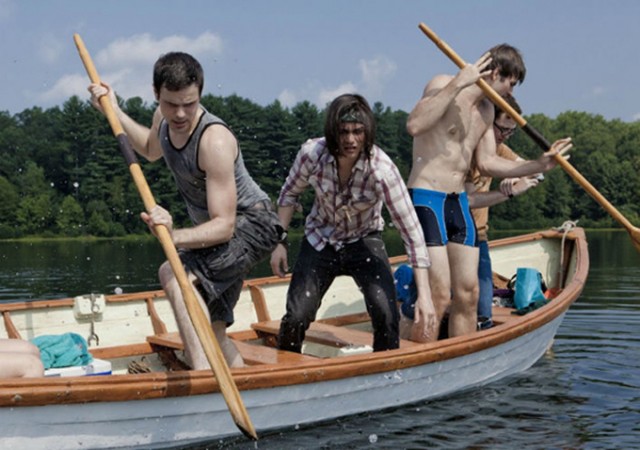
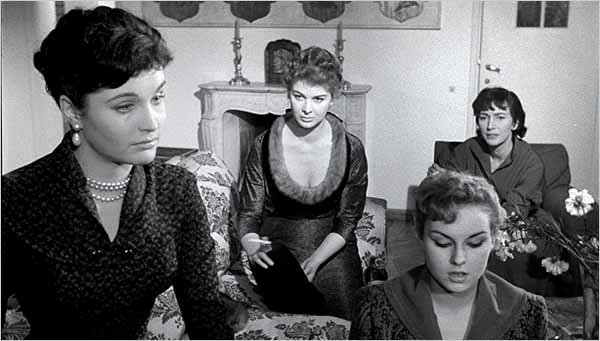
 Winner of the Silver Lion at the 1955 Venice Film Festival, Michelangelo Antonioni’s sublimely marvelous Le Amiche follows the life and loves of a group of oh-so-fabulous catty, chatty, and ultra-fashionable Italian women and the men they keep around for adornment. Returning to her native Turin after having lived in Rome for many years, Clelia (Eleonora Rossi Drago) discovers that the young woman in the hotel room next to hers, Rosetta (Madeleine Fischer), has attempted suicide, thrusting Clelia into the middle of a collection of self-centered girlfriends who make the shenanigans of George Cukor’s The Women look like child’s play. The leader of the vain, vapid vamps is Momina (Yvonne Furneaux), who carefully orchestrates situations to her liking, particularly when it comes to her husband and her various, ever-changing companions, primarily architect Cesare (Franco Fabrizi). As Rosetta falls for painter Lorenzo (Gabriele Ferzetti), who is married to ceramicist Nene (Valentina Cortese), Clelia considers a relationship with Cesare’s assistant, Carlo (Ettore Manni), and the flighty Mariella (Anna Maria Pancani) considers just about anyone. Based on the novella Tra Donne Sole (“Among Only Women”) by Cesare Pavese, Le Amiche is one of Antonioni’s best, and least well known, films, an intoxicating and thoroughly entertaining precursor to his early 1960s trilogy, L’Avventura, La Notte, and L’Eclisse. Skewering the not-very-discreet “charm” of the Italian bourgeoisie, Antonioni mixes razor-sharp dialogue with scenes of wonderful ennui, all shot in glorious black and white by Gianni Di Venanzo. Recently restored in 35mm, Le Amiche is a newly rediscovered treasure from one of cinema’s most iconoclastic auteurs. The film will have a special screening July 15 at 7:00 as part of Film Forum’s ongoing celebration of the fiftieth anniversary of the New York Review of Books and will be introduced by frequent NYRB contributor Luc Sante (Low Life, The Factory of Facts). The NYRB edition of The Selected Works of Cesare Pavese, which will be available at Film Forum, includes Among Only Women in addition to Pavese’s The Beach, The House on the Hill, and The Devil in the Hills.
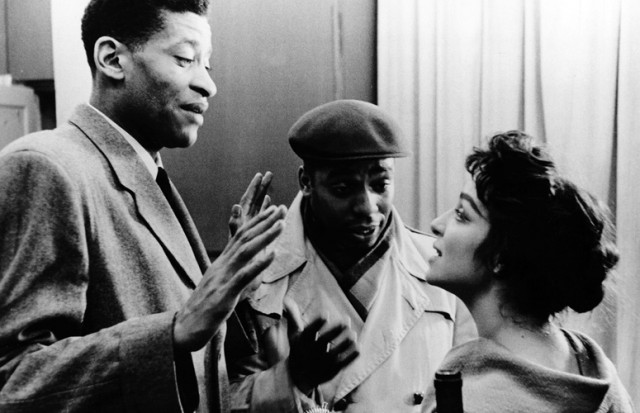
 John Cassavetes’s directorial debut, Shadows, is a landmark moment in the history of independent cinema and one of the most influential films ever made. Shot in black-and-white with a 16mm handheld camera on a modest budget of $40,000, much of which was raised following Cassavetes’s appearance on Jean Shepherd’s radio show — the credits include the line “Presented by Jean Shepherd’s Night People” — Shadows is a gritty, underground examination of race in New York City, one of the first major anti-Hollywood American movies. Although the script is credited to Cassavetes, the film is primarily improvised by a group of mostly nonprofessional or first-time actors using their real first names, set to a jazzy, moody score by Charles Mingus saxophonist Shafi Hadi. Lelia Goldoni stars as twenty-year-old Lelia, a confused young woman who loses her virginity to Tony (Anthony Ray), who thought it was a one-night stand but then decides they should start dating after she becomes clingy. However, Tony freaks out when he meets one of Lelia’s brothers, singer Hugh (Hugh Hurd), who is black. Meanwhile, their other brother, trumpeter Ben (Ben Carruthers), spends his nights with his two buddies, Dennis (Dennis Sallas) and Tom (Tom Reese), bumming money and trying to pick up chicks. Amid Bohemian parties, street fights, and visits to Central Park, Port Authority, Grand Central Terminal, and MoMA’s sculpture garden, Cassavetes and the cast explore life, love, and racism in realistic ways, even if some of the actors are a lot better than others and certain scenes fall flat. Gordon is particularly annoying through much of the film; the most interesting relationship exists between Hugh and his devoted agent, Rupert (Rupert Crosse, who spent the next thirteen years appearing in myriad television series). Look for Cassavetes in the scene in which a stranger harasses Lelia in Times Square. Shadows, which comes alive with the rhythm and energy of late 1950s New York, is being shown July 9 at 7:00 and 9:30 as part of the BAMcinématek series “Cassavetes”; the 7:00 screening will be followed by a Q&A with Goldoni, who appeared in only a few more films after Shadows (Alice Doesn’t Live Here Anymore, The Day of the Locust, the 1978 remake of Invasion of the Body Snatchers). The “Cassavetes” series runs July 6-31 with films that Cassavetes either directed and/or starred in, opening, appropriately enough, with Opening Night and continuing with such wide-ranging works as The Dirty Dozen, Edge of the City, The Killers, Machine Gun McCain, Faces, Husbands, Rosemary’s Baby, and Tempest.