this week in lectures, signings, panel discussions, workshops, and Q&As

BERNARD AND IRENE SCHWARTZ CLASSIC FILM SERIES: PATHS OF GLORY

Kirk Douglas discovers that war is indeed hell in PATHS OF GLORY (courtesty Photofest)

Kirk Douglas discovers that war is indeed hell in PATHS OF GLORY (courtesty Photofest)

PATHS OF GLORY (Stanley Kubrick, 1957)
New-York Historical Society
The Robert H. Smith Auditorium
170 Central Park West at 77th St.
Friday, November 22, free, 7:00
212-873-3400
www.nyhistory.org

Stanley Kubrick’s harrowing Paths of Glory, based on the novel by Humphrey Cobb, is quite simply the best English-language antiwar film ever made. Kirk Douglas stars as Colonel Dax, a French military man who disagrees with his superiors’ insistence on sending his men into certain annihilation in order to take a worthless hill during World War I. Dax’s verbal battles with Generals Broulard (Adolphe Menjou) and Mireau (George Macready) are unforgettable, as are the final scenes, in which three random men are chosen to pay the price for what the generals call cowardice. Filmed in stunning black and white, Paths of Glory puts you right on the front lines of the folly of war. Kubrick, who wrote the unrelenting script with Calder Willingham and Jim Thompson, also made the best film about the cold war (Dr. Strangelove, or How I Learned to Stop Worrying and Love the Bomb), the Roman slave revolt (Spartacus), and, arguably, the Vietnam War (Full Metal Jacket). One of the most emotional, powerful stories ever put on celluloid, Paths of Glory is screening for free on November 22 at 7:00 as part of the New-York Historical Society’s Bernard and Irene Schwartz Classic Film Series and will be introduced by author Michael Korda (Ike: An American Hero, With Wings Like Eagles: A History of the Battle of Britain) with a focus on “WWI and Its Legacy in Film.”

DOC NYC CLOSING NIGHT: IS THE MAN WHO IS TALL HAPPY?

Michel Gondry

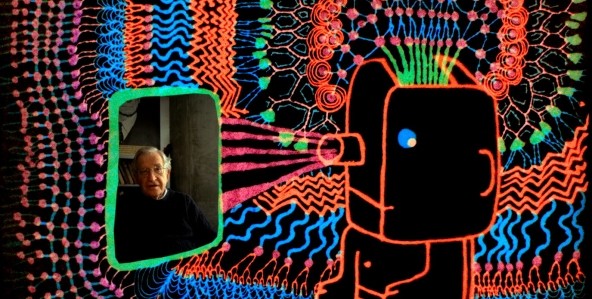
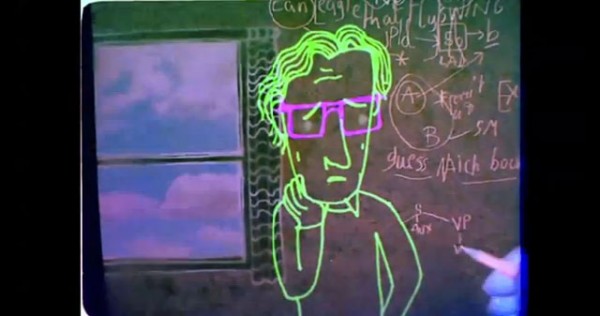
Michel Gondry details a series of animated conversations with Noam Chomsky in brilliant new documentary

IS THE MAN WHO IS TALL HAPPY? AN ANIMATED CONVERSATION WITH NOAM CHOMSKY (Michel Gondry, 2013)
Thursday, November 21, SVA Theatre, 333 West 23rd St. between Eighth & Ninth Aves., 7:00
IFC Center
323 Sixth Ave. at West Third St.
Opens Friday, November 22
212-924-7771
www.docnyc.net
www.ifccenter.com

As it turns out, Michel Gondry’s exciting new documentary, Is the Man Who Is Tall Happy? An Animated Conversation with Noam Chomsky, is animated in more ways than one. The fifty-year-old French director initially set out to go toe-to-toe with the controversial octogenarian linguist and philosopher, but he realized early on that the battle was lost. So when editing the series of interviews he had with Chomsky over the course of several months in 2010, he decided to illustrate the film with animated cartoon drawings, only occasionally showing the live-action Chomsky, often in a small box or circle within a colorfully rendered scene. After an attempt to impress Chomsky — the author of such books as Syntactic Structures; Cartesian Linguistics: A Chapter in the History of Rationalist Thought; Studies on Semantics in Generative Grammar; and The Logical Structure of Linguistic Theory — with his own views on image and representation, Gondry becomes embarrassed. “As you can see,” he says while the handwritten words appear on the screen, “I felt a bit stupid here. Let me explain: I think I couldn’t get my point through to Noam. Misuse of words and heavy accent aggravated my attempt.” Chomsky and Gondry go on to explore such concepts as generative grammar, language acquisition, and psychic continuity as Gondry, the director of such offbeat films as Eternal Sunshine of the Spotless Mind, The Science of Sleep, Human Nature, and Be Kind, Rewind, makes his endearing, often childlike drawings, a genius counterpoint to Chomsky’s cool and calm super-intellectualism.

Noam Chomsky

Michel Gondry comes up with a unique way to depict Noam Chomsky in IS THE MAN WHO IS TALL HAPPY?

Gondry does get Chomsky to open up a little about his personal life, especially his relationship with his late wife, and they wisely avoid politics. The film eventually takes a hysterical turn when Gondry realizes that he better finish it soon, since it’s been three years since he conducted the talks with Chomsky and he wants to make sure he finishes it before Chomsky dies. In the end, Gondry manages to level the playing field as the two men diagram the title question. Is the Man Who Is Tall Happy? is an absolute treat, a fun and fascinating examination of human intelligence, the creative process, the manipulative relationship between director and viewer, and the essence of film and storytelling itself. Is the Man Who Is Tall Happy? is the closing-night selection of DOC NYC, screening November 21 at 7:00 at the SVA Theatre, and will be followed by a discussion with Gondry and Chomsky, moderated by Anthony Arnove. The film then opens on Friday, November 22, at the IFC Center, with Gondry participating in Q&As following the 6:10 and 8:15 shows on Friday and Saturday.

THE BERLIN SCHOOL — FILMS FROM THE BERLINER SCHULE: BARBARA

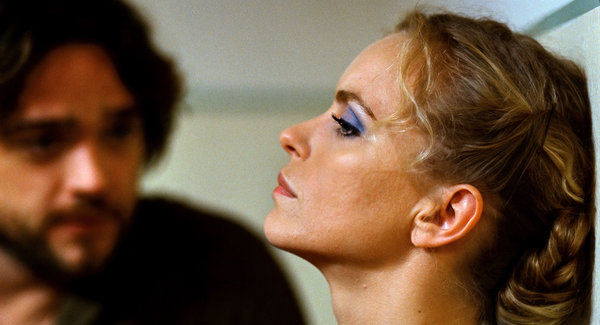
Andre (Ronald Zehrfeld) and Barbara (Nina Hoss) try to retain their humanity under difficult conditions in 1980 East Germany

BARBARA (Christian Petzold, 2012)
MoMA Film, Museum of Modern Art
11 West 53rd St. between Fifth & Sixth Aves.
Saturday, November 23, 7:30, and Friday, December 6, 7:00
Series runs November 20 – December 6
Tickets: $12, in person only, may be applied to museum admission within thirty days, same-day screenings free with museum admission, available at Film and Media Desk beginning at 9:30 am
212-708-9400
www.moma.org
www.adoptfilms.net

Christian Petzold’s Barbara is a gripping, eerily slow-paced psychological thriller that explores fear, paranoia, and responsibility. Nina Hoss, in her fifth film with writer-director Petzold, gives a subtly powerful performance as Barbara Wolff, an East German doctor who has been shipped off by the government to a country hospital run by Andre (Ronald Zehrfeld). It is 1980, and Barbara has done something to get on the GDR watch list, causing her to be under near-constant surveillance. She carefully looks around everywhere she goes, wondering if the woman on the bus, the man out for a smoke, or the person on the pay phone is working for the Stasi. She is most suspicious of Andre as he attempts to get close to her, asking her personal questions and trying to spend more and more time with her. Meanwhile, Barbara has secret meetings with various people, including her West German lover, Jörg (Mark Waschke), who wants to get her out of the east. But as much as Barbara wants to live a free and open life, she is also a dedicated doctor who has become attached to two patients: Stella (Jasna Fritzi Bauer), a pregnant woman who does not want to be sent back to a labor camp, and Mario (Jannik Schümann), who has suffered a potentially fatal head injury following a suicide attempt.


Barbara (Nina Hoss) has to watch her every move in powerful cold war drama

Barbara (Nina Hoss) has to watch her every move in powerful cold war drama

Petzold (Something to Remind Me, Wolfsburg, Yella), inspired by the likes of Claude Chabrol, To Have and Have Not, and The French Connection, drapes Barbara in a compulsive feeling of paranoia and dread, creating a blanketing atmosphere of mystery and imminent danger in which one wrong move can result in capture, imprisonment, or worse. Wrapped in a cloak of suspicion, Barbara evokes for the viewer what living in 1980 East Germany might have been like. The complex relationship between Barbara and Andre is handled with great skill by Petzold, balancing their individual needs with their responsibilities to their profession and the state. Germany’s official submission for the 2012 Best Foreign Language Film, Barbara is a tense tale that examines the cold war in unique and fascinating ways. Barbara is screening on November 23 at 7:30 and December 6 at 7:00 as part of the MoMA series “The Berlin School: Films from the Berliner Schule,” with Petzold and Hoss on hand to introduce the November 23 show. The series continues through December 6 with such other works by directors associated with the Berlin School as Thomas Arslan’s Brothers and Sisters and Gold, Ulrich Köhler’s Sleeping Sickness, and Christoph Hochhäusler’s The City Below.

THE CONTENDERS 2013: GRAVITY

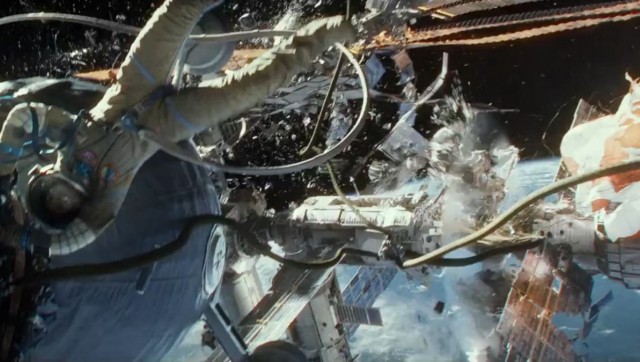
Space debris from a Russian satellite threatens an American shuttle crew in GRAVITY

Space debris from a Russian satellite threatens an American shuttle crew in GRAVITY

GRAVITY (Alfonso Cuarón, 2013)
MoMA Film, Museum of Modern Art
11 West 53rd St. between Fifth & Sixth Aves.
Tuesday, November 19, 7:00
Series continues through January 16
Tickets: $12, in person only, may be applied to museum admission within thirty days, same-day screenings free with museum admission, available at Film and Media Desk beginning at 9:30 am
212-708-9400
www.moma.org
www.gravitymovie.warnerbros.com

Alfonso Cuarón’s Gravity is a breathtaking thriller that instantly enters the pantheon of such classic space fare as 2001: A Space Odyssey, Alien, and The Right Stuff. While medical engineer Dr. Ryan Stone (Sandra Bullock) is fixing a computer glitch outside the shuttle Explorer, veteran astronaut and wisecracker Matt Kowalski (George Clooney), on his final mission before retirement, is playing around with a new jetpack and Shariff (voiced by Paul Sharma) is having fun going on a brief spacewalk. But disaster strikes when debris from a destroyed Russian satellite suddenly comes their way, killing Shariff and the rest of the crew and crippling the shuttle, leaving Stone and Kowalski on their own in deep space, their communication with Mission Control in Houston (voiced by Ed Harris, in a nod to his participation in Apollo 13 and The Right Stuff) gone as well. Kowalski is cool and calm, listening to country music as he tries to come up with a plan that will get them to the International Space Station, but the inexperienced Stone is running out of oxygen fast as she tumbles through the emptiness, Earth in the background, so close yet so far. Written by Cuarón (Y Tu Mamá También, Children of Men) with his son Jonás, Gravity is spectacularly photographed by Emmanuel Lubezki, the master behind numerous works by Cuarón and Terrence Malick (The New World, The Tree of Life), among others. Lubezki and his team even created a new LED light box to increase the film’s realism, which is nothing less than awe-inspiring and mind-bending as it takes place in real time. Despite the vastness of space, Gravity often feels claustrophobic, particularly as Stone struggles to get a breath or attempts to operate a foreign module.

GRAVITY

Matt Kowalski (George Clooney) and Dr. Ryan Stone (Sandra Bullock) try to remain together in Alfonso Cuarón’s masterful space epic

Close-ups of Stone and Kowalski reveal reflections of the shuttle and Earth, emphasizing the astronauts’ dire situation as they engage in a very different kind of pas de deux. Gravity also succeeds where directors like James Cameron often fail, as a solid, relatively unsentimental and unpredictable script accompanies the remarkable visuals, which evoke both harrowing underwater adventures as well as dangerous mountain-climbing journeys. (Cuarón also manages to bring it all in in a terrifically paced ninety minutes.) Cuarón and Lubezki favor long takes, including an opening shot lasting more than thirteen minutes, immersing the viewer in the film, further enhanced by being projected in IMAX 3D, which is not used as merely a gimmick here. Stephen Price’s score increases the tension as well until getting melodramatic near the end. Clooney is ever dapper and charming and Bullock is appropriately nervous and fearful in their first screen pairing, even though they only make contact with each other through bulky spacesuits, their connection primarily via speaking. Cuarón, who also edited Gravity with Mark Sanger, has made an endlessly exciting film for the ages, a technological marvel that should have a tremendous impact on the future of the industry. Gravity is screening November 19 at 7:00 as part of MoMA’s annual series “The Contenders” and will be followed by a discussion with both Alfonso and Jonás Cuarón. “The Contenders,” which consists of exemplary films that MoMA believes will stand the test of time, continues this month with Nicole Holofcener’s Enough Said, John Wells’s August: Osage County, Denis Villeneuve’s Prisoners, and Richard Linklater’s Before Midnight.

THE LINE KING’S LIBRARY: AL HIRSCHFELD AT THE NEW YORK PUBLIC LIBRARY

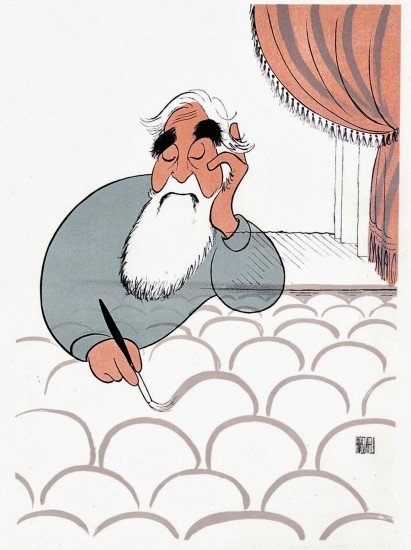
Al Hirschfeld’s long relationship with the New York Public Library is explored in exhibit at Lincoln Center

Al Hirschfeld’s long relationship with the New York Public Library and the arts is celebrated in exhibit at Lincoln Center

New York Public Library for the Performing Arts
40 Lincoln Center Plaza
Exhibition continues through January 4
Film screening: Bruno Walter Auditorium, 111 Amsterdam Ave., Monday, November 18, free, 6:00
212-642-0142
www.nypl.org/lpa

Twelve years ago, New York celebrated the life and eighty-plus-year career of legendary artist Al Hirschfeld with a major retrospective at the Museum of the City of New York and an exhibit of his celebrity caricatures at the New York Public Library’s main branch; in addition, Abrams released two books of his work, one focusing on New York, the other on Hollywood, and Hirschfeld made appearances to promote the publications. Nearly eleven years after his passing in January 2003 at the age of ninety-nine, the New York Public Library is honoring Hirschfeld again with a lovely exhibit at the Dorothy and Lewis B. Cullman Center, “The Line King’s Library: Al Hirschfeld at the New York Public Library.” Visitors can first stop by a re-creation of Hirschfeld’s work area, complete with his drawing table and barber chair, which is on permanent view at the library entrance. The exhibition is straight ahead, consisting of more than one hundred color and black-and-white drawings and lithographs, posters, books, letters, video, newspaper and magazine clippings, and various other ephemera, divided by the discipline of Hirschfeld’s subjects: theater, music, dance, and film, in addition to a section on those artists who influenced the man known as the Line King.

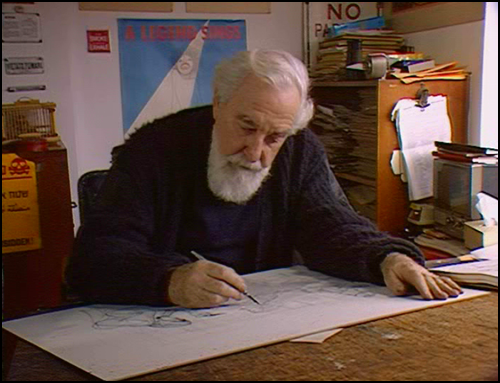
Oscar-winning documentary on Al Hirschfeld screens for free at NYPL on November 18

Oscar-winning documentary on Al Hirschfeld screens for free at NYPL on November 18

“My contribution is to take the character — created by the playwright and acted out by the actor — and reinvent it for the theater,” Hirschfeld once explained, and the evidence is on the walls, including works depicting Jack Lemmon in Tribute, Lee J. Cobb in Death of a Salesman, Christopher Plummer in Macbeth, Jessica Tandy and Marlon Brando in A Streetcar Named Desire, Rex Harrison and Julie Andrews in My Fair Lady, Alan Cumming in Cabaret, and Jackie Mason in The World According to Me, among so many more. There are also caricatures of Marcel Marceau, S. J. Perelman, George Bernard Shaw, Leonard Bernstein, Vladimir Horowitz, Dizzy Gillespie, Katharine Hepburn, and a dazzling, rarely shown 1969 print of Martha Graham. Another highlight is the original drawing for “Broadway First Nighters,” along with a key identifying the dozens of celebrities gathered in a packed room, and paraphernalia from Hirschfeld’s musical comedy Sweet Bye and Bye, a collaboration with Perelman, Vernon Duke, and Ogden Nash. And for those fans who have spent years trying to find all the inclusions of “Nina” in Hirschfeld’s drawings, “Nina’s Revenge” features his daughter holding a brush and smiling, the names “Al” and “Dolly” (for Dolly Haas, her mother and Hirschfeld’s second wife) in her long hair. In conjunction with the exhibition, there will be a free screening of the Oscar-winning 1996 documentary The Line King: The Al Hirschfeld Story, introduced by the director, Susan W. Dryfoos, on November 18 at 6:00 in the Bruno Walter Auditorium at the New York Public Library for the Performing Arts.

DOC NYC: THE PUNK SINGER

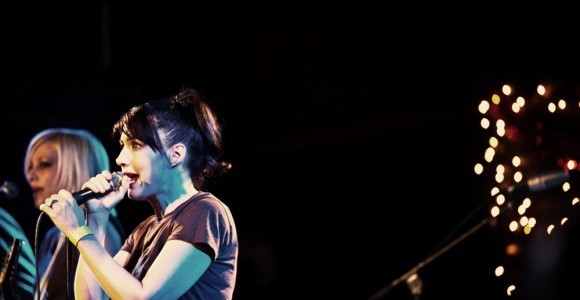
(photo courtesy of Pat Smear)

Riot grrrl Kathleen Hanna opens up about her life in intimate documentary (photo courtesy of Pat Smear)

SONIC CINEMA — THE PUNK SINGER: A FILM ABOUT KATHLEEN HANNA (Sini Anderson, 2013)
SVA Theatre
333 West 23rd St. between Eight & Ninth Aves.
Saturday, November 16, 7:15
Festival runs November 14-23
212-924-7771
www.thepunksinger.com
www.docnyc.net

A cofounder of the riot grrrl movement, Kathleen Hanna was an outspoken feminist as she toured the world with Bikini Kill and then Le Tigre starting in 1991. But it all came to a mysterious halt in 2005 when the Portland, Oregon, native suddenly went on what became a long hiatus for undisclosed health reasons. Director Sini Anderson gets to the heart of the matter in the intimate, revealing documentary The Punk Singer: A Film About Kathleen Hanna. Incorporating rousing archival footage and photographs along with new interviews, Anderson, in her feature debut, gets Hanna to open up about her life and career, discussing such influences as Kathy Acker and Gloria Steinem as well as the serious health problem that kept her out of the public eye for five years. Hanna also talks about her childhood, a sexual assault that happened to her best friend, her photography and fashion work in college, her zine writing, and the formation of her bands, along the way always pushing her message. “We didn’t give a shit,” she says about the beginnings of Bikini Kill. “We weren’t making money; we knew we were never going to make money. And it was really important that we made our music. We were on a mission. We were going to do what we did whether we got attention or not.” Anderson also speaks with such former and current Hanna bandmates as Johanna Fateman, JD Samson, Kathi Wilcox, and Tobi Vail, musical icons Joan Jett and Kim Gordon, Sleater-Kinney’s Corin Tucker and Carrie Brownstein, and Hanna’s husband, Beastie Boy Adam Horovitz; many are interviewed in the back of a snazzy van during a Hanna tribute concert at the Knitting Factory in 2010.

Kathleen Hanna gets her message out with Bikini Kill, Le Tigre, and the Julie Ruin

Kathleen Hanna gets her message out with Bikini Kill, Le Tigre, and the Julie Ruin

Anderson weaves in plenty of music clips that display Hanna’s powerful stage presence, including snippets of such songs as “Rebel Girl,” “White Boy,” “Distinct Complicity,” “Hot Topic,” “Deceptacon,” and “Aerobicide” from Bikini Kill, Le Tigre, and the Julie Ruin. The Punk Singer is a gripping portrait of a fearless, talented woman who continues to do whatever it takes to get her message out. “What is the story of my life?” Hanna says near the end. “I have no fucking idea.” But now, thanks to Anderson, we do, even if that story is still being written. The Punk Singer is having its New York City premiere November 15 at 9:45 at the SVA Theatre as part of the “Sonic Cinema” section of this year’s DOC NYC festival, with Hanna on hand to talk about the film. DOC NYC, which seeks to “curate [by] guiding audiences toward inspiring work,” runs November 14-21 at the IFC Center and the SVA Theatre; among the other “Sonic Cinema” selections are Rodrigo H. Vila’s Mercedes Sosa: Voice of Latin America, Trevor Laurence and Simeon Hutner’s Harlem Street Singer, Joe Angio’s Revenge of the Mekons, and Jeremy Xido’s Death Metal Angola.

RICHIE’S FANTASTIC FIVE — KUROSAWA, MIZOGUCHI, OZU, YANAGIMACHI & KORE-EDA: THE LIFE OF OHARU

LIFE OF OHARU

Oharu (Kinuyo Tanaka) lives a life filled with misery after misery in Mizoguchi melodrama

THE LIFE OF OHARU (SAIKAKU ICHIDAI ONNA) (Kenji Mizoguchi, 1952)
Japan Society
333 East 47th St. at First Ave.
Saturday, November 16, $12, 6:00
Series runs monthly through February
212-715-1258
www.japansociety.org

We used to think that Aki Kaurismäki’s The Match Factory Girl was the saddest film ever made about a young woman who just can’t catch a break, as misery after misery keeps piling up on her ever-more-pathetic existence. But the Finnish black comedy has nothing on Kenji Mizoguchi’s The Life of Oharu, a searing, brutal example of the Buddhist observation of impermanence and the role of women in Japanese society. The film, based on a seventeenth-century novel by Ihara Saikaku, is told in flashback, with Oharu (Kinuyo Tanaka) recounting what led her to become a fifty-year-old prostitute nobody wants. It all starts to go downhill after she falls in love with Katsunosuke (Toshirô Mifune), a lowly page beneath her family’s station. The affair brings shame to her mother (Tsukie Matsuura) and father (Ichiro Sugai), as well as exile. The family is redeemed when Oharu is chosen to be the concubine of Lord Matsudaira (Toshiaki Konoe) in order to give birth to his heir, but Lady Matsudaira (Hisako Yamane) wants her gone once the baby is born, and so she is sent home again, without the money her father was sure would come to them. Over the next several years, Oharu becomes involved in a series of personal and financial relationships, each one beginning with at least some hope and promise for a better future but always ending in tragedy. Nevertheless, she keeps on going, despite setback after setback, bearing terrible burdens while never giving up. Mizoguchi (Sansho the Bailiff, The 47 Ronin, Street of Shame) bathes much of the film in darkness and shadow, casting an eerie glow over the unrelentingly melodramatic narrative. Tanaka, who appeared in fifteen of Mizoguchi’s films and also became the second Japanese woman director (Love Letter, Love Under the Crucifix), gives a subtly compelling performance as Oharu, one of the most tragic figures in the history of cinema.
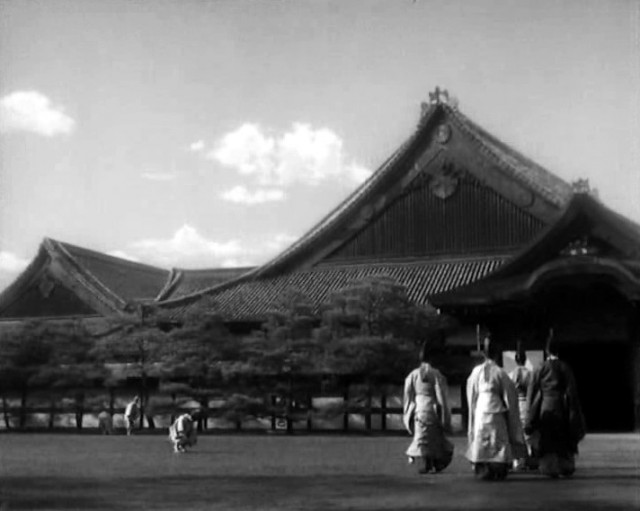
Donald Richie called THE LIFE OF OHARU “one of Mizoguchi’s most elegantly beautiful films”

Donald Richie called THE LIFE OF OHARU “one of Mizoguchi’s most elegantly beautiful films”

Winner of the International Prize at the 1952 Venice International Film Festival, The Life of Oharu is screening on November 16 at 6:00 at Japan Society, introduced by filmmaker and scholar Joel Neville Anderson, as part of the monthly tribute series “Richie’s Fantastic Five: Kurosawa, Mizoguchi, Ozu, Yanagimachi & Kore-eda,” which honors Ohio-born writer, critic, scholar, curator, and filmmaker Donald Richie, who died in February at the age of eighty-eight. Richie was a tireless champion of Japanese culture and, particularly, cinema, and the series features six works by five of his favorite directors. Here’s what Richie said about The Life of Oharu: “Based on a light and picaresque novel by the seventeenth-century writer Saikaku, the film takes a more serious view of the decline and fall of the heroine — from court lady to common whore. Yoshikata Yoda’s script, Tanaka’s performance as Oharu, Hiroshi Mizutani’s art direction, and Ichiro Saito’s score — using Japanese instruments — help make this one of Mizoguchi’s most elegantly beautiful films.” The series continues in December with Yasujiro Ozu’s Late Autumn (screening on Ozu’s birthday, which will also mark the fiftieth anniversary of his death), in January with Mitsuo Yanagimachi’s Himatsuri, and in February with Hirokazu Kore-eda’s After Life, appropriately on the one-year anniversary of Richie’s passing.