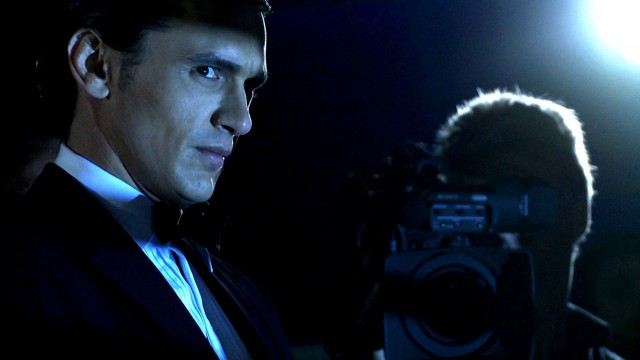
James Franco is feeling the pressure as he prepares for critical GENERAL HOSPITAL scene in FRANCOPHENIA
FRANCOPHENIA (OR: DON’T KILL ME, I KNOW WHERE THE BABY IS) (James Franco & Ian Olds, 2012)
IFC Center
323 Sixth Ave. at West Third St.
Thursday, March 6, 7:45, and Monday, March 10, 12:45
Series runs March 5-13
212-924-7771
www.ifccenter.com
www.foxsearchlight.com
 Okay, we have an important confession to make: We can’t get enough James Franco. There, we said it. And we are truly excited about the IFC Center’s FrancoFest, a nine-day cinematic tribute to the California-born actor, screenwriter, director, artist, poet, teacher, philanthropist, college student, novelist, Oscar cohost, dance-theater enthusiast, fragrance spokesman, bon vivant, and soon-to-be Broadway star. We’re not about to fault him for wanting to get the most out of life. He’s also not afraid to poke fun of his own image, which he does in Francophenia (Or: Don’t Kill Me, I Know Where the Baby Is). The film follows Franco as he prepares for a critical scene for General Hospital, the soap opera in which he has portrayed a visual artist named Franco on and off since 2009. Dressed in a sharp tux, the fictional Franco is getting ready for the opening of his new exhibition at the Museum of Contemporary Art in Los Angeles as well as plotting to commit murder. He eagerly meets with adoring fans and speaks with the media, but as day turns to night, he starts doubting himself, although it’s not clear which Franco is suffering the psychological dilemma. In whispered voice-overs by codirector Ian Olds and cowriter Paul Felten, the actor/character becomes overwhelmed with fear and paranoia. “What’s gonna happen to me? Can you tell me?” he says, adding, “What was I thinking?” But he then remembers who he is and seeks to gain control. “I made this machine, and all the parts are moving perfectly, just as they should. I’m the foreman of the factory. I made this happen, all of it. And it’s brilliant. It’s a masterpiece,” he murmurs. The ramblings also take shots at his own “Being James Franco” persona as he declares, “Look at this: I’m everywhere. I’m the light of this world. I begat this motherf&*ker. What have you ever made?” Is Franco/Franco/Franco in on all the jokes or the subject of derision? Who cares, since it all seems to be in such good, self-referential fun. Francophenia is screening March 6 & 10 at the IFC Center, with Franco and Olds on hand for the first showing to talk about the work. FrancoFest runs March 5-13 with screenings of Danny Boyle’s 127 Hours, Rob Epstein and Jeffrey Friedman’s Howl (in which Franco plays Allen Ginsberg), Harmony Korine’s Spring Breakers, William Friedkin’s Cruising, Gus Van Sant’s My Own Private Idaho, and such Franco-directed flicks as Sal, My Own Private River, Good Time Max, The Broken Tower, As I Lay Dying, The Ape, and his latest, Interior. Leather Bar, which he directed with Travis Mathews, with Franco present at various screenings the first four days.
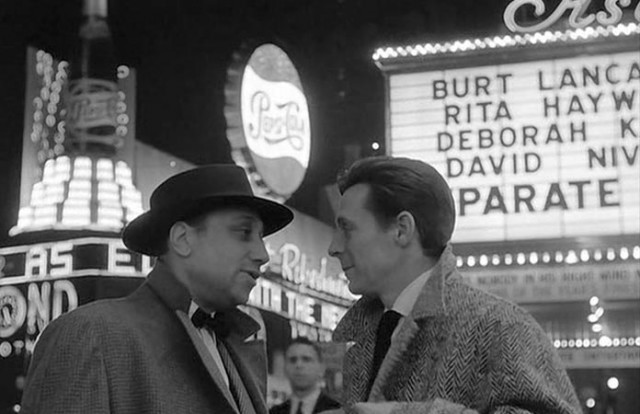
 When French U.N. delegate Fèvre-Berthier goes missing in director Jean-Pierre Melville’s 1959 noir, Two Men in Manhattan, reporter Moreau (Melville) of the French Press Agency and freelance photographer Pierre Delmas (Pierre Grasset) go out on the town, trying to find out what happened. While Moreau is seeking the truth, Delmas is after a sensationalist photograph he can sell to the highest bidder. They meet up with several women who knew the married diplomat — some much better than others — including his secretary, Françoise Bonnot (Colette Fleury), actress Judith Nelson (Ginger Hall), stripper Bessie Reid (Michèle Bailly), and jazz singer Virginia Graham (Glenda Leigh). As the men make their way through Rockefeller Plaza, Times Square, Greenwich Village, Broadway, the subway, and the United Nations, Marial Solal’s and Christian Chevallier’s jazzy score dominates the outdoor scenes, soaking the viewer in the New York at night atmosphere. And all the while, the reporter and photographer are trailed by someone in a mysterious car. As they get closer to their destination, they are faced with some serious ethical choices, not just about journalism, but about life itself. Nearly fifty-five years after its release, Two Men in Manhattan feels as stiff and dated as Melville’s (Bob le Flambeur, Le Doulos, Le Samouraï) lead performance, his only starring role and his sole appearance in one of his own films. It’s difficult to tell if Two Men in Manhattan is a serious procedural, an homage to classic noirs, a tribute to New York City, or a sly genre parody — perhaps it’s all of them, but far too many of the twists and turns are hard to swallow, especially when it comes to Delmas’s selfish decisions and Moreau’s often absurd brainstorms that seem to exist just to quicken the plot despite their incredulity. Still, it’s beautifully shot in shadowy darkness by Nicholas Hayer, and it was proclaimed by Jean-Luc Godard to be the second best film of the year. A digitally remastered version of Two Men in Manhattan is screening March 4 at 4:00 & 7:30 as part of the FIAF CinéSalon series “Remastered & Restored: Treasures of French Cinema”; the later screening will be presented by Phillip Lopate, and both shows will be followed by a wine reception. The three-month festival continues March 11 with Claire Denis’s Chocolat, introduced by African Film Festival founder Mahen Bonetti, before concluding March 18 with Henri-Georges Clouzot’s The Truth.