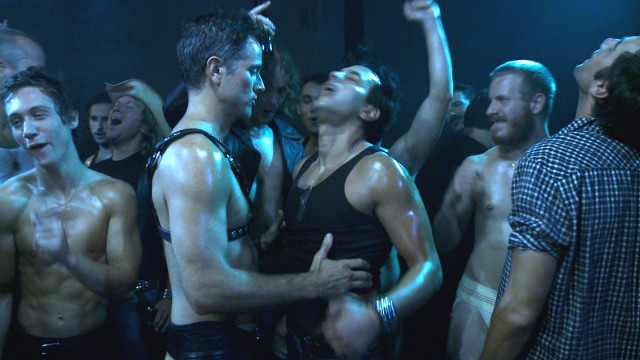
Be prepared for big crowds at the Armory Show
THE ARMORY SHOW
Piers 92 & 94, 12th Ave. at 55th St.
March 6-9, $20-$75
646-616-7434
www.thearmoryshow.com
On the heels of the New-York Historical Society exhibition “The Armory Show at 100” comes the real deal, the Armory Show, which anchors Armory Arts Week. The Armory Show, which is affiliated with the original in name only, will display modern art at Pier 92 and contemporary art at Pier 94, along with a focus on China, including Xu Zhen’s Armory Artist commission “Action of Consciousness” and a two-day China Symposium with such experts as Alexandra Munroe, Barbara Pollack, Huang Ri, Philip Tinari, and Zhao Yao. New to the fair is Armory Presents, consisting of installations from one or two up-and-coming artists from newer galleries. There will also be such panel discussions as “Venus Drawn Out: 20th Century Works by Great Women Artists” and “Art Scene: Hong Kong Now” as well as a screening of the documentary Art21 @ the Armory Show.
VOLTA NY
82 Mercer between Spring & Broome Sts.
March 6-9, $10-$15
www.ny.voltashow.com
VOLTA is the Armory’s sister fair, a boutique invitational comprising more than a hundred solo installations. The seventh edition takes place at 82Mercer in SoHo, with such artists as Kim Dorland, Zoë Charlton, Jürgen Wolf, Takahiro Yamamoto, Jin Joo Chae, Dan Coombs, Florian Heinke, and Meg Hitchcock. On Thursday and Saturday at 1:30, Wilmer Wilson IV will perform the living sculpture “From My Paper Bag Colored Heart”; on Thursday at 7:00 and Sunday at 1:30, Pamela Council will channel Bishop Charles Manuel “Sweet Daddy” Grace as she wanders around the fair; on Saturday at 6:00, Kate Sutton will moderate the panel discussion “Performance Art in Popular Culture” with Pati Hertling, Ryan McNamara, Adam Whitney Nichols, and Carl Swanson; and Bad at Sports will host a series of “Bedside Chats” with artists in a John Lennon / Yoko Ono–inspired installation.
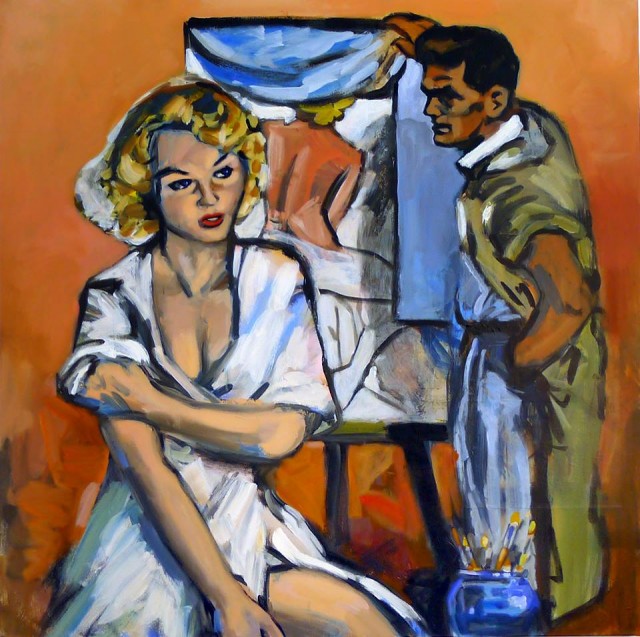
Work by Walter Robinson will be on view at the Spring/Break Art Show
SPRING/BREAK ART SHOW
Old School
233 Mott St. (enter at 32 Prince St.)
March 5-9, $5
www.springbreakartshow.com
The curator-driven Spring/Break Art Show focuses this year on “PUBLICPRIVATE,” investigating surveillance, self-portraiture, photo bombing, digital spectatorship, public defamation and confessions, and other variants of self-exposure. Among the exhibiting artists are Vanessa Albury, Andrew Chan, Peter Clough, Marlene Dumas, Carl Gunhouse, Lynn Hershman Leeson, An Hoang, Patrick Meagher, Paul Pfeiffer, Jacob Rhodes, Walter Robinson, Daniel Rozin, Shoplifter aka Hrafnhildur Arnardottir, Kendra Sullivan, and Michael Valinsky. Maureen Sullivan has curated “Private Drive-In” by Fall on Your Sword as well as “Screen Tests for Stalkerpooh,” an experimental workshop of video and live performance by Eve Sussman and Simon Lee that evokes both Andrei Tarkovsky and A. A. Milne; for #wishingpelt, visitors can whisper in Sean Fader’s ear and interact with him in other ways; Scott Avery (aka Amani Olu) gives uncomfortably personal polygraph tests for “Reasonable Doubt”; and Lia Chavez will present a durational performance involving meditation and social media, in addition to many other special projects.
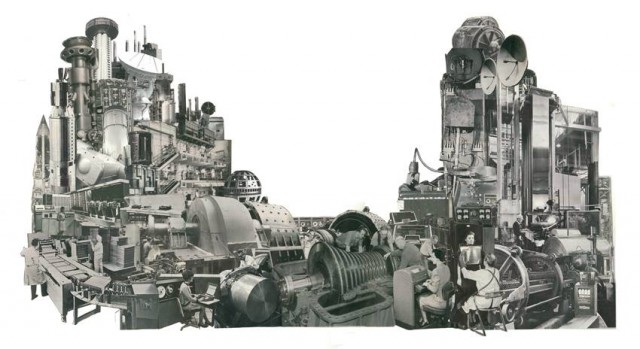
Morgan Jesse Lappin’s “The Machine II” collage can be found in the Murder Lounge at Fountain
FOUNTAIN ART FAIR
69th Regiment Armory
Lexington Ave. at 26th St.
March 7-9, $10-$15
www.fountainartfair.com
More than one hundred galleries will be part of Fountain Art Fair, which takes place in the original home of the Armory Show, the 69th Regiment Armory on Lexington Ave. We always love the Murder Lounge, where such artists as Dave Tree, Victor Cox, and Sergio Coyote do things their own way. Other returning favorites include McCaig + Welles, Mighty Tanaka, and Grace Exhibition Space. On opening night, March 7, the Yeah Yeah Yeahs’ Nick Zinner will deejay from 9:00 to midnight, with the Deep playing on Saturday night. Panel discussions will take place each afternoon at 12:30, with “The Challenges of Creating Art in Public Space” on Friday, “Women in Street Art” on Saturday, and “The New Muralism” on Sunday.

Andrew Feuerstein and Bret Quagliara designed the layout for the 2014 Independent art fair
INDEPENDENT 2014
48 West 22nd St. between Tenth & Eleventh Aves.
March 6-9, $20
www.independentnewyork.com
The Independent, founded by Elizabeth Dee and Darren Flook and held in the old Dia space in Chelsea, used to have a truly independent feel, but it has taken a significant professional downturn this year, becoming more of a buyers fair, and in doing so, it has lost its edge. There are still all kinds of art spread across multiple floors, so you have to be careful where you walk, because pieces suddenly show up in every nook and cranny. But this formerly free fair is now twenty bucks to get in, yet there is still a line. Is it worth it? Some of the best works on display are from New York galleries, including Anton Kern and Murray Guy, so we found it had little that is new and exciting. In fact, the one-floor Clio rivaled any of the Independent floors. The fifth edition includes some five dozen international galleries in a layout designed in collaboration with Andrew Feuerstein and Bret Quagliara. The stairs can get extremely crowded, and the elevator too, so be ready to take your time, just breathing in those Dan Flavin lights.

CLIO ART FAIR: THE ANTI-FAIR FOR INDEPENDENT ARTISTS
508 West 26th St. between Tenth & Eleventh Aves.
March 6-8, free
www.clioartproject.com
The Clio Art Fair gives voice to artists who are not represented by a New York City gallery, letting them run free without worrying about art market constraints and rules. Among the participating artists are Ted Barr, Gustavo Blanco-Uribe, Adrian Coleman, John Coplans, Alessandro Del Pero, Rodolfo Edwards, Loren Ellis, Roxanne Faber Savage, Borinquen Gallo, Floor Grootenhuis, and such old-timers as Mel Rosenthal and Vito Acconci. There’s a charming freshness to this one-floor, first-time fair that the others lack, caring about the art and the artists ahead of the sale and actually enjoying itself, which rubs off on visitors.
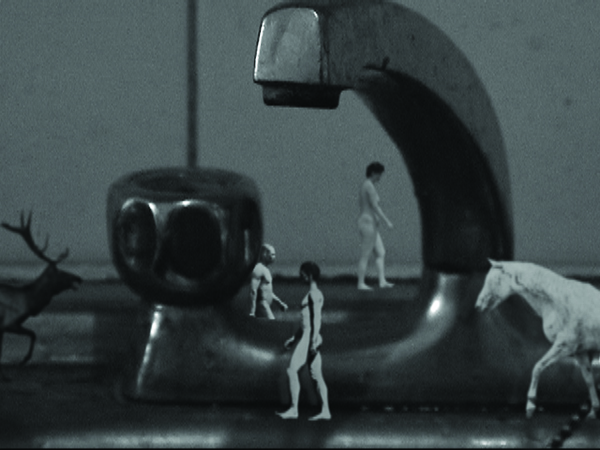
Hiraki Sawa’s “Migration” will be shown at the Moving Image fair
MOVING IMAGE
Waterfront Tunnel
269 Eleventh Ave. between 27th & 28th Sts.
March 6-9, free
www.moving-image.info
Moving Image is a video art fan’s dream, with more than thirty-six artists presenting video pieces along the passageway in the Waterfront Tunnel in Chelsea. This year’s roster is highlighted by Mark Bradford (“The Practice”), Oded Hirsch (“50 Blue”), Nam June Paik (“Dog”), Alyson Shotz (“Fluid State”), and Hiraki Sawa (“Migration”) in addition to new works by Patty Chang (“Invocation for a Wandering Lake, Part 1”), Jesse Fleming (“Mirror Mirror”), Aaron Garber-Maikovska (untitled), Rollin Leonard (“Wave”), and Lisa Gwilliam & Ray Sweeten (DataSpaceTime) (“Debugging”). On Saturday at noon, Alice Gray Stiles will moderate the panel discussion “Moving Image Moving Forward: Expanding the White Box?” with Jonas Mekas, Leslie Thornton, Christiane Paul, Ed Halter, and Elle Burchill, followed at 2:00 by “Selling Video Art via Online Channels,” with Sebastian Cwilich, Aditya Julka, Chris Vroom, and Andrea Pollan, also moderated by Stiles. At 6:00, Moving Image is hosting Claudia Hart and Edmund Campion’s “The Alices (Walking): A Sculptural Opera and Fashion Show” at Eyebeam.
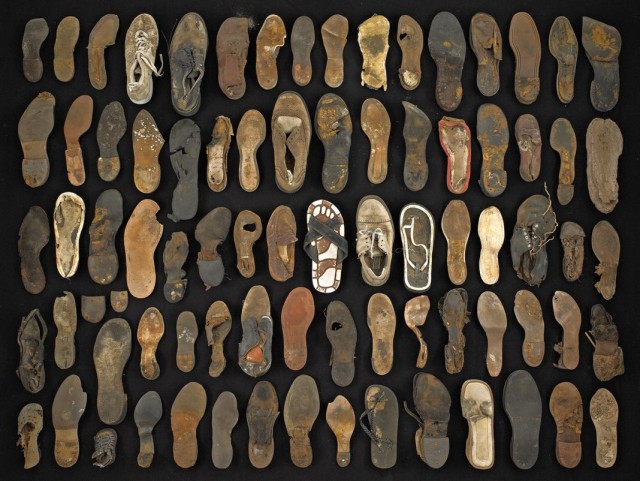
Art lovers can walk over to chashama to scope out Barry Rosenthal’s “Soles”
SCOPE
312 West 33rd St. between Eighth & Ninth Aves.
March 7-9, $15-$25
www.scope-art.com
SCOPE is back at the Skylight at Moynihan Station, delivering works from more than seventy galleries from around the world, including Galleria Ca’ d’Oro from Roma and Miami, Andenken from Amsterdam, Gallery G77 from Kyoto, Corridor Contemporary from Tel-Aviv, Barbarian Art Gallery from Zurich, La Lanta Fine Art from Bangkok, YY from Chicago, Villa del Arte Galleries from Barcelona, Hans Alf from Copenhagen, and 55Bellechasse from Paris. This year’s special programs include Sinéad O’Donnell’s “Headspace: White Cube” performances at Golden Thread, the BucketFeet #MadeToStandOut competition, and See.Me Year in Review winner Aerosyn-Lex Mestrovic’s “Atramentum.”
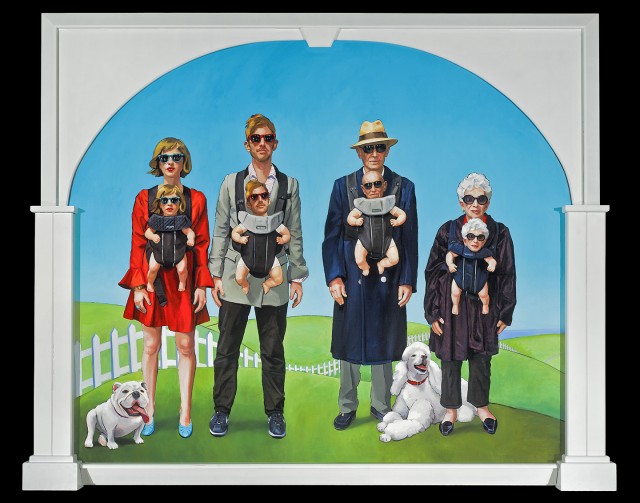
Zezziou’s “Bjorn Identity” will be on view at the (Un)Fair in Midtown West
THE (UN)FAIR
500 West 52nd St. at Tenth Ave.
March 5-9, free
www.theunfairartshow.com
The (Un)Fair seeks to emphasize fun and freedom, getting away from what it refers to as “fair frenzy” and instead “celebrating passion rather than fashion.” This year’s theme is “Exploring the Divide,” featuring such artists as Liz Adams-Jones, BaltzerGlass, Gill & Lagodich, Brian Gonzalez aka Taxiplasm, Robert C. Jackson, Will Kurtz, Marilyn Manson, David Pierce, Norman Rockwell, Brittany Schall, Tracey Snelling, and Zezziou.
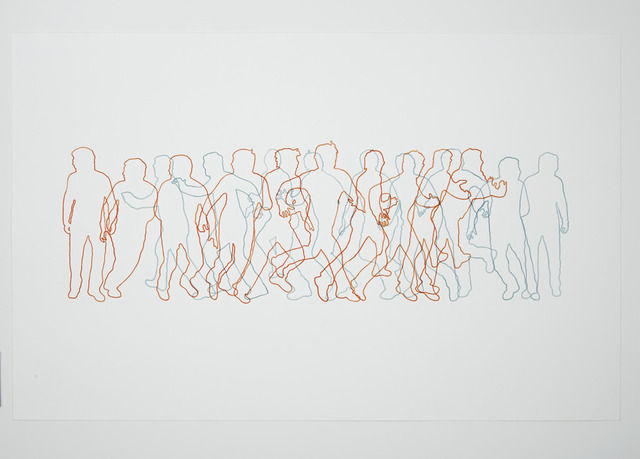
Roxy Paine’s “Running from Neon Study” is part of Marianne Boesky display at the Art Show
ADAA: THE ART SHOW
Park Avenue Armory
Park Ave. at 67th St.
March 5-9, $25
www.artdealers.org
The Art Show enters its second quarter century with an all-star lineup of works from six dozen galleries, with solo presentations by such living and dead artists as Roxy Paine, Spencer Finch, Diane Arbus, James Castle, Jeff Wall, Sol LeWitt, Kehinde Wiley, Sara McEneaney, Philip Taafe, Sara VanDerBeek, James Turrell, Irving Penn, Dana Schutz, Laurie Simmons, Ann Hamilton, and Ad Reinhardt. Themed exhibits include Barbara Krakow Gallery’s “Intersections of the Unknown: Works by Artschwager, Calle, Serra and Others”; Aquavella Galleries’ “Masterworks: Allegory and Allusion in Modern Art, from Arp to Warhol”; Debra Force Fine Art’s “Modern Life in America: Works on Paper by Milton Avery, Edward Hopper, Reginald Marsh, and Others”; Barbara Mathes Gallery’s “The Automobile: Mixed Media Works by d’Arcangelo, Ruscha, Chamberlain, and Others”; Julie Saul Gallery’s “Just Looking”; and Adler & Conkright’s “Numbers + Letters: Works from the Modernist Era to Today.” On March 7 at 6:00, Adam Gopnik will give the Collectors’ Forum keynote lecture “What Makes the Humanities Human” in the Tiffany Room.
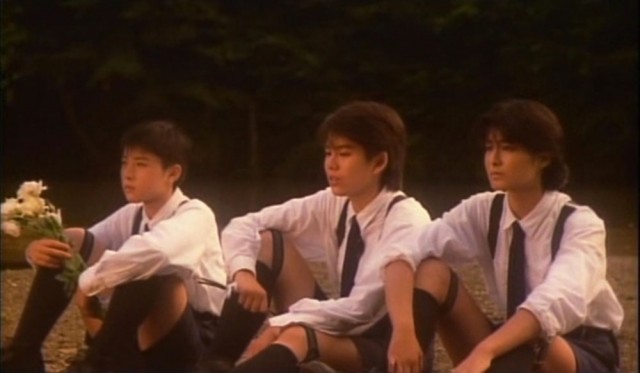
 The first part of Japan Society’s tribute to Ohio-born writer, critic, scholar, curator, and filmmaker Donald Richie, who died in February 2013 at the age of eighty-eight, consisted of five classic dramas from Japan’s cinematic elite (Akira Kurosawa, Kenji Mizoguchi, Yasujiro Ozu, Mitsuo Yanagimachi, and Hirokazu Kore-eda). “Richie’s Fantastic Five” is now being followed by “Richie’s Electric Eight: The Bold & the Daring,” comprising eight cutting-edge works by emerging filmmakers. The seventeen-day festival begins March 13 with a rare screening of Shusuke Kaneko’s gender-bending Summer Vacation 1999. Based on Moto Hagio’s shōjo manga The Heart of Thomas, the 1988 film takes place in a boarding school in the near future, as three friends, Kazuhiko (Tomoko Otakara), Naoto (Miyuki Nakano), and Norio (Eri Fukatsu), who are spending the summer alone in their all-boys boarding school, try to recover from the suicide of Yu (Eri Miyajima), who jumped off a cliff after being rejected by Kazuhiko. When a new student, Kaoru (Miyajima), shows up, looking and acting just like Yu, the other boys are forced to face their innermost fears and desires.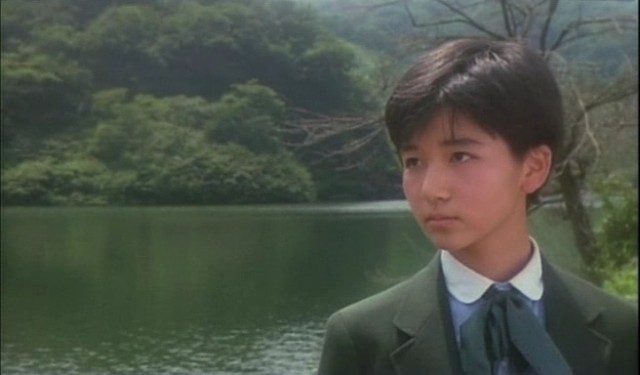
 In his 2013 autobiography, The Friedkin Connection, writer-director William Friedkin delves into his controversial 1980 film, Cruising, explaining, “I cut at least half an hour from the club scenes and the murder scenes. I had purposely let these scenes of pornography and violence run long, knowing they’d be cut and I’d be left with the story I wanted to tell. Despite these cuts, the film pushes the boundaries of what is acceptable in an R-rated film, something the critics were quick to point out.” Cruising, which stars Al Pacino as an undercover cop hunting a serial killer in New York City’s underground gay community, was a critical and financial flop; the Variety reviewer wrote, “If this is an R, then the only X left is actual hardcore.”