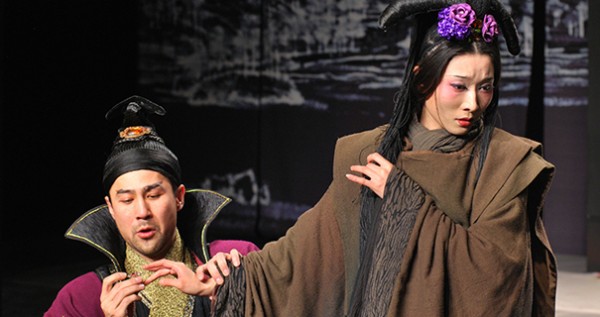
National Theatre of China makes its U.S. company debut with RICHARD III at Skirball Center (photo by Liu Weilen)
NATIONAL THEATRE OF CHINA: RICHARD III
NYU Skirball Center for the Performing Arts
566 La Guardia Pl. between Third & Fourth Sts.
March 26-30, $39-$65
212-992-8484
nyuskirball.org
In just the last two years, New York has seen numerous productions of Richard III, from Mark Rylance in the throwback Globe version on Broadway to Kevin Spacey’s star turn as part of the Bridge Project at BAM, from Ron Cephas Jones’s multiborough performance in the Public Theater’s Mobile Shakespeare Unit to Alessandro Colla in a suit and tie for Shakespeare in the Parking Lot’s outdoor production on the Lower East Side. Each of those shows had its own unique take on the Bard’s exploration of power, desire, and corruption, but perhaps the most unusual rendition is the National Theatre of China’s presentation, which comes to NYU’s Skirball Center March 26-30 as part of the second annual “Visions + Voices” festival. Streamlined to a mere hundred minutes, this Richard III will feature Chinese costumes, martial arts, acrobatics, music, and other elements of traditional Eastern staging by the National Theatre of China, in its U.S. company debut. The March 27 performance will be followed by a talk with director and National Theatre vice president Wang Xiaoying and script editor and dramaturge Luo Dajun, and the March 28 and 30 shows will be followed by conversations with Wang and actors Zhang Donglei and Zhang Xin; in addition, the panel discussion and audience Q&A “Beyond Puck: Performing Shakespeare in Asian America” will take place March 28 at 5:30 (free with advance registration) with Farah Bala, Ruy Iskander, Ching Valdes-Aran, Danielle Ma, Vandit Bhatt, Tisa Chang, and Ariel Estrada. “Visions + Voices: China” continues April 12 with a screening of Zhang Meng’s The Piano in a Factory and May 12 with Tan Dun’s “The Map” and “Concerto for String Orchestra and Pipa,” performed by the NYU Symphony Orchestra, featuring conductor Andrew Cyr, pipa virtuoso Zhou Yi, and cellist Wendy Sutter.
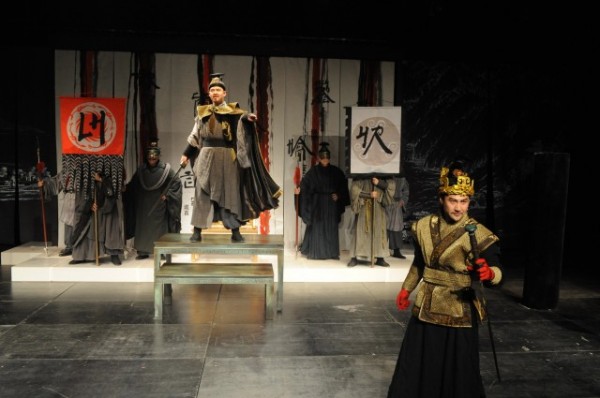
Chinese production of RICHARD III leaves a lot to the imagination (photo by Liu Weilen)
Update: The National Theatre of China’s American debut ended up being a rather curious affair. What was advertised as a one-hundred-minute Chinese production of Shakespeare’s Richard III with English surtitles ended up being around two and a half hours, with extremely limited descriptive sentences (that often worked improperly) instead of a full translation. The action, which includes acrobatics and martial arts, takes place on Liu Kedong’s spare but elegant set, featuring two carved columns and an ornate throne behind which hangs a series of calligraphy banners displaying such words as “Truth,” “Blood,” and “Conspiracy.” Zhang Dongyu portrays the title character with a sexy bravado, hunching and limping only when he’s delivering his scheming monologues; otherwise, he stands tall and proud as he woos Lady Anne (Zhang Xin) and kills off all possible challengers; following each death, blood drips down the banners, almost as if keeping score. Shakespeare’s story of the power struggles within and between the Yorks and the Lancasters, rival dynasties fighting for the English crown, moves easily across cultures, settling smoothly into an imperial Chinese milieu. But even for those who are very familiar with the details of Shakespeare’s tale, the decision to not translate any of the dialogue left many in the dark; it was particularly disconcerting when those members of the audience who understood Mandarin would laugh at a line, making everyone else feel left out — and resulting in dozens of people not returning after intermission. It also made it difficult to figure out why three witches seemed to have come over from Macbeth. But the costumes are colorfully grand, and percussionist Wang Jianan virtually steals the show, as no translation is needed for his thrilling, evocative live score.
 A real family affair, the

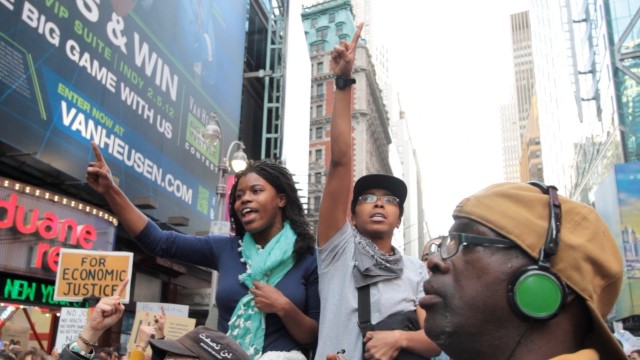
 Ira McKinley has had plenty of opportunities to give up on life and turn his back on society. His father was shot and killed by the police when Ira was fourteen. He suffered through a crack addiction, has PTSD after serving in the Air Force, spent three years in prison for attempted robbery, and has been homeless and jobless for virtually all of his adult life. But he was determined to not end up just another throwaway, someone with no present and no future. “They look at you like you’re nothing, like you’re, like I said, a throwaway. And they expect you to fail,” McKinley says in the powerful hour-long documentary The Throwaways, which he codirected with Bhawin Suchak. “That’s when I started my activism. I told people, ‘Listen, you’re in here messing with the wrong person.’” McKinley went to Northampton, Massachusetts, where he learned about filmmaking at a public access station. He then went out with his camera, using it as a “tool,” a “weapon,” and an “equalizer” as he talked to people in the abandoned streets of Albany, attended press conferences by Van Jones, mayor Jerry Jennings, and police chief Steven Krokoff, and met with such activists as Michelle Alexander, author of The New Jim Crow: Mass Incarceration in the Age of Colorblindness, a book that has had a profound influence on McKinley. He also visits places from his past that are filled with a mix of painful and poignant memories. The documentary was initially supposed to be about social justice in the state capitol, but the focus turned to McKinley when Suchak couldn’t line up enough talking heads — and, perhaps more important, because McKinley, a big bear of a man, proved to be such a fascinating character, one who the camera is naturally drawn to. McKinley has been through it all, so he’s not afraid to get up in people’s faces, which is not always the best way to try to implement change, but he’s determined to show the government and society at large that human beings should not be thrown away like yesterday’s trash and that something can be done about it.