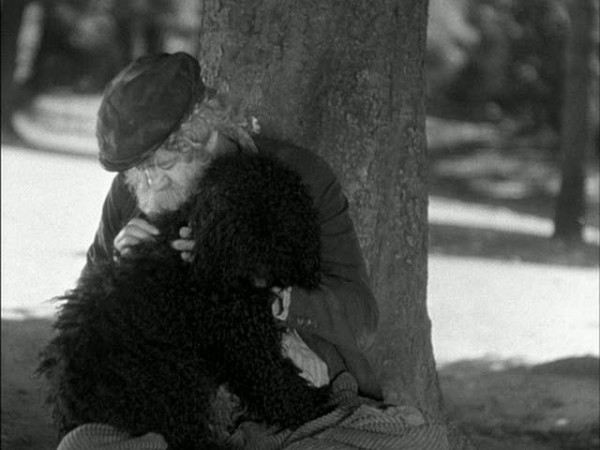
Jean Renoir’s BOUDU SAVED FROM DROWNING is a very different kind of shaggy dog tale
CINÉSALON: BOUDU SAVED FROM DROWNING (BOUDU SAUVÉ DÉS EAUX) (Jean Renoir, 1932)
French Institute Alliance Française, Florence Gould Hall
55 East 59th St. between Madison & Park Aves.
Tuesday, February 4, $13, 4:00 & 7:30
212-355-6100
www.fiaf.org
 After his dog runs away, a homeless tramp jumps into the Seine, only to be rescued by a bookseller who brings him home to stay with his family in Jean Renoir’s 1932 masterpiece, Boudu Saved from Drowning. Adapted by Renoir from René Fauchois’s play — the brief opening scene takes place onstage, announcing that what is to follow is essentially a fable — the depression-era social satire centers on the relationship between the wacky, unpredictable bum, Priapus Boudu (Michel Simon, who also played the lead in the play), and Edouard Lestingois (Charles Granval), a bourgeois bookstore owner cheating on his wife, Emma (Marcelle Hainia), with one of their maids, Anne-Marie (Sévérine Lerczinska). Lestingois first spots Boudu while looking through his telescope at the masses on the Pont des Arts, like a filmmaker shooting a documentary; “I’ve never seen such a perfect tramp!” he declares. (Indeed, Renoir regularly comments on the art of filmmaking in Boudu, especially with his use of music, nearly all of which is eventually revealed to be coming from natural sources.) Lestingois helps save the suicidal Boudu, nursing him quickly back to health and letting him stay at the house, much to the chagrin of his wife. Rather than being thankful, Boudu is a whirling dervish of ill manners, breaking dishes, using fancy lingerie to shine his shoes, and daring to eat sardines with his hands. Despite Boudu’s rudeness, Edouard, Emma, and Ann-Marie are all drawn to him in different ways, particularly Edouard, who dresses Boudu in his clothes as if he were a kind of doppelgänger, an alternate version with a completely different set of expectations and responsibilities. But there’s no controlling the bushy-haired Boudu, who reacts to all stimuli like a child who does whatever he wants, not caring about the consequences. One of the keys to the film is that very barrier, the question as to whether Boudu is a conniving tramp who knows exactly what he’s doing or just a pitiable poor soul with no self-control. Boudu — and, therefore, Simon, who gives a towering, spectacular performance, one of the greatest of early cinema — is part Charlie Chaplin, part Buster Keaton, part Little Rascal, and the influence of the character extends to Denis Lavant’s underground creature in Léos Carax’s Merde short in the Tokyo! omnibus and Eddie Murphy’s Billy Ray Valentine in John Landis’s Trading Places. (The film has also been remade twice; Paul Mazursky’s Down and Out in Beverly Hills stars Nick Nolte as the tramp, while Gérard Depardieu plays the role in Gérard Jugnot’s 2005 Boudu.)
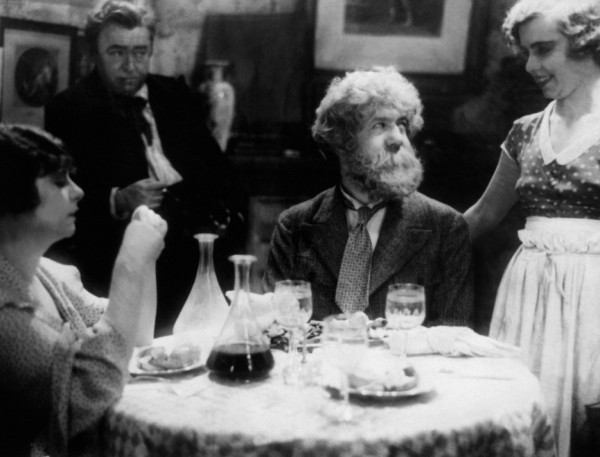
Michel Simon gives one of the great performances of early cinema in Jean Renoir’s masterful social satire
Renoir, who had previously worked with Simon on La Chienne and On purge bébé, frames each shot with careful precision, from squeezing in a large group trying to help the unconscious Boudu to a more open scene in which a fancifully dressed couple is picnicking in the park, reminiscent of an Impressionist painting, calling to mind, of course, Renoir’s father, Pierre-Auguste. Indeed, the younger Renoir sets apart his interiors from his exteriors in the film quite distinctly; indoors, Boudu feels closed in, unable to sleep in a bed, while outdoors he seems much more at home. At one point he rests off the ground in the doorway to the bookstore, neither inside nor out, caught in between the two worlds. But he ultimately makes his choice, and it’s really the only one available to him. A new digital restoration of Boudu Saved from Drowning is screening February 4 at 4:00 & 7:30 as part of the FIAF CinéSalon series “Remastered & Restored: Treasures of French Cinema”; the later screening will be introduced by screenwriter and director Henry Bean (Internal Affairs, The Believer), and both shows will be followed by a wine reception. The three-month festival continues with such other recently restored French classics as Max Ophüls’s Lola Montès (introduced by Lola Montes Schnabel), Jacques Demy’s Une chambre en ville (introduced by Adam Gopnik), and Claude Chabrol’s The Color of Lies (introduced by Jacques Gamblin).


 Based on Andrew Lau and Alan Mak’s awesome Infernal Affairs (2002), Martin Scorsese’s relatively faithful remake, The Departed, moves the relentless action and intrigue from Hong Kong to the mean streets of Boston, where it is hard to tell cop from criminal. Just out of the academy, Colin Sullivan (Matt Damon) rises quickly to detective in the Special Investigations Unit, but he’s actually in cahoots with master crime lord Frank Costello (Jack Nicholson). Meanwhile, Billy Costigan (an excellent Leonardo DiCaprio), training to become a cop, is sent deep undercover (including a prison stint) to infiltrate Costello’s gang, with only Captain Queenan (Martin Sheen) and Sergeant Dignam (a very funny and foul-mouthed Mark Wahlberg) aware of the secret mission. Sullivan and Costigan are like opposite sides of the same persona; in between them stands Costello — and Madolyn (Vera Farmiga), a psychiatrist who is in a relationship with one and is doctor to the other. As both the cops and the criminals search desperately for their respective rats, no one can trust each other, leading to lots of blood and a spectacular finale. Nicholson has a field day as the aging gangster, chewing up mounds of scenery in his first film with Scorsese, who returned to peak form with his best work since 1990’s Goodfellas. The film was nominated for five Oscars, winning four, for Best Director, Best Film Editing (Thelma Schoonmaker), Best Adapted Screenplay (William Monahan), and Best Picture, while Wahlberg was nominated for Best Supporting Actor.

 “Tanny’s body created inspiration for choreographers,” one of the interviewees says in Nancy Buirski’s documentary Afternoon of a Faun: Tanaquil Le Clercq. “They could do things that they hadn’t seen before.” The American Masters presentation examines the life and career of prima ballerina Tanaquil Le Clercq, affectionately known as Tanny, who took the dance world by storm in the 1940s and ’50s before tragically being struck down by polio in 1956 at the age of twenty-seven. Le Clercq served as muse to both Jerome Robbins, who made Afternoon of a Faun for her, and George Balanchine, who created such seminal works as Western Symphony, La Valse, and Symphony in C for Le Clercq — and married Tanny in 1952. In the documentary, Buirski (