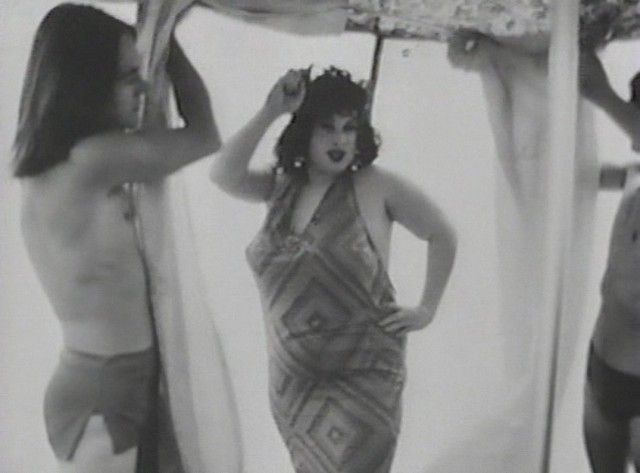
Divine is the star of “Cavalcade of Perversions” in John Waters’s splendidly lurid MULTIPLE MANIACS
MULTIPLE MANIACS (John Waters, 1970), THE DIANE LINKLETTER STORY (John Waters, 1970), and MONDO TRASHO (John Waters, 1969)
Film Society of Lincoln Center, Francesca Beale Theater, Elinor Bunin Munroe Film Center
144 West 65th St. between Eighth Ave. & Broadway
Thursday, September 11, $25 (standby only) 7:00
Series runs September 5-14
212-875-5050
www.filmlinc.com
 The awesomely titled Film Society of Lincoln Center complete retrospective “Fifty Years of John Waters: How Much Can You Take?” was probably primarily inspired by the fabulously titled September 11 program “Celluloid Atrocity Night!” That evening includes three of the Baltimore-born auteur’s craziest early works, hailing from 1969-70, when the King of Bad Taste, serving as writer, director, producer, cinematographer, and editor, was in his early twenties. The triple feature kicks off with the extremely low budget romp Multiple Maniacs, which begins with barker Mr. David (David Lochary) inviting people into “Lady Divine’s Cavalcade of Perversions,” proclaiming, “This is the show you want. . . . the sleaziest show on earth. Not actors, not paid imposters, but real, actual filth who have been carefully screened in order to present to you the most flagrant violation of natural law known to man.” Of course, that serves as the perfect introduction to the cinematic world of John Waters, one dominated by the celebration of sexual proclivities, fetish, salaciousness, indecency, violence, and marginalized weirdos living on the fringes of society. Lady Divine, played by Divine, turns out to be a cheat, the freak show just a set-up for a robbery. Soon Divine is jealous of David’s relationship with Bonnie (Mary Vivian Pearce), hanging out with her topless daughter, Cookie (Cookie Mueller), and being led into a church by the Infant of Prague (Michael Renner Jr.), where she’s brought to sexual ecstasy by Mink (Mink Stole). There’s also rape, murder, Jesus (George Figgs), the Virgin Mary (Edith Massey), and the famed Lobstura. Shot in lurid black-and-white, Multiple Maniacs is a divine freak show all its own, an underground classic that redefined just what a movie could be, a crude, disturbing tale that you can’t turn away from.
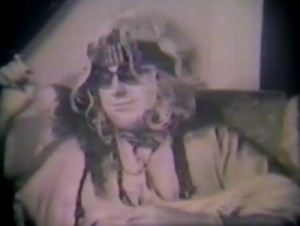
Divine plays Diane Linkletter on the day of her suicide in John Waters’s wicked short
On October 4, 1969, Diane Linkletter, the twenty-year-old daughter of television personality Art Linkletter (Kids Say the Darndest Things) and his wife, Lois Foerster, committed suicide. The next day, her father announced that it was Diane’s use of LSD that killed her, and he soon became a virulent right-wing antidrug crusader. Also on October 5, John Waters made the nine-minute The Diane Linkletter Story, an improvised fictional dramatization of Diane’s suicide, with Lochary as Art, Pearce as Lois, and Divine as Diane. The short begins and ends with snippets of the real Art and Diane’s Grammy-winning spoken-word record “We Love You, Call Collect”; in between, Divine acts up a storm as a defiant drug-loving hippie standing up to her white-bread parents. Is the film a mean-spirited attack in horrifically bad taste? A clarion call for the youth of America to continue their revolt against squares? Just an experiment for a group of friends exploring the boundaries of cinema? You decide.
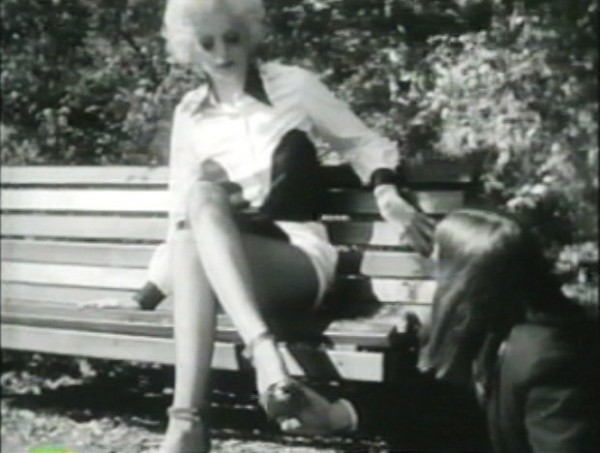
Prince Charming has a thing for a blonde bombshell’s feet in MONDO TRASHO
The Waters hat trick concludes with 1969’s truly bizarre Mondo Trasho, a freestyle foray into fast cars, foot fetishism, and severely fractured fairy tales. Pearce stars as a Cinderella-like blonde woman whose feet are attacked by Prince Charming (John Leisenring, who also plays the Shrimper) in a park. Later she is accidentally run down by Divine driving a cherry 1959 Cadillac Eldorado convertible as the story turns into a freak noir / 1950s rock-and-roll movie. There is minimal dialogue; instead, Waters fills the film with a ricocheting cacophony of R&B, rock, classical, doo wop, gospel, opera, show tunes, and more that fly by like a chicken without its head. (Beware of the opening scene, when that’s just what happens.) Much of Mondo Trasho is hard to watch, and very little of it makes any sense, but there’s something endearing about its madness, although it won’t seem nearly as sick and twisted to those familiar with the work of Kenneth Anger and Jack Smith. (Well, actually, perhaps it still will.) Waters made the film for a mere two grand, and it features his regular troupe, including Lochary as Dr. Coathanger and Susan Lowe, George Figgs, and Mink Stole as asylum inmates (and other characters), while taking on authority, the medical community, conventional society, religion, and even cinema itself. The screenings will be followed by a conversation with Waters moderated by Dennis Dermody. The series continues through September 14 and features all of Baltimore’s favorite son’s shorts and full-length movies in addition to “Movies I’m Jealous I Didn’t Make,” eight films that Waters says are “extreme, astoundingly perverse, darkly funny, and, most importantly, supremely surprising films that turn me green with envy.”
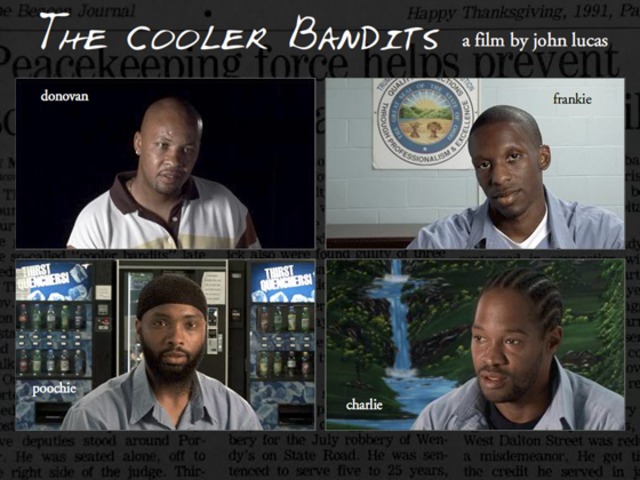
 Most prison documentaries are about drugs, violence, race, systemic abuse and corruption, politics, and social justice, focusing on frightening crime statistics. But first-time director John Lucas takes a different approach in the thoroughly engaging new film The Cooler Bandits. In 1991, Ohio teenagers Charlie Kelly, Donovan Harris, Richard “Poochie” Roderick, and Frankie Porter pulled off a string of restaurant robberies in which they locked employees in refrigeration rooms or freezers. Caught, tried, and convicted, the four friends got vastly different sentences; while Harris accepted a plea bargain and got 16 to 50 years, the others went to trial: Kelly and Roderick received sentences of 60 to 150 years and Porter 200 to 500 years. But Lucas, a longtime Ohio photojournalist, doesn’t concentrate on the men’s past, their fair or unfair treatment, or their experiences behind bars; instead, the film follows them from 2006 to 2013 as Harris adjusts to life outside and his release before the others, Kelly and Roderick prepare for possible parole, and Porter faces much more time in prison. Kelly and Roderick, in particular, speak openly and honestly about their plans for their future, thinking about education, careers, and family, fully accepting their punishment without any chips on their shoulders despite sentences that even the prosecutor agrees were far too harsh. They refuse to turn themselves into victims, making for a surprising and refreshing film. Lucas also speaks with their parents, siblings, aunts, uncles, and cousins, who are much more emotional than the four men; while standing by their family members, they recognize that the group committed serious crimes that deserved jail time, but they also want them to still be able to have a chance at a good life on the outside. The Cooler Bandits is screening September 11 at 7:00 at Aaron Davis Hall as part of the ninth annual Harlem International Film Festival; it will be preceded by Melanie Hibbert’s Coalition for Women Prisoners: Harlem NYC and Indrani Kopal’s The Game Changer and followed by a performance and Q&A with the filmmakers. Among the other films at the five-day fest, consisting of nearly one hundred shorts and features from more than two dozen countries, are Jason Paul Laxamana’s Magkakbaung (The Coffin Maker), Tim Wilkerson’s Oracles of Pennsylvania Ave., Joel Lamangan’s Kamkam (Greed), and Kevin Chu’s I See Love.

 At the beginning of Eric Merola’s Second Opinion: Laetrile at Sloan-Kettering, a 1970s news reporter says, “Dr. Robert Good, president of the Sloan Kettering Institute, one of the world’s biggest and richest cancer research centers, said Laetrile does not prevent cancer, nor cure cancer, nor stop cancer from spreading.” For the next seventy-five minutes, Ralph W. Moss, PhD, the public affairs science writer for the Memorial Sloan Kettering Cancer Center from 1974 to 1977, talks about what lay behind that statement and the furor that followed. He tells the captivating story of what went on behind the scenes as Laetrile, a form of amygdalin used in tumor treatment, was coveted by cancer patients but demonized by the medical establishment. The controversy over the drug, which was eventually banned in America, forced patients to go to Mexico in search of the palliative care medicine while the FDA, the National Cancer Institute, and several high-profile MSK doctors considered it to be quackery. MSK’s own top researcher, Dr. Kanematsu Sugiura, had exciting success treating mice with the drug, hopeful that the positive effects would be proven in humans as well. But when Dr. Good, MSK vice presidents Dr. Lloyd J. Old and Dr. Chester Stock, and MSKCC president Dr. Lewis Thomas decided that Laetrile was not the future of cancer treatment, despite what some of them had previously stated in public, Moss was confused and distressed. Others were as well; the documentary reveals that the political dimension of the debate eventually brought even the ultra-right-wing John Birch Society into the fray. Moss eventually became a whistleblower, writing numerous books on the subject, including The Cancer Industry, Cancer Therapy: The Independent Consumer’s Guide to Non-Toxic Treatment & Prevention, and the brand-new Doctored Results: The Suppression of Laetrile at Sloan-Kettering Institute for Cancer Research, which spurred the documentary.