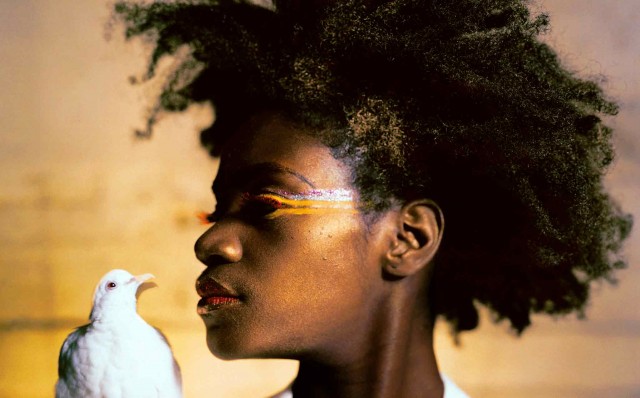
Brothers Lyle Ashton Harris and Thomas Allen Harris collaborate on a photo of their cousin Peggy in THROUGH A LENS DARKLY
THROUGH A LENS DARKLY: BLACK PHOTOGRAPHERS AND THE EMERGENCE OF A PEOPLE (Thomas Allen Harris, 2014)
Film Forum
209 West Houston St.
August 27 – September 9
212-727-8110
www.filmforum.org
www.throughalensdarkly.wordpress.com
 Thomas Allen Harris exposes the conflicting relationship between the public and private visual depiction of African Americans in the powerful, if overly idealistic and methodical, Through a Lens Darkly: Black Photographers and the Emergence of a People. Inspired by Deborah Willis’s 2000 book, Reflections in Black: A History of Black Photographers 1840 to the Present, the documentary examines how black men, women, and children have been portrayed in advertising and the media and on postcards since the development of the camera and daguerreotypes, depicting them in negative, stereotyped ways as animals, criminals, and, most horrifically, victims of lynchings. Over the course of seven years, the Bronx-born Harris interviewed such photographers and scholars as Carrie Mae Weems, Glenn Ligon, Lorna Simpson, Dawoud Bey, Coco Fusco, Chuck Stewart, and Lyle Ashton Harris (Harris’s brother), as well as Willis (one of the film’s producers) and her son, artist Hank Willis Thomas, exploring how blacks countered these distortions through family photos, where they not only controlled the image but the gaze itself. “How was, is, the photograph used in the battle between two legacies, self-affirmation and negation?” Harris (Twelve Disciples of Nelson Mandela, É Minha Cara/That’s My Face), the founder and president of Chimpanzee Productions, asks early in the film. “Our salvation as a people, as a culture, depends on salving the wounds of this war, a war of images within the American family album.” Harris and his many talking heads look at the importance of such black photographers as J. P. Ball, James Van Der Zee, Roy DeCarava, Vera Jackson, and Gordon Parks as well as such trailblazers as Sojourner Truth, Frederick Douglass, Booker T. Washington, and W. E. B. Du Bois, who used the camera to their advantage when presenting themselves and their views to the public.
The documentary does get repetitive, and Harris’s personal story occasionally stops the compelling general narrative as he attempts to relate his family history to the bigger picture. But the film is worth seeing just for the amazing archival footage, a marvelous collection of black-and-white and color photographs that show how a people can reclaim their image and validate their culture in the face of extreme prejudice. Winner of the Social Justice Award at the Santa Barbara International Film Festival and Best Diaspora Documentary at the tenth Africa Movie Academy Awards, Through a Lens Darkly is playing August 27 to September 9 at Film Forum, with special events scheduled to follow one screening per day for the first eleven days, including a Q&A with Thomas Allen Harris and producers Deborah Willis, Don Perry, and Ann Bennett on August 27 (7:20), a Salute to Harlem Photographers with Renee Cox, C. Danny Dawson, and John Pinderhughes, moderated by Moikgantsi Kgama, on August 29 (7:20), a Salute to Women Photographers with Willis and Coreen Simpson, moderated by Michaela Angela Davis, on August 30 (2:50), a Q&A with composer Vernon Reid on September 1 (2:50), and a Salute to Brooklyn Photographers with Delphine Fawundu-Buford, Russell Frederick, and Radcliffe Roye, moderated by Dawson, on September 6.

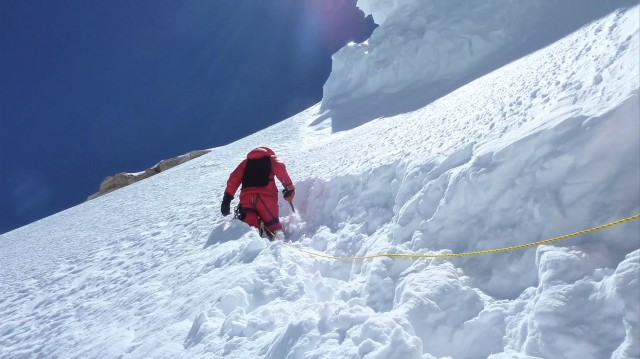
 In 1909, Prince Luigi Amedeo, the Duke of the Abruzzi, sought to climb to the summit of K2, the second highest mountain in the world after Everest, bringing with him writer Filippo de Filippi and photographer Vittorio Sella to document their journey. To celebrate the centennial of that seminal event, alpinist and mountain guide Fabrizio Zangrilli gathered a team of climbers to attempt to reach the top of K2 in 2009, bringing along first-time director Dave Ohlson to capture their daring adventure. Situated in the Karakoram mountain range along the Pakistan-China border, K2 — one of the fourteen legendary “eight-thousanders” (mountains of more than eight thousand meters) — stands 8,611 meters tall, challenging climbers with a death rate much higher than that of Everest. “The will to just try something big, something dangerous, something extraordinary — it’s part of who we are,” says one member of the team, which includes Zangrilli, Canadian mountain guide Chris Szymiec, Austrian alpinist Gerlinde Kaltenbrunner, British mountaineer Jake Meyer, and German cameraman David Göttler. As they make their way across the treacherous Karakoram Highway and through Skardu, the Baltoro Glacier, and Concordia, Ohlson cuts between thrilling still photos and film footage from the 1909 trip and the 2009 attempt, delving into the history of the spectacularly beautiful area and emphasizing how difficult it is to reach K2’s summit. “Everest and K2 aren’t even the same sport,” Szymiec says. Joined by a group of porters, they find obstacles every step of the way — and it gets even more threatening the closer they get. The film reveals the depth of the human spirit and the fierce power of nature, especially when the team has to stop when a friend dies while skiing down the mountain. Watching the seventy-five-minute documentary, you just might consider taking on K2 yourself someday — and then you’ll quickly change your mind and settle back comfortably into your chair. K2: Siren of the Himalayas opens August 22 at the Quad, with Ohlson and Jason Reid, one of the producers and editors, participating in Q&As following the 4:30 and 8:05 shows on Friday and Saturday.