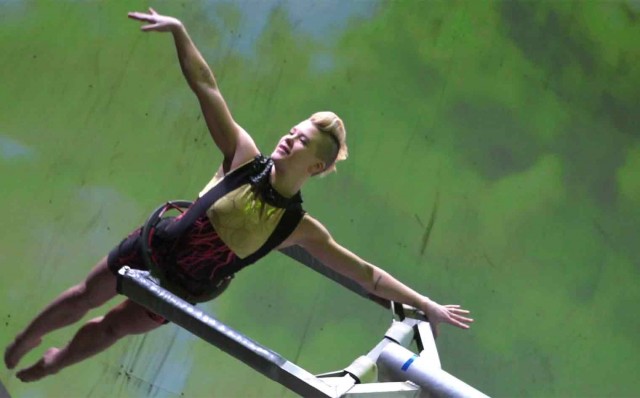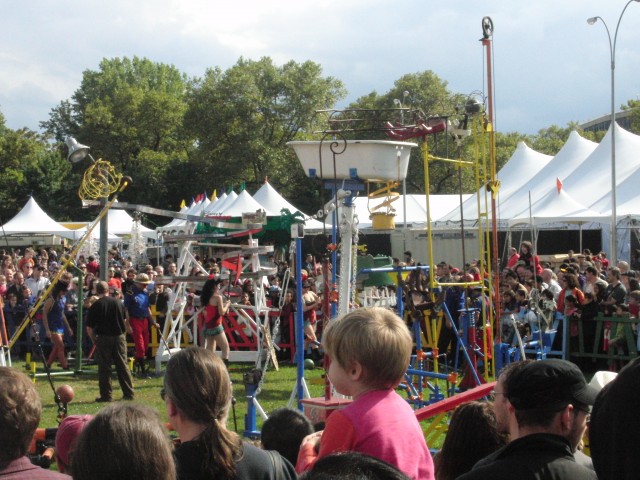
The Life-Size Mousetrap is an annual tradition at Maker Maire (photo by twi-ny/mdr)
New York Hall of Science
47-01 111th St., Flushing Meadows Corona Park
September 20-21, $17.50-$32.50 per day, weekend pass $30-$60
718-699-0005
www.makerfaire.com
www.nysci.org
Now in its fifth year, World Maker Faire New York is an event that should be on your annual radar, regardless of your age, whether or not you have kids, and no matter how much you know (or care) about modern technology. Held at the New York Hall of Science, the two-day fair celebrates “invention, creativity, and resourcefulness,” as more than seven hundred makers will display their cutting-edge work in such areas as 3D imaging and printing (we first saw 3D printing there, four years before its current popularity), electric vehicles, robotics, wearables, drones, kinetic art, open source hardware, gaming, and circuit bending — and boy, do the makers love talking about their projects, so ask away. The self-described “part science fair, part county fair, and part something entirely new” takes place over a huge expanse outside and inside the Hall of Science; in the surrounding grounds, visitors can watch the always awesome giant Coke Zero and Mentos Fountains, check out the Life-Size Mousetrap, participate in the Power Racing Series, and, inside and out, see such speakers as FIRST founder Dean Kamen, Arduino Project cofounder Massimo Banzi, Moog synthesizer cocreator Herb Deutsch, and Science Bob Pflugfelder from The Jimmy Kimmel Show. Below are only some of the highlights of this crazy, fun, and, yes, highly educational party. (Maker Week kicks off September 15 with a free screening (with advance RSVP) of the new documentary Maker: The Movie at Microsoft’s offices, followed September 17-18 by MakerCon at the New York Hall of Science.)
Saturday, September 20
Game of Drones Aerial Sports League, 10:00 am – 6:30 pm
Frank Story, with Jon Ronson, cowriter of Frank and keyboard player in the Frank Sidebottom Band, NYSCI Auditorium, 12:30
Re-creating Historic Coney Island, One Layer at a Time, with Fred Kahl, the Great Fredini, NYSCI Auditorium, 5:30
Saturday, September 20, and Sunday, September 21
Inventing a Better Mousetrap, with Alan Rothschild, including presentation of original patent models from the eighteenth and nineteenth centuries, Saturday at 11:30 at the Make: DIY Stage and Sunday at 11:00 in the NYSCI Auditorium and 3:00 at the Make: DIY Stage
Life-Size Mousetrap, Saturday and Sunday at 11:30, 12:30, 2:30, and 5:30
Coke Zero & Mentos Fountains, Saturday at 1:00 & 4:00, Sunday at 4:00
Making Movies: Behind-the-Scenes with Print the Legend, new Netflix documentary, Saturday at 4:00, Make: Live Stage, Sunday at 5:00, Make: DIY Stage
Arduino + LEGO Mindstorm Robotics — Get Started! with Matthew Beckler and Adam Wolf, Maker Shed “Get Making” Stage, Saturday at 4:30 and Sunday at 3:00
Sunday, September 21
Being Human in a Digital World: Lessons from the Intersections of Technology and Culture, with Genevieve Bell, director of user experience research in Intel Labs, NYSCI Auditorium, 1:00
Makers @ MIT: Admitting & Empowering Technically Creative Students, with Chris Peterson of MIT Admissions, NYSCI Auditorium, 3:30
How and Why You Should Hack Your Brain, with Nathan Whitmore, Make: Electronics Stage, 4:30
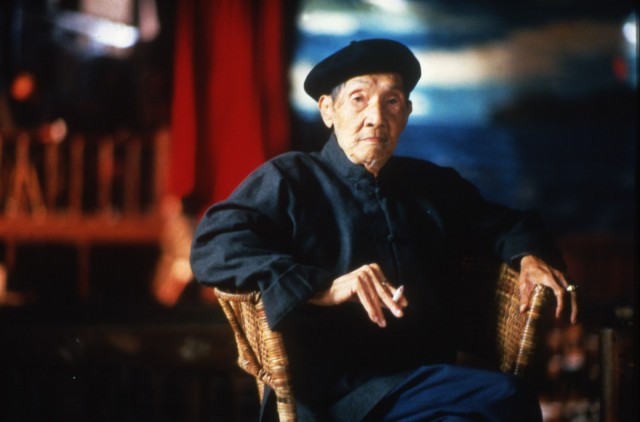
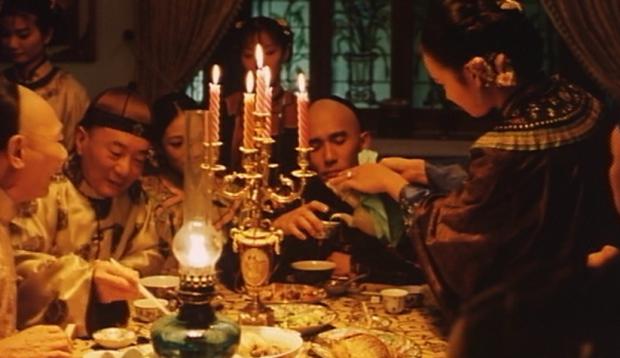
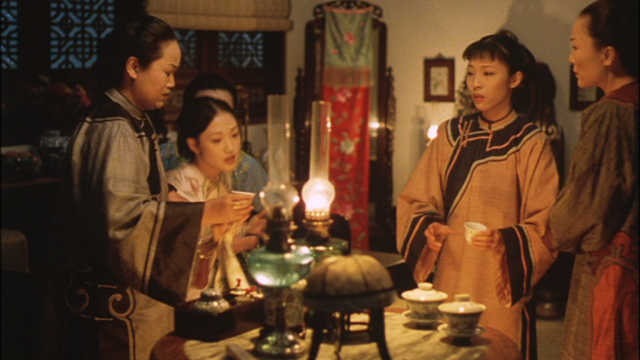
 Taiwanese New Wave auteur Hou Hsiao-hsien’s masterpiece, The Puppetmaster, is a beautifully poetic exploration of the art of storytelling. The second film of his history trilogy, coming between 1989’s A City of Sadness and 1995’s Good Men, Good Women, the 1993 work employs three unique methods as it traces the life and career of puppeteer Li Tien-lu from 1909 to 1945, during the Japanese occupation of Taiwan. Episodes from Li’s life are re-created, beginning even before his birth, as his father sacrifices his family name and takes his wife’s instead at the request of her clan, with the modern-day Li adding voice-over narration. (The film is based on Li’s memoirs.) Hou also uses Peking opera, theater, and puppet shows to demonstrate Li’s skill and to place the film in artistic and historical context. And the eighty-four-year-old Li, who had already been in three of Hou’s films, appears onscreen several times, right on the set, adding an intimate, personal touch to the proceedings. Hou and cinematographer Mark Lee Ping-Bin often let the camera remain still for long periods of time, allowing viewers to decide where to look and what to focus on, as if they were watching a live performance. The film features stunning art direction by Chang Hung and Lu Ming-jin and a lovely traditional score by Chen Ming-chang; the stellar cast includes Lin Chung and Lim Giong as Li, Tsai Chen-nan as his father, Yang Li-yin as his stepmother, Liou Hung as his grandfather, Bai Ming Hwa as his grandmother, and Vicky Wei as Lei Tzu.
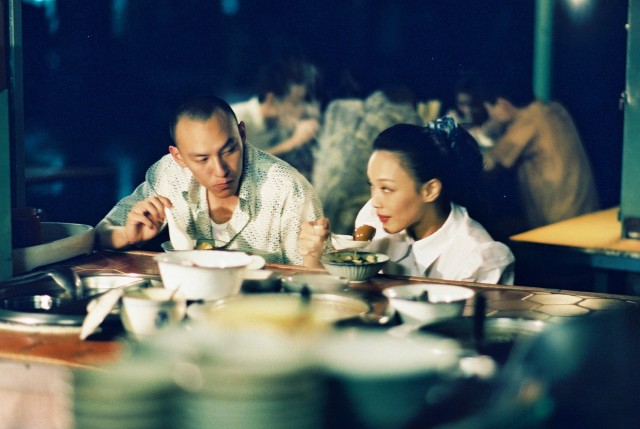
 Hou Hsiao-hsien’s gorgeous Three Times is an evocative, poetic trilogy of tales about life and love in Taiwan, all starring the mesmerizing Shu Qi (Hou’s Millennium Mambo) and the stalwart Chang Chen (Wong Kar-wai’s 2046 and Happy Together). In A Time for Love, set in 1966 and featuring a repeated soft-rock soundtrack, Chen, about to leave for military service, meets May, a pool-hall girl, and promises to write to her even though they have only just met and barely said a word to each other. When he gets a furlough, he goes to the pool hall only to find that she’s on the move, so with Zen-like cool he tries to track her down. A Time for Freedom, a silent film with interstitial dialogue and period music, takes place in an elegant brothel in 1911, where Mr. Chang regularly visits a beautiful courtesan. But while she dreams of him buying out her contract and marrying her, he seems intent on helping out another couple instead. Hou concludes the trilogy with A Time for Youth, set in fast-paced modern-day Taipei, as Jing, an epileptic singer, and Zhen, a motorcycle-riding photographer, embark on a passionate, nearly wordless affair that has serious consequences for their significant others. Three Times is a rare treat for cineastes, a poetic, intelligent, though overly long study of relationships between men and women in a changing Taiwan over the last hundred years, focusing on character, time and place, and the art of filmmaking itself. Three Times is screening September 14 at 7:00 as part of the Museum of the Moving Image series “Also like Life: The Films of Hou Hsiao-hsien” and will be introduced by Amy Taubin.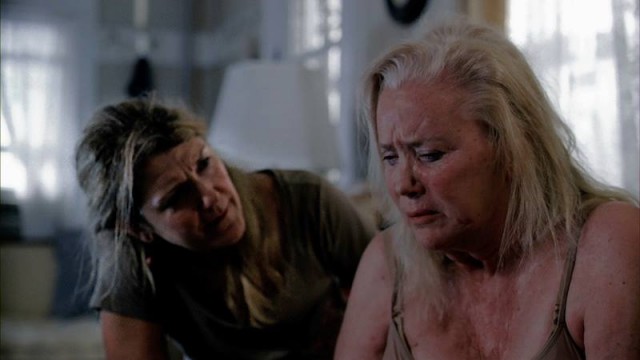
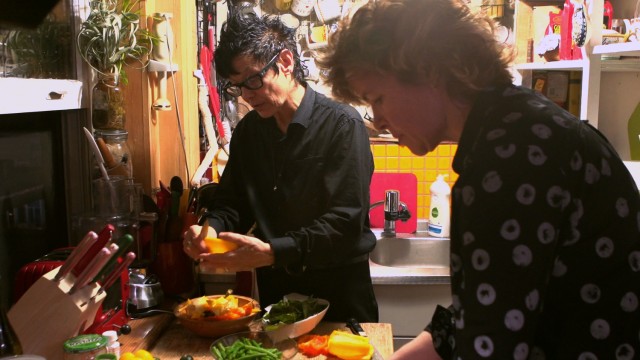
 Inspired by her mother’s aging and another family member’s struggle with Alzheimer’s disease, Sharon Greytak’s Archaeology of a Woman examines the complex relationship between Kate (Tony winner Victoria Clark), a New York City chef, and her mother, Margaret (Oscar nominee Sally Kirkland), a fiercely independent woman who is suffering the beginning stages of dementia. As the film opens, Margaret cannot find her car in a parking lot and reaches out to the police for help. Disoriented, she calls Kate, who is in the midst of passionate sex with her boyfriend (Alex Emanuel). Soon Kate is shuttling back and forth on Metro-North between Manhattan and her mother’s suburban home as Margaret continues having episodes that often turn destructive, to both herself and others. Although she keeps getting more and more forgetful and unsettled, one memory keeps haunting her, something that happened thirty years before and has risen up again to threaten her. Kirkland (Anna, Cold Feet) does all she can with the juicy role, baring her heart and soul — and septuagenarian body — but Greytak’s choppy direction and hole-filled script let the talented Method actor and teacher down. The subplots don’t meld into the main storyline, instead lingering outside as annoying diversions, including scenes with a young police officer (Karl Geary) who takes a liking to Kate, and an older cop, Sergeant Calder (James Murtaugh), who is caught between speculating about Margaret’s past and wanting to be part of her future. Greytak (The Love Lesson, Hearing Voices) never achieves a flow in the film, which plays out like a series of disjointed moments that don’t come together, as if she had too much to say but not enough time to say it all, unfortunately choosing melodrama over nuance. Archaeology of a Woman opens September 12 at the Village East; Greytak and Kirland will participate in Q&As following the 7:00 screening on Friday night (moderated by Michael Musto) and the 4:25 shows on Saturday and Sunday.