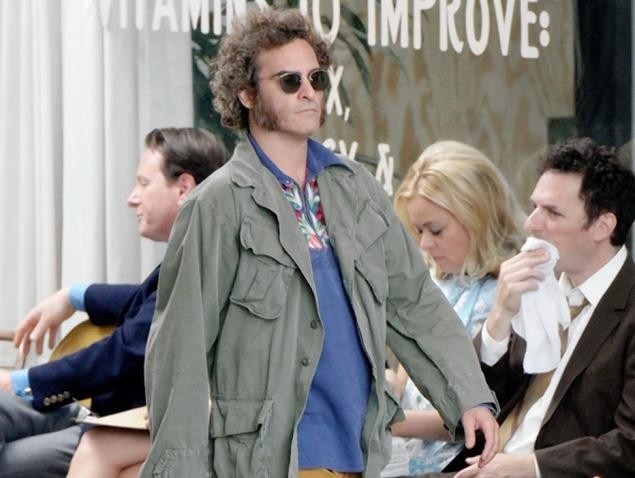
Joaquin Phoenix stars in New York Film Festival Centerpiece, Paul Thomas Anderson’s adaptation of Thomas Pynchon’s INHERENT VICE
Alice Tully Hall, 1941 Broadway at 65th St.
Walter Reade Theater, 165 West 65th St. at Amsterdam Ave.
Elinor Bunin Munroe Film Center: Francesca Beale Theater, Howard Gilman Theater, Amphitheater, 144 West 65th St. between Broadway & Amsterdam Ave.
September 26 – October 12
212-875-5601
www.filmlinc.com
Tickets are on sale for the 52nd edition of the New York Film Festival, a wide-ranging collection of film screenings, panel discussions, lectures, interactive presentations, video art, and more organized into nine different sections plus a preliminary event. It all gets under way September 19-29 with NYFF Opening Acts, fourteen early works by directors who have new films in the 2014 lineup, including Mike Leigh, Paul Thomas Anderson, Frederick Wiseman, Olivier Assayas, David Fincher, Albert Maysles, and Alan Resnais, taking place at the Film Society of Lincoln Center as well as the Maysles Cinema, Nitehawk Cinema, and UnionDocs. The festival itself, which runs September 26 through October 12, is divided into the following categories: Main Slate, Projections, Convergence, Revivals, Spotlight on Documentary, HBO Directors Dialogues, On Cinema, Special Events, and Joseph L. Mankiewicz: The Essential Iconoclast. Below are only some of the highlights; keep watching twi-ny as more highlights and select advance reviews are posted. You can also follow everything on the free NYFF app.
Friday, September 26
Main Slate Opening Night World Premiere: Gone Girl (David Fincher, 2014), 6:00, 9:00, 9:15
Saturday, September 27
NYFF52 Revivals: Once Upon a Time in America (Sergio Leone, 1984), 2:30
NYFF52 Convergence: A Brief History of Transmedia Worlds with Henry Jenkins, Keynote Address, 3:00
NYFF52 Convergence: Immigrant Nation (Theo Rigby, 2014), installation and interactive presentation, free, Elinor Bunin Munroe Film Center, 1:00 – 7:00
Saturday, September 27, 9:00, and Wednesday, October 1, 9:00
Main Slate: Goodbye to Language (Jean-Luc Godard, 2014) in 3-D
Sunday, September 28
NYFF52 Convergence: Futurestates (ITVS, 2014), interactive presentation, 6:00
Monday, September 29
HBO Directors Dialogue: Mathieu Amalric, The Blue Room, 6:00
Tuesday, September 30, 6:00, and Wednesday, October 1, 9:00
NYFF52 Spotlight on Documentary: The Look of Silence (Joshua Oppenheimer, 2014), companion piece to The Act of Killing
Tuesday, September 30, 6:00, and Wednesday, October 8, 9:00
Main Slate: U.S. premiere of Hill of Freedom (Hong Sang-soo, 2014), Main Slate
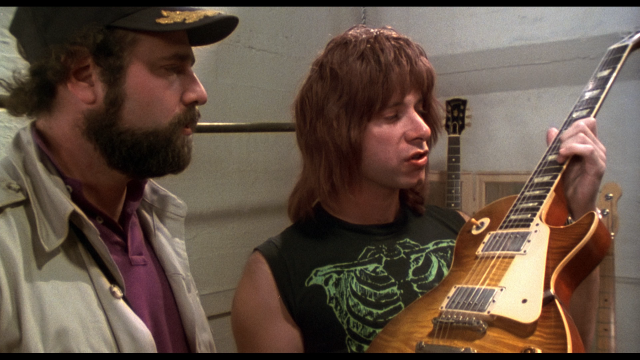
Christopher Guest will be at the New York Film Festival for the thirtieth anniversary screening of Rob Reiner’s THIS IS SPINAL TAP
Thursday, October 2, 6:00, and Friday, October 3, 9:00
Main Slate: U.S. premiere of Pasolini (Abel Ferrara, 2014)
Saturday, October 4
NYFF52 Projections: Sauerbruch Hutton Architects (Harun Farocki, 2013), 1:00
Main Slate Centerpiece World Premiere: Inherent Vice (Paul Thomas Anderson, 2014), 5:30, 5:45, 9:00, 9:15
Sunday, October 5
NYFF52 On Cinema: Paul Thomas Anderson, Inherent Vice, 12:30
HBO Directors Dialogue: Mike Leigh, Mr. Turner, 2:30
NYFF52 Spotlight on Documentary: National Gallery (Frederick Wiseman, 2014), 4:00
Tuesday, October 7
NYFF52 Retrospective – Joseph L. Mankiewicz: The Essential Iconoclast: 5 Fingers (Joseph L. Mankiewicz, 1952), 8:30
Wednesday, October 8
NYFF52 Special Events: 30th Anniversary Screening of This Is Spinal Tap (Rob Reiner, 1984), followed by a Q&A with Christopher Guest, 9:00
Friday, October 10
NYFF52 Revivals: Hiroshima Mon Amour (Alain Resnais, 1959), 6:00
Saturday, October 11
Main Slate Closing Night: Birdman or The Unexpected Virtue of Ignorance (Alejandro G. Iñárritu, 2014), 6:00, 9:15
Monday, October 13
NYFF52 Retrospective – Joseph L. Mankiewicz: The Essential Iconoclast: Cleopatra (Joseph L. Mankiewicz, 1963), 1:30

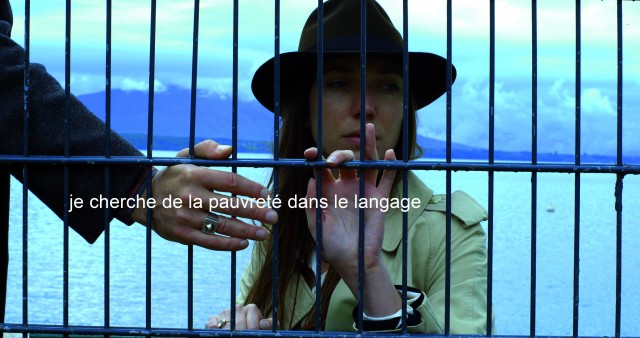
 After the New York Film Festival advance press screening of Jean-Luc Godard’s 3D Goodbye to Language, a colleague turned to me and said, “If this was Godard’s first film, he would never have had a career.” While I don’t know whether that might be true, I do know that Goodbye to Language is the 3D flick Godard was born to make, a 3D movie that couldn’t have come from anyone else. What’s it about? I have no idea. Well, that’s not exactly right. It’s about everything, and it’s about nothing. It’s about the art of filmmaking. It’s about the authority of the state and freedom. It’s about extramarital affairs. It’s about seventy minutes long. It’s about communication in the digital age. (Surprise! Godard does not appear to be a fan of the cell phone and Yahoo!) And it’s about a cute dog (which happens to be his own mutt, Miéville, named after his longtime partner, Anne-Marie Miéville). In the purposefully abstruse press notes, Godard, now eighty-three, describes it thusly: “the idea is simple / a married woman and a single man meet / they love, they argue, fists fly / a dog strays between town and country / the seasons pass / the man and woman meet again / the dog finds itself between them / the other is in one / the one is in the other / and they are three / the former husband shatters everything / a second film begins / the same as the first / and yet not / from the human race we pass to metaphor / this ends in barking / and a baby’s cries.” Yes, it’s all as simple as that. Or maybe not.