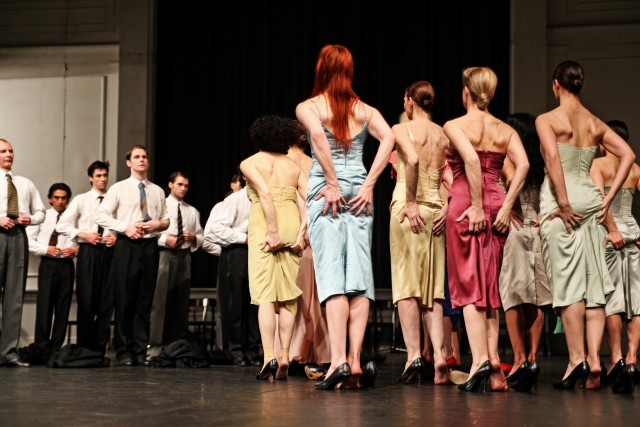
Tanztheater Wuppertal Pina Bausch’s KONTAKTHOF returns to BAM after nearly thirty years (photo by Oliver Look)
BAM Howard Gilman Opera House
Peter Jay Sharp Building
230 Lafayette Ave.
October 23 – November 2, $25-$110
718-636-4100
www.bam.org
www.pina-bausch.de/en
To celebrate Tanztheater Wuppertal Pina Bausch’s thirtieth anniversary of its New York debut at BAM — the German company presented Rite of Spring, 1980, Cafe Muller, and Bluebeard back in June 1984 — the innovative, influential, and highly entertaining troupe is bringing back one of its most famous works October 23 – November 2 at BAM’s Howard Gilman Opera House as part of the 2014 Next Wave Festival. First performed at BAM in October 1985, Kontakthof (“Courtyard of Contact”) is a playful look at the world of dance itself, as well-dressed men and women battle it out in an intensely physical competition with plenty of fun humor. The work, which includes music by Charlie Chaplin, Anton Karas, Nino Rota, Jean Sibelius, and Juan Llossas and costume and set design by Rolf Borzik, has been performed by teenagers and senior citizens since its premiere in 1978; at BAM, the current company will take the stage, led by such familiar mainstays as Rainer Behr, Dominique Mercy, Eddie Martinez, Julie Anne Stanzak, Franko Schmidt, Cristiana Morganti, Andrey Berezin, and the inimitable Nazareth Panadero. The company is continuing on following Bausch’s death in 2009 at the age of fifty-eight, with longtime TW dancer Lutz Förster as artistic director. It’s always an event when they come to Brooklyn, having dazzled dance-theater lovers with such thrilling productions as Vollmond (Full Moon), “…como el musguito en la piedra, ay si, si, si…” (Like moss on a stone), Danzón, Nefés, Masurca Fogo, and so many others over these last thirty years. If you’ve never seen this fabulous company in person, stop what you’re doing right now and pick up some tickets while they’re still left; you won’t be disappointed. You can also check out Wim Wenders’s Oscar-nominated Pina on Netflix to get a taste of what you’re in for. In conjunction with Kontakthof, on October 25 at 12 noon BAM and Dance Umbrella will present a free live stream of “Politics of Participation,” a cross-Atlantic panel discussion at King’s College with Penny Woolcock, Matt Fenton, Kenrick “H2O” Sandy, and Michael “Mikey J” Asante and at BAM with Stanzak and Simon Dove, moderated by Dr. Daniel Glaser. And on October 27 at 7:30, BAMcinématek will screen Dancing Dreams: Teenagers Dance Pina Bausch’s “Contact Zone,” followed by a Q&A with longtime Tanztheater Wuppertal members Bénédicte Billiet and Mercy, moderated by Marina Harss.
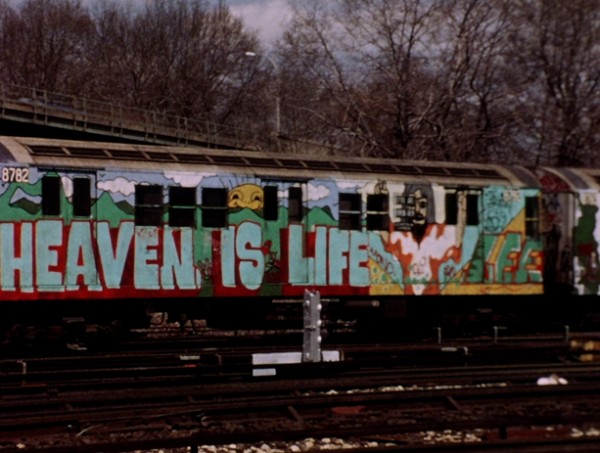
 Thirty-three years after screening at the New York Film Festival, Manfred Kirchheimer’s Stations of the Elevated is finally getting its official U.S. theatrical release, in a gorgeous new restoration showing at BAMcinématek October 17-23. In 1977, Manfred Kirchheimer, whose family escaped Nazi Germany in 1936, went to the Bronx and filmed graffiti-covered subway cars at the train depot and rushing across the elevated tracks, kids playing in a burned-out housing project, and giant billboards advertising hamburgers, cigarettes, alcohol, and suntan lotion. Shot on 16mm reversal stock, Stations of the Elevated is more than just a captivating document of a bygone era; it is a deeply poetic socioeconomic journey into class, race, art, and freedom of expression, told without a single word of narration or onscreen text. Instead, producer, director, editor, and photographer Kirchheimer (Colossus on the River, Bridge High with Walter Hess) shifts from the natural sound of the environment to a superb jazz score by Charles Mingus while cutting between shots of trains covered in tags and illustrations (and such phrases as “Heaven Is Life,” “Invasion of the Earth,” “Never Die,” and “Earth Is Hell”) by such seminal figures as Blade, Daze, Lee, Pusher, Shadow, and Slave and views of colorful billboards filmed peeking through the geometric architecture of the elevated railways and set against bright blue skies. Most often, the camera focuses on the painted eyes in the ads, looking right back at the viewer as they dominate the scene, evoking the optician’s ad in that famous novel of American class, The Great Gatsby. (The concentration on the eyes also predicts how Madison Ave. was watching the graffiti movement, eventually coopting the imagery into mainstream advertising.) Through this dichotomy of meaning and execution, Kirchheimer reveals similarities in artistic styles and how the elements influenced each other; a particularly telling moment occurs when a man is shown hand painting a billboard who could have just as well been spray painting a subway car.