this week in lectures, signings, panel discussions, workshops, and Q&As

THALIA DOCS: ROCKS IN MY POCKETS

ROCKS IN MY POCKETS

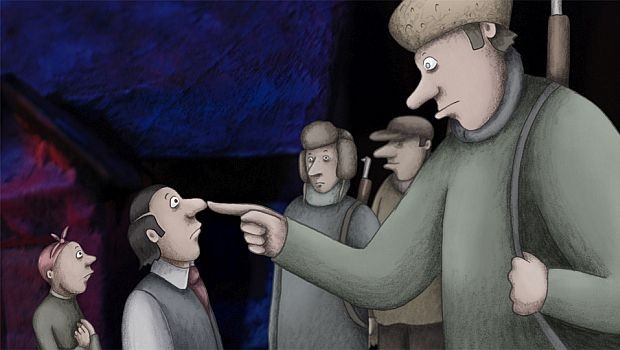
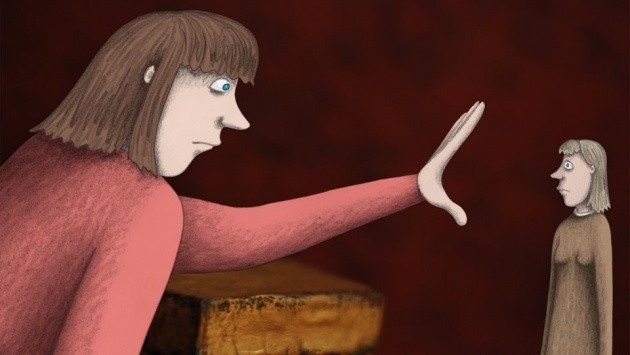
Signe Baumane examines her family history of suicide and depression in ROCKS IN MY POCKETS

ROCKS IN MY POCKETS: A CRAZY QUEST FOR SANITY (Signe Baumane, 2014)
Symphony Space, Leonard Nimoy Thalia
2537 Broadway at 95th St.
Sunday, October 19, $14, 7:00
212-864-5400
www.symphonyspace.org
www.rocksinmypocketsmovie.com

The recent suicide of Robin Williams shook the nation, once again pointing out that depression is no laughing matter. But Latvian-born, Brooklyn-based writer-director-producer-animator Signe Baumane takes a unique approach to depression and suicide in the darkly twisted animated film Rocks in My Pockets: A Crazy Quest for Sanity. Influenced by such animation giants as Jan Švankmajer and Bill Plympton in addition to Lithuanian-Polish illustrator Stasys Eidrigevicius and Russian animator Yuri Norstein, Baumane, a self-described “Master of Self Pity,” incorporates hand-drawn animation, papier-mâché constructions, and stop-motion animation in telling the story of her family’s long history of mental illness and suicide. Inspired by her own thoughts of ending it all, Baumane (Teat Beat of Sex), in her feature-length debut, divides the film into segments about her suicidal relatives. She narrates the tales of Indulis, an entrepreneur and failed counterfeiter with an “idea-generating brain”; Anna, a university graduate and secretary who falls in love with Indulis, her married boss; Miranda, who looks at the world as if everything were a work of art; Linda, a medical student with big dreams; Irbe, a lonely music teacher who hears voices in her head; and herself as they all experience various aspects of severe depression while facing the trials and tribulations of everyday life in a changing sociopolitical climate in Eastern Europe.

ROCKS IN MY POCKETS

ROCKS IN MY POCKETS uses twisted humor to explore some very serious subjects

Despite the serious topics and events — and the regular appearance of nooses tempting the protagonists — Rocks in My Pockets is filled with clever jokes, imaginative visual puns, beautiful imagery, and a playful score by Kristian Sensini; Baumane refers to it as “a funny film about depression,” and that’s just what it is. The animated characters make their way through lush forests, across a real chess board, and past other colorful backgrounds as reality strikes them hard. The personal nature of the film is enhanced by Baumane’s own narration, in her thick Latvian accent. (Her mother attempted to talk her out of doing the narration, thinking it was a bad idea.) “I want to survive, but I don’t want to live,” Baumane says halfway through the film. “When my brain is idle, it starts eating itself.” Fearing that depression and suicide are part of her DNA, she’s unsure how she can get away from it — and prevent it from affecting future generations of her family. Winner of the International Critics (FIPRESCI) Prize at the 2014 Karlovy Vary Film Festival and financed in part by a Kickstarter campaign (where you can learn more about the making-of process), Rocks in My Pockets will be screening October 19 at 7:00 as part of Symphony Space’s Thalia Docs series and will be followed by a Q&A with Baumane.

HALLOWEEN: THE HAUNTED PUMPKIN GARDEN

Spooky

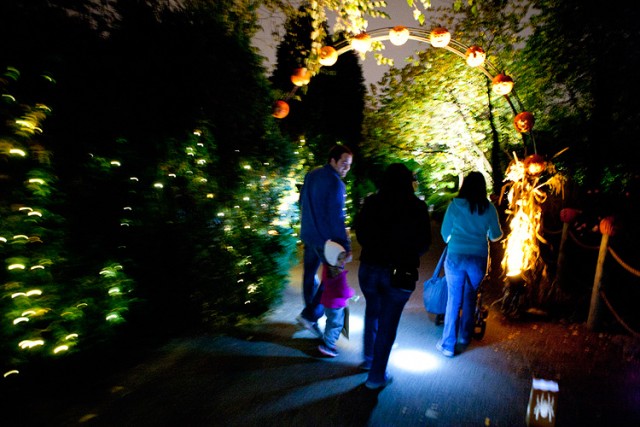
Haunted Pumpkin Garden at NYBG offers Spooky Nighttime Adventures

The New York Botanical Garden, Everett Children’s Adventure Garden
2900 Southern Blvd., Bronx (easily accessible via Metro-North)
Tuesday – Sunday through October 31 (special events October 18-19, 24-26, 31), $20
718-817-8700
www.nybg.org

The Haunted Pumpkin Garden opened last month at the New York Botanical Garden, featuring a vast array of pumpkins and gourds of all shapes and sizes. Continuing through All Hallow’s Eve, the display is accompanied by daily family-friendly activities in the Everett Children’s Adventure Garden, including interactive puppet shows, a pumpkin sprouting demonstration, a scavenger hunt, and parades (Tuesday – Friday, 1:30 – 5:30; Saturday & Sunday, 10:00 am – 5:30 pm). On October 18-19 and 25-26, there will also be a Creepy Creatures of Halloween picnic with live animals (12 noon & 2:00). On October 18 & 25, children (recommended eight and up) can participate in a Budding Masters Creepy Pumpkin Carving Adventure ($50, 10:00), while Spooky Nighttime Adventures take place October 18, 24-25, and 31 ($20, 6:30 & 7:15) with programs geared for children four to twelve; flashlights will be supplied as families encounter ghost stories at the Wild Wetland Trail gazebo, make trick-or-treat bags (and go trick-or-treating), decorate gourds, carve pumpkins, dissect owl pellets, and more. On October 18-19, pumpkin carver extraordinaire Ray Villafane will give demonstrations (10:00 am – 6:00 pm) and take part in Q&As with growers (12 noon – 4:00), while the giant pumpkins will make their way into the garden October 25-26.

BEIJING DANCE THEATER: WILD GRASS

WILD GRASS

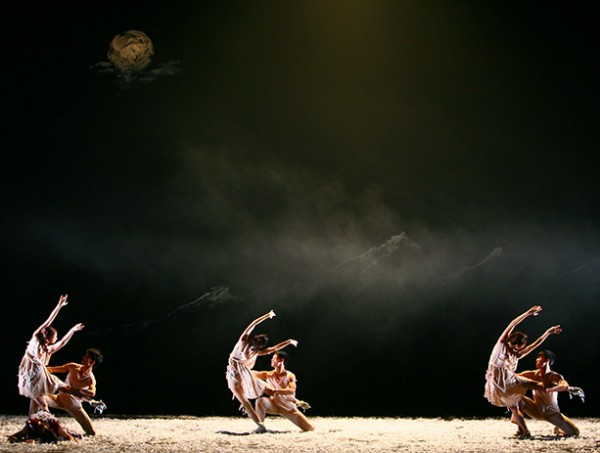
Beijing Dance Theater returns to BAM with poetry-inspired WILD GRASS (photo by Li Huimin)

NEXT WAVE FESTIVAL
Brooklyn Academy of Music
BAM Harvey Theater
651 Fulton St. between Ashland & Rockwell Pl.
October 15-18, $20-$40, 7:30
718-636-4100
www.bam.org
www.beijingdancetheater.org

Three years ago, China’s Beijing Dance Theater made its U.S. debut with the three-part Haze, an emotional, abstract examination of environmental and economic crises that was part of BAM’s 2011 Next Wave Festival. Founded in 2008 by choreographer Wang Yuanyuan, visual artist Tan Shaoyuan, and lighting and set designer Han Jiang, BDT is back in Brooklyn for the 2014 Next Wave Festival this week with another three-part presentation, Wild Grass. In choreographing the work, which combines tradition with modernity, Wang found inspiration in Lu Xun’s seminal 1927 prose-poetry collection, Wild Grass, also known as Yecao and Weeds, which includes such poems as “The Shadow’s Leave-Taking,” “My Lost Love,” “Revenge,” “Hope,” “Snow,” “Tremors of Degradation,” and “The Awakening.” The three sections, “Dead Fire,” “Farewell, Shadows!” (aka “Farewell of the Shadow”), and “Dance of Extremity,” each of which will have a different kind of floor, delve into the nature of human spirit and perseverance. The first movement, in BDT’s own poetic description, “has burning form but no flickering. It stands frozen like corals, with black smoke curdled on its tips that makes you wonder whether it has just emerged from a house on fire — and that is why it looks burnt and dead.” That is followed by “Farewell, Shadows!,” in which “I linger between light and darkness; know not whether it is dusk or dawn. Let me raise my ashen grey hand and feign a toast; I shall journey far, far away, unbeknownst to all.” The evening concludes with “Dance of Extremity,” where “there remains only the vast wilderness; this dried couple, completely naked, sword in hand, stand in the middle. With dead men’s eyes they observe with gusto the withering passers-by in a great bloodless carnage. They are eternally plunged into life’s giddy, excruciating bliss.” Wild Grass runs October 15-18 at BAM’s Harvey Theater; on October 18, Wang will lead an afternoon class at the Mark Morris Dance Center for experienced and professional dancers ($25, 3:00).

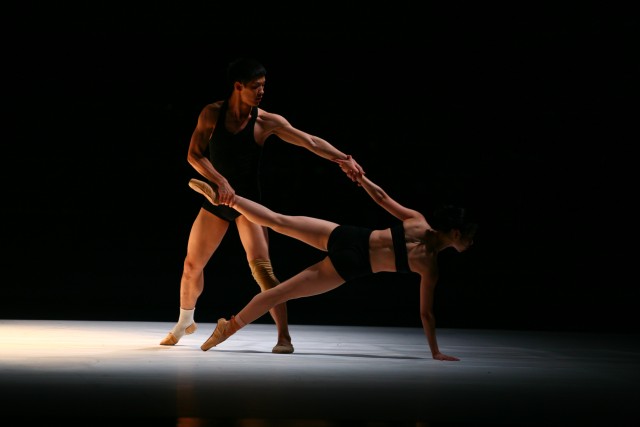
Dancers glide across the stage in “Farewell, Shadows,” second section of WILD GRASS (photo by Jan Jiang)

Dancers glide across the smooth stage in “Farewell, Shadows,” second section of WILD GRASS (photo by Jan Jiang)

Update: As with Beijing Dance Theater’s 2011 U.S. debut at BAM, Haze, the company’s 2014 Next Wave Festival presentation, Wild Grass, is very much about surface. However, while the three sections take place on three different floor surfaces, artistic director, choreographer, and cofounder Wang Yuanyuan and the dancers never quite get below the surface in the work, which was inspired by the prose poetry of writer and activist Lu Xun. The fourteen dancers are individually technically proficient, but they never really catch fire as a unit, although Wu Shanshan stands out when she invigorates the second part with passion and humor otherwise missing from the evening. At several points, it’s possible to see how the dancers prepare their bodies for what is going to happen next, like a baseball hurler telegraphing his pitches. The first movement, “Dead Fire,” set to a minimalist piano score composed by Su Cong and played by He Peixun, takes place on a standard black dance floor that is continually littered with paper confetti that evokes snow, with the moon and white-capped mountains on the backdrop; “Farewell, Shadows” features electronic music by Biosphere and Kangding Ray and a slippery white floor across which the women glide, towed by male dancers; and “Dance of Extremity” has music composed by Wang Peng, with Yahg Rui on violin and Wang Zhilin on cello, as the dancers trudge through a straw-covered field that rises slightly in one corner, where a man stands next to a hanging rope. To paraphrase what we said in our review of Haze, there’s a lot to admire about Wild Grass, but Wang never quite achieves the narrative flow she aspires to.

JEFF KOONS: A RETROSPECTIVE

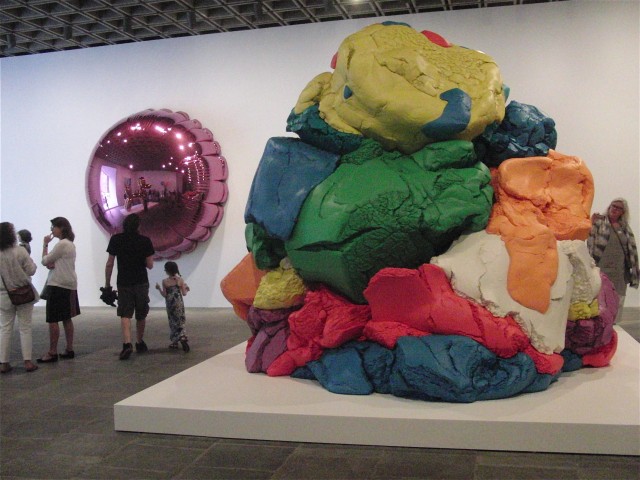
Jeff Koons, “Moon (Light Pink),” mirror-polished stainless steel with transparent color coating, 1995-2000, and “Play-Doh,” polychromed aluminum, 1994-2014 (photo by twi-ny/mdr)

Jeff Koons, “Moon (Light Pink),” mirror-polished stainless steel with transparent color coating, 1995-2000, and “Play-Doh,” polychromed aluminum, 1994-2014 (photo by twi-ny/mdr)

Whitney Museum of American Art
945 Madison Ave. at 75th St.
Through Sunday, October 19, $16-$20 (pay-what-you-wish Fridays, 6:00 – 9:00)
212-570-3600
www.whitney.org

Perhaps no other living contemporary artist elicits such a vast range of emotions and responses at the mere mention of his name than Jeff Koons. For three dozen years, Koons has been giving the people what they want while confounding and angering his many, many critics. “From the beginning, Jeff Koons provoked superlatives. Mere adjectives seemed insufficient to describe the jolt of his art — and soon him,” curator Scott Rothkopf writes in his essay “No Limits” in the catalog for the museumwide exhibition “Jeff Koons: A Retrospective,” which runs through October 19 at the Whitney. “As far as art and artists are concerned, shock, fame, expense, controversy, subversiveness, and ambition are certainly not accepted unanimously as virtues. Finally, it must be said that not one of these claims . . . could be verified as true.” From a purely aesthetic point of view, Koons’s vast oeuvre, primarily works in series that often involve the readymade, is colorful and engaging, inviting and personable, even as it induces even the least jaded individual to wonder, “But is it art?” Accepting it as art without question, I found myself, as I walked through the retrospective, transported back to my childhood, happily besieged by recollections popping into my head that I hadn’t thought about for years. “Unlike many artists, for whom a conventional American hometown was a place to escape, Koons continues to draw on his boyhood home of York, Pennsylvania, as a primary source of inspiration,” writes Jeffrey Deitch in his catalog essay, “York to New York,” adding, “The city has remained central to his life as an artist, and he returns there almost every weekend. Koons retains an extraordinary ability to access his early childhood memories and build on them in creating his art. He can recall childhood visions and the emotions that accompanied them as if they are happening in the present. He claims even to remember being in his crib. Koons is able to experience these images not just as fleeting memories but as deep aesthetic structures that can be channeled into artistic form.”
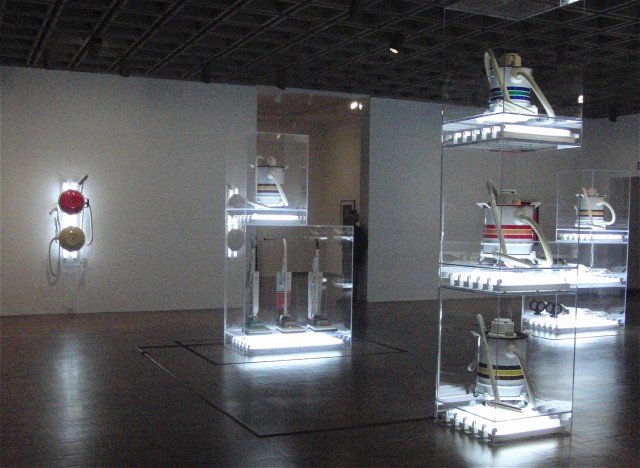
Jeff Koons’s Hoover installations are part of “The New” series from the 1980s (photo by twi-ny/mdr)

Jeff Koons’s Hoover installations are part of “The New” series from the 1980s (photo by twi-ny/mdr)

For me, winding my way through the nearly 150 paintings, sculptures, and installations was an immensely pleasurable journey into my own past. Koons’s vacuum-cleaner pieces, such as “New Hoover Convertibles Green, Blue, New Hoover Convertibles Green, Blue Doubledecker,” from his 1980s series “The New,” had me back in the den, trying to hear my favorite Saturday-morning cartoons as my mother vacuumed the house, while the lithograph-on-cotton billboard “New Rooomy Toyota Family Camry” reminded me of when my father came home with a new Dodge Charger. Koons’s “One Ball,” “Two Ball,” “Three Ball” works featuring basketballs suspended in water tanks, from the “Equilibrium” series, reminded me of when we realized that my father had put up our backyard basketball hoop too high, at more than ten feet. The “Luxury and Degradation” series of oils consists of reproductions of booze ads, along with a stainless-steel ice bucket and “Travel Bar,” that sent me back to memories of my friends and I raiding my parents’ liquor cabinet when they were away. Polychromed wood and porcelain figures from the “Banality” series — Koons’s series titles are another important part of his own self-evaluation, intentions, and art-historical references — had me thinking of the tchotchkes my mother collected and displayed in the living room. And “Made in Heaven,” comprising revealing paintings and sculptures of Koons having sex with Hungarian-born Italian porn star and politician Illona Staller — shortly thereafter they were married, had a son, and then divorced — sent me back to the day I found my father’s hidden stash of Playboy magazines and Swedish blue movies.
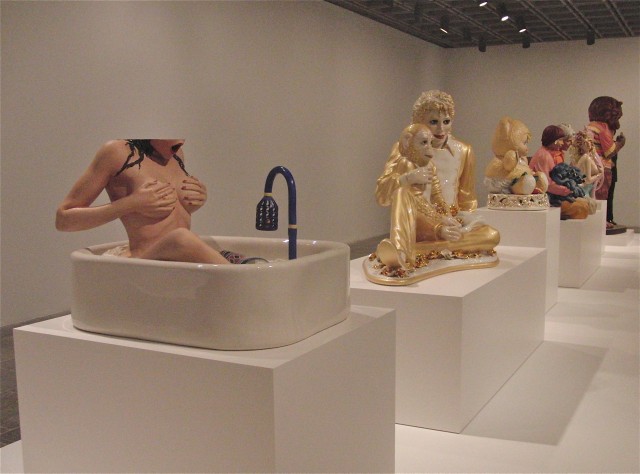
Jeff Koons’s “Banality” series offers different views of domesticity and life as kitsch (photo by twi-ny/mdr)

Jeff Koons’s “Banality” series offers different views of domesticity and life as kitsch (photo by twi-ny/mdr)

Of course, Koons’s recurring use of animals and toys, including stainless-steel balloon dogs, a bronze Hulk, an inflatable bunny, a granite gorilla and Popeye, an oil painting of a slice of birthday cake, and an adorable (if crucifixion-like) polyethylene cat on a clothesline, evoke more universal childhood memories. In addition, many of his works involve mirrors and mirror-polished stainless steel, from the enormous balloon dogs to crystal-glass depictions of the heads of a giraffe, a kangaroo, a walrus, and other animals, as well as the lovely “Hanging Heart (Violet/Gold)”; children and adults flock to see their reflections in these pieces and take pictures of themselves in them, as if they are part of the exhibition, at least for a moment, creating new (digital) memories. However, despite their seemingly overt simplicity, much of Koons’s output took years to fabricate, as new machination procedures had to be developed in order for them to come into existence. Wall text highlights fascinating details about Koons’s construction techniques, adding a level of depth to works that are often ridiculed as simplistic and, well, banal. The centerpiece of the show, and perhaps the single piece that is most representative of Koons’s mind-set, is “Play-Doh” (1994-2014), a large-scale polychromed-aluminum rendition of multiple blobs of different-colored Play-Doh reaching ten feet high and nine feet wide. “‘Play-Doh’ is a deceptively simple sculpture,” Rothkopf explains on the audio guide. “I say ‘deceptive’ because it’s one of the most technically challenging objects in the entire exhibition and one that Koons has been working on for twenty years and completed, in fact, just in June. The idea for this work originally came about out of a mound of Play-Doh that his son, Ludwig, made. Koons talks about his interest in this object being the freedom that the child had to express himself.” That essentially sums up where Koons is coming from, a place inside himself, and each of us, that we all can relate to, the freedom that childhood offers. Eventually, we grow up and move on to other things, saying goodbye to childhood, which is a shame, as this retrospective — which in its own way is helping us all say farewell to Marcel Breuer’s familiar building (the Koons show is the last in the Upper East Side space, as the Whitney moves next year to a new home in the Meatpacking District, designed by Renzo Piano) — is a love letter to the glories of being a kid and retaining at least some of that innocence. The Whitney will celebrate the end of the exhibit and the closing of the building with a marathon viewing for the final weekend, remaining open from 11:00 am on Saturday, October 18, through 11:00 pm on Sunday, October 19. Koons will be at the museum on Saturday night at 9:00 to sign copies of the exhibition catalog, while Rothkopf will participate in a Q&A Saturday at midnight.

THE POETRY OF BASKETBALL WITH WALT “CLYDE” FRAZIER

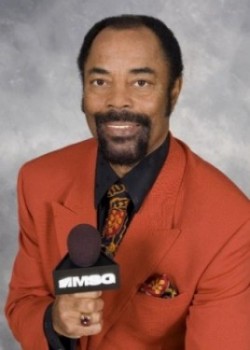
Walt Frazier will discuss poetry and hoops in City Lore fundraiser

Walt Frazier will discuss poetry and hoops in City Lore fundraiser

City Lore Gallery
56 East First St. between First & Second Aves.
Thursday, October 16, $40, 7:00
212-529-1955
www.citylore.org

“I began announcing nine years after I ended my playing career, and I had to catch up with some new terminology,” New York Knicks basketball legend Walt “Clyde” Frazier wrote in the afterword to the 2010 edition of his 1974 book, Rockin’ Steady: A Guide to Basketball & Cool. “‘Dishing’ was passing off. So in time I would add ‘swishing.’ ‘Dishing and swishing’ became one of my trademark calls. Then came ‘wheeling and dealing,’ and ‘believing and achieving.’ The blackboard was now generally called ‘the glass,’ and so when there was an exceptional rebound pulled down, it was ‘splendor on the glass.’” The Hall of Famer, who practiced saying such words as ubiquitous, tenacious, and mesmerizing in the mirror after seeing them used in articles on arts and entertainment, will be at City Lore on October 16 for the special program “The Poetry of Basketball,” a fundraiser for the organization whose mission is to “document, present, and advocate for New York City’s grassroots cultures to ensure their living legacy in stories and histories, places and traditions.” The Atlanta-born Frazier, one of the all-time-stylish New Yorkers and captain of the Knicks’ 1970 and 1973 championship teams, also uses such phrases as “hustling and bustling,” “bounding and astounding,” “posting and toasting,” “shaking and baking,” and “hacking and whacking,” is as cool and smooth away from the arena as he is in it, and opinionated as well, so get ready for plenty of “moving and grooving,” “stopping and popping,” “dancing and prancing,” and maybe even some “draining and paining.”

HALLOWEEN IN NYC: A NITE TO DISMEMBER 2014

MIDNITE SCREENINGS / ONE NITE ONLY
Nitehawk Cinema
136 Metropolitan Ave. between Berry St. & Wythe Ave.
Friday, October 31, $50, 12 midnight
718-384-3980
www.nitehawkcinema.com

Last year Williamsburg’s Nitehawk Cinema celebrated Halloween with the inaugural Nite to Dismember, an all-night horror-movie marathon that included An American Werewolf in London, Burn Witch Burn, Fright Night, The Burning, and Dawn of the Dead. For the second annual event, which begins at midnight on Halloween, Nitehawk will be honoring the sequel with an all-night marathon of horror sequels. The frightful fun begins with a 35mm screening of Sam Raimi’s Evil Dead II, which is really more of a parody remake, followed by digital projections of James Whale’s The Bride of Frankenstein, Steve Miner’s Friday the 13th: Part 2, Terence Fisher’s Dracula: Prince of Darkness (with Christopher Lee and dubbed Scream Queen Barbara Shelley), and Dan O’Bannon’s The Return of the Living Dead, with the Pathmark man himself, James (Poltergeist) Karen. In addition, there will be horror shorts, trivia, giveaways, and a costume contest, all hosted by Fangoria’s Sam Zimerman and Nitehawk’s Kris King, eighteen and over only, please. This is likely to sell out well in advance, so don’t wait to get tickets for this sequel-filled sequel. (Keep on watching twi-ny as we highlight other crazy, weird, funny, scary, bizarre, wacky, eclectic, and downright stupid things to do for Halloween this year.)

MY DOG LOVES CENTRAL PARK FAIR

Central Park Fair

There should be lots of high-fiving at twelfth annual My Dog Loves Central Park Fair

Naumburg Bandshell, midpark at 72nd St.
Saturday, October 11, free, 11:00 am – 3:00 pm
www.centralparknyc.org

A plethora of puppies will parade around Central Bark — er, Central Park — on October 11 for the twelfth annual My Dog Loves Central Park Fair. The deluge of doggies will descend on the Naumburg Bandshell, where pups and their owners can participate in such games and events as Tic-Tac-Dog, Tricks for Treats, the Woof Wheel, Pooch Pinko, and Dancing with Your Dog; get tips from Behavior Matters director Parvene Farhoody; receive microchips from the Mayor’s Alliance for New York City’s Animals; apply for or renew dog licenses from the New York City Department of Health and Mental Hygiene; test their skill on an agility course; and take part in the Paws Promenade and the world’s largest dog selfie. There will also be educational information, a Bark Boutique supporting fair hosts Central Park Paws and the Central Park Conservancy, canine makeovers, the Freshpet Food Truck, and a Family Fun Zone with therapy dogs, a scavenger hunt, Halloween-themed stenciling, interactive storytelling, and face painting.