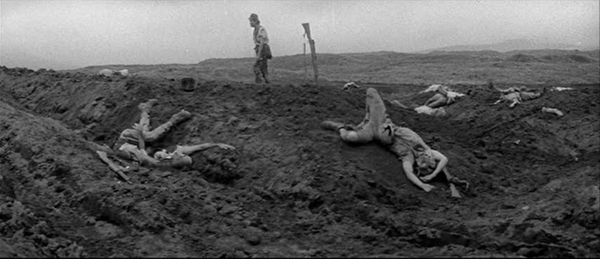
Kon Ichikawa’s harrowing FIRES ON THE PLAIN is part of War Against War sidebar of 2015 New York Jewish Film Festival
FIRES ON THE PLAIN (NOBI) (Kon Ichikawa, 1959)
Film Society of Lincoln Center, Walter Reade Theater
165 West 65th St. between Eighth Ave. & Broadway
Monday, January 19, 1:00
Festival runs January 14-29 at the Film Society of Lincoln Center and the Jewish Museum
212-875-5050
www.nyjff.org
www.filmlinc.com
 Kon Ichikawa’s Fires on the Plain is one of the most searing, devastating war movies ever made. Loosely based on Shohei Ooka’s 1952 novel and adapted by Ichikawa’s wife, screenwriter Natto Wada, the controversial film stars Eiji Funakoshi as the sad sack Tamura, a somewhat pathetic tubercular soldier on the island of Leyte in the Philippines at the tail end of World War II. After being released from a military hospital, he returns to his platoon, only to be ordered to go back to the hospital so as not to infect the other men. He is also given a grenade and ordered to blow himself up if the hospital refuses him, which it does. But instead of killing himself, Tamura wanders the vast, empty spaces and dense forests, becoming involved in a series of vignettes that range from darkly comic to utterly horrifying. He encounters a romantic Filipino couple hiding salt under their floorboards, a quartet of soldiers stuffed with yams trying to make it alive to a supposed evacuation zone, and a strange duo selling tobacco and eating “monkey” meat. As Tamura grows weaker and weaker, he considers surrendering to U.S. troops, but even that is not a guarantee of safety, as the farther he travels, the more dead bodies he sees. Fires on the Plain is a blistering attack on the nature of war and what it does to men, but amid all the bleakness and violence, tiny bits of humanity try desperately to seep through against all the odds. And the odds are not very good. Fires on the Plain is screening January 19 at 1:00 at the Walter Reade Theater as part of the War Against War sidebar program of the twenty-fourth annual New York Jewish Film Festival, which focuses on antiwar films from the 1950s and 1960s; the schedule also includes Gillo Pontecorvo’s Battle of Algiers, Stanley Kubrick’s Fear and Desire, Konrad Wolf’s I Was Nineteen, Jean-Luc Godard’s Les Carabiniers, and Peter Watkin’s The War Game, anchored by a panel discussion on January 19 at 3:00 at the Elinor Bunin Munroe Film Center (free with advance RSVP) with Kent Jones, Martha Rosler, Harrell Fletcher, and Trevor Paglen, moderated by Jens Hoffmann.

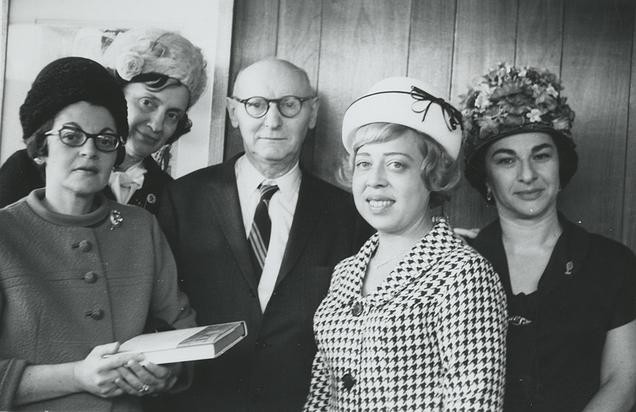
 Who ever thought that little old Yiddish mensch Isaac Bashevis Singer was such a horndog? Asaf Galay and Shaul Betser begin The Muses of Bashevis Singer, their light and playful documentary, with the following quote from the Nobel Prize-winning author: “In my younger days I used to dream about a harem full of women. Lately I’m dreaming of a harem full of translators. If those translators could be women in addition, this would be paradise on earth.” Well, it seems that Singer, who was born in Poland in 1902, emigrated to the United States in 1935, and died in Florida in 1991 at the age of eighty-eight, found that paradise, as Galay and Betser meet with a series of women who were among many hand-picked by Singer, the man who nearly singlehandedly preserved Yiddish literature in the twentieth century, to serve as his translators, and not necessarily because of their language skills. “There were certain women who were more than just translators to him. It happened quite often,” says his Swedish publisher, Dorothea Bromberg, who also talks about Alma, Singer’s wife of more than fifty years. “He loved her, I’m sure, in his own way,” she adds. “She was very jealous of him, and she was completely right.” Galay and Betser meet with translators Eve Fridman, Evelyn Torton Beck, Dvorah Telushkin, Marie-Pierre Bay, Duba Leibell, and Dr. Bilha Rubenstein as well as Singer biographers Florence Noiville and Janet Hadda, his granddaughters Hazel Karr and Merav Chen-Zamir, Yentl the Yeshiva Boy playwright Leah Napolin, and his longtime secretary and proofreader, Doba Gerber, who share intimate, surprising tales about the author of such books as The Family Moskat, The Magician of Lublin, Shosha, and Enemies, a Love Story and such short stories as “Gimpel the Fool,” “A Friend of Kafka,” and “Zlateh the Goat.”
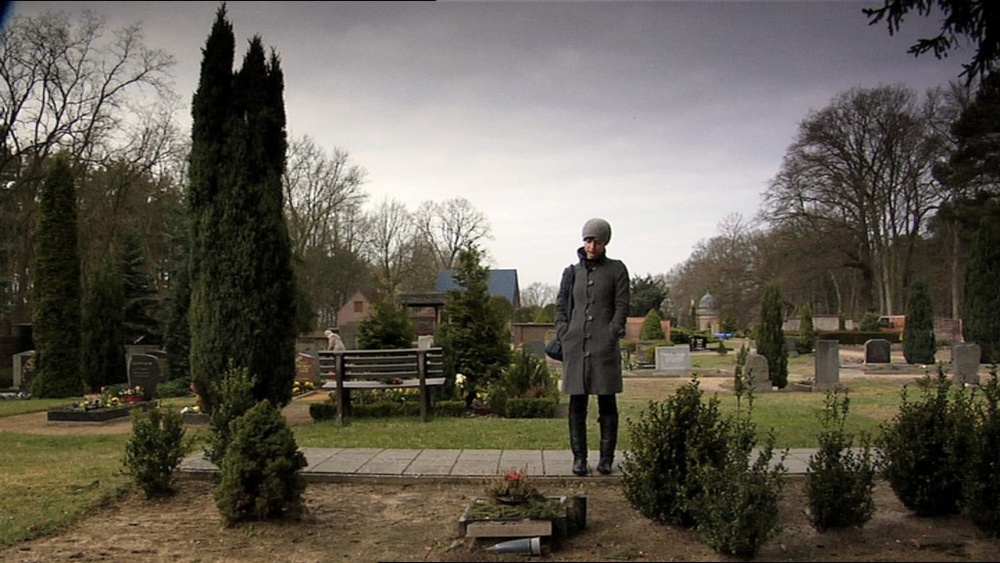
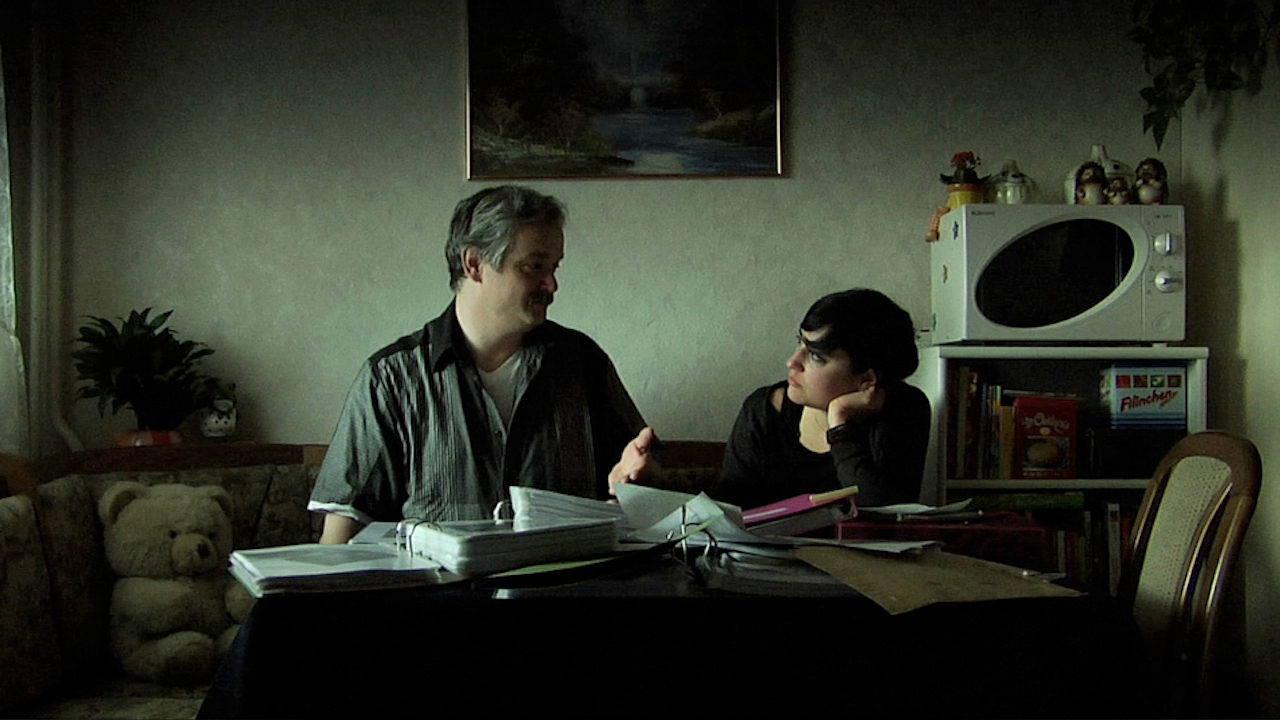
 Named Best Documentary at the 2013 Haifa International Film Festival, Yael Reuveny’s Farewell, Herr Schwarz offers a unique look at the Holocaust and its continuing effects on her and her family through three generations. “We were raised to reject the Diaspora,” the Israeli-born, Berlin-based writer and director says near the beginning of her first feature-length film. “I was supposed to be ‘the new Jew’ but somehow I ended up living in Germany, in the land I wasn’t allowed to set foot in. I wasn’t allowed to be here because of my grandmother’s story. But still, her story, which haunted my childhood, eventually made me build my home here.” And a haunting story it is, filled with intrigue, mystery, and powerful emotions. Sensitively shot by cinematographer Andreas Kohler and featuring an elegiac score by Volker “Hauschka” Bertelmann, the film explores what happened between Reuveny’s grandmother, Michla Schwarz, and Michla’s beloved brother, Feiv’ke. During the war, Feiv’ke was sent to the Schleiben concentration camp in Germany, where Michla thought he perished. Yet Reuveny discovers that her great-uncle actually survived the Holocaust but remained in the same town he had been held in, changing his first name to Peter, marrying a non-Jewish German woman whose brother was a Nazi, and starting a family.