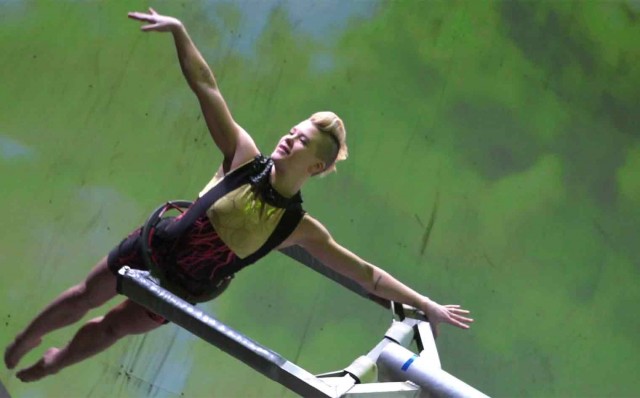
Documentary reveals how Elizabeth Streb and her Extreme Action Company (including Jackie Carlson, seen here) take dance to a whole new level
BORN TO FLY: ELIZABETH STREB vs. GRAVITY (Catherine Gund, 2014)
Symphony Space, Leonard Nimoy Thalia
2537 Broadway at 95th St.
Sunday, December 21 & 28 and January 4, $14, 4:30
212-864-5400
www.symphonyspace.org
www.borntoflymovie.com
 Over the last several years, New Yorkers have gotten the chance to see Elizabeth Streb’s Extreme Action Company perform such dazzling works as Ascension at Gansevoort Plaza, Kiss the Air! at the Park Avenue Armory, and Human Fountain at World Financial Center Plaza as her team of gymnast-dancer-acrobats risk their physical well-being in daring feats of strength, stamina, durability, and grace. In addition, Streb herself walked down the outside wall of the Whitney as part of a tribute to one of her mentors, Trisha Brown. Now Catherine Gund takes viewers behind the scenes in the exhilarating documentary Born to Fly: Elizabeth Streb vs. Gravity, going deep into the mind of the endlessly inventive and adventurous extreme action architect and the courage and fearlessness of her company. Gund follows Streb as she discusses her childhood, her dance studies, the formation of STREB in 1985, and her carefully thought out views on space, line, and movement as her work stretches the limits of what the human body can do. “I think my original belief and desire is to see a human being fly,” Streb says near the beginning of the film, which includes archival footage of early performances, family photos, and a warm scene in which the Rochester-born Streb and her partner, Laura Flanders, host a dinner party in their apartment, cooking for Bill T. Jones, Bjorn Amelan, Anne Bogart, Catharine Stimpson, and A. M. Homes.
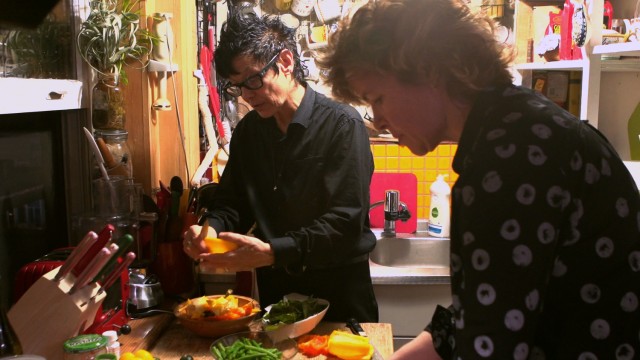
Elizabeth Streb and her partner, Laura Flanders, prepare for a dinner party in new documentary
Gund also speaks with current and past members of the talented, ever-enthusiastic company — associate artistic director Fabio Tavares, Sarah Callan, Jackie Carlson, Leonardo Giron, Felix Hess, Samantha Jakus, Cassandre Joseph, John Kasten, and Daniel Rysak — who talk about their dedication to Streb’s vision while using such words as “challenge,” “velocity,” “endurance,” “magic,” “invincibility,” and “risk” to describe what they do and how they feel about it. Gund focuses on the latter, as virtually every one of Streb’s pieces is fraught with the possibility of serious injury, as evidenced by their titles alone: Fly, Impact, Rebound, Breakthru, and Ricochet, not to mention the use of such materials as spinning I-beams, plastic barricades, dangling harnesses, and a rotating metal ladder. “I have to be able to ask someone to do that and be okay about it. Those aren’t easy requests,” Streb explains. “Knowing where you are is how you survive the work,” adds former STREB dancer Hope Clark. Gund goes with Streb to her doctor, where the choreographer describes what happened to her gnarled feet, and also meets with former dancer DeeAnn Nelson Burton, who had to retire after breaking her back. The film concludes with an inside look at STREB’s spectacular “One Extraordinary Day,” a series of hair-raising site-specific events staged for the 2012 London Olympics at such locations as the Millennium Bridge, the London Eye, and the sphere-shaped city hall, photographed by documentary legend Albert Maysles. In her Kickstarter campaign, Gund (Motherland Afghanistan, A Touch of Greatness) said, “Action architect Elizabeth Streb has reinvented the language of movement. [Born to Fly] will rewrite the language of documentary.” That’s a bold declaration, but the film does have a lot of the same spirit that Streb displays in her awe-inspiring work. Born to Fly is screening December 21 & 28 and January 4 at 4:30 as part of Symphony Space’s ongoing Thalia Docs series.

 Back in October, a