this week in lectures, signings, panel discussions, workshops, and Q&As

ORSON WELLES 100: CITIZEN KANE

Orson Welles masterpiece kicks off centennial celebration of controversial auteur’s birth

CITIZEN KANE (Orson Welles, 1941)
Film Forum
209 West Houston St.
January 1-8
Series continues through February 3
212-727-8110
www.filmforum.org
www2.warnerbros.com

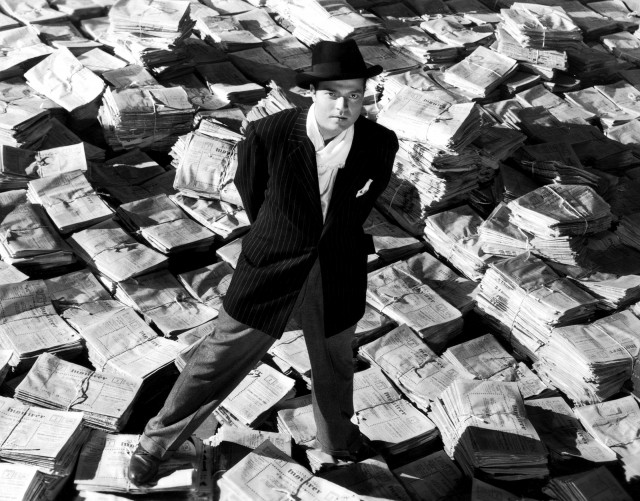
Film Forum is ringing in 2015 with the greatest American movie ever made, the epic Citizen Kane, kicking off a massive centennial celebration of the birth of its creator, the rather iconoclastic writer, director, producer, actor, and wine spokesman Orson Welles. In 1941, a young, brash, determined Welles shocked Hollywood with a masterpiece unlike anything seen before or since — a beautifully woven complex narrative with a stunning visual style (compliments of director of photography Gregg Toland) and a fabulous cast of veterans from his Mercury radio days, including Everett Sloane, Joseph Cotten, Ray Collins, Paul Stewart, and Agnes Moorehead. Each moment in the film is unforgettable, not a word or shot out of place as Welles details the rise and fall of a self-obsessed media mogul. The film is prophetic in many ways; at one point Kane utters, “The news goes on for twenty-four hours a day,” foreseeing today’s 24/7 news overload. And it doesn’t matter if you’ve never seen it and you know what Rosebud refers to; the film is about a whole lot more than just that minor mystery. Like every film the Wisconsin-born Welles made, Citizen Kane was fraught with controversy, not the least of which was a very unhappy William Randolph Hearst seeking to destroy the negative of a film he thought ridiculed him. Kane won only one Oscar, for writing — which also resulted in controversy when Herman J. Mankiewicz claimed that he was the primary scribe, not Welles. The film lost the Academy Award for Best Picture to John Ford’s How Green Was My Valley, but it has topped nearly every greatest-films-of-all-time list ever since.

Orson Welles

Orson Welles was one of a kind, as splendid Film Forum series shows

A classic American story that never gets old, Citizen Kane, in a 4K restoration, will run at Film Forum January 1-8, igniting “Orson Welles 100,” a four-week festival programmed by Bruce Goldstein along with consultant Joseph McBride, author of What Ever Happened to Orson Welles? A Portrait of an Independent Career. Welles’s career was fraught with controversy, with battles over editorial control, finances, and politics, with more unfinished projects than completed ones. As McBride points out at the start of his 2006 book, “‘God, how they’ll love me when I’m dead!’ Welles was fond of saying in his later years, with a mixture of bitterness and ironic detachment. But that’s a half-truth at best. More than two decades after Welles’s death, his career is, in a very real sense, still flourishing. But it is a disturbing irony that Welles is more ‘bankable’ now than when he was living.” The Film Forum series confirms this statement, consisting of more than thirty films that Welles directed and/or appeared in, including multiple versions of Touch of Evil and Macbeth; the lineup ranges from the familiar (The Magnificent Ambersons, The Third Man, Compulsion, A Man for All Seasons) to the obscure (Prince of Foxes, The Black Rose, Man in the Shadow, Black Magic), from the Shakespearean (Chimes at Midnight, Macbeth, Othello) to the Muppets (The Muppet Movie). Among the double features are The Immortal Story and F for Fake, The Stranger and Journey into Fear, and Jane Eyre and Tomorrow Is Forever. McBride will be on hand to present the rarities collection “Wellesiana” as well as the “Preview version” of Touch of Evil on January 14 and the “Scottish version” of Macbeth on January 16, joined by Welles’s daughter Chris Welles Feder.

FIRST SATURDAY: “CROSSING BROOKLYN” ARTISTS’ CHOICE

Brooklyn Museum
200 Eastern Parkway at Washington St.
Saturday, January 3, free, 5:00 – 11:00
212-864-5400
www.brooklynmuseum.org

The Brooklyn Museum welcomes in 2015 by handing over the reins of its free monthly First Saturdays program to several of the artists featured in “Crossing Brooklyn: Art from Bushwick, Bed-Stuy, and Beyond,” which concludes on January 4. The night before, curators Eugenie Tsai and Rujeko Hockley will discuss the exhibition at 5:30, “Crossing Brooklyn” artist Linda Goode Bryant will talk about urban farming at 6:15, jazz percussionist Ches Smith will activate David Horvitz’s forty-seven suspended bells as part of a site-specific musical composition at 6:30, and BFAMFAPhD (Blair Murphy, Susan Jahoda, and Vicky Virgin) will delve into the nature of creativity and debt at 7:15. “‘Crossing Brooklyn’ Artists’ Choice” also features live performances by Snarky Puppy, DJ Selly and DJ Asen from Fon, ventriloquist Nigel “Docta Gel” Dunkley (telling the story of Cindy Hot Chocolate from Geltown), immersive dance company Ani Taj and the Dance Cartel, Fela! veterans Chop and Quench led by Sahr Ngaujah, and spoken word poets Corina Copp, Patricia Spears Jones, Rickey Laurentiis, and Charles North as well as Greg Barris’s “Heart of Darkness” comedy showcase with Janeane Garofalo and Ilana Glazer, a print-making art workshop, a creative writing workshop led by Jaime Shearn Coan, and D’hana Perry’s multimedia improvisational “LOOSE.” In addition, you can check out such exhibitions as “Revolution! Works from the Black Arts Movement,” “Judith Scott — Bound and Unbound,” and “Chitra Ganesh: Eyes of Time.”

CHARLES BUKOWSKI MEMORIAL READING 2015

bukowski

Who: Three Rooms Press Presents the Monthly @ Cornelia Street Cafe
What: Eighth Annual Charles Bukowski Memorial Reading
Where: Cornelia Street Cafe, 29 Cornelia St., 212-989-9319
When: Friday, January 2, $12 (includes one drink), 6:00 pm
Why: Bicarbonate of Bukowski Tribute Readings with Kim Addonizio, Richard Vetere, Michael Puzzo, Puma Perl, Thomas Fucaloro, Peter Carlaftes, and anyone else who signs up before 6:00, hosted by Kat Georges and featuring rare videos, oral history, prizes, and more

NEW YEAR’S DAY MARATHON BENEFIT READING

John Giorno will once again be part of the New Years Day Marathon Reading at the Poetry Project

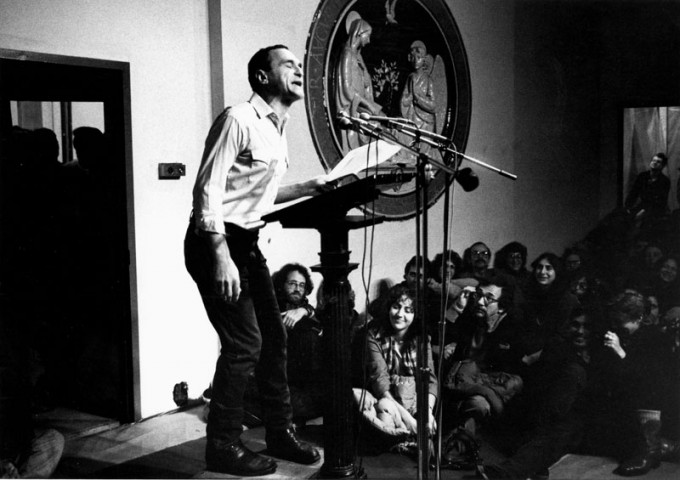
John Giorno will once again be part of the New Year’s Day Marathon Benefit Reading at the Poetry Project (photo by Sarah Wells 1981)

Who: The Poetry Project
What: Forty-first Annual New Year’s Day Marathon Benefit Reading
Where: The Poetry Project at St. Mark’s Church, 131 East Tenth St., 212-674-0910
When: Thursday, January 1, $20, 2:00 pm – 12 midnight
Why: More than 140 poets, including Anne Waldman Anselm Berrigan, Bob Rosenthal, CAConrad, Dael Orlandersmith, Eileen Myles, Elinor Nauen, Matt Longabucco & Nicole Eisenman, JD Samson, John Giorno, John S. Hall, Jonas Mekas, Kristin Prevallet, Lenny Kaye, Luciana Achugar, Matthew Shipp, Monica de la Torre, Nick Hallett, Penny Arcade, Philip Glass, Steve Dalachinsky, Thomas Sayer Ellis and James, Yuko Otomo, and Vito Acconci

JANUARY PERFORMANCE FESTIVALS

Who: COIL
What: Interdisciplinary festival featuring dance, theater, music, art, and discussion, organized by PS 122
Where: Baryshnikov Arts Center, Chocolate Factory, Vineyard Theatre, Invisible Dog Art Center, the Swiss Institute, Asia Society, Parkside Lounge, New Ohio Theatre, Danspace Project, Times Square
When: January 2-17, free – $30
Why: Dancers and choreographers Molly Lieber and Eleanor Smith in Rude World; Temporary Distortion’s durational multimedia live installation My Voice Has an Echo in It; Faye Driscoll’s extraordinary, interactive Thank You for Coming: Attendance; Alexandra Bachzetsis’s Diego Velázquez-inspired From A to B via C

Who: Under the Radar Festival and Incoming!
What: Interdisciplinary festival featuring dance, theater, music, and art, organized by the Public Theater
Where: The Public Theater, 425 Lafayette St., and La MaMa, 74 East Fourth St.
When: January 7-18, free – $40
Why: Daniel Fish’s A (radically condensed and expanded) Supposedly Fun Thing I’ll Never Do Again based on audio recordings of David Foster Wallace; Marie-Caroline Hominal’s The Triumph of Fame, a one-on-one performance inspired by Petrarch’s “I Trionfi”; Taylor Mac’s A 24-Decade History of Popular Music: 1900-1950s; Toshi Reagon’s Octavia E. Butler’s Parable of the Sower: The Concert Version; Reggie Watts’s Audio Abramović, in which Watts will go eye-to-eye with individuals for five minutes

Who: American Realness
What: Interdisciplinary festival featuring dance, theater, music, art, conversation, discussion, readings, and a workshop, organized by Abrons Arts Center
Where: Abrons Arts Center, 466 Grand St.
When: January 8-18, $20
Why: World premiere of Jack Ferver’s Night Light Bright Light; Cynthia Hopkins’s A Living Documentary; Tere O’Connor’s Undersweet; Luciana Achugar’s Otro Teatro: The Pleasure Project; My Barbarian’s The Mother and Other Plays; Dynasty Handbag’s Soggy Glasses, a Homo’s Odyssey

Who: Prototype
What: Festival of opera, theater, music, and conversation
Where: HERE, St. Paul’s Chapel, La MaMa, St. Ann’s Warehouse, Park Ave. Armory, Joe’s Pub
When: January 8-17, $22-$75
Why: The Scarlet Ibis, inspired by James Hurst’s 1960 short story; Carmina Slovenica’s Toxic Psalms; Bora Yoon’s Sunken Cathedral; Ellen Reid and Amanda Jane Shark’s Winter’s Child
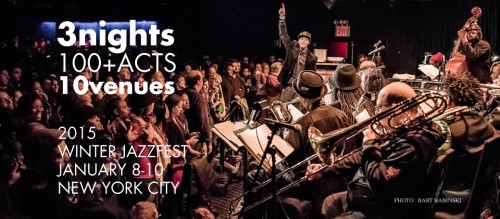
winter jazzfest

Who: Winter Jazzfest NYC
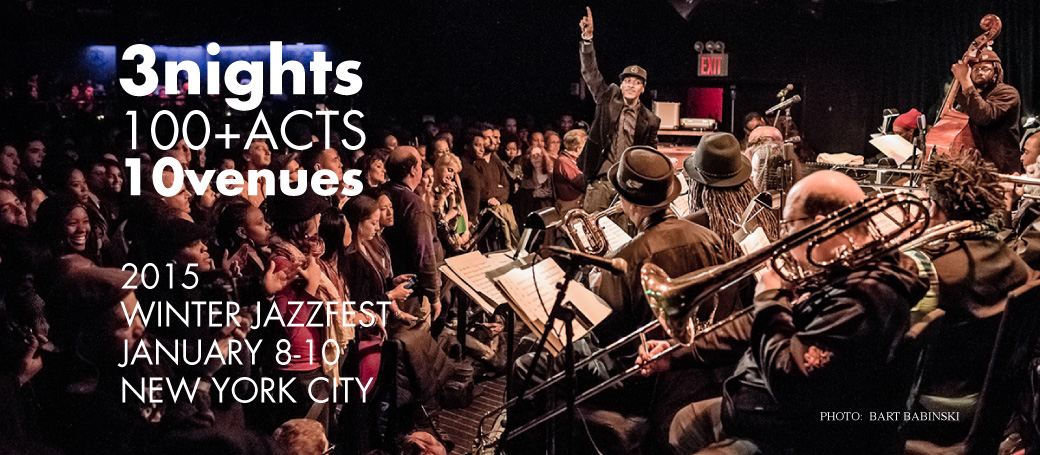
What: More than one hundred jazz groups playing multiple venues in and around Greenwich Village
Where: The Blue Note, (le) poisson rouge, Judson Church, the Bitter End, Subculture, Bowery Electric, others
When: January 8-10, $25-$145
Why: Catherine Russell, David Murray Infinity Quartet with Saul Williams, Jovan Alexandre & Collective Consciousness, Marc Ribot & the Young Philadelphians with Strings, So Percussion Feat. Man Forever, Theo Bleckmann Quartet with Ambrose Akinmusire, and David Murray Clarinet Summit with Don Byron, David Krakauer, and Hamiet Bluiett
ZERO: COUNTDOWN TO TOMORROW, 1950-60s

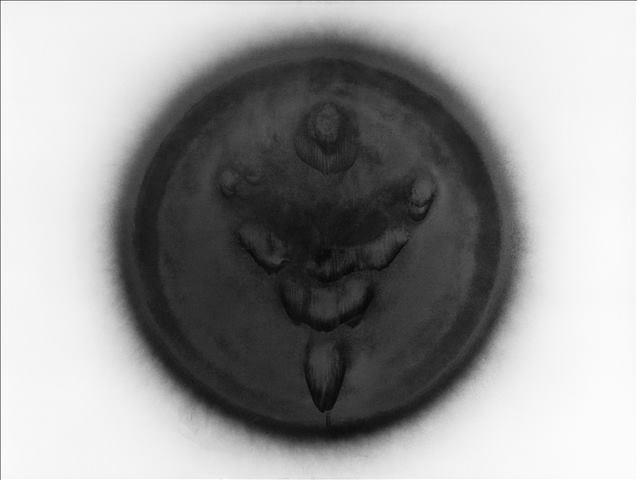
Otto Piene, “Venus of Willendorf (Venus von Willendorf),” oil and soot on canvas, 1963 (© Otto Piene; photo courtesy Stedelijk Museum Amsterdam)

Otto Piene, “Venus of Willendorf (Venus von Willendorf),” oil and soot on canvas, 1963 (© Otto Piene; photo courtesy Stedelijk Museum Amsterdam)

Solomon R. Guggenheim Museum
1071 Fifth Ave. at 89th St.
Friday – Wednesday through January 7, $18-$22 (pay-what-you-wish Saturday 5:45-7:45)
212-423-3587
www.guggenheim.org

The Guggenheim completes its third revelatory group show in a row with “ZERO: Countdown to Tomorrow, 1950s–60s,” coming hot on the heels of “Gutai: Splendid Playground” and “Italian Futurism, 1909–1944: Reconstructing the Universe.” Founded in 1957 by German artists Otto Piene and Heinz Mack, Zero brought together European artists who sought a fresh, optimistic start following the devastation of WWII. “From the beginning we looked upon the term [ZERO] not as an expression of nihilism — or as a dada-like gag, but as a word indicating a zone of silence and of pure possibilities for a new beginning as at the countdown when rockets take off — zero is the incommensurable zone in which the old state turns into the new.” Joined by Günther Uecker in 1961, the collective created monochromatic paintings, kinetic sculptures, and action works that explored light, nature, and space, often removing the hand of the artist. Subtle, complex brushstrokes of multiple colors were not on the agenda; instead, Lucio Fontana slashed his canvases, Uecker hammered in nails, and Piene, Yves Klein, Bernard Auberlin, Piero Manzoni, and Henk Peeters used fire and soot. Numerous pieces, including Gianni Colombo’s “Pulsating Structure,” Klein’s “Space Excavator,” Daniel Spoerri’s “Auto-Theater,” Piene’s “Light Ballet,” and Jean Tinguely’s “Butterfly (Two Points of Stability),” contain mechanically powered elements that move, and in the Guggenheim show they are active only at timed intervals, adding an expectant quality to the viewer’s experience, which echoes the group’s hopefulness for the future. Meanwhile, Mack’s “Silver Dynamo,” Almir Mavignier’s “Convex-Concave II,” and Jesús Rafael Soto’s vibration works play with viewers’ perception in engaging ways.

During the early 1960s, Group Zero’s influence spread to Japan, the Americas, and other parts of Europe; the exhibition features more than 180 works by some forty artists from Belgium (Walter Leblanc, Paul Van Hoeydonck), Romania (Spoerri), Brazil (Almir Mavignie), the Netherlands (herman de vries, Jan Schoonhoven), Japan (Yayoi Kusama), America (Robert Breer, George Rickey), Switzerland (Dieter Roth), and other nations. Curator Valerie Hillings bookends “ZERO: Countdown to Tomorrow, 1950s–60s” with two wonderful rooms, beginning in the High Gallery with an examination of the seminal 1959 Antwerp exhibition “Vision in Motion — Motion in Vision,” which serves as a kind of primer for what visitors can expect as they make their way up the Guggenheim’s Rotunda to the very last room, which contains a re-creation of the 1964 Documenta 3 installation “Light Room: Homage to Fontana,” as light-based kinetic works by Mack, Piene, Ueker, and Fontana turn on and off seemingly randomly, casting shadows on the walls and lighting up the darkness. The exhibition closes on January 7 with the panel discussion “ZEROgraphy: Mapping the ZERO Network, 1957–67” ($12, 6:30), with Antoon Melissen, Johan Pas, and Francesca Pola, moderated by Hillings and followed by a reception and a final viewing.