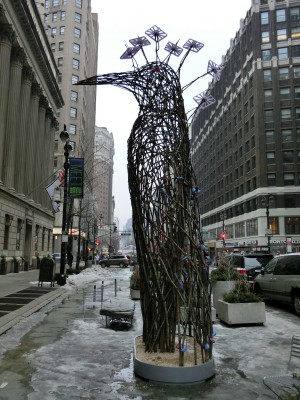
The Tourist, a Victoria crowned pigeon, hovers not far from Macy’s (photo by twi-ny/mdr)
Garment District Plazas
Broadway between 41st & 36th Sts.
Through April 30 (all events free with advance RSVP)
“Chocolate and Roses” tour February 14 at 3:00
www.garmentdistrictnyc.com
www.themythmakers.blogspot.com
avian avatars slideshow
This rather cold and bleak winter hasn’t stopped a group of very large, determined birds from migrating to the Garment District and nesting right smack on Broadway. Married couple and artistic collaborators Donna Dodson and Andy Moerlein have placed five monumental sculptures between Thirty-Sixth and Forty-First Streets, giant birds constructed from found materials both natural (maple saplings) and machine-made (various repurposed plastic objects). Since 2010, Dodson and Moerlein, as the Myth Makers, have been installing public projects inspired by nature and wildlife throughout the Northeast and other locations. They work primarily with new-growth saplings, culling them from forestry sites and then steaming and bending the wood, weaving them into beautiful arcs and outlines. For “Avian Avatars,” the first winter installation sponsored by the Garment District Alliance, the Myth Makers have incorporated a New York City sensibility into the works, which stand between eighteen and twenty-six feet high, each one accompanied by an inspirational quote by a famous figure. At the north end is the Scold, a crow whose feathers are made of yellow “caution” and “cuidado” tape, sending out a warning to all comers in two languages. According to Dodson and Moerlein’s mythology, the crow is “a raucous chatterbox [that] has an opinion on everything.” Feel free to step inside for a different kind of view while considering this pearl from Henry David Thoreau: “I wished to live deliberately, to front only the essential facts of life….” One block south is an owl known as the Great Spirit, whose fur is made of white and brown plastic bags snapping in the breeze. Described as “a humble leader [that] embraces the strengths and weaknesses of humanity,” the Great Spirit gazes intensely over the city as it shares this thought from Mother Teresa: “Not all of us can do great things. But we can [each] do small things with great love.”
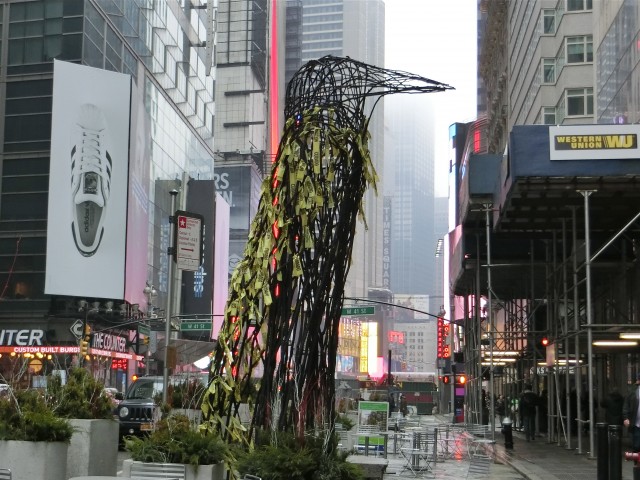
“Avian Avatars” are nesting along Broadway through April (photo by twi-ny/mdr)
Next up is the falcon called the Taste Maker, boasting a dark black head (made from burned saplings) and a body covered in thin plastic tubing. The Myth Makers consider the falcon to be “an uncompromising harbinger of taste,” explaining that “the critic is not a populist,” and they relate the bird to something Ayn Rand once said: “The truth is not for all . . . but only for those who seek it.” The Realist is that favorite New York City flying icon, the red-tailed hawk, in this case showing off a glorious plumage composed of red plastic barricade fencing that is so familiar on construction sites. “Everyone has a killer instinct, a desire to fly, and an ambition to achieve their fifteen minutes of fame,” the Myth Makers proclaim, while Bruce Springsteen adds some words to live by: “When it comes to luck, you make your own.” The final bird is a proud Victoria crowned pigeon called the Tourist, its feathers formed by golf clubs with colorful handles, while purple plastic pieces sit atop its head, affirming its royalty. Its legend states, “Visitors drawn to this vibrant city shape culture with their impulsive consumer behavior,” while Malcolm Gladwell adds, “Who we are cannot be separated from where we’re from.”
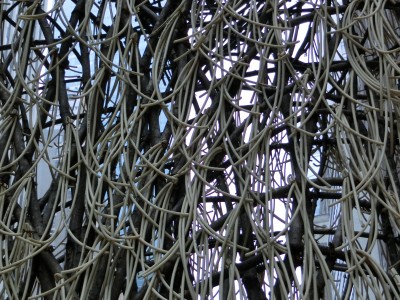
Towering bird sculptures are made with bent sapling branches and repurposed plastic (photo by twi-ny/mdr)
As with all of the Myth Makers’ work, “Avian Avatars” is temporary, although it will not go up in flames as so many of their other projects are designed to do. The five birds will continue roosting on Broadway through April, as the snow melts away and spring is on the horizon. Several of the pieces can be entered, so feel free to walk inside; don’t be surprised if you’re sharing space with real birds, as sparrows twitter and flit through the wooden shapes. A thoroughly congenial pair, Dodson and Morelein will be hosting a series of special events, all free with advance RSVP, in conjunction with the installation, which brings a playful life to the area. On February 14 at 3:00, they will be presenting a romantic Valentine’s Day “Chocolate and Roses” tour; be sure to ask them about how they met. After the tour, they will head over to Harlow at 109 East Fifty-Sixth St. to inaugurate their “Love Birds” indoor installation, complete with a reception and cocktail party. On March 7, they will give a tour for Armory Arts Week. On March 25, they will team up for a behind-the-scenes conversation at 3:00 and will then discuss public art projects at the Artists Talk on Art panel at the Jefferson Market Library at 6:00, followed by a Q&A. And on April 24, they will give their last tour as part of International Sculpture Day, shortly before “Avian Avatars” flies away for good.

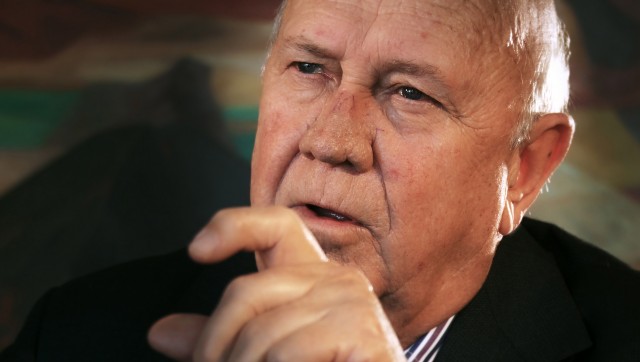
 In The Other Man: F. W. de Klerk and the End of Apartheid, filmmaker Nicolas Rossier examines the legacy of the man who won the 1993 Nobel Peace Prize with Nelson Mandela, painting an intriguing portrait of former South African president Frederik Willem de Klerk, who ended the ban on the African National Congress and ultimately ceded power to Mandela. “I’ve come to the conclusion that apartheid was wrong, that it was morally unjustifiable, and therefore it had to be changed,” de Klerk states emphatically in the film. “And I’m not justifying in any way the wrongs which took place and which was done to the majority of the people living in South Africa in the period of apartheid and separate development.” De Klerk was born into a privileged family, his father one of the chief architects of apartheid, which its supporters prefer to call “separate development.” Taking over the presidency in 1989 from P. W. Botha, de Klerk saw the inevitable downfall of white leadership in South Africa and worked with Mandela to create a new future for the country. Rossier speaks with such anti-apartheid activists as Mathews Phosa, Albie Sachs, Yasmin Sooka, Randall Robinson, and Father Michael Lapsley; such members of de Klerk’s inner circle as Director General David Steward, cabinet ministers Leon Wessels and Roelf Meyer, and friend and foreign ministry spokeswoman Alayne Reesberg; journalists Allister Sparks and Max du Preez; human rights abuse investigator Richard Goldstone; U.S. assistant secretary of state Chester Crocker; former SADF soldier Piet Croucamp; and former South African president Thabo Mbeki, who share wide-ranging opinions and stories about de Klerk as a man and a politician, examining his motives and responsibilities and placing them in context of the changes swirling throughout his country.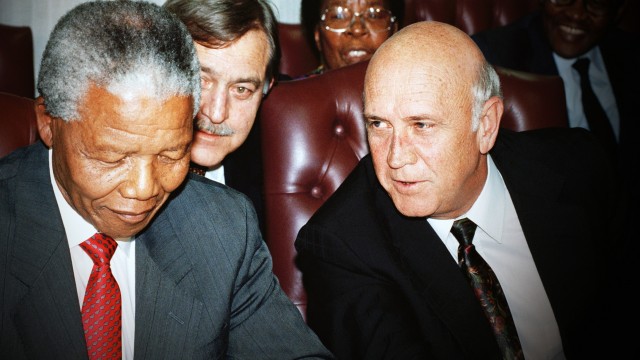
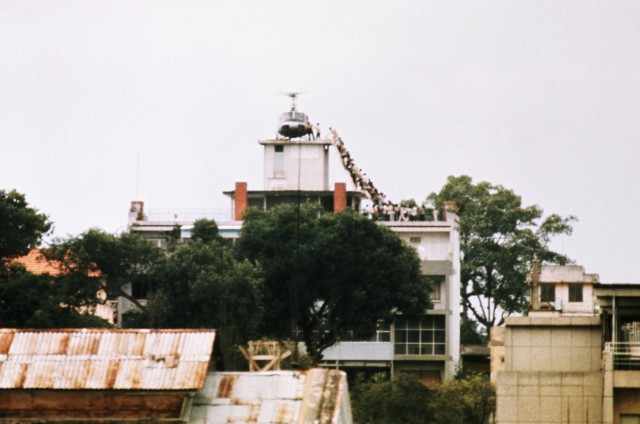
 To many, the fall of Saigon immediately brings to mind images of men, women, and children climbing the gate at the U.S. embassy, desperately trying to board American helicopters and escape the country as the North Vietnamese army approached. Director and producer Rory Kennedy takes viewers behind the scenes of that madness in the harrowing and revealing documentary Last Days in Vietnam. Kennedy, the youngest daughter of Bobby and Ethel Kennedy, and editor Don Kleszy have woven together remarkable footage from 1970s Vietnam as more than a dozen insiders share their compelling stories, which play out like a gripping thriller with a surprise, emotionally powerful ending. At the center of it all is the late U.S. ambassador Graham Martin, a stubborn patriot who continually refused to vacate the embassy until it was almost too late. U.S. Army captain Stuart Herrington gets personal as he talks about trying to help potential refugees. Secretary of State Henry Kissinger and White House press secretary Ron Nessen discuss President Gerald Ford’s attempts to persuade Congress to fund a major evacuation. CIA analyst Frank Snepp and Special Forces advisor Richard Armitage delve into the military’s plans, while South Vietnamese Navy captain Kiem Do, South Vietnamese Army lieutenant Dam Pham, and Vietnamese student Binh Pho tell what it was like from their vantage points. USS Kirk chief engineer Hugh Doyle, USS Kirk captain Paul Jacobs, and Marine pilot Gerald Berry reveal stunning stories of bravery and daring during the evacuation on land and sea and in the air. If you think this is old news, you’re mistaken, as the film offers a whole new perspective on this seminal moment in the history of two nations — and it’s nearly impossible to watch it without thinking that something similar might occur in Iraq and Afghanistan soon. An American Experience production and nominated for an Oscar for Best Documentary Feature, Last Days in Vietnam is screening February 8 at 7:30 as part of the Maysles Documentary Center series “Oscar Buzz Presents” and will be followed by a Q&A with Kennedy (Ethel, Ghosts of Abu Ghraib); the series includes such other Oscar-nominated and shortlisted films as Laura Poitras’s Citizenfour, Sam Cullman, Mark Becker, and Jennifer Grausman’s Art and Craft, and Al Hicks’s Keep on Keepin’ On.
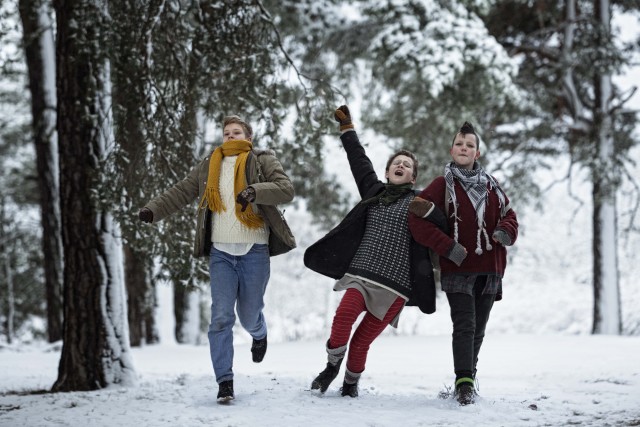
 Thank goodness Lukas Moodysson changed his mind. After his 2009 film, Mammoth, and the death of his father, the Swedish director of such indie faves as Show Me Love, Together, and Lilya 4-ever was extremely depressed and considering quitting the movie business. But he was eventually inspired to make a happy film, and the result is the absolutely delightful We Are the Best! A liberal adaptation of his wife Coco’s semiautobiographical graphic novel Never Goodnight, the film, set in 1982 Sweden, follows the adventures of thirteen-year-old best friends Bobo (Mira Barkhammar) and Klara (Mira Grosin), a pair of outsiders who think they are rebellious punk rockers, making statements by running down the up escalator at the mall and writing an anti-sports song. Joined by fourteen-year-old Christian classical guitarist Hedvig (Liv LeMoyne), they form a punk band to rival middle school heavy metalers Iron Fist. Determined to show that punk is not dead, they futz with their hair, attempt to bond with a teen-boy punk trio, and try their darnedest to gel as a band, even though drummer Bobo and bassist Klara don’t really know how to play their instruments. All the adults in the film, primarily Klara’s parents (Lena Carlsson and David Dencik), Bobo’s mother (Anna Rydgren) and her strange friends, and the two youth recreation leaders (Matte Wiberg and Johan Liljemark, real-life members of the band Sabotage), are pretty goofy themselves, not exactly your prototypical role models, so silliness pervades in wonderfully funny ways.