this week in lectures, signings, panel discussions, workshops, and Q&As

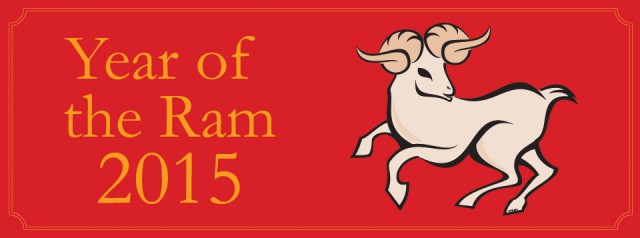
LUNAR NEW YEAR 4713: THE YEAR OF THE RAM (or GOAT or SHEEP)

year of the ram

Sara D. Roosevelt Park and other locations
East Houston St. between Forsythe & Chrystie Sts.
February 19-28, free – $115
www.betterchinatown.com
www.explorechinatown.com

Gōng xǐ fā cái! New York City is ready to celebrate the Year of the Wood Goat (aka the Year of the Ram and the Year of the Sheep) this month with special events all over town, in all five boroughs. The sixteenth New Year Firecracker Ceremony and Cultural Festival will explode in and around Sara D. Roosevelt Park on February 19 at 11:00 am, with live music and dance, speeches by politicians, drum groups, lion, dragon, and unicorn dancers making their way through local businesses, and more than half a million rounds of firecrackers warding off evil spirits and welcoming in a prosperous new year. The Flushing Lunar New Year Parade takes place February 21 at 10:00; following the parade, there will be a family festival at the Queens Botanical Garden ($2-$4, 1:00 – 4:00). Also on February 21 ($5-$12, 1:00 – 4:00), Asia Society will present its annual Family Day: Moon over Manhattan, featuring lion dance and kung-fu demonstrations, live music, and arts and crafts. The New York Chinese Cultural Center will present a Lunar New Year program with folk dances, paper cutting, calligraphy, and lion dances at the Bronx Museum of the Arts on February 21 (free, 2:00 – 4:00). One of our favorite restaurants, Xi’an Famous Foods, will be hosting a culinary Lunar New Year concert at the Music Hall of Williamsburg on February 21 with MC Jin, Wanting Qu, Clara C, Esther & Lara Veronin, the Shanghai Restoration Project, and Mree, benefiting Apex for Youth ($50-$165, 6:00). There will be a performance by Chinese Theater Works, a zodiac-themed scavenger hunt, and sheep meet-and-greets at the Prospect Park Zoo February 21-22 ($6-$8). The Museum of Chinese in America will give Lunar New Year walking tours on February 21-22 ($8-$15, 11:00 and 1:00), followed on February 28 ($10, 11:00 am – 4:00 pm) by its Lunar New Year Family Festival, with lion dances and workshops, food tastings and demonstrations, storytelling, calligraphy, balloon animals, arts and crafts, and the Red Silk Dancers. The sixteenth annual Chinatown Lunar New Year Parade and Festival will wind its way through Chinatown, Sara D. Roosevelt Park, and Columbus Park on February 22 starting at 1:00, with cultural booths in the park and a parade with floats, antique cars, live performances, and much more from China, Korea, Japan, Vietnam, Taiwan, Malaysia, Singapore, and other nations.

year of the goat

On February 22 (free – $25, 11:00 – 3:00), the China Institute’s Chinese New Year Family Celebration boasts lion dance and kung-fu performances, gallery tours with receptions, and dumpling and lantern workshops. Dr. Hsing-Lih Chou has curated a Lunar New Year Dance Sampler at Flushing Town Hall on February 22 (free, 2:00). The New York Philharmonic gets into the party spirit with Yo-Yo Ma leading a Chinese New Year musical evening on February 24 at Avery Fisher Hall ($45-$115, 7:30); the program includes the U.S. premiere of Zhao Lin’s Duo concerto for cello, sheng, and orchestra, conducted by Long Yu. Earlier that day, the Nai-Ni Chen Dance Company and students from the National Dance Institute will perform traditional dances on Josie Robertson Plaza (free, 4:30). The annual Lunar New Year Festival at the Metropolitan Museum of Art is set for February 28 (free with suggested museum admission, 12 noon – 5:00), with puppet shows, martial arts demonstrations, dances, storytelling, tea presentations and ceremonies in the Astor Chinese Garden Court, and activities inspired by the exhibition “The Art of the Chinese Album.” And the Queens Zoo will honor the goat/ram/sheep February 28 – March 1 with scavenger hunts, arts and crafts, live live performances, calligraphy workshops, and meet-the-sheep programs.
STURTEVANT: DOUBLE TROUBLE

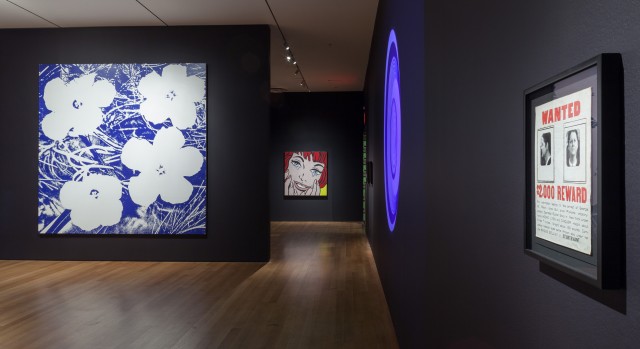
Installation view, “Sturtevant: Double Trouble,” all works by Sturtevant © Estate Sturtevant, Paris (© 2014 the Museum of Modern Art; photo by Thomas Griesel)

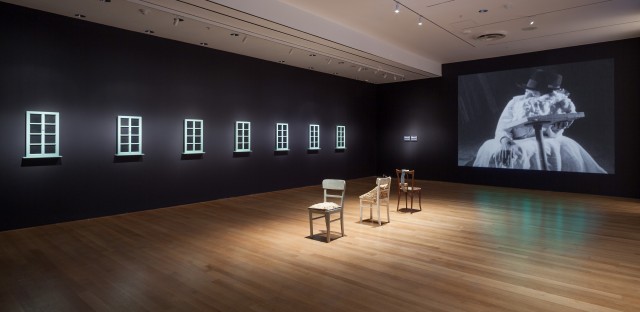
Installation view, “Sturtevant: Double Trouble,” all works by Sturtevant © Estate Sturtevant, Paris (© 2014 the Museum of Modern Art; photo by Thomas Griesel)

Museum of Modern Art
Special Exhibitions Gallery, third floor
The Sue and Edgar Wachenheim III Painting and Sculpture Gallery, Gallery 5, fifth floor
11 West 53rd St. between Fifth & Sixth Aves.
Daily through February 22, $25
212-708-9400
www.moma.org

Walking into MoMA’s “Sturtevant: Double Trouble” exhibit, you’re likely to be overcome with a feeling of déjà vu, or perhaps wonder whether you’ve actually sauntered into one of the museum’s painting and sculpture galleries featuring works by a multitude of artists. Ohio-born artist Elaine Sturtevant spent her long career — she died in May 2014, while participating in this first major American survey of her oeuvre — taking the work of others and making it her own, leaving some critics to cheer her bold individuality and others to decry her as little more than a plagiarist. “Same is a copy but it’s not the same,” she said, fiercely defending her method, which delves into wide-ranging questions of authorship, gender, and originality. “Her longstanding concern with the political, economic, and cultural circumstances that underpin art’s creation and consumption is an essential part of her work,” MoMA director Glenn D. Lowry writes in the foreword to the exhibition catalog. “‘Sturtevant: Double Trouble’ draws attention to that aspect of her bold and groundbreaking practice, suggesting that she opens the art history of her time — and ours — in new directions, challenging us to rethink many of our assumptions about what we see, how we value what we see, and the histories that our institutions perpetuate.” Sturtevant didn’t just “repeat” random works of others; instead, she asks viewers to reconsider iconic images by major artists, usually done without the express permission of those artists, aside from Andy Warhol, who let her do whatever she wanted with his films and silkscreens. In “Warhol Flowers,” she has taken an image, generally associated with femininity, by a sexually ambiguous Pop artist, and forced the viewer to reconsider it in multiple ways. In “Johns 0 through 9,” she stencils the numbers zero through nine in the style of Jasper Johns, in encaustic on a ripped piece of newspaper from the business section, adding her own element of the financial nature of art. In “Study for Muybridge, Plate #97: Woman Walking,” Sturtevant has photographed herself, naked, walking in front of re-created paintings by James Rosenquist, Johns, and Roy Lichtenstein. (Interestingly, this past November, Sturtevant’s painting “Lichtenstein, Frighten Girl” sold at Christie’s for more than $3.4 million, up from $710,500 in 2011; multiples of the Lichtenstein lithograph on which it is based, “Crying Girl,” have reached as high as $78,400.)

Installation view, “Sturtevant: Double Trouble,” all works by Sturtevant © Estate Sturtevant, Paris (© 2014 the Museum of Modern Art; photo by Thomas Griesel)

Installation view, “Sturtevant: Double Trouble,” all works by Sturtevant © Estate Sturtevant, Paris (© 2014 the Museum of Modern Art; photo by Thomas Griesel)

In “Duchamp Man Ray Portrait,” Sturtevant depicts her face, neck, and head covered in shaving cream, a decidedly male activity, echoing Man Ray’s 1924 gelatin silver print “Duchamp with Shaving Lather for Monte Carlo Bond.” In the collage “Working Drawing Wesselmann Great American Nude Lichtenstein Hot Dog,” Sturtevant juxtaposes works by two seminal artists, making a deliciously wry and decadent statement about women as sex objects. She also copies, er, appropriates, um, pays homage to, uh, skewers, well, echoes, eh, repeats, oh, reconfigures works by Claes Oldenburg, Jim Dine, Felix Gonzalez-Torres, Joseph Beuys, Keith Haring, Frank Stella, and Robert Gober. There are also several video installations from 2010 and 2012, further repurposing pop-culture imagery in the digital age, including re-creating the decidedly analog “Pac-Man” game as if she herself is eating up and spitting out art history. In the September-October 2005 issue of Index magazine, she told Peter Halley, in reference to criticism of her 1973 show “Studies for Warhols’ Marilyns Beuys’ Actions and Objects Duchamps’ Etc. Including Film,” at the Everson Museum of Art in Syracuse, “The reviews for that show were the same as always — that I was reviewing history, or that the pieces were all copies, blah blah blah. I realized that if I continued to work and get that kind of critique, then the work would get diluted. So I decided to wait until the mental retards caught up. And, indeed they did.” It’s a shame Sturtevant didn’t live long enough to see what everyone had to say about MoMA’s stellar survey, which continues through February 22. (On February 21 at 11:30, there will be a special Gallery Session, “20 Questions in the Wormhole,” which examines the intentions of this fascinating, exciting, and controversial “copycat artist.”)

ECCENTRICS OF FRENCH COMEDY: THE TREE, THE MAYOR, AND THE MEDIATHEQUE

Eric Rohmer

A patch of greenery and an old tree are the center of controversy in Éric Rohmer satire

CINÉSALON: THE TREE, THE MAYOR, AND THE MEDIATHEQUE (L’ARBRE, LE MAIRE ET LA MÉDIATHÈQUE) (LES SEPTS HASARDS) (Éric Rohmer, 1993)
French Institute Alliance Française, Florence Gould Hall
55 East 59th St. between Madison & Park Aves.
Tuesday, February 17, 4:00 & 7:30
Series continues Tuesdays through February 24
212-355-6100
www.fiaf.org

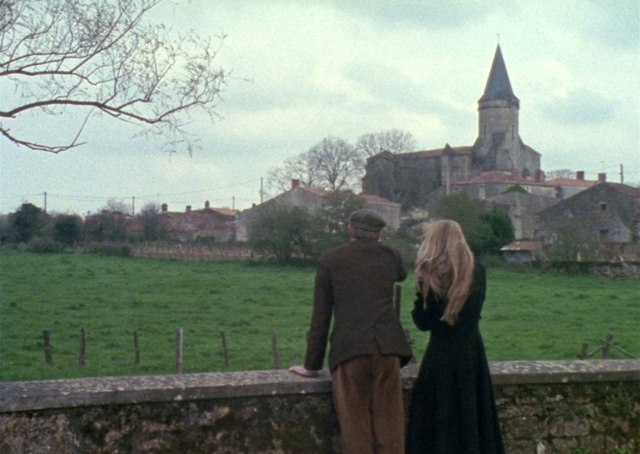
Éric Rohmer’s The Tree, the Mayor and the Mediatheque is a delightfully simple, outrageously funny satire that stands apart from the majority of the French auteur’s works, especially his three famous series: Six Moral Tales, Comedies and Proverbs, and Tales of the Four Seasons. “French can be illogical, as we’ll see,” school principal Marc Rossignol (Fabrice Luchini) tells his young students at the beginning, and the same can be said for the French characters in the film as well, each one thinking they are nothing if not completely logical. Rohmer divides The Tree, the Mayor and the Mediatheque into seven chapters, each built around a conditional “if” clause; for example, chapter four begins, “If Blandine Lenoir, at the monthly ‘Tomorrow,” had not, while recording a cultural broadcast, inadvertently unplugged her answering machine…” Each chapter pits philosophical, sociopolitical foes against one another as the small rural town of Saint-Juire-Champgillon prepares to build a new cultural, sports, and media center on an expanse of greenery that is home to a large, beautiful old tree. The center is the pet project of the mayor, Julien Dechaumes (Pascal Greggory), who aspires to higher office, while Rossignol is dead-set against anyone tampering with the natural environment. The battle heats up as magazine editor Régis Lebrun-Blondet (François-Marie Banier) hires freelance journalist Blandine Lenoir (Clémentine Amouroux) to do a story on the town’s situation.
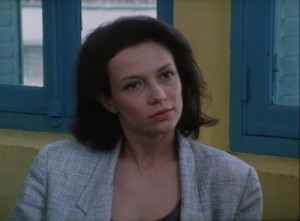
Reporter Blandine Lenoir (Clémentine Amouroux) finds herself in the middle of controversy in wickedly funny Rohmer satire

Reporter Blandine Lenoir (Clémentine Amouroux) finds herself in the middle of controversy in wickedly funny Rohmer satire

Arguments abound over parking lots, the relative values of country vs. city, traditional farming vs. new advances, form vs. function, politics and ecology, and chance vs. the imponderable nature of history, involving Rossignol, Dechaumes, Lebrun-Blondet, Lenoir, architect Antoine Pergola (Michel Jaouen), the mayor’s girlfriend, author Bérénice Beaurivage (Arielle Dombasle), and even Rossignol’s ten-year-old daughter, Zoé (Galaxie Barbouth). Oddly, and most refreshingly, the extremely French rational, irrational, scientific, metaphysical, subtle, obvious, logical, and illogical discussions don’t involve any smoking, drinking, or sex. Even so, The Tree, the Mayor and the Mediatheque, which features an endearingly goofy score by Sébastien Erms, is a purely French film from start to finish, a lovely little slice of life that is one of Rohmer’s unsung masterworks. The Tree, the Mayor and the Mediatheque is screening February 17 at 4:00 & 7:30 in the French Institute Alliance Française’s CinéSalon series “Eccentrics of French Comedy” series; the 7:30 show will be introduced by film critic Nicholas Elliott, and both shows will be followed by a wine reception. The series concludes February 24 with Luc Moullet’s The Land of Madness, introduced by theater director Pavol Liska.

CARMEN DE LAVALLADE: AS I REMEMBER IT

(photo by Christopher Duggan)

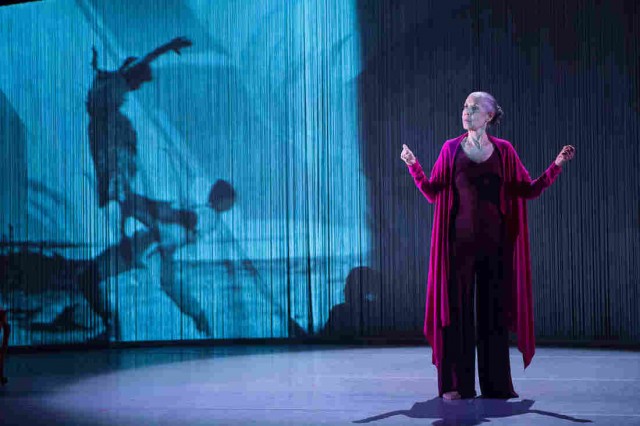
Carmen de Lavallade examines her life and career in multimedia one-woman show (photo by Christopher Duggan)

Who: Carmen de Lavallade
What: As I Remember It
Where: Baryshnikov Arts Center, Jerome Robbins Theater, 450 West 37th St. between Ninth & Tenth Aves., 866-811-4111
When: February 19-21, 24, 8:00, February 25, 1:00, $25-$30
Why: Legendary dancer and choreographer Carmen de Lavallade’s one-woman show, As I Remember It, was developed during two residencies at the Baryshnikov Arts Center in 2012 and 2014. The production will now make its New York premiere at BAC February 19-25, with de Lavallade using archival footage, personal writings, and live dance to share her compelling story, which includes performing onscreen and/or onstage with Dorothy Dandridge, Harry Belafonte, Josephine Baker, Duke Ellington, and many others; she has also choreographed for the Alvin Ailey American Dance Theater, the Dance Theatre of Harlem, Philadanco, and the Metropolitan Opera. Sadly, since the show began its tour, de Lavallade’s husband of nearly sixty years, multidisciplinary artist Geoffrey Holder, passed away in October 2014, but the eighty-three-year-old de Lavallade has soldiered on. (Their love story was told in Linda Atkinson and Nick Doob’s 2006 documentary, Carmen & Geoffrey.) The hour-long As I Remember It is directed by longtime character actor Joe Grifasi and cowritten with dramaturg Talvin Wilks; the lighting is by James F. Ingalls, video design by Maya Ciarrocchi, set design by Mimi Lien, and costumes by Esther Arroyo. The February 25 matinee finale will be followed by a conversation with the ever-lovely Ms. de Lavallade.

THE RED BALLOON

THE RED BALLOON

A boy has a magical relationship with a red balloon in children’s classic

THE RED BALLOON (LE BALLON ROUGE) (Albert Lamorisse, 1956)
Museum of the Moving Image
35th Ave. at 36th St., Astoria
February 16-21, free with museum admission, 1:00
718-777-6800
www.movingimage.us

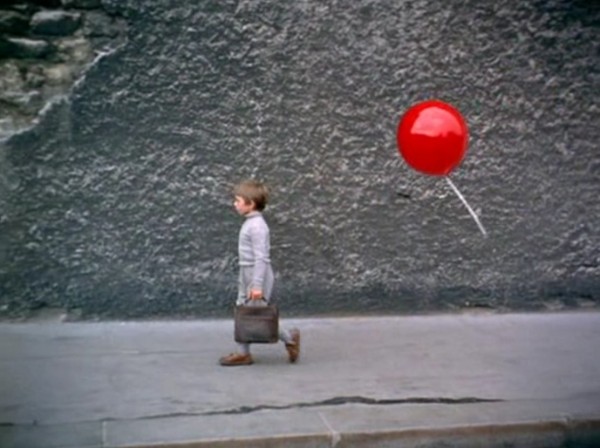
Lovingly restored several years ago by Janus Films in a new 35mm print, Albert Lamorisse’s The Red Balloon, which won the Palme d’Or at Cannes and an Oscar for Best Original Screenplay, tells the story of a young boy (Pascal Lamorisse, the director’s son) who makes friends with an extraordinary red balloon, which follows him through the streets of Belleville in Paris, waits for him while he is in school, and obeys his every command. But the neighborhood kids are afraid of this stranger and go on a mission to burst the young boy’s bubble. Lamorisse gives life and emotion to the balloon (more than twenty-five thousand were used in the making of the film) in a masterful use of simple special effects well before CGI and other modern technology. The Red Balloon also features the splendid music of Maurice Leroux and the fine photography of Edmond Séchan, which beautifully sets the large red balloon against the gray of the streets and buildings of Paris’s Ménilmontant district. The thirty-four-minute film can also be seen as a parable about Jesus and the birth or Christianity, though it’s best not to read too much into it. The Red Balloon is screening daily February 16-21 at 1:00 at the Museum of Moving Image in conjunction with city schools’ winter break. On February 19 at 2:15, the museum will be hosting “The Red Balloon Animation Adventure,” an hour-long workshop ($5) for children ages six in which kids can create their own little Red Balloon movie.
THE BIG QUIZ THING: PRESIDENTS DAY EDITION

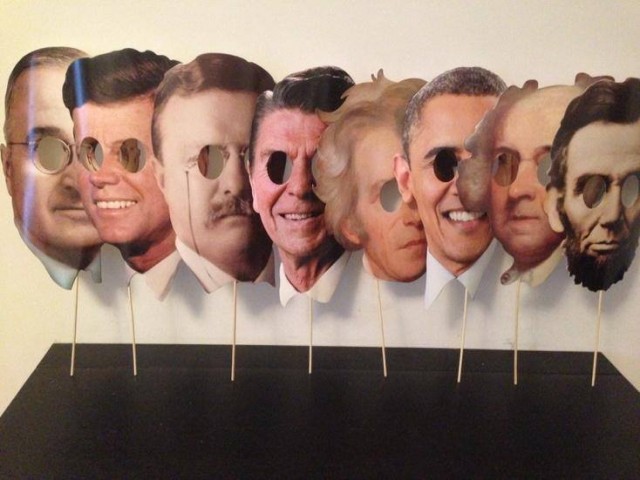
The New-York Historical Society will host a special Presidents Day edition of the Big Quiz Thing on February 16

The New-York Historical Society will host a special Presidents Day edition of the Big Quiz Thing on February 16

Who: Noah Tarnow and competitors
What: The Big Quiz Thing
Where: New-York Historical Society, 170 Central Park West at 77th St., 212-873-3400
When: Monday, February 16, $25 (includes two beer/wine tickets), 6:30
Why: The New-York Historical Society is celebrating Presidents Day by not only opening its doors on Monday, February 16, but hosting a special multimedia holiday edition of the Big Quiz Thing. “The Live Game Show Spectacular,” which has spread to L.A., Boston, and Chicago, was created in 2002 by Noah Tarnow, the self-proclaimed “Official Quizmaster of New York City.” Study up on those heads of state if you want to impress your friends and win prizes, but keep an eye out for such teams as 88 Lines of Coke for 44 Presidents, Jean-Claude Van Damme We’re Good at Trivia, and Rick Santorum and the Eurythmics, as well as a surprise guest quizmaster. The festivities will take place in the library, and every ticket comes with two drinks. Future Big Quiz Things include an Oscar-themed battle and screening on February 22 at (le) poisson rouge and the Brooklyn Brain Jam on March 15 at Littlefield.

FUNLAND: PLEASURES & PERILS OF THE EROTIC FAIRGROUND

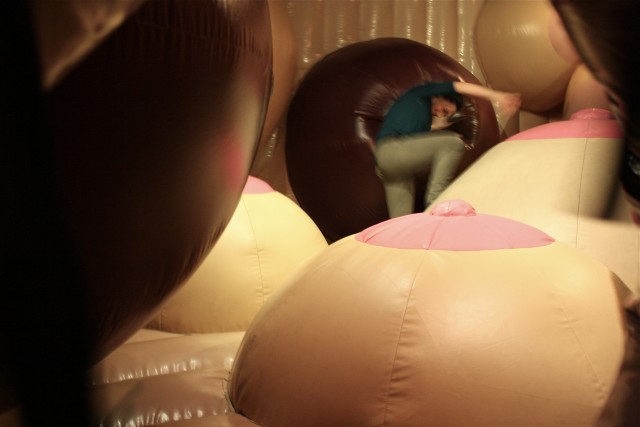
(photo by twi-ny/mdr)

”Jump for Joy” is one of the highlights of immersive “Funland” exhibit at the Museum of Sex (photo by twi-ny/mdr)

Museum of Sex
233 Fifth Ave. at 27th St.
Daily through spring 2015, $17.50
Portal of Love: Sunday, February 15, $25-$30, 10:00 pm – 4:00 am
212-689-6337
www.museum.museumofsex.com

When it comes right down to it, sex, in all its iterations, if done right, should be fun, if a little dangerous. And that’s the premise behind the Museum of Sex’s playful interactive exhibition “Funland: Pleasures & Perils of the Erotic Fairground.” Bompass & Parr, the jelly-loving London-based conceptual art duo of Sam Bompass and Harry Parr that has celebrated death in the architectural design competition Monumental Masonry, created a multisensory church organ promoting the wonders of whisky with the Flavour Conductor, and built the cake-inspired nine-hole Crazy Golf course on Selfridge’s roof, has now transformed a section of the Museum of Sex into a kinky carnival where visitors get to shed a bit of their inhibition and have a rousingly bawdy good time — while getting to release orgasmic endorphins in public. “Funland” comprises a handful of amorous attractions that add tantalizing twists to fairground favorites, all set in a luridly lit amorously red setting, with a carny, carnal soundscape by Dom James. Begin with “Foreplay Derby,” in which challengers roll balls into a hole in order to make their assigned gold phallus cross a finish line first; the winner just might get whipped by a seductively clad museum worker. “The Tunnel of Love” is a hall of mirrors that leads to a sculpture of a G-spot that is also a Theremin that plays music when you wave your hand over it.

“Grope Mountain” is a three-sided climbing wall where you have to grab on to casts of sexual body parts and orifices in order to successfully make it across. And in “Jump for Joy,” visitors remove their jackets and shoes and spend several minutes bouncing around a room of giant inflated breasts, like kids playing in a balloon room; be prepared to exit somewhat dizzy and winded. The exhibit also includes a vitrine that offers daringly shaped edible delights and the “Erotic Picture Palace,” which shows NSFW old movies and carnival footage, including The Rotascope. Professor Vanessa Toulmin of the National Fairground Archive at the University of Sheffield puts it all in cultural context in her essay “As Graceful as They Were Disgraceful: Eroticism and the Fairground,” in which she writes, “Despite the attempts by moral puritans to tame the baying crowds, the elements of untamed sexuality, the Baktinian world of the carnivalesque remained beneath the veneer of the modernistic fairground roundabouts and carousels. . . . However, it was entry into the sideshows that revealed to the visitor the full frontal erotic reality of the female nude. . . . The sideshows of the twentieth century were a continuous link to the bacchanalia of the medieval and preindustrial European fairs, offering sex, nudity, and the wonders of gay Paree for a penny or a dime.” The Museum of Sex offers its own whimsical twenty-first-century take on bacchanalia for $17.50 plus tax.

portal of love

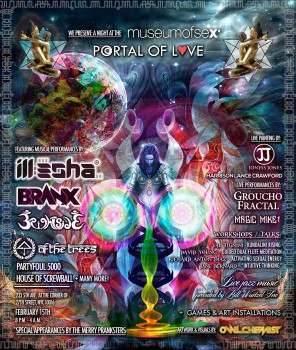
The museum also has a large yet intimate new café/den/bar appropriately called Play, where you can grab a drink or dinner while perusing a book from its extensive sexually charged library. For Valentine’s Day weekend, MoSex is hosting “Get Steamy” specials, with “The Full Treatment: 3 Aphrodisiac Shooters,” a trio of vodka-infused cocktails (Lychee Libidinal, Pomegranate Virility, and Citrous Oxide); bath and body packages; and extended hours, remaining open till midnight on Friday and Saturday. And on Sunday night from 8:00 till 4:00, “Portal of Love” will feature modern burlesque and genre-bending performances by ill-Esha, BRANX, Brightside, Of the Trees, PartyFoul 5000, Soohan, the Bill Wurtzel Trio, House of Screwball, Groucho Fractal, Magic Mike, Cat Wolf, Wild Torus, Kevin Karpt, Evelyn Von Gizycki, Lindsee Lonesome, and the Merry Pranksters, live painting by Joness Jones and Harrison Lance Crawford, and workshops led by Val Tignini (“Kundalini Rising”), David Young (“Guided Dual Flute Meditation”), Richard Anton Diaz (“Activating Sexual Energy”), and Jane Bernard (“Intuitive Thinking”). You can also check out the other exhibitions at the museum: “The Eve of Porn: Linda Lovelace” examines the controversy surrounding Deep Throat and the treatment of its star, while “The Sex Lives of Animals” is an engaging and educational exploration of animal sexual behavior.