this week in lectures, signings, panel discussions, workshops, and Q&As

GALLERY SESSIONS: BJÖRK EXPLAINED BY A FAN

Björk (photo by twi-ny/mdr)

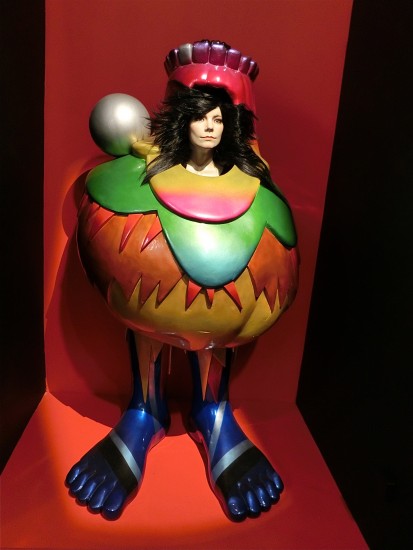
“Björk” exhibit at MoMA has led to quite a cacophony (photo by twi-ny/mdr)

BJÖRK
MoMA, Museum of Modern Art
11 West 53rd St. between Fifth & Sixth Aves.
Exhibit runs through June 7, $14-$25 (timed tickets available same day only)
212-708-9400
www.moma.org
bjork.com

There doesn’t seem to be a whole lot more that can be said about Björk’s disastrous solo exhibition at MoMA, so reviled that critics are calling for the heads of chief curator at large Klaus Biesenbach and museum director Glenn D. Lowry. The truth hurts; it’s a head-scratchingly absurd show. I went in determined to see something everyone else missed, trying to find something positive in the four-part presentation, having admired Björk Guðmundsdóttir’s work for many years, from her time leading the Sugarcubes to her award-winning performance in Lars von Trier’s Dancer in the Dark to her innovative Biophilia album, app, tour, and concert film. But alas, the simply titled “Björk” exhibition seems to go out of its way to annoy. The MoMA-commissioned ten-minute “Black Lake” music video, for a song from her latest album, Vulnicura, about her breakup with longtime partner Matthew Barney, is fine, a two-screen projection in which she lets loose against Barney, who just last week sued her for custody of their twelve-year-old daughter. “My soul torn apart / My spirit is broken / Into the fabric of all / He is woven,” she sings in a haunting volcanic landscape that features dripping substances evoking Barney’s use of petroleum jelly at the Guggenheim and in Drawing Restraint 9 (in which Björk had a major role) and lava and feces in “River of Fundament.” However, you will have to wait a lot longer than ten minutes to get into the specially designed area in MoMA’s atrium, then wait again after it’s over to enter the theater that shows many of Björk’s cutting-edge videos. Also, several of her unique Biophilia instruments play music in the lobby by the sculpture garden entrance. But it’s the heart of the show that is so disturbing, the time-ticketed “Songlines,” in which an iPod touch guides visitors through eight rooms, a chronological trip through Björk’s eight albums, from 1993’s Debut through January’s Vulnicura. The very small spaces feature handwritten notes and lyrics, costumes, video paraphernalia, and, through headphones, a bizarre fairy-tale-like fictionalized narrative, written by Icelandic poet Sjón and narrated by actress Margret Vilhjalmsdottir, about a young girl (Björk) growing up to become someone. You can’t purchase timed tickets in advance (only same day, onsite), so you might be shut out if you get to MoMA too late in the afternoon. Also, once you start going through “Songlines,” you are not allowed to go back to a previous room; you must proceed forward, and since it’s unlikely you’ll actually need all five minutes for each stop, the audio will often not be in sync with your physical surroundings.

Despite living part-time in New York (and Iceland and London) and having held several concerts in the city on her Vulnicura tour (she had to cancel her April 4 show but will be coheadlining the Governors Ball on Randall’s Island on June 6), Björk has not participated in any events and given only one interview (to Time magazine) in conjunction with the exhibit — although there are mannequins of an ornately designed Björk in “Songlines” — so MoMA is leaving it up to others to put it all in perspective and try to make sense of this utter mess. But they’re not exactly calling in the big guns; instead, on April 10 at 11:30 and April 22 at 1:30, the gallery session “Björk Explained by a Fan” will be led by an unnamed “dedicated fan of the composer, musician, and artist,” moderated by a museum educator. On April 12 and 18 at 11:30, “Sights and Sounds” will delve into how sound can be made visible. On April 17 and 24 at 11:30, “Björk” will examine art in relation to post-technological culture. And on April 26 at 11:30 and April 30 at 1:30, anyone can participate in “Björk: Human Behavior,” an open group discussion about Björk’s exploration of the connections between nature and human behavior; people are encouraged to share “their personal experience of the Björk exhibition,” which could be quite fascinating in and of itself. All talks are first-come, first-served and do not include a visit to the show. I can’t imagine that any of these talks will enhance your personal experience of a show that has been called “abominable,” “an ill-conceived disaster,” “oh so disappointing,” “a waste of time,” “a strangely unambitious hotchpotch,” and, quite simply and right to the point, “bad.”

MoCCA FEST 2015

mocca fest

Who: Guests of honor Aline Kominsky-Crumb, Scott McCloud, and Raina Telgemeier, international special guests Pénélope Bagieu, DoubleBob, Annie Goetzinger, Ilan Manouach, Anne-Françoise Rouche, and Barbara Stok, and many other comic artists
What: Society of Illustrators: MoCCA Arts Festival
Where: Center 548, 548 West 22nd St. between Tenth & Eleventh Aves., and the High Line Hotel, 180 Tenth Ave. at Twentieth St.
When: Saturday, April 11, and Sunday, April 12, $5, 11:00 am – 6:00 pm
Why: More than 350 publishers and artists will be exhibiting at the annual MoCCA Fest at Center 548, including Nick Bertozzi, C. M. Duffy, Fantagraphics, Dean Haspiel, Keren Katz, Peter Kuper, Liz Means, NBM, Greg Ruth, and Daniel Zender. Among the special programs (advance RSVP recommended), taking place at the nearby High Line Hotel, are Q&As with Scott McCloud, Aline Kominsky-Crumb, and Raina Telgemeier and such panel discussions as “Work in Progress” with Kim Deitch, Sarah Glidden, Dash Shaw, and Julia Wertz, moderated by Richard Gehr; “Alt-Weekly Comics” with Ben Katchor, Michael Kupperman, and Mark Newgarden, moderated by Bill Kartalopoulos; and “Saul Steinberg 101” with Austin English, Françoise Mouly, Joel Smith, and Patterson Sims.

STEPHEN PETRONIO COMPANY: BLOODLINES

Who: Stephen Petronio Company
What: “Bloodlines”
Where: Joyce Theater, 175 Eighth Ave. at 19th St., 212-691-9740
When: April 7-12, $10-$69
Why: Stephen Petronio Company concludes its thirtieth anniversary celebration with its annual season at the Joyce, kicking off its latest project, “Bloodlines,” a five-year initiative in which the company will perform works by other choreographers in addition to its namesake artistic director, starting with Merce Cunningham’s 1968 RainForest, featuring Andy Warhol’s “Silver Clouds,” costumes sliced by Jasper Johns, and a live score by David Tudor performed by John Driscoll, Phil Edelstein, Matt Rogalsky, and Stephan Moore. The program also includes the world premiere of Petronio’s Locomotor Non Locomotor, the follow-up to last year’s Locomotor; the new piece has music by hip-hop producer Clams Casino (who, coincidentally, released the EP Rainforest in 2011), costumes by Narciso Rodriguez, and vocal contributions by the Young People’s Chorus of New York City. (“Bloodlines,” which seeks to foster an artistic dialogue between paired works and choreographers, will continue with Trisha Brown’s Glacial Decoy and pieces by Anna Halprin, Lucinda Childs, and others. “Hanging with giants has its advantages to a mind in formation,” Petronio writes in his 2014 memoir, Confessions of a Motion Addict.) Former Merce Cunningham dancer Melissa Toogood will appear as a special guest, along with company members Davalois Fearon, Gino Grenek, Barrington Hinds, Jaqlin Medlock, Nicholas Sciscione, Emily Stone, and Joshua Tuason. Petronio will participate in a postperformance Curtain Chat following the April 9 show.

HAUTE COUTURE ON FILM: FUNNY FACE

FUNNY FACE

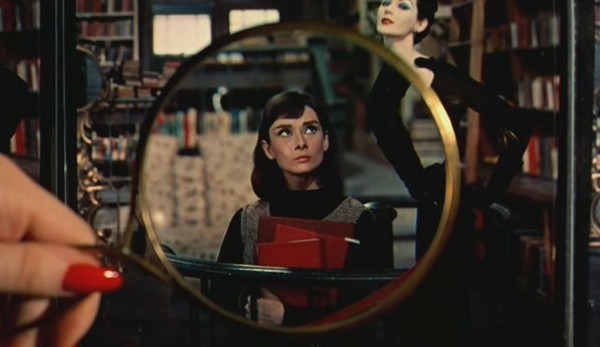
Jo Stockton (Audrey Hepburn) is not happy about fashionistas taking over the bookstore where she works in FUNNY FACE

CinéSalon: FUNNY FACE (Stanley Donen, 1957)
French Institute Alliance Française, Florence Gould Hall
55 East 59th St. between Madison & Park Aves.
Tuesday, April 7, $13, 4:00 & 7:30
Festival runs April 7 – May 26
212-355-6100
www.fiaf.org

The French Institute Alliance Française’s third annual “Fashion at Fiaf” festival kicks off April 7 with the “’s wonderful, ’s marvelous” 1957 romantic musical comedy Funny Face. When Quality magazine editor and publisher Maggie Prescott (Kay Thompson) decides she’s after the next big thing, photographer Dick Avery (Fred Astaire playing a fictionalized version of Richard Avedon, who served as a consultant on the film and took the photos) asks, “Are there no models who can think as well as they look?” So they descend on a “sinister” bookstore in Greenwich Village, Embryo Concepts, to show the intellectual side of star model Marion (real-life model Dovima), but instead Dick believes that the bohemian bookstore’s mousy, idealistic sales clerk, Jo Stockton (Audrey Hepburn), might just be exactly what they’re looking for, a fresh face with “character, spirit, and intelligence.” Jo is steadfastly averse to the plan at first, until Dick convinces her that it would be a great opportunity for her to see Paris and go to a lecture by her favorite philosopher, professor Emile Flostre (Michel Auclair), the father of empathicalism. So Maggie, Dick, Jo, and their crew head over to France, where Jo will soon be strutting down the runway in a line specially created for her by superstar designer Paul Duval (Robert Flemyng). But once they get to the City of Lights, everything goes more than a bit haywire as haute couture battles counterculture chic.
FUNNY FACE

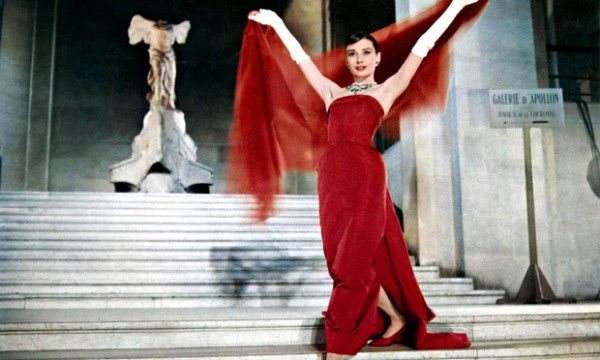
Audrey Hepburn is glamorous in Givenchy in classic musical

Partially based on an unproduced show by screenwriter Leonard Gershe called Wedding Bells — which was inspired by the real-life relationship between Avedon and model and actress Doe Nowell — and including four songs from George Gershwin’s 1927 musical, also called Funny Face (and starring Astaire and his sister, Adele), the film is an utter delight from start to finish. Despite an age difference of nearly thirty years, Hepburn and Astaire have genuine chemistry as their characters fall for each other. Unlike 1964’s My Fair Lady, in which Hepburn’s singing voice was dubbed by Marni Nixon, she does all of her own vocalizing in Funny Face, including a lovely solo on “How Long Has This Been Going On?,” and she uses her childhood dance training to fabulous effect in a stunning modern dance scene in a dark and smoky bohemian club. Astaire is a joy as Avery, particularly in the dazzling solo number “Let’s Kiss and Make Up,” performed with hat, raincoat, and umbrella. And Thompson, in her only major film role — she was already in the midst of her four-book children’s series about Eloise, the girl who lives in the Plaza Hotel in New York City — gets things going with the glorious opener “Think Pink!,” her character inspired by Harper’s Bazaar editors Carmel Snow and Diana Vreeland. Among the other songs by George and Ira Gershwin are “On How to Be Lovely,” “He Loves and She Loves,” “Clap Yo’ Hands,” and “Bonjour, Paris!” The costumes, of course, are spectacular, courtesy of Edith Head and Hubert de Givenchy, as are Eugene Loring’s choreography and Stanley Donen’s direction as the story roams around many of Paris’s iconic locations. Everything about the film, which was nominated for four Oscars but came up empty, is fun and fashionable, including cameos by model Suzy Parker; Carole Eastman, who would go on to write Five Easy Pieces and The Fortune; Hepburn’s mother; and a group of girls dressed up like French children’s book favorite Madeline.

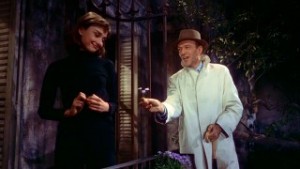
Dick Avery (Fred Astaire) want to kiss and make up with Jo Stockton (Audrey Hepburn) in FUNNY FACE

Dick Avery (Fred Astaire) want to kiss and make up with Jo Stockton (Audrey Hepburn) in FUNNY FACE

Funny Face is screening April 7 at 4:00 & 7:30 as part of the FIAF CinéSalon series “Haute Couture on Film”; both screenings will be followed by a wine reception, and journalist Anne-Katrin Titze will introduce the later show. The series continues through May 26 with such other films as Lisa Immordino Vreeland’s Diana Vreeland: The Eye Has to Travel, John Cassavetes’s Gloria, Jean Renoir’s The Rules of the Game, and Jean Negulesco’s How to Marry a Millionaire. “Fashion at Fiaf” also includes talks with Jack McCollough and Lazaro Hernandez of Proenza Schouler, Kate Betts, and Garance Doré and a gallery show of the work of photographer Grégoire Alexandre.

FLOYDADA

(photo by Dan Lane Williams)

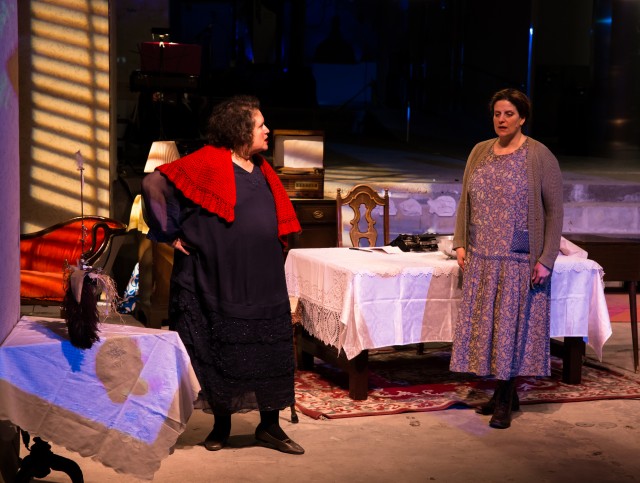
Sisters Dalia (Nomi Tichman) and Ada (Catherine Porter) reconnect in FLOYDADA (photo by Dan Lane Williams)

Peculiar Works Project
Merchants Square Building
40 Worth St. between Church St. & West Broadway
Wednesday – Saturday through April 11, $12-$18, 7:00
www.peculiarworks.org

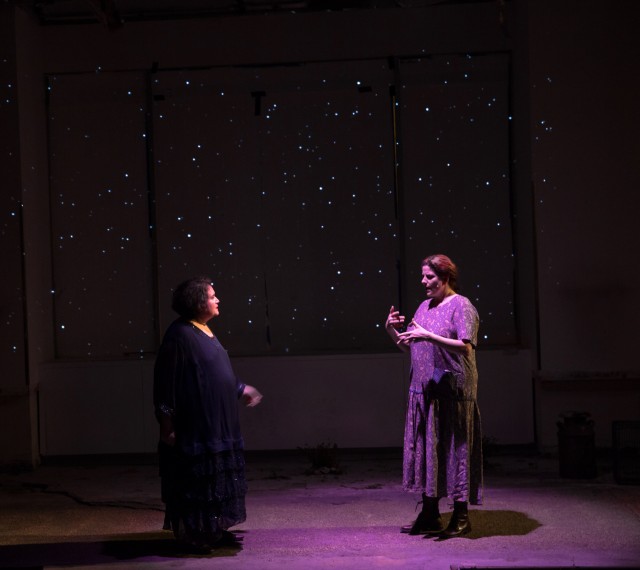
When you think of the revolutionary art movement known as Dada, West Texas is not generally one of the first things that comes to mind. But in the early 1990s, playwright Barry Rowell was driving to Lubbock when he saw a sign for the small town of Floydada, Texas, and decided right then and there that he was going to write a play that involved Dadaism. The result is Floydada, a two-character show running through April 11 in a large, empty storefront in the Merchants Square Building on Worth St. The premise is a bit thin, as well as somewhat random — which, of course, is a key element of Dada. But you don’t have to know anything about Dada — the experimental movement, based on readymade objects and chance, that developed from a disgust with the death and destruction of WWI — to understand the play; after all, “Dada does not mean anything,” Tristan Tzara wrote in his 1918 manifesto. It’s March 1927, and Dalia (Nomi Tichman) is ill, so she has returned home to be with her sister, Ada (Catherine Porter), in the small town of Floydada. Dalia has spent the last several decades primarily in New York, Berlin, and Paris — France, not Texas — writing poetry, giving performances, and hanging out with the cultural elite, including the Baroness Elsa von Freytag-Loringhoven, a close friend with whom she continues to exchange letters. Elsa has also given Dalia one of her most famous sculptures, “Portrait of Marcel Duchamp,” an avant-garde work that mystifies Ada almost as much as her sister’s activities do. Over the course of ten months, the sisters reconnect, the city girl and the country girl learning from each other and even performing together, turning the family’s dry goods store into a cabaret where they sing and recite poetry for the close-knit local community.

(photo by Dan Lane Williams)

FLOYDADA features unusual characters in an unusual space (photo by Dan Lane Williams)

When Dalia first suggests that they perform, she tells Ada, “All we need is an empty space.” The same can be said for Peculiar Works Project, the Obie-winning company, cofounded by Porter, Rowell, and Ralph Lewis in 1993, that specializes in experimental productions in unusual spaces. In 2013, they presented Rowell’s Manna-Hatta in multiple rooms upstairs in the James A. Farley Post Office. Floydada takes place on the ground floor of the Merchants Square Building, which was built in 1928, right around the time in which the play is set. One side of the long, horizontal room, which boasts large pillars, a cement floor, and an open ceiling revealing pipes, wires, and insulation, has been filled with new Dada-inspired art by Carlo Adinolfi, Michelle Beshaw, Myrel Chernick, Norman Chernick-Zeitlin, Anna Kiraly, Ray Neufeld, and Francesco Vizzini. A makeshift box-office area features a urinal tip jar and a slideshow of Dada artists. The play itself unfolds in an open area with some furniture, as the two actors wander from living room to outside road to dry goods store, using sound to indicate their coming and going. Porter and Tichman portray Ada and Dalia with an oddball eccentricity that is reminiscent of the mother and daughter Bouvier Beales from Grey Gardens, though not nearly as off the wall. “People think you’re strange, you know,” Ada says, to which Dalia replies, “I am.” Director David Vining (Cracked, The Blue Puppies Cycle) makes creative use of the space, though a lot of the movement grows repetitive; at times you’ll just wish the characters just stayed put for a few moments instead of constantly getting up and down and moving back and forth on Casey McLain’s set. Yoonmi Lee adds fine piano and percussion, while Lianne Arnold’s projections and Leila Ghaznavi’s live manipulations (and sound effects) are colorful but confusing. The overall aesthetic has a sweetly innocent DIY charm, as well as plenty of strangeness, but it’s probably about twenty minutes too long, which, in its own way, is rather Dada itself. It’s also extremely cold in the space, with no heating, so be prepared to leave your coat and hat on if the weather remains so bitter. Floydada runs Thursdays, Fridays, and Saturdays through April 11; there will be a “Dada (Re)Creation” benefit on April 6 with dance, music, art, and poetry, and the April 9-11 shows will be followed by a DadaDialogue with Pratt professor Dr. Dorothea Dietrich and other panelists.

FIRST SATURDAY: BASQUIAT

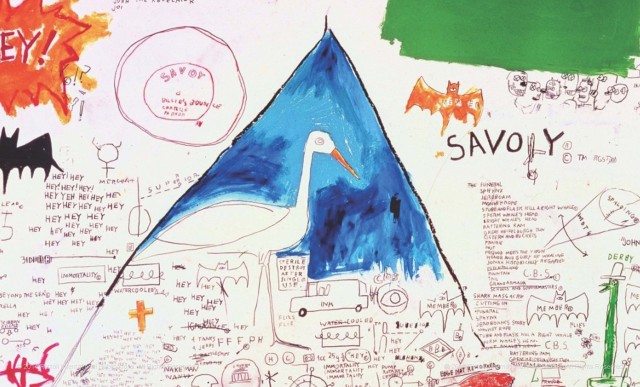
The opening of “Basquiat: The Unknown Notebooks” will be celebrated at free First Saturday program at the Brooklyn Museum

The opening of “Basquiat: The Unknown Notebooks” will be celebrated at free First Saturdays program at the Brooklyn Museum

Brooklyn Museum
200 Eastern Parkway at Washington St.
Saturday, April 4, free, 5:00 – 11:00
212-864-5400
www.brooklynmuseum.org

The April edition of the Brooklyn Museum’s First Saturdays program celebrates the opening of its latest exhibit on Jean-Michel Basquiat, “Basquiat: The Unknown Notebooks,” a collection of 160 pages from his never-before-shown notebooks, focusing on his use of text and image, along with works on paper and large-scale paintings. The free evening will feature live musical performances by the James Francies Trio and Lion Babe and a DJ set by Natasha Diggs; a curator talk by Tricia Laughlin Bloom about the new exhibition; a Basquiat crown-making workshop; a Basquiat-inspired writing workshop led by Tom La Farge and Wendy Walker; Cave Canem “Poetry Meets Art” readings from LaTasha N. Nevada Diggs and Roger Reeves; a children’s book presentation with illustrator Javaka Steptoe discussing Radiant Child: The Story of Young Artist Jean-Michel Basquiat; a screening of Tamra Davis’s 2010 documentary Jean-Michel Basquiat: The Radiant Child; a performance of Dark Swan by Urban Bush Women; and an interactive performance and dance workshop with W.A.F.F.L.E. (We Are Family for Life Entertainment). In addition, you can check out such exhibitions as “Revolution! Works from the Black Arts Movement,” “Kehinde Wiley: A New Republic,” “The Dinner Party by Judy Chicago,” and “Chitra Ganesh: Eyes of Time.”

OVERDUE: JAMES B. HARRIS

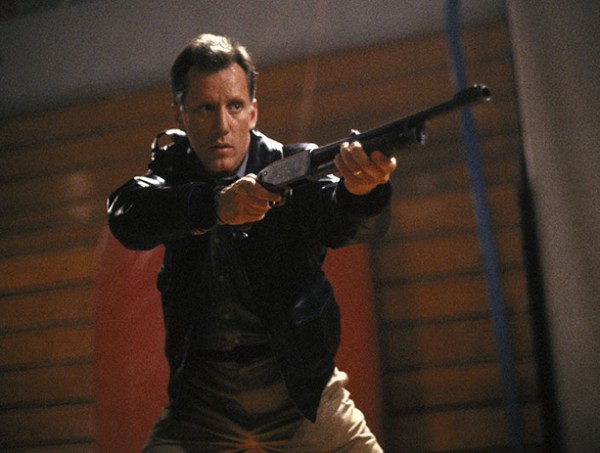
COP, starring James Woods, is part of overdue look at the career of James B. Harris

COP, starring James Woods, is part of overdue look at the career of James B. Harris

Who: James B. Harris
What: “Overdue,” critics Nick Pinkerton and Nicolas Rapold’s ongoing series that pays tribute to overlooked films and filmmakers
Where: BAMcinématek, BAM Rose Cinemas, 30 Lafayette Ave. between Ashland Pl. & St. Felix St., 718-636-4100
When: April 1-6
Why: Writer, director, and producer James B. Harris is finally given his due in this six-day series at BAM featuring eight of his nine films, including Stanley Kubrick’s The Killing, Lolita, and Paths of Glory and Don Siegel’s Telefon (starring Charles Bronson) in addition to four of his five directorial efforts, The Bedford Incident with Sidney Poitier and Richard Widmark, the Sleeping Beauty update Some Call It Loving, and Fast-Walking and Cop, both starring James Woods. The only film left out is the 1993 crime drama Boiling Point. The eighty-six-year-old Harris will be at BAM for Q&As following the April 1 screening of Some Call It Loving and the 6:30 screening of Cop on April 4 in addition to introducing the 9:30 showing of Paths of Glory on April 4, a film in which he also makes a cameo.