this week in lectures, signings, panel discussions, workshops, and Q&As

HEBREW ILLUMINATION FOR OUR TIME: THE ART OF BARBARA WOLFF

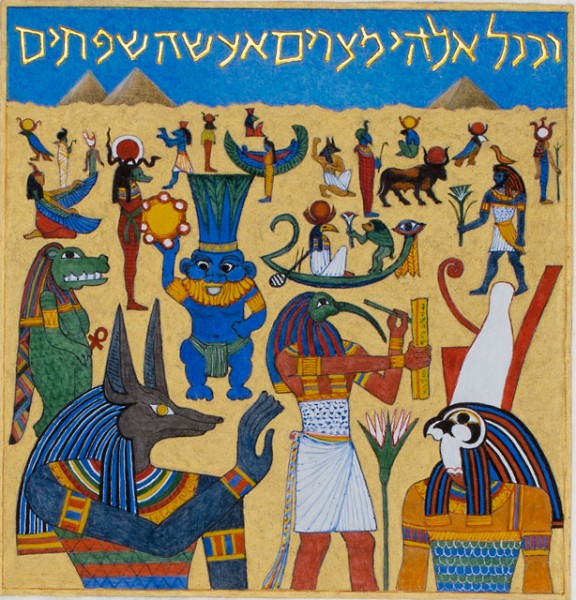
Barbara Wolff, “The Rose Haggadah,” detail, p. 19, illuminated manuscript, 2011-13 (artwork © 2014 Barbara Wolff / digital photography by Rudi Wolff)

Barbara Wolff, “The Rose Haggadah,” detail, p. 19, illuminated manuscript, 2011-13 (artwork © 2014 Barbara Wolff / digital photography by Rudi Wolff)

Morgan Library & Museum
225 Madison Ave. at 36th St.
Tuesday – Sunday through May 3, $12-$18 (free Fridays 7:00 to 9:00)
212-685-0008
www.themorgan.org
www.artofbarbarawolff.com

Passover doesn’t begin until April 3, but you can get a head start on the holiday, in which Jews around the world retell the story of the exodus from Egypt, by visiting the Morgan Library and checking out its lovely exhibition “Hebrew Illumination for Our Time: The Art of Barbara Wolff,” comprising the first two illuminated Hebrew texts to join the Morgan’s celebrated collection of illuminated manuscripts, as well as its very first Haggadah. In 2011, New York artist Barbara Wolff was commissioned by the Rose family to create an illuminated Haggadah, the book used at the Passover seder that contains prayers, hymns, historical tales, biblical scenes, and other elements that expand upon the Jews’ enslavement and their battle with the Pharaoh more than three thousand years ago. Working with her unique blend of silver, gold, and platinum foils on vellum, Wolff designed beautiful artwork to accompany Izzy Pludwinski’s Ashkenazic Hebrew calligraphy and Karen Gorst’s English captions, incorporating flora and fauna native to the Middle East along with the standard elements of the Passover seder, including such symbolic food as the Paschal lamb, matzah, and bitter herbs. Each page is exquisitely designed: A large eye oversees a pyramid in which slaves are shown hard at work, more than twenty colorful ancient Egyptian gods are gathered together in the desert, and the ten plagues are depicted above and below a lush gold area featuring silver Kiddush cups spilling drops of red wine. The Rose Haggadah is a far cry from the familiar, old-fashioned blue-and-white Maxwell House Haggadah that was so prevalent throughout much of the twentieth century. Wolff’s remarkable sixty-four-page book honors Jewish tradition in a format more associated with Christianity, bringing new life to an annual ritual that honors the past while projecting hope for the future.

Barbara Wolff, “Among the Branches They Sing” from “You Renew the Face of the Earth: Psalm 104,” illuminated manuscript, MS M.1190, fol. 3 (artwork © 2015 Barbara Wolff / photography by Rudi Wolff)

Barbara Wolff, “Among the Branches They Sing” from “You Renew the Face of the Earth: Psalm 104,” illuminated manuscript, MS M.1190, fol. 3 (artwork © 2015 Barbara Wolff / photography by Rudi Wolff)

The exhibit also includes Wolff’s illuminated version of Psalm 104, “You Renew the Face of the Earth,” ten elegant works in which she uses platinum, silver, and gold leaf on goatskin parchment. “This great hymn to the divine in nature directs our awareness to the miracle of the world,” Wolff writes in the free exhibition handout. “The sentiments expressed in this psalm have particular relevance for our own era, a time of growing consciousness of the profound effect of human enterprise on nature, and of questioning our role as steward of our planet.” The ten illuminations include the signs of the zodiac, which represent the twelve tribes of Israel; golden Hokusai-like waves above rising mountains; a silver leviathan encapsulating smaller sea creatures; and twenty-eight Israeli birds in and around a Tabor oak, with every animal specifically identified. Wolff adds commentary about each folio; for example, in “To Bring Forth Bread,” which shows grains growing, she writes, “Wild grass, ancestor of man’s most ancient cultivated crop, became the foundation of civilization. . . . Shining fields of wheat and filled granaries are symbols of security, peace, and plenty.” The exhibition is supplemented by illuminated manuscripts from the Morgan’s collection that influenced Wolff, as well as a twenty-two-minute film that highlights her intricate, intensely dedicated working process. In conjunction with the exhibition, Vassar professor Marc Michael Epstein will deliver the talk “Skies of Parchment, Seas of Ink: Barbara Wolff and her Place in the History of Jewish Manuscript Illumination” on April 1 at 6:30; on April 12 at 2:00, Wolff will lead the workshop “The Midas Touch”; on April 15 at 7:00, composer and accordionist Merima Ključo, artist Bart Woodstrup, and pianist Seth Knopp will team up for the multimedia presentation “The Sarajevo Haggadah: Music of the Book”; and on April 18 at 2:00, Stephanie Krauss will lead the workshop “My Very Own Illuminated Manuscript — Part 2: Putting It Together” for children eight and older.

MONTY PYTHON AT THE TRIBECA FILM FESTIVAL

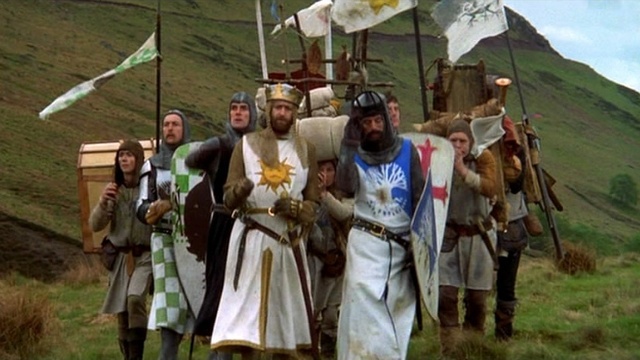
The five surviving Pythons will be at the Tribeca Film Festival celebrating the fortieth anniversary of MONTY PYTHON AND THE HOLY GRAIL

The five surviving Pythons will be galloping into the Tribeca Film Festival celebrating the fortieth anniversary of MONTY PYTHON AND THE HOLY GRAIL

Beacon Theatre
2124 Broadway at 75th St.
Friday, April 24, $70-$355 (on sale March 28 at 12 noon), 7:30
Other screenings April 25-26 (on sale March 31 for AmEx cardholders and April 6 to the general public)
212-465-6500
tribecafilm.com
www.beacontheatre.com

Tickets go on sale to the general public Saturday morning at 12 noon for one of the premier events of the 2015 Tribeca Film Festival: the fortieth anniversary screening of the 1975 classic Monty Python and the Holy Grail, taking place at the Beacon Theatre on April 24 — with John Cleese, Terry Gilliam, Eric Idle, Terry Jones, and Michael Palin on hand to talk about the film, one of the most quotable comedies ever made. “The Pythons are looking forward very much to the Tribeca Film Festival and the chance to meet anyone who can remember why we made Monty Python and the Holy Grail,” Palin said in a statement. “All we know is that it was a documentary about coconuts that rather lost its way. If anyone at Tribeca can explain why we made it and didn’t call it Braveheart, then our visit to New York will not have been wasted.” The closing weekend of the fifteenth annual TFF will also feature Roger Graef and James Rogan’s 2014 documentary, Monty Python: The Meaning of Live, on April 24 at 3:30 at the SVA Theater, Monty Python’s Life of Brian on April 25 at 12:30 at Bow Tie Chelsea Cinemas, and Monty Python’s The Meaning of Life on April 26 at 1:30 at Regal Cinemas Battery Park. (Tickets for those films, as well as the rest of the TFF, go on sale to American Express cardholders on March 31 and everyone else on April 6.)

TICKET ALERT: BACON AND BEER CLASSIC

Bacon and Beer Classic

Bacon and Beer Classic will take the field at Mets’ home stadium on April 25

Citi Field
123-01 Roosevelt Ave.
Saturday, April 25, brunch session 12 noon – 3:00 pm, evening session 7:00 – 10:00, $29-$129
www.baconandbeerclassic.com

Two great tastes that taste great together — bacon and beer — make up the menu at the annual Bacon and Beer Classic, returning to Citi Field on April 25 while the Mets are playing the Yankees up north in the Bronx. More than one hundred craft brews will be available, along with more than fifty bacon-inclusive dishes from local restaurants. There will also be workshops, demonstrations, live music, interactive games, a DJ, and other activities. Among the participating breweries are Broken Bow, Two Roads, Central Waters, Thirsty Dog, Knee Deep, the Radiant Pig, Elysian, River Horse, and Angry Orchard, while bacon delicacies will be served by City Crab, Landhaus, Route 66 Smoke House, Pig Guy NYC, Bamboo Bites, BarBacon, Ribs Within, BacoBurger, Carnal, and others. There are two sessions, one for brunch and one for dinner, with VIP tickets gaining you early admission, as well as access to the warning track and dugouts. If you’re not an imbiber, you can get in for a mere $29 for food and nonalcoholic beverages; otherwise, ticket packages range from $59 to $129. In addition there will be various awards given out by a panel of judges consisting of Liza De Guia, Lisa Fernandes, Derrick Prince, Adam Poch, and David “the Rev” Cancio.

MACY’S FLOWER SHOW: ART IN BLOOM

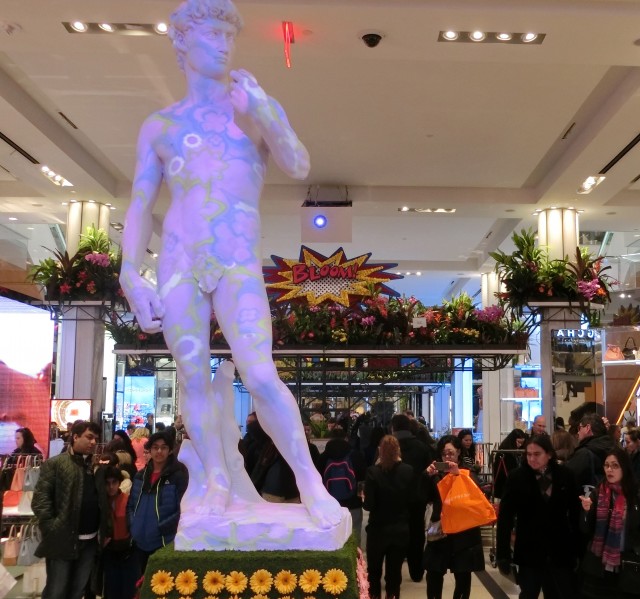
(photo by twi-ny/mdr)

Macy’s Flower Show is dedicated to “Art in Bloom” (photo by twi-ny/mdr)

Macy’s Herald Square
151 West 34th St. at Broadway
Daily through Sunday, April 4, free
212-494-4495
macys.com
art in bloom slideshow

Macy’s annual Flower Show is up and running, offering a lovely indoor respite during this cold start to spring. This year’s theme is “Art in Bloom,” with displays dedicated to abstract art, surrealism, impressionism, Pop art, the Renaissance, Art Nouveau, Contemporary, and portraiture. Bouquets of the Day will be designed by Martha Stewart (March 22-24), DeJuan Stroud (March 26-26), Kenji Takenaka (March 27-29), Polux Fleuriste (March 30-31), Olivier Giugni (April 1-2), and Jes Gordon (April 3-4). Among the related special events are a floral seminar with Michael Gaffney on March 27 at 1:00, the Puzzle Art Installation & Collaboration Project on March 28 at 2:00, an H.BLOOM floral seminar on March 30 at 1:00, and a Starbright floral seminar on April 3 at 1:00.

ART OFF THE WALL — CHITRA GANESH: EYES OF TIME

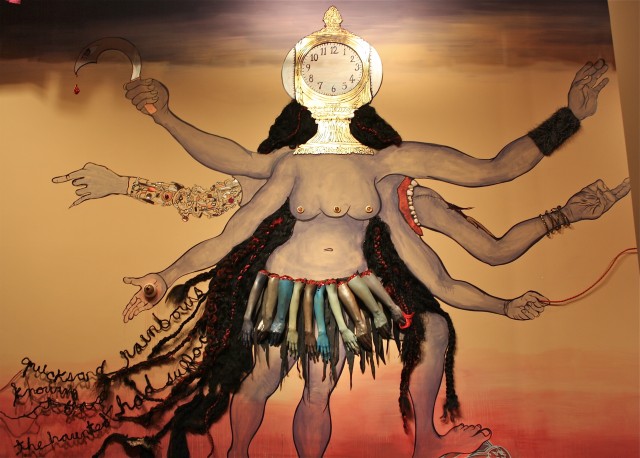
“Chitra Ganesh: Eyes of Time,” detail, mixed-media wall mural, 2015 (photo by twi-ny/mdr)

Chitra Ganesh, “Eyes of Time,” detail, mixed-media wall mural, 2015 (photo by twi-ny/mdr)

Brooklyn Museum
Elizabeth A. Sackler Center for Feminist Art, Herstory Gallery, fourth floor
200 Eastern Parkway at Washington St.
Thursday, March 26, free with museum admission, 6:00-9:30
Exhibition continues through July 12
212-864-5400
www.brooklynmuseum.org
www.chitraganesh.com
eyes of time online slideshow

In her exceptional new site-specific installation, “Eyes of Time,” in the Brooklyn Museum’s Herstory Gallery, multimedia artist Chitra Ganesh investigates female divinity, multiplicity, and power, inspired by the goddess Kali, one of the women honored with a place setting in Judy Chicago’s seminal work “The Dinner Party,” the centerpiece of the museum’s Elizabeth A. Sackler Center for Feminist Art, home to the Herstory Gallery. Ganesh, a lifelong Brooklynite, supplements her wall sculpture with selections from the museum’s collection, comprising contemporary works by Kiki Smith, Shoichi Ida, and Barbara Jones-Hogu as well as a small seventeenth-century Indian bronze of a standing Kali and an ancient Egyptian bronze of a seated Sekhmet. “In mythic tales both Sekhmet and Kali are connected to blood, death, destruction, and protection, and to fierce animals such as lions and tigers,” Ganesh writes in a wall label. “These qualities contrast with characteristics typically idealized in women today and point to the formidable roles played by the ancient goddesses.” About Louise Bourgeois’s 1996 drypoint, “Eyes,” Ganesh adds, “The third eye, as seen on Kali, has often been associated with supernatural powers in Indian mythology and continues to appear in contemporary imagery. The act of gazing into numerous eyes might also recall the practice of darshan, a dialectical and spiritual way of looking that considers the object as both image and living being, providing an experience of seeing that informs South Asian culture.”

Those explanations also offer just the right way to approach “Eyes of Time,” a sprawling mural of three women that covers one wall of the gallery. At the left is a contemporary figure holding a jagged, starlike piece of the universe over one eye while the other eye looks directly at the viewer. In the middle is a figure based on Kali, the goddess of time, change, and destruction, who has six arms, three legs, three breasts, and a skirt of severed arms of different colors. Words emerge from her long hair, including “quicksand,” “rainbows,” and “knowing.” One hand has an eyeball in its palm, one holds a whip, while another wields a blood-dripping scythe with an eye on it. Instead of a head, on her neck is the Grand Central clock, without its hands. And on the right is a science-fiction woman made out of such machine parts as gears and speakers laid out in a kind of architectural rendering. All three women, representing the past, the present, and the future, have shiny jewels embedded into their being, while two rows of decorated flags hang above them. In some ways, it’s like the three figures have escaped from Ganesh’s comic book Tales of Amnesia, which is also on view, giving three-dimensional life to these superhero characters. “These narrative devices allude to the power of multiple forms of femininity that coexist within the same frame and, at times, within a single being, as well as to darker aspects of Kali,” Ganesh writes about her 2002 book. On March 26, the Brooklyn Museum’s next edition of “Art Off the Wall” will celebrate “Eyes of Time” with an evening of special activities, consisting of an artist and curator talk with Ganesh and Saisha Grayson, a zine library inspired by Tales of Amnesia, screenings of three of Ganesh’s short films (Rabbithole; What Remains; My dreams, my works must wait till after hell…), a movement workshop with Ajna Dance Company, and a Bhangra dance party with DJ Rekha.

NOVA REN SUMA: THE WALLS AROUND US BOOK LAUNCH WITH LIBBA BRAY

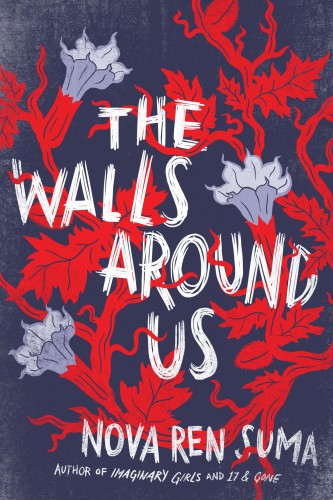
walls around us

THE WALLS AROUND US (Algonquin Young Readers, March 24, $17.95)
McNally Jackson
52 Prince St. between Lafayette & Mulberry Sts.
Monday, March 23, free, 7:00
212-274-1160
mcnallyjackson.com
novaren.com

“We went wild that hot night. We howled, we raged, we screamed. We were girls — some of us fourteen and fifteen; some sixteen, seventeen — but when the locks came undone, the doors of our cells gaping open and no one to shove us back in, we made the noise of savage animals, of men.” So begins Nova Ren Suma’s third YA novel, the ghost story The Walls Around Us. Her follow-up to Imaginary Girls and 17 & Gone, Suma’s latest book is told from the point of view of a convicted killer and a ballerina (Suma herself danced from the age of six to sixteen) and includes quotes from Shirley Jackson’s The Haunting of Hill House, Alice Sebold’s The Lovely Bones, and Margaret Atwood’s The Handmaid’s Tale to help set the mood. Suma, who we once had the extreme pleasure of working with in the children’s books business, is a master of her craft, creating warm, believable characters, writing sharp, realistic dialogue, and bringing intriguing situations to life with atmospheric dexterity. A very active member of the YA community, Suma took a big leap of faith with The Walls Around Us, letting her ideas run wild and trusting her instincts instead of worrying what her editor, agent, reviewers — and she herself — expected.

the walls around us

The result is a novel that was named the #1 Indie Next pick for Spring ’15, is an Amazon Best Book of the Month, and has garnered numerous starred reviews. Suma, who gave her first official public YA reading at twi-ny’s tenth anniversary celebration in 2011, will be at McNally Jackson in SoHo on March 23, launching The Walls Around Us with her friend and colleague, Michael L. Printz Award winner Libba Bray (The Diviners, Going Bovine). There will be a short reading, a conversation between the two literary stalwarts, a Q&A with the audience, and a signing. In addition, Suma will be giving away lots of Walls tattoos. And don’t worry; Suma isn’t really like one of her narrators, Violet, who explains early in the book, “I slip behind the curtain — it’s almost time, get the spotlight ready, soon I’ll be on. This’ll be my last dance before I leave town. My last chance to make them remember me, and remember me they will. When I’m onstage, I’m all for them, and they’re all for me. I feed off what they give me, and they bask in what I give them. When I’m offstage, these people are nothing to me. I’ve got some level of hate for practically almost everyone I run into on any given day. But in the midst of dancing? When they’re watching me and I’m letting them watch? I’ve got so much love, I’m like a whole different person.” Suma, who teaches writing workshops around the country, will also be participating in the “Exploring Feminist YA” panel on March 21 at 1:10 at the NYPL on Forty-Second St. with keynote speaker Bray, Gayle Forman, Scott Westerfeld, and moderator David Levithan for the 2015 NYC Teen Author Festival.

STRANGER THAN FICTION: THE MUSES OF ISAAC BASHEVIS SINGER

THE MUSES

Documentary delves into Isaac Bashevis Singer’s love of women and their work as his translators

THE MUSES OF BASHEVIS SINGER (Asaf Galay & Shaul Betser, 2014)
IFC Center
323 Sixth Ave. at West Third St.
Tuesday, March 24, 8:00
212-924-7771
www.stfdocs.com
www.the-muses-of-bashevis-singer.com

Who ever thought that little old Yiddish mensch Isaac Bashevis Singer was such a horndog? Asaf Galay and Shaul Betser begin The Muses of Bashevis Singer, their light and playful documentary, with the following quote from the Nobel Prize-winning author: “In my younger days I used to dream about a harem full of women. Lately I’m dreaming of a harem full of translators. If those translators could be women in addition, this would be paradise on earth.” Well, it seems that Singer, who was born in Poland in 1902, emigrated to the United States in 1935, and died in Florida in 1991 at the age of eighty-eight, found that paradise, as Galay and Betser meet with a series of women who were among many hand-picked by Singer, the man who nearly singlehandedly preserved Yiddish literature in the twentieth century, to serve as his translators, and not necessarily because of their language skills. “There were certain women who were more than just translators to him. It happened quite often,” says his Swedish publisher, Dorothea Bromberg, who also talks about Alma, Singer’s wife of more than fifty years. “He loved her, I’m sure, in his own way,” she adds. “She was very jealous of him, and she was completely right.” Galay and Betser meet with translators Eve Fridman, Evelyn Torton Beck, Dvorah Telushkin, Marie-Pierre Bay, Duba Leibell, and Dr. Bilha Rubenstein as well as Singer biographers Florence Noiville and Janet Hadda, his granddaughters Hazel Karr and Merav Chen-Zamir, Yentl the Yeshiva Boy playwright Leah Napolin, and his longtime secretary and proofreader, Doba Gerber, who share intimate, surprising tales about the author of such books as The Family Moskat, The Magician of Lublin, Shosha, and Enemies, a Love Story and such short stories as “Gimpel the Fool,” “A Friend of Kafka,” and “Zlateh the Goat.”

The seventy-two-minute film, lifted by a bouncy, airy soundtrack by Jonathan Bar-Giora, also includes footage of Singer making speeches, appearing on interview programs, going to a Jewish deli, walking on the Coney Island boardwalk, and writing with pen on paper and on a typewriter with Yiddish characters. But as the title implies, The Muses of Bashevis Singer doesn’t depict him as a callow cad but as a determined writer — and father and husband — who just loved women, loved being surrounded by women, using them as inspiration for his marvelous stories that mixed fiction with reality. “Isaac was a very frisky old man,” says Leibell, who worked with Singer in his later years after he moved to Florida with Alma. “That’s to put it very mildly.” The Muses of Bashevis Singer concludes the IFC Center’s winter Stranger than Fiction series on March 24 and will be followed by a Q&A with the director.