this week in lectures, signings, panel discussions, workshops, and Q&As

MULTIMEDIA ARTIST TALK: KEHINDE WILEY AND DJ SPOOKY

Who: Kehinde Wiley and DJ Spooky
What: Interactive multimedia talk
Where: Brooklyn Museum, Iris and B. Gerald Cantor Auditorium, 200 Eastern Pkwy. at Washington St., 718-638-5000
When: Thursday, April 16, $16 (includes museum admission), 7:00
Why: Kehinde Wiley and DJ Spooky will team up at the Brooklyn Museum to discuss Wiley’s midcareer retrospective, “Kehinde Wiley: A New Republic,” featuring five dozen of his unique portraits and sculptures. The evening will include a talk, a performance by Paul D. Miller, better known as That Subliminal Kid, DJ Spooky, and a Q&A.

TRIBECA FILM FESTIVAL FREE EVENTS

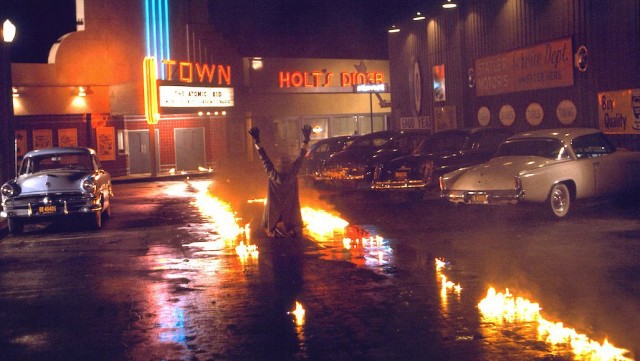
Free thirtieth anniversary screening of BACK TO THE FUTURE at the Tribeca Film Festival should be a hot ticket

Free thirtieth anniversary screening of BACK TO THE FUTURE at the Tribeca Film Festival should be a hot ticket

TRIBECA FILM FESTIVAL
Multiple locations
April 16-26, free
tribecafilm.com

The Tribeca Film Festival can get rather pricey, with tickets for screenings followed by Q&As running $38.50, while special events such as the Monty Python appearance at the Beacon reaches $355. Below are eleven TFF 2015 programs that won’t cost you a cent.

Thursday, April 16
Tribeca Talks Master Class — ARC Adorama Rental Company: The Producers, with Matt Parker, Olivia Wilde, Carly Hugo, and Alex Orlovsky, moderated by Tatiana Seigel, SVA Theater 2 Beatrice, 333 West 23rd St. between Eighth & Ninth Aves., 2:30

Friday, April 17
Tribeca Talks Script & Screen: Act Your Age, with Felix Thompson, Jeppe Ronde, and Ido Mizrahy, moderated by Gordon Cox, Barnes & Noble Union Square, 33 East 17th St., 1:00

Tribeca Talks Master Class: Get the Look, with Catherine Martin and Hamish Bowles, SVA Theater 2 Beatrice, 333 West 23rd St. between Eighth & Ninth Aves., 2:30

Saturday, April 18
Tribeca Talks Script & Screen: The Beauty of Angst, with Reed Morano, David Osit, Malika Zouhali-Worrall, and Sibs Shongwe-La Mer, moderated by Eric Kohn, Barnes & Noble Union Square, 33 East 17th St., 1:00

Sunday, April 19
Tribeca Family Festival: Downtown Youth Behind the Camera, featuring works by young filmmakers, SVA Theater 1 Silas, 333 West 23rd St. between Eighth & Ninth Aves., 11:00 am

Tribeca Talks Script & Screen: This Is the Real Life, with Pamela Romanowsky, Kevin Kerslake, Zachary Treitz, and Nick Sandow, moderated by Ross Miller, Barnes & Noble Union Square, 33 East 17th St., 1:00

Monday, April 20
Tribeca Talks Master Class: CNN Films Capture Reality, with Liz Garbus, Rachel Boynton, and Roger Ross Williams, moderated by Eric Hynes, SVA Theater 2 Beatrice, 333 West 23rd St. between Eighth & Ninth Aves., 2:30

Tuesday, April 21
Tribeca Talks Master Class — The Dolby Institute: The Sound of the Coens, with Carter Burwell and Skip Lievsay, moderated by Glenn Kiser, SVA Theater 2 Beatrice, 333 West 23rd St. between Eighth & Ninth Aves., 2:30

Saturday, April 25
Tribeca Family Festival Street Fair, Greenwich St. from Hubert to Chambers Sts., 10:00 am

Tribeca/ESPN Sports Day, North Moore St. from Greenwich to West Sts., 10:00 am

Back to the Future — Thirtieth Anniversary Screening, BMCC Tribeca PAC, 199 Chambers St., 6:00
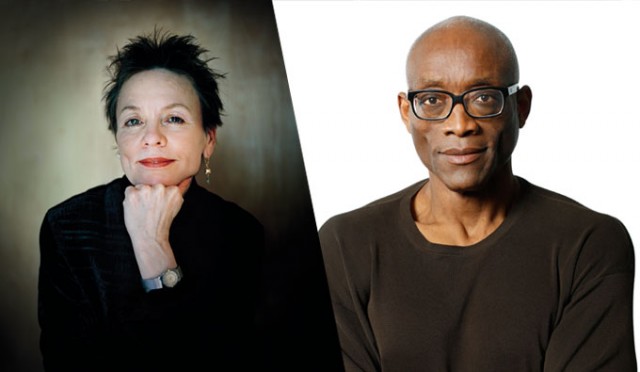
LIVE IDEAS: S K Y — FORCE AND WISDOM IN AMERICA TODAY

Laurie Anderson and Bill T. Jones

Laurie Anderson and Bill T. Jones will join forces for third annual Live Ideas festival at NYLA

New York Live Arts
219 West 19th St.
April 15-19
212-691-6500
newyorklivearts.org

In April 2013, New York Live Arts held its inaugural Live Ideas multidisciplinary festival, celebrating the life and career of Oliver Sachs through dance, music, film, theater, panel discussions, and scientific investigation, with Sachs participating in multiple events. Last year, Live Ideas paid tribute to writer James Baldwin, whom NYLA artistic director Bill T. Jones called “another multifaceted generator of and magnet for ideas.” This year, NYLA has handed the reins over to Laurie Anderson, who is curating the third Live Ideas festival, “S K Y – Force and Wisdom in America Today.” From April 15 to 19, more than two dozen programs will examine social, political, artistic, and environmental issues, taking stock of the state of the country in the twenty-first century. The free Noon-Time Talk Series consists of “Timothy Ferris: Beyond Belief”; “Arvo Pärt, Journeys in Silence,” with Anderson, Peter Bouteneff, James Jordan, and William Robin; “Marjorie Morrison: Proactive Military Mental Health,” with Marjorie Morrison, Mateo H. Romero, and Joseph Mauricio; the multimedia presentation “Vito Acconci: WORD/ACT/SIGN/DE-SIGN”; and the three-hour installation “Lou Reed: DRONES,” introduced and operated by Reed’s longtime guitar tech, Stewart Hurwood. Every evening will conclude with the free “Blue Room” DJ party either in the NYLA lobby or G Lounge right down the street, with King Britt, Drew Daniel, Glasser, Yuka C. Honda, and Jonathan Toubin and Geo Wyeth.

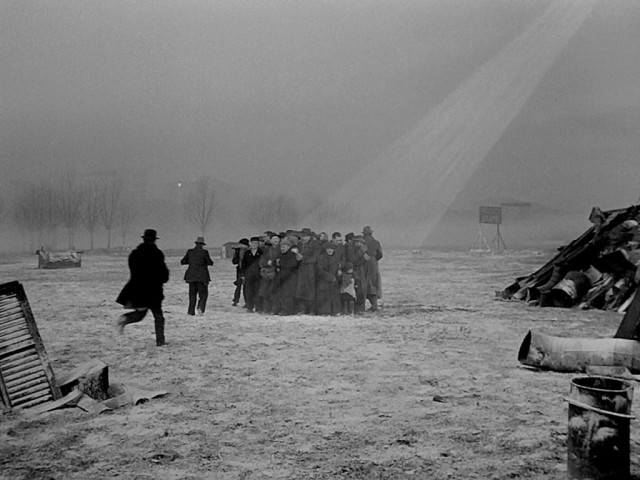
MIRACLE IN MILAN will help shed some light on NYLA Live Ideas festival

Vittorio De Sica’s MIRACLE IN MILAN will help shed some light on NYLA Live Ideas festival

Film will play an important role, with Robert Milazzo introducing Chris Marker’s seminal La Jetée; Julian Schnabel’s Before Night Falls, followed by a conversation with Anderson and Schnabel; Vittorio De Sica’s Miracle in Milan; Dorian Supin’s 24 Preludes for a Fugue, introduced by Bouteneff; and a selection of Anderson’s films, including Hidden Inside Mountains, What You Mean We?, Carmen, and excerpts from The Personal Service Announcements, with Anderson on hand to talk about the works. Among the live musical events are Eyvind Kang’s “Time Medicine,” with Kang and Anderson; John Zorn’s “Music for Piano, Strings and Percussion,” with “In the Hall of Mirrors” performed by pianist Steve Gosling, bassist Greg Cohen, and drummer Tyshawn Sorey and “CERBERUS” featuring Kinan Idnawi on oud, Erik Friedlander on cello, Cohen on bass, and Cyro Baptista on percussion; a pop-up show by the Symptoms (John Colpitts, Tony Diodore, and Anderson); a concert of chamber works by Pärt including Solfeggio, Da Pacem, Fratres, Spiegel im Spiegel, and Für Alina; and a two-part evening starting with a performance by Reverend Billy & the Stop Shopping Choir and ending with Hal Willner and Chloe Webb’s “Doing the Things We Want To,” a tribute to the late Reed and Kathy Acker.

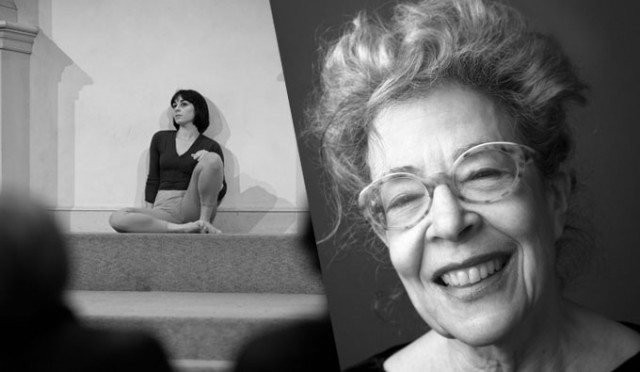
Beth Gill and Deborah Hay

Beth Gill and Deborah Hay will present new works on April 15 at multidisciplinary NYLA festival

Dance, NYLA’s bread and butter, will be represented by New York choreographer Beth Gill’s specially commissioned Portrait Study, paired with an advance look at legendary experimental choreographer Deborah Hay and Anderson’s Figure a Sea. The former is built around short autobiographical solos by such dancers as Neal Beasley, Eleanor Hullihan, John Jasperse, Jodi Melnick, Stuart Singer, David Thomson, Meg Weeks, and Emily Wexler, set to live music by Eliot Krimsky and Ryan Seaton, with a transitioning lighting and color design by Thomas Dunn. The latter is a sneak peek at Hay and Anderson’s evening-length piece for the Cullberg Ballet, premiering in Stockholm in September. There’s a whole lot to take in at the 2015 Live Ideas festival, but Anderson and Jones will get right to the point — and explain how they came up with the name “S K Y – Force and Wisdom in America Today” — in their opening-day discussion, aptly titled “Where Are We Going?” To Jones, the sky is “a multidimensional symbol of aspiration, vastness, change, threat, and now information storage,” while Anderson will explore why we live in “a society that is deeply divided, unjust, and often toxic.” And if all of that isn’t wide ranging enough for you, on April 17, Master Ren will lead a Taijiquan martial arts demonstration, accompanied by Lou Reed’s DRONES.

THE ORCHID SHOW: CHANDELIERS

Orchids are beautiful from up close and from far away in beautiful show at the New York Botanical Garden (photo by twi-ny/mdr)

Orchids are beautiful from up close and from far away in lovely show at the New York Botanical Garden (photo by twi-ny/mdr)

The New York Botanical Garden
Enid A. Haupt Conservatory
2900 Southern Blvd., Bronx
Tuesday – Sunday through April 19, $8-$10 children two to twelve, $20-$25 adults, 10:00 am – 6:00 pm
718-817-8700
www.nybg.org
chandeliers slideshow

“They lean over the path / Adder-mouthed / Swaying close to the face / Coming out, soft and deceptive / Limp and damp, delicate as a young bird’s tongue / Their fluttery fledgling lips / Move slowly / Drawing in the warm air.” So begins Theodore Roethke’s 1946 poem “Orchids,” one of many poetic works that accompany the New York Botanical Garden’s thirteenth annual Orchid Show. This year’s edition is titled “Chandeliers,” as curator Francisca Coelho, who has been at the garden for three decades, has designed a gorgeous display with orchids everywhere — at floor level, on trees, in large pots, and especially hanging from the glass ceilings of the Enid A. Haupt Conservatory. Thousands of orchids are on view, in mixes of white, purple, blue, yellow, red, and other colors and in varying shapes, as well as a few aromatic flowers. It’s an orchid heaven wherever you look, but the most glorious sections are at the beginning, with a series of orchids atop the conservatory’s reflecting pool, and near the middle, where a giant star-shaped chandelier of orchids hangs above a walkway so viewers can gather underneath and take in yet more beauty from an unexpected angle. There are even orchids more naturally posed, in the Tropical Rain Forest Galleries.

NYBG Orchid Show offers visitors a chance to reflect on the beauty of nature (photo by twi-ny/mdr)

NYBG Orchid Show offers visitors a chance to reflect on the beauty of nature (photo by twi-ny/mdr)

Occasional signage shares facts about the history and conservation of orchids, and phone numbers with codes to punch offer for more detailed information. The rooms can get crowded — especially in particularly resplendent areas that provide a profusion of Kodak moments — but everything is calm and lovely, the orchids’ charm spreading to all comers, even when that kid won’t get out of the way as you try to snap a photo. Numerous programs are being held in conjunction with the show, including free orchid care demonstrations on Sundays at 2:00 & 3:00, the ticketed class “Divide, Repot, Rejuvenate!” on April 18 at 10:00 ($59), and “Orchid Evenings” on April 17 & 18. In addition, a large selection of orchids are for sale in the shop; we make sure to bring a plant home every year.

DIOR AND I

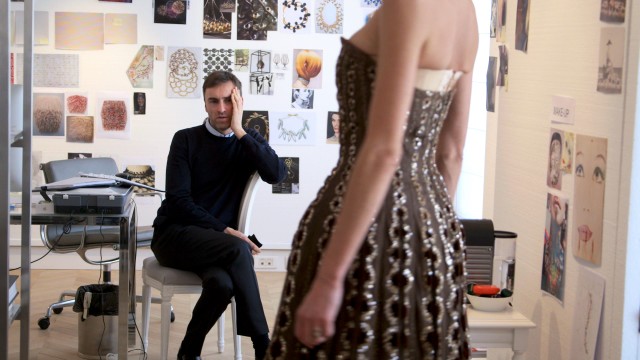
Documentary follows Raf Simons as he becomes new creative director of Christian Dior

Documentary follows Raf Simons as he becomes new creative director of Christian Dior

DIOR AND I (Frédéric Tcheng, 2014)
Film Forum, 209 West Houston St., 212-727-8110
Film Society of Lincoln Center, Walter Reade Theater, 165 West 65th St., 212-875-5601
Opens Friday, April 10
www.diorandimovie.com

After working on two previous fashion-related films, Diana Vreeland: The Eye Has to Travel and Valentino: The Last Emperor, Frédéric Tcheng makes his solo directorial debut with Dior and I. In April 2012, fashion designer Raf Simons was named the new creative director of Christian Dior, bringing along his right-hand man, Pieter Mulier. Tcheng goes behind the scenes to follow Simons as he prepares his first-ever haute couture collection, which is due in a mere two months. Tcheng zooms in on the Belgian designer’s working methods and general anxiety as he takes over at the legendary company, developing important relationships with Dior CEO Sidney Toledano, première atelier flou Florence Chehet, première atelier tailleur Monique Bailly, the seamstresses, the models, and other employees. Simons chooses to pay homage to Dior’s past with his new collection while attempting to rid himself of the designation of “minimalist designer.” One of his most fascinating directions is attempting to incorporate the work of artist Sterling Ruby into his designs. All the while he is haunted by the ghost of company founder and New Look creator Christian Dior, who is shown by Tcheng in archival footage accompanied by a voice-over of Omar Berrada reading from Dior’s memoirs. Dior and I is a slight but affecting race against time, as one man in the present honors the past while laying the groundwork for a bright future. Dior and I opens April 10 at Film Forum and the Film Society of Lincoln Center, with Tcheng and Berrada appearing at Film Forum for the 7:30 show April 10 and the 5:20 show April 11; Tcheng will also be at the Walter Reade Theater for a Q&A following the 7:00 show April 11.
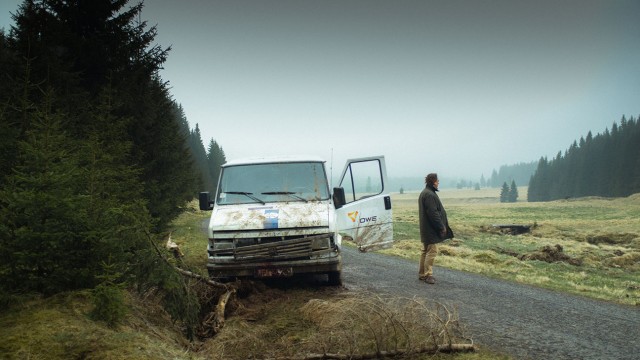

KINO! 2015 FESTIVAL OF GERMAN FILMS: SCHMITKE

SCHMITKE

Julius Schmitke (Peter Kurth) takes stock of his life in existential black comedy

SCHMITKE (Štěpán Altrichter, 2014)
Cinema Village
22 East 12th St. between University Pl. & Fifth Ave.
Sunday, April 12, 10:00, and Wednesday, April 15, 6:00
Festival runs April 9-16
212-924-3363
www.schmitkefilm.com
www.kinofestivalnyc.com

Based on the wonderfully titled Tomáš Končinský short story “Julius Schmitke slipped through death’s fingers like an awkward seal,” Czech director Štěpán Altrichter’s debut feature, Schmitke, is a darkly comic, Kaurismäkian character study of a middle-aged engineer making his way through a pretty simple life. Julius Schmitke (Peter Kurth) wakes up each morning, watches the coffeemaker get going, walks about slowly, stares a lot, and follows the story of a Bear-Man living in the German woods. A bear of a man himself, he is disappointed when he is reassigned — demoted — to fix a broken wind turbine in the small, foggy Czech border town of Chřmeleva in the Ore Mountains. Meanwhile, his grown daughter shows up unexpectedly, moving in with him and declaring, “I invested my energy wrong!” Schmitke and his new partner, the young, rather talkative Thomas Gruber (Johann Jürgens), head out in their white van, getting lost before ultimately arriving at their destination, where everyone, including the mayor (Jakub Žáček), hangs out in the local pub, drinking all day. But when Gruber suddenly goes missing, Schmitke sets off on a desperate search to find him — and, perhaps, himself in the process.
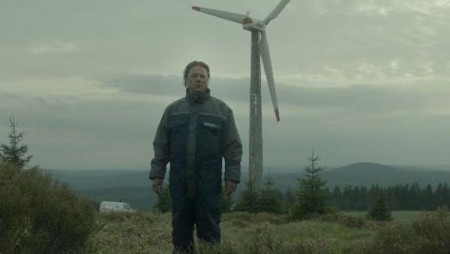
Peter Kurth stars as a man chasing a different kind of windmill in SCHMITKE

Peter Kurth stars as a man chasing a different kind of windmill in SCHMITKE

Cinematographer Cristian Pîrjol shoots Schmitke in muted greens and blues, with sudden bursts of red and yellow; his camera loves Schmitke, zooming in on his tired, heavy face, a man filled with desperation but too exhausted to do anything about it; instead, he dreams of becoming the Bear-Man himself. The old, rotting turbine, C174, turns agonizingly slowly, starting and stopping, emitting loud, echoing creaks that Schmitke might like to voice himself but won’t. “Damned thing,” he says to himself, but he could just as well be talking about his own life. He’s an existential Don Quixote figure, chasing windmills but just going around in circles. Altrichter, who wrote the script with Končinský and Jan Fusek, prefers short cuts with little camera movement, populating his film with strange characters and surreal plot twists. Johannes Repka’s moody score, going from mysterious to cheesy, and Katharina Grischkowski’s clever sound design enhance the overall subtly bizarre atmosphere. The motto of the company Schmitke works for is “Efficiency. Esteem. Energy.” The film has all three of those, albeit in its own unusual way. Schmitke is having its North American premiere April 12 and 15 as part of the Kino! 2015 Festival of German Film, which runs April 9-16 at Cinema Village and consists of ten recent features and one evening of shorts from Germany. Among the other films being screened are Mark Monheim’s About a Girl, Neele Leana Vollmar’s The Pasta Detectives, Christoph Hochhäusler’s The Lies of the Victors, and Christian Zübert’s Tour de Force. In addition, there will be conversations with some of the filmmakers at the Goethe-Institut and Deutsches Haus at NYU.

GALLERY SESSIONS: BJÖRK EXPLAINED BY A FAN

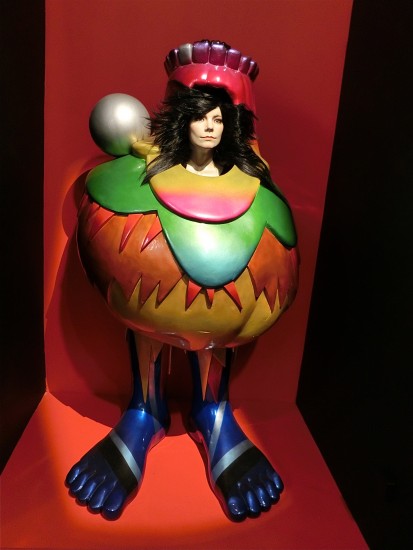
Björk (photo by twi-ny/mdr)

“Björk” exhibit at MoMA has led to quite a cacophony (photo by twi-ny/mdr)

BJÖRK
MoMA, Museum of Modern Art
11 West 53rd St. between Fifth & Sixth Aves.
Exhibit runs through June 7, $14-$25 (timed tickets available same day only)
212-708-9400
www.moma.org
bjork.com

There doesn’t seem to be a whole lot more that can be said about Björk’s disastrous solo exhibition at MoMA, so reviled that critics are calling for the heads of chief curator at large Klaus Biesenbach and museum director Glenn D. Lowry. The truth hurts; it’s a head-scratchingly absurd show. I went in determined to see something everyone else missed, trying to find something positive in the four-part presentation, having admired Björk Guðmundsdóttir’s work for many years, from her time leading the Sugarcubes to her award-winning performance in Lars von Trier’s Dancer in the Dark to her innovative Biophilia album, app, tour, and concert film. But alas, the simply titled “Björk” exhibition seems to go out of its way to annoy. The MoMA-commissioned ten-minute “Black Lake” music video, for a song from her latest album, Vulnicura, about her breakup with longtime partner Matthew Barney, is fine, a two-screen projection in which she lets loose against Barney, who just last week sued her for custody of their twelve-year-old daughter. “My soul torn apart / My spirit is broken / Into the fabric of all / He is woven,” she sings in a haunting volcanic landscape that features dripping substances evoking Barney’s use of petroleum jelly at the Guggenheim and in Drawing Restraint 9 (in which Björk had a major role) and lava and feces in “River of Fundament.” However, you will have to wait a lot longer than ten minutes to get into the specially designed area in MoMA’s atrium, then wait again after it’s over to enter the theater that shows many of Björk’s cutting-edge videos. Also, several of her unique Biophilia instruments play music in the lobby by the sculpture garden entrance. But it’s the heart of the show that is so disturbing, the time-ticketed “Songlines,” in which an iPod touch guides visitors through eight rooms, a chronological trip through Björk’s eight albums, from 1993’s Debut through January’s Vulnicura. The very small spaces feature handwritten notes and lyrics, costumes, video paraphernalia, and, through headphones, a bizarre fairy-tale-like fictionalized narrative, written by Icelandic poet Sjón and narrated by actress Margret Vilhjalmsdottir, about a young girl (Björk) growing up to become someone. You can’t purchase timed tickets in advance (only same day, onsite), so you might be shut out if you get to MoMA too late in the afternoon. Also, once you start going through “Songlines,” you are not allowed to go back to a previous room; you must proceed forward, and since it’s unlikely you’ll actually need all five minutes for each stop, the audio will often not be in sync with your physical surroundings.

Despite living part-time in New York (and Iceland and London) and having held several concerts in the city on her Vulnicura tour (she had to cancel her April 4 show but will be coheadlining the Governors Ball on Randall’s Island on June 6), Björk has not participated in any events and given only one interview (to Time magazine) in conjunction with the exhibit — although there are mannequins of an ornately designed Björk in “Songlines” — so MoMA is leaving it up to others to put it all in perspective and try to make sense of this utter mess. But they’re not exactly calling in the big guns; instead, on April 10 at 11:30 and April 22 at 1:30, the gallery session “Björk Explained by a Fan” will be led by an unnamed “dedicated fan of the composer, musician, and artist,” moderated by a museum educator. On April 12 and 18 at 11:30, “Sights and Sounds” will delve into how sound can be made visible. On April 17 and 24 at 11:30, “Björk” will examine art in relation to post-technological culture. And on April 26 at 11:30 and April 30 at 1:30, anyone can participate in “Björk: Human Behavior,” an open group discussion about Björk’s exploration of the connections between nature and human behavior; people are encouraged to share “their personal experience of the Björk exhibition,” which could be quite fascinating in and of itself. All talks are first-come, first-served and do not include a visit to the show. I can’t imagine that any of these talks will enhance your personal experience of a show that has been called “abominable,” “an ill-conceived disaster,” “oh so disappointing,” “a waste of time,” “a strangely unambitious hotchpotch,” and, quite simply and right to the point, “bad.”