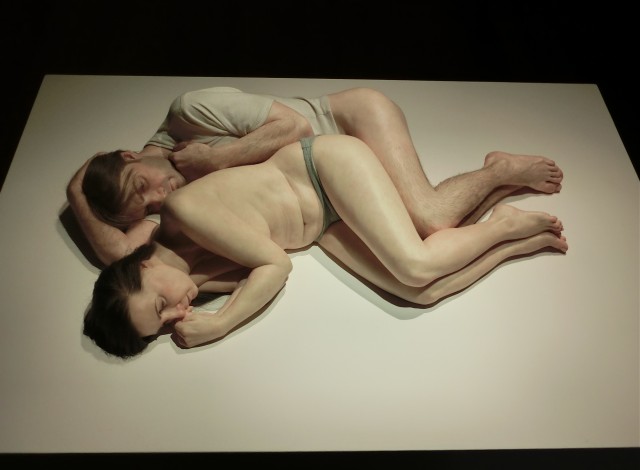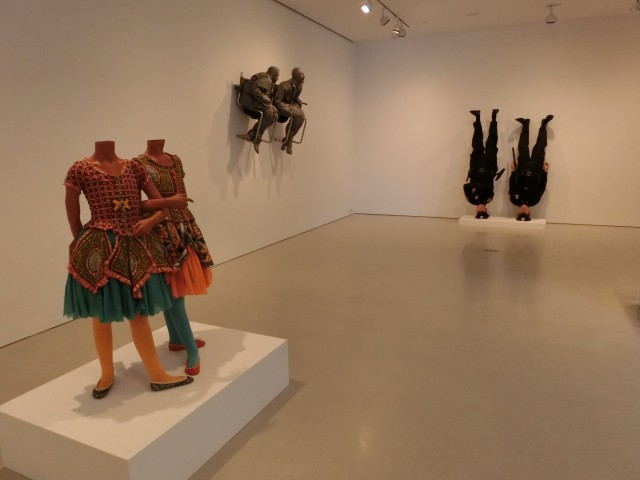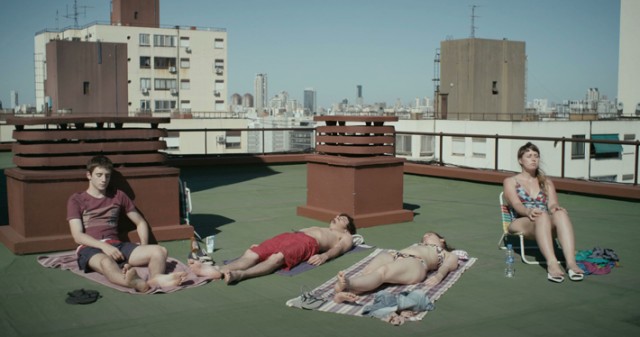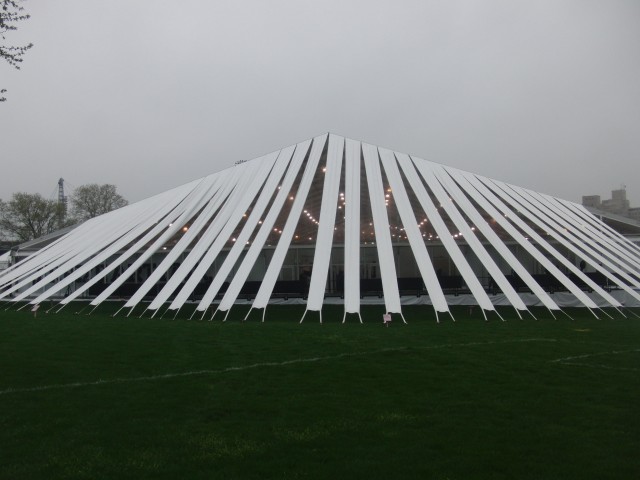
The art world will descend on Randall’s Island for the Frieze Art Fair this week (photo by twi-ny/mdr)
FRIEZE ART FAIR
Randall’s Island Park
May 14-17, $28-$109
friezenewyork.com
The giant white tents of the Frieze Art Fair will cover Randall’s Island once again for four days in May, promising crowds of eager patrons and onlookers both provocative, astonishing, world-class, expensive art and a group of often delightful, sometimes mystifying, occasionally participatory projects, as well as superlative people-watching and classy eats. Those looking to acquire museum-level works can check out the booths of Marian Goodman, which features the work of Giuseppe Penone, a member of the Italian Arte Povera group; or Paul Kasmin, who has works by Sigmar Polke, Iván Navarro, Jules Olitski, and Laylah Ali on its temporary walls. Matthew Marks will show lots of Nan Goldin and Paul Sietsema; Cheim & Read has Ghada Amer, Louise Bourgeois, and Lynda Benglis; Yoko Ono is at Galerie Lelong; and fans of German painting can choose from Martin Eder, David Schnell, and Melora Kuhn at Eigen + Art. With more than two hundred galleries, Frieze can be overwhelming, but there’s an app to download here and sustenance provided by high-end dining-scene stalwarts Frankie’s Sputino, Milk Bar, Prime Meats, and Roberta’s, among others.
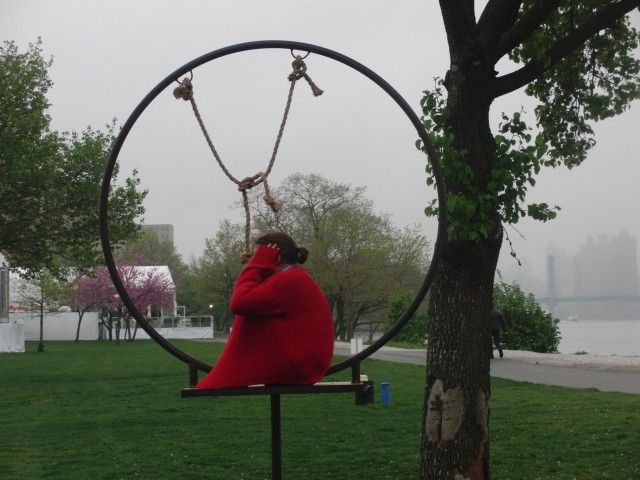
Performance projects and an outdoor sculpture garden are part of annual Frieze Art Fair (photo by twi-ny/mdr)
We enjoy the Frieze projects immensely; you can see our video with Marie Lorenz here, as we exited the fair in a rather unique way. This year, there seems to be a theme; two projects boast mazelike layouts and a third is highlighted by a hidden subterranean chamber. Japanese-born Aki Sasamoto makes his maze into a sort of personality test and multiple-choice questionnaire via a series of rooms and doors (shades of Door Number Two and Let’s Make a Deal, perhaps?) while the Flux-Labyrinth reconceives George Maciunas’s 1975 Fluxus work as a participatory set of narrow corridors and mysterious door handles. Korakrit Arunanondchai’s massage chairs and Pia Camil’s free fabric giveaways add to fairgoers’ fun. Los Angeles-based artist Samara Golden’s secret room beneath the fair reveals the working underbelly of pillars, electric cables, and air-conditioning vents — vents that we fervently hope work very well as the enormous crowds descend on this, one of twi-ny’s all-time favorite New York art fairs. Below are some of the special programs at Frieze, as well as information about the other fairs in town this week.
Thursday, May 14
Frieze Talks: ‘Some may like a soft Brazilian singer,’ with Christian Jankowski, featuring the music of Caetano Veloso, 4:00
Friday, May 15
‘Aesthetics’ of ‘Female’ ‘Attractiveness,’ with Casey Jane Ellison, Grace Dunham, Reina Gossett, Karley Sciortino, and Leilah Weinraub, 12 noon
Saturday, May 16
‘Ask Jerry,’ with Jerry Saltz, 12 noon
Sunday, May 17
Paul McCarthy & Leigh Ledare in conversation with Chrissie Iles, 12 midday
COLLECTIVE DESIGN FAIR
Skylight Clarkson Sq.
550 Washington St.
May 13-17, $15-$25
collectivedesignfair.com
Saturday, May 16
“Witness to the Future: Vladimir Kagan and Michael Boodro in Conversation,” 2:30
Sunday, May 17
“Among Friends: The Collaborative Practice and Ongoing Influence of Isamu Noguchi,” 1:00
NADA NEW YORK 2015
Basketball City, 299 South St. at the East River
May 14-17, free
newartdealers.org
Thursday, May 14
“Tachyon Path,” a musical piece composed by Jay Israelson, 6:00
Friday, May 15
Regina Rex presents “Selections from Sports Closet,” a performance by Alina Tenser, 1:00 & 5:00
Sunday, May 17
“On Connectivity,” a discussion with artists from the New Museum’s 2015 Triennial: “Surround Audience,” 3:00
ART MIAMI NEW YORK
Pier 94, 12th Ave. at 55th St.
May 14-17, $15-$25 (multiday pass $55)
www.artmiaminewyork.com
Friday, May 15
Artist Spotlight: “The Diamond,” with Iftah Geva and Gal Goldner, 1:00
Saturday, May 16
“Bad Collector — A Primer on What Not to Do,” with Karen Boyer, Albina De Meio, James Kober, and Samuel Pugatch, 2:00
Book Signing with Acclaimed Photographer & Stylist Marisol, Post-Modern Booth #B19, 3:00 – 6:00
Sunday, May 17
Artist Spotlight: Alexander Zakharov — Exploring New Media Art,” 1:00
SELECT
Center 548, 548 West 22nd St. St.
May 14-17, $10-$20 (multiday pass $25)
www.select-fair.com
Saturday, May 16
“Freedom of Press?” with Lori Cole, Christopher Howard, Aruna D’Souza, and Colleen Asper, moderated by Dushko Petrovich, Select Lounge, third floor, 2:00
Sunday, May 17
“Digital Objects,” with Zoë Salditch, Greg Borenstein, Andrea Wolf, Marco Antonini, and Siebren Versteeg, moderated by Yin Ho, Select Lounge, third floor, 2:00
FRIDGE ART FAIR
Retro Bar & Grill at the Holiday Inn
150 Delancey St.
May 14-17, free
www.fridgeartfair.com
1:54 CONTEMPORARY AFRICAN ART FAIR
Pioneer Works
159 Pioneer St., Red Hook
May 15-17, $5-$10 ($25 with catalog)
1-54.com/new-york
Friday, May 15
Keynote Address: “Black Aesthetics Unbound,” Margo Natalie Crawford, 1:30
Saturday, May 16
“Breaking the Ice,” with Christian Haye and Melvin Edwards, moderated by Ugochukwu-Smooth C. Nzewi, 3:00
 In 1979, Iranian protestors took fifty-four American embassy personnel hostage. However, six diplomats managed to escape, secretly protected by Canadian embassy official John Sheardown and Ambassador Ken Taylor. Producer-directors Drew Taylor (no relation to Ken) and Larry Weinstein take viewers behind the scenes of what became known as the Canadian Caper in Our Man in Tehran, the real tale that lay behind Ben Affleck’s Oscar-winning thriller,
  At the beginning of Know How, graffiti-style words announce, over shots of the Manhattan skyline at night, “We are a group of foster care youth. We came together to change our lives and communities. We wrote and performed a musical based on our lives. We adapted our musical into this film.” Now, before you stop reading this because you figure this will be a self-serving, melodramatic vanity project made by a bunch of kids extolling a social cause, you need to understand something: Know How is a gripping little gem, a smart portrayal of the based-on-fact real-life problems experienced by underserved minority youth in New York’s foster-care system. The film, written (with the five main actors) and directed by Juan Carlos Piñeiro Escoriaza (Second Skin), follows Addie (Niquana Clark), Marie (Ebonee Simpson), Megan (Claribelle Pagan), Eva (Gabrielle Garcia), and Austin (Gilbert Howard) as they deal with sexual abuse, crime, drugs and alcohol, bullying, death, treatment centers, education, and the Administration for Children’s Services. They have battles with parents, grandparents, teachers, administrators, police, and lovers, facing turning points that will change their futures forever, from choosing to steal to trying to get into college. Made in conjunction with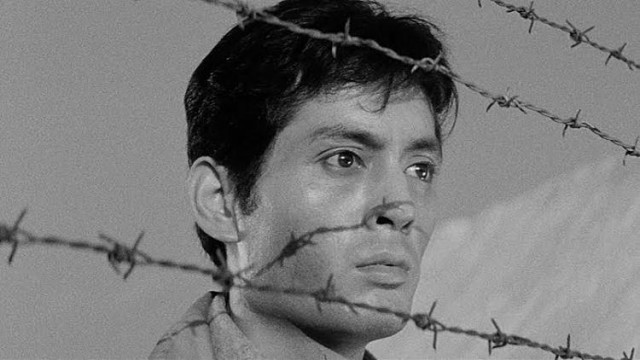
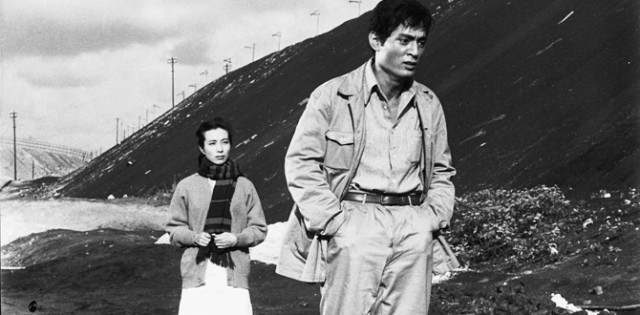
 Masako Kobayashi’s ten-hour epic, The Human Condition, based on a popular novel by Jumpei Gomikawa, is one of the most stunning achievements ever captured on film, and you can catch it all this weekend at the Museum of the Moving Image. Shot over the course of three years, the film follows one man’s harrowing struggle to never give up his humanity as he is dragged deeper and deeper into the morass of WWII. Tatsuya Nakadai is remarkable as Kaji, a man who believes in common decency, personal discipline, and, above all else, that humanity will always triumph. In the first part, No Greater Love, the steadfastly practical Kaji is hesitant to marry his sweetheart, Michiko (Michiyo Aratama), for fear that he will be called to serve in the Japanese army and might not come back to her alive. But when his detailed plan to treat workers fairly is accepted by the government, he is made labor supervisor of a mine in far-off Southern Manchuria, where hundreds of Chinese prisoners are brought in as well — and regularly starved, beaten, and, on occasion, brutally killed in cold blood. Kaji’s methods, which have close ties to communism, leading many to refer to him as a “Red,” anger both sides — the Japanese want to treat the workers like animals, and the Chinese prisoners don’t trust that he has their welfare in mind. A series of escape attempts threatens the stability of the labor camp and comes between Kaji and Michiko, whose undying love is echoed in the yearning, unfulfilled desire between a Korean prisoner and a Japanese prostitute. Broken promises, lies, and betrayal reach a tense conclusion that sets the stage for the second part of Kobayashi’s masterpiece.